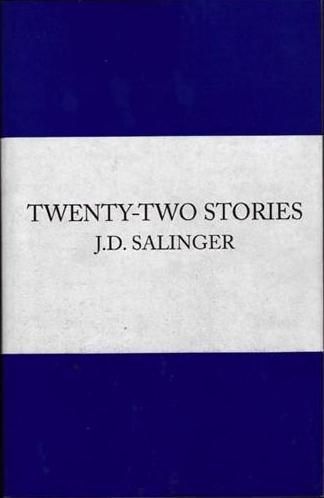
A new "bootleg book", containing all 22 missing stories in one perfect-bound volume. The book is blue, with a paper ring around the cover. It has the title stamped on the title page and attributes itself to "Train Bridge Recluse" as a publisher. Supposedly, 1000 copies were made.
This book contains twenty short stories and two novellas that have never before been collected or published outside of their original magazine appearences due to the wishes of the author who has declined to publish any of his work since 1965. Stories collected here for the first time include two 30,000 word novellas (The Inverted Forest & Hapworth 16, 1924), two stories featuring Holden Caulfield in expanded scenes from The Catcher in the Rye (I'm Crazy & Slight Rebellion Off Madison), and the Babe Gladwaller and Vincent Caulfield series (Last Day of the Last Furlough, This Sandwich Has No Mayonnaise & The Stranger). This collection includes all known works by Salinger not already widely available.
Librarian Note: There is more than one author by this name in the Goodreads database.
Works, most notably novel The Catcher in the Rye (1951), of American writer Jerome David Salinger often concern troubled, sensitive adolescents.
People well know this author for his reclusive nature. He published his last original work in 1965 and gave his last interview in 1980. Reared in city of New York, Salinger began short stories in secondary school and published several stories in the early 1940s before serving in World War II. In 1948, he published the critically acclaimed story "A Perfect Day for Bananafish" in The New Yorker, his subsequent home magazine. He released an immediate popular success. His depiction of adolescent alienation and loss of innocence in the protagonist Holden Caulfield especially influenced adolescent readers. Widely read and controversial, sells a quarter-million copies a year.
The success led to public attention and scrutiny: reclusive, he published new work less frequently. He followed with a short story collection, Nine Stories (1953), of a novella and a short story, Franny and Zooey (1961), and a collection of two novellas, Raise High the Roof Beam, Carpenters and Seymour: An Introduction (1963). His last published work, a novella entitled "Hapworth 16, 1924", appeared in The New Yorker on June 19, 1965.
Afterward, Salinger struggled with unwanted attention, including a legal battle in the 1980s with biographer Ian Hamilton. In the late 1990s, Joyce Maynard, a close ex-lover, and Margaret Salinger, his daughter, wrote and released his memoirs. In 1996, a small publisher announced a deal with Salinger to publish "Hapworth 16, 1924" in book form, but the ensuing publicity indefinitely delayed the release.
Another writer used one of his characters, resulting in copyright infringement; he filed a lawsuit against this writer and afterward made headlines around the globe in June 2009. Salinger died of natural causes at his home in Cornish, New Hampshire.
“Salinger told Whit Burnett his writing teacher at Columbia University and the editor of Story magazine, that on D-Day [June 6, 1944] he was carrying six chapters of The Catcher in the Rye, that he needed those pages with him not only as an amulet to help him survive but as a reason to survive.” Salinger by David Shields and Shane Salerno
Most people would assume these six chapters must be the first six chapters of The Catcher in the Rye. However, in 1945, Salinger published the short story, “I’m Crazy, “which roughly tracks with Chapters 1, 2, 21, and 22 from The Catcher in the Rye; however, there are significant differences between the short story format and the ultimate book version with the book version clearly being the superior version.
Again, in 1946, Salinger published another short story featuring Holden Caulfield, “Slight Rebellion off Madison.” This story roughly tracks with Chapters 17 and parts of Chapters 19 and 20. Although published later, Salinger wrote this story before “I’m Crazy.” The New Yorker temporarily shelved its publication after the events of Pearl Harbor. In this story, “Slight Rebellion off Madison,” Salinger experiments utilizing the third-person perspective. Ultimately, The Catcher in the Rye took a different direction, utilizing the first-person perspective.
How did Salinger transform a couple of slightly above average short stories into one of the most read books in America? This is something worthy of being studied in detail, and I am currently in the process of writing out the original short stories and their book equivalents.
This 2-volume set caused quite a commotion when it first appeared in bookstores in 1974, because Salinger didn’t authorize this collection. The Complete Uncollected Stories is a collection of stories previously published in magazines/newspapers from 1940 to 1965. Similar to F. Scott Fitzgerald, Salinger would take details or experiences from his own life and utilize them in his stories. For example, after some school issues, Salinger did travel to Vienna on behalf of his father’s company to study the German language, and this is essentially the plot in “A Girl I Knew.”
Salinger also reveals the fate of Holden Caulfield in “Last Day of the Last Furlough” and “This Sandwich Has No Mayonnaise.” For fans of The Glass Family, Seymour and Buddy reappear in Hapworth 16, 1924.
This collection is a must for any true Salinger fan!
The Green Light at the End of the Dock (How much I spent): Softcover Text – Second Printing $300 from Third Mind Books
Something tells me that this book is gonna be my goddamn white whale, but to be honest I'm not that upset about that. Better to actually want the thing you'll be chasing, right? Although if I die before I get my hands on this I'll be pissed off (but also dead and therefore unable to do anything about it).
I can hardly believe I am done reading all of Salinger's published works. (Only author whose entire body of work I have read)
This book is a of short stories that are some of Salinger's earliest works that were rejected/unpublished (or probably published by magazines - not sure) as well as two stories featuring Holden Caulfield, his most popular character. 'I'm Crazy' featuring Holden is an unpolished version of the beginning of The Catcher in The Rye. A lot of stories in this collection talk about war, a topic that Salinger wrote about during/after his involvement in the war.
Some of my favourites from this collection are: The Heart of A Broken Story, The Varioni Brothers, The Stranger, The Inverted Forest and Blue Melody. I read Hapworth as a standalone book and would suggest every person who has read Franny & Zooey or Raise High to read it.
I have been trying to figure out why I love Salinger so much and I haven't come to any definite answer yet. Someday, hopefully.
22 Stories is a must read for any J.D. Salinger fan.
The book has stories that were originally published in magazines. I believe Salinger never wanted all of these stories collected*. However, an enterprising young publisher located all of the stories** and published them despite the blatant copyright infringement. The text is extremely small. The book is a paperback with a solid blue cover. A white paper sleeve surrounds the book where each story is listed and annotated with bibliographic information.
*I don't know a whole lot about Salinger other than reading his work. **any trip to a public library's reference desk would help you find the originals.
this is an unpublished book of stories by Salinger,, but it is possible to find it in some libraries, especially universities with extensive collections. well worth the search. Xerox every page for yourself.
I was enticed to buy the 699-page doorstopper of a book called Salinger by Shane Salerno and David Shields because of my lifetime love affair with Salinger’s short stories. The book is a collection of oral histories (sorry–ho hum), which was then made into an eponymous documentary by the same team. Once having ho-hummed the book (honestly, who cares how many testicles the man had? Or if he was bad at poker or bad in bed or if his wife was a Gestapo agent?) I couldn’t bring myself to watch the documentary.
I set the book aside and pick up my journal and write from memory:
“Hapworth 16, 1924,” or quite in the laps of the gods!!”
–and that J. D. Salinger quote takes me back to Berkeley, 1973 when his Uncollected Short Stories first hit the streets. I picked my two volume set up at Cody’s Bookstore. I had recently read Franny and Zooey and Raise High the Roofbeams, Carpenters, and I loved that family named Glass. I loved Salinger’s sprawling, circuitous, self-conscious, distinctive voice and the Glass Family world so much more than I had Catcher in the Rye.
Salinger Uncollected Short StoriesI grabbed my copies of the two volume set of Salinger’s Uncollected Shorty Stories the first days they appeared in the bookstalls and shops that lined Berkeley’s streets back in the 1970s. The pirated editions of the Uncollected Short Stories, which Salinger had pulled off the streets as fast as he could, showed earlier imaginings of both the Glass Family storylines and characters.
I remember being so delighted (Hey! I was an English major! ‘Nuff said!) with the older brother character named Seymour Glass, whose name “see more,” presaged his fate, which was to commit suicide because apparently life was just too heartbreakingly beautiful.
Seymour was some kind of spiritual savant, a professor at Columbia at 20 years old, and then his fragile, hypersensitive soul had to fight in Europe in 1942. That’s where the damage was done. In “A Perfect Day for Bananafish,” he commits suicide on a second honeymoon with his wife in bed beside him. I still think that a selfish and shocking event, but that isn’t what is appealing about this character or this story.
What is appealing and compelling is Salinger’s voice, inextricably identified with the narrator bother, Buddy; for example, in “Hapworth 16, 1924,” which is a letter a seven-year-old Seymour writes from summer camp back home to his family and Buddy transcribes years after his brother’s death:
“My God, let me achieve missing my beloved family without yearning that they miss me in return! It requires a less wishy-washy character than the one available to me. My God, however, on the other side of the ledger, it is a pure fact that you are utterly haunting persons in simple retrospect! How we miss every excitable, emotional face among you! I was born without any great support in the event of continued absence of loved ones. It is a simple, nagging, humorous fact that my independence is skin deep….”
That’s a powerful, wise yet childlike voice for a seven-year-old. I agree with Andrew Romano in his “Heart of Glass: What We Really Know About J. D. Salinger,” that Salinger "created a style that mirrored his theme: intimate, engaged, idiosyncratic, informal, garrulous, and convoluted, with the narrator always present on the page.”
“Hapworth 16, 1924,” was published in The New Yorker in 1965 and was famously savaged by the critics. I know I’m a critic, too, but some of my colleagues then as now, just don’t let themselves fall under the enchantment of a new and original voice. No, he’s not Hemingway. “[The critics] were still measuring Salinger by Hemingway’s old yardstick. Hemingway believed that the only sensible response to modern life was to withdraw into oneself, and he invented a prose style that reflected his theme: cool, plain, unadorned, and detached, with the author absent and surfaces, as apprehended by the five senses, in the spotlight” (Romano).
I love Hemingway for being Hemingway. But you have to admit that anyone who tries to write like him ends up sounding like a competitor for the Bad Hemingway contest. Nor do I want to read anyone who takes as many verbal and mental picnics as Salinger; I want to read Salinger for that.
I also think I saw a lot of myself as a young woman growing up in the 1960s and 70s wanna be Ivy league educational system as a member of the Glass Family. Everyone in the Glass Family – parents and seven siblings – were all so emotionally fragile and artistically gifted that they could be easily shattered, or they could see clearly through the windows of their vitrine souls into the beauty and horror of the world. I saw myself as just about that nervy, too.
Salinger himself was the uber Glass, and it is said he considered “Hapworth 16, 1924” to be a definitive work. He must have been thrilled to have it published in The New Yorker and then devastated by the critical backlash because after that, he withdrew into his famous isolation, a fractured glass if not completely broken.
Romano discusses in his essay that the Salinger estate may reveal that the author worked the Glass Family saga for the rest of his life, everyone growing older along with the author. “In At Home in the World (1998), Salinger’s former girlfriend Joyce Maynard wrote that ‘he had compiled stacks of notes and notebooks concerning the habits and backgrounds of the Glasses—music they like, places they go, episodes in their history. Even the parts of their lives that he may not write about, he needs to know. He fills in the facts as diligently as a parent, keeping up to date with the scrapbooks.’”
Personally, I can hardly wait until the lifetime vision of this Great American Writer hits the streets.
I watched the documentary "Salinger" and felt compelled to track down and read these 22 uncollected stories. Similar to the published collection "Nine Stories," these 22 offer a very insightful glimpse into the masquerade of class and veneer of wealth and civil "breeding." There's not a lot of plot to speak of and the focus is primarily tone, dialog and behavior, but like so much of Salinger, it's damning and true. I enjoyed all the stories, which aren't really all that diverse, each one proves equally as compelling. I especially enjoyed the stories that extended the Caulfield family. A must for any Salinger fan.
As a Salinger fan this collection of tales was the only remaining thing that I had to read. The quality of the stories is not the same as in Salinger's great works but there are interesting things in the book . Stories as “The Young Folks” or “A Girl I Knew” are written with Salinger's genuine style and could have been included in " Nine stories" becasue they would fit perfectly. The story " The heart of a broken story" is my favourite and I think is wonderfully good. I think that through these stories we also learn about Salinger's life because topics as army life, loneliness or broken hearts are seen through the pages of this book.
Finally got around to reading this, 20 years later — my assumption that the stories would be early exercises and/or mediocre light entertainment written for cash was mostly borne out, though a couple are quite good (especially “No Waist at All”).
The main attraction, though, is “The Inverted Forest,” which is ridiculously amazing, I can see why so many critics have mentioned it over the years . . . it was so odd, for me, to read ‘new’ high-quality fiction by a mature Salinger that had nothing to do with Caulfields or Glasses.
In any event, definitely looking forward to the Salinger estate publishing a couple thousand pages of the post-Hapworth fiction over the next decade.
You can't just read this book. You have to stop and breathe once in a while. Each story will leave you wanting for more and when you've finally quenched your thirst you realise that you are on still on the spiral and loving it.
So! 22 uncollected stories, only attainable through polite inquiries on the internet with the right people? (thank you, you know who you are <3) Wow, and just a year or so ago I was finding out that he wrote anything else besides Catcher in the Rye. The iceberg runs deep. Maybe next I'll actually read a Salinger biography and finally know what I'm completely talking about.
I took profuse-ish notes through my reading of this but I'd like to give at least small mention to every story there was just to record it, but the ones I thought were best were The Young Folks (1940), Go See Eddie (1940), The Long Debut of Lois Taggett (1942), Both Parties Concerned (1944), Last Day of the Last Furlough (1944), A Boy in France (1945), This Sandwhich Has no Mayonaise (1945), and The Stranger (1945), I'm Crazy (1945), and Slight Rebellion off Madison (1946), which I'll subsequently go into more detail about.
However, if I compare it to Nine Stories, those nine stories are like 9 gods. The lesser of those 9 have common ground with some of these guys. It is clear why those 9 were selected, and why their number was 9 and it wasn't titled 31 stories. However, the lore and series, especially from the alt Catcher in the Rye series and Babe Gladwaller/Vincent Caulfield series, were just too enticing to stand by from.
No matter what, Salinger has created a canon in his work that people want to know and read more about. At least for me, I really enjoyed those interconnected Caulfeild/Gladwaller series stories, and of course the Glass family that would come later. Though even the unconnected stories that I liked here shared the same tone and themes. Well now, let's get into it.
The Young Folks-1940, Story, 4/5? Some shitty young folks are having a party, could it be a deleted scene from This Is Spinal Tap? So here's the first short story he ever submitted! Probably, at least it comes first here... The characters here were maybe kind of splotchy but it was an interesting vignette for a couple of reasons. I liked how the main character was struggling for attention and social interaction- it gave the impression that this party was both extraordinary to her life while also being what brings her life down. It's shallow and spiteful to it's characters but there's maybe some sad attention to be shown to them. I don't know. I'm not very good with subtle humorous satire- usually it'll make me sad and I'll still enjoy it for all the wrong reasons. This is Spinal Tap (1984) made me sob because I interpreted it as childhood and childlike ideals and behaviors sticking around too long and enabling your current life to an unhealthy degree. I'm a sucker for that stuff, but luckily there's another story coming up here that deals with that even better (and more intentionally) than Spinal Tap.
Go See Eddie- 1940, University of Kansas City Review, 2/5? Passive aggressive brother tells his sister to go see Eddie cause she's being a bitch So I didn't really think this story was very good but I liked it. It is very reminiscent of "Pretty Mouth and Green My Eyes," in both the tone and part of the subject, though Green my Eyes was better. Go See Eddie walked so Pretty Mouth and Green My Eyes could be an excellent back and forth dream of dialogue and strangely familiar allusions to cheated people.
The Hang of It- 1941, Collier's, 1/5? Guy talks about how this idiot was shit at the army. Turns out it was him the whole time and now his son is in the army and also shit- But guess what, with the power of perseverance, he rose through the ranks and his son will too! How cool!1!! Literally something I could have read in Boy's Life (cub scout magazine) when I was nine and thought was super de duper funny and clever.
The Heart of a Broken Story- 1941, Esquire, 2/5? Very meta mockery of boy-meets-girl stories. This theoretically makes different decisions to get the girl but he's a simp so he never gets her. I guess it was kind of cool for the time or whatever, but not much my thing. Notable for being the only story narrated by Salinger himself, though.
The Long Debut of Lois Taggett- 1942, Story, 4/5? Lois Taggett debuts. Very big Uncle Wiggly in Connecticut vibes. I mean as a character study, Lois's debut is fascinating. It's the story of how she became a woman of style and substance- All the people she had to find along the way. Particularly her two husbands, the insane but well-meaning first husband and the well-meaning and role-reversal second husband. It was just interesting because, well, maybe it was just her Debut- it was a couple of events early in her life that made for the start of Lois Taggett, at least who she turns out to be. So the perspective and time frame is interesting too.
Personnel Notes on an Infantryman- 1942, Collier's, 2/5? A little bit confusing- it got the spirit but what the hell was the ending? It was either a kitschy family twist-cop-out like the Hang of It, or a complex and misplaced ritual of human compassion and reassurance. But it was probably the first.
The Varioni Brothers- 1943, The Saturday Evening Post, 2.5/5? The Varioni Brothers and Sarah Smith are back with a full scale zeitgeist of brotherly angst. I don't know, it was very different in style and tone and didn't sit very well. Even if Joe Varioni was a prototype Seymour Glass(?)
Both Parties Concerned (originally Wake Me When It Thunders, it was renamed by Sat Evening Post and it pissed of Salinger,)- 1944, The Saturday Evening Post, 5/5? Immature young couple trying to move out of adolescence. Told with such endearing (immaturity) and love, with some real insights into behavior- reminded me very much of Catcher in the Rye and Raise High the Roofbeams, Carpenters. Lots of funny little quotes like that, and in first person- any first person male Salinger writes is gonna be kind of immature like Holden unless it's Buddy Glass or some guy like that. Anyway, this is what I was talking about with Spinal Tap- These both hit a nerve with me because they are stories about adults who still deal with things like kids do- they might not act exactly like kids but it's difficult for them to do stuff but they do everything with a steadfast love. Take the main characters, Billy and Ruthie. Billy is kind of clueless and Ruthie is going through a breakdown- But it's just a night out that gives them answers to their mutual love and mutual capabilities. the title comes from when Billy gives assurance to Ruth- He might not understand her (he dosen't) but he loves her and wants her to not be scared and sad. She's afraid of thunder. I like that original title alot more than "Both Parties Concerned."
As for the writing style- it was still in that vein of immature male narrator, but I noticed that as the story went on the writing became a little more mature, as the narrator became more mature- I don't know if that's me making it up, but it's neat. Lastly, it had a song to go along with it- When a book mentions a song playing within earshot of the characters I'll just listen to that song on repeat for the rest of the read. For ol Wake Me When it Thunders, we got Moonlight Becomes You by Frank Sinatra. Nice.
Soft-Boiled Sergeant (originally Death of a Dogface, it was renamed by Sat Evening Post and it pissed off Salinger)- 1944, Saturday Evening Post, 3.75/5? Dogface is ugly as hell but he has a heart of gold. He dosen't get the girl and Get yourself a girl who will cry for a Dogface. Very big Laughing Man vibes.
Last Day of the Last Furlough- 1944, The Saturday Evening Post, 5/5? It's almost time to go, Babe Gladwaller. What can you bring with you? "This is for me. I'm happier than I've ever been in my life. This is better than my books, this is better than Frances, this is better and bigger than myself. All right. Shoot me, all you sneaking Jap snipers that I've seen in the newspaper. Who cares?"
Really great short story here. It's a whole story of a little time, little characters- it's an introduction and a goodbye both at once. Also, first mention of a Holden Caulfeild, described as a "nutty kid" who's missing in action. Also just a very good and condensed story about a couplea dumb kids on the last day of the last furlough. These three characters, Vincent, Babe, and Maddie, take such exquisite comfort and togetherness in their short times together. All three in their different dynamics are just some kind of relationship goals.
Last furlough- Babe is such an unexperienced, unknowing soft kid here that from the perspective of the whole series is weird to look back on. He makes some weird speeches a coupla times- You can't really read his mind in this story, too, which is interesting. What's on your mind, king?
Once a Week Won't Kill You- 1944, Story, 3.5/5? Very compelling as a quick character study, but I don't know if there's enough information? About a guy leaving for war and he has to deal with what his aunt is up to.
A Boy in France- 1945, The Saturday Evening Post, 5/5? Babe Gladwaller is a boy in France.
Babe is there in France- I hardly knew it was Babe at first because it uses that kind of narration from the second part of To Esme with Love and Squalor, where it dehumanizes a character by referring to them in third person but without their names as a result of war and hardship. Babe is just a boy in France- He gets some solace from a letter from Maddie. It's the result of the Last Furlough and it's worse than he thought but he still has the parts he had before- Maddie. It's a gritty and really sad piece.
((review still in progress, check back later for the rest ))
So I don’t have this collection but I did recently read an online collection called The Out of Print Publications which was tremendous. I have read that their will be some complete collections issued at some point by his estate, these should be in those.
The Young Folks shows scenes at a party. A girl has been introduced to a boy in hopes of setting them up. He, however, has eyes for another girl at the party.
Go Ask Eddie has a woman visited by her brother. His purpose is two fold. To encourage her to call a mutual acquaintance about a spot in his show he has parts for, and to criticize her for her latest relationship with a married man
The Hang of It has a man talking of his sons experiences in the army. The boy loves it but is having trouble with the drills, it reminds our narrator of a boy he was in the service with decades ago who also struggled.
Soft Boiled Sargent has a young recruit talking about joining up at 16 and being homesick and scared. A Sargent with every medal in the book becomes his friend and mentor but the young man regrets how sad his Sargent’s life was
The Heart of a Broken Story follows a writer who describes a couple, two characters, that he has created that are on a bus at the same time. He creates many ideas to bring them together but in the end says he can find no realistic way to do so.
The Long Debut of Lois Taggert : Story follows young woman from wealthy family as she marries a man who is most attracted to her money. By the time he actually sees that he lives her his propensity to violence the marriage. Later she marries a. An who is solid and staid, the opposite of her first. But he bores her
Personal Notes on an Infantryman : During the war a man in his forties appears at a recruiting station. He is encouraged to stay in his job to help the war effort but insists on enlisting. He becomes a model soldier and finally after much intervention to prevent it by his wife he is sent to Europe. We find out the Sargent writings he report is his son
The Varioni Brothers is a neat story. A woman tells the story of a Professor she had on college. A gifted writer he had been convinced by his brother to write lyrics to the music the brother wrote. They were very successful but this kept her Professor from finishing his novel. Years later, teaching college herself the musician brother show up and asks her to help him put together his long dead brother’s book to publish
Both Parties Concerned follows a young couple who get married too young, especially according to her Mother. After a child is born it appears on its way to becoming a self fulfilling prophecy
Last Day of the Last Furlough is tremendous. In it a young man is getting ready to ship overseas for the war. He hasn’t told his Family yet his Mother will worry. Has an appearance by Holden Caulfield’s brother
Once a Week Won’t Kill You also features a man ready to ship out. In this case it’s a young married man who insists his wife take his beloved Aunt to the movies once a week
A Boy in France follows a young soldier on the front in France as he prepares his foxhole for the night, and rereads a letter from his younger sister
Elaine is the title of a story that follows a young woman whose Father dies when she is very young. She grows up in a small apartment with her Mother and Grandmother. Described as beautiful but not too bright she is almost sixteen by the time she finished eighth grade. While planning to start high school her beauty attracts a boy who acts her to marry him. On the day of the marriage the mother in laws fight and her own Mother realizes her seventeen year old daughter is a child and spirit and calls off the wedding minutes after it has taken place
This Sandwich Has No Mayonnaise has Holden Caulfield’s older brother on a base on a rainy night determining who gets to go to town to a dance. At the same time he worries over the news that Holden, somewhere in the Pacific, is missing
In “ The Stranger “ a soldier named Babe is home from World War Two. He takes his little sister into the city for a movie and along the way they stop to see Vince’s girl. He knows she is married now, they had broke up even before he was killed but he feels he should tell her what he knows about Vince
“ I’m Crazy “ is a fantastic Holden Caulfield story. He has been kicked out of his third boarding school and visits with a favorite professor before he leaves. When he gets home he goes in his sisters Phoebe and Viola’s room. Phoebe loves and worries. Viola still crib bound wants her Donald Duck which was appropriated because she told the maid she had bad breath and some ‘awlives’ which Phoebe says she wants all the time. Later after Holden ( off camera in the story) tells his parents he goes back to his sisters room and, with them asleep again, leaves the doll and a row of olives in Viola’s crib. I thought that a very sweet visualization
Slight Rebellion off Madison : Another fine Holden Caulfield story. Home from prep school over Christmas break he meets up with a girlfriend named Sally, home from her school as well. They go to a play and skating but when talking about school Holden tells her he wants them to quit school and run away with the $112.00 in his pocket. He wants to break all the rules of which he, in his social class, is supposed to live by. She declines and he leaves and goes to a bar and drinks until two in the morning when he calls her and agrees he will come to her house that night and trim the tree. Salinger could write some evocative phrases. Including this one “ they greeted each other with the gusto of two who might have taken baths together when they were small children.”
“ A Young Girl in 1941 With No Waist at All : A young woman is with her soon to be mother in law on a cruise in the months before America has to join World War Two. Her fiancé is in the military. She meets a worker on the ship who she spends the night on shore with. He too will soon be joining the war effort. That night in the hours before dawn she tells her mother in law she does not want to marry her son anymore
The Inverted Forest : A very lengthy novella length story that tells a long tale of the relationship between a young boy and girl. The girl is the daughter of a German count raised on Long Island. During World War One when in elementary school she is rebuked for her German heritage and a young boy comes to her rescue. Unlike most of the children at her school he is poor, very poor. She invites him to a birthday party that he fails to attend. He actually moves that night and she witnessed it, her and her chauffeur giving him and his Mother to the station. After a quite eventful but romantically unfulfilled next twenty years she comes into contact with the boy, now man. He is now a famous poet. What should be a love story for the ages has an ending much different than we would like
A Girl I Knew is a great but terribly sad story. A boy flunks out of college and so his Father seeks a way to get him brought into his company. Deciding on a plan he sends him to Europe to learn languages. It is the decade of the thirties. While in Vienna his downstairs neighbors have a seventeen year old daughter named Leah. They have stilted, polite conversations for months, she is Jewish and already betrothed but thier friendship is pure. Later when he is back in New York City he gets a letter from her. He intends to write back but never does. Then the Germans come and he worries over what became of her and her husband and her family. After the war he returns to Vienna to see what he can find out. It is incredibly sad. Trying to get into his old apartment which is now being used for American military quarters he states his missions how he used to know a girl there. Explaining what happened to a bedraggled and disinterested sentry he states “ She and her family were burned in an incinerator, I’m told.” There is no way to make that story less brutal than it is
Blue Melody is a story told to our narrator by a fellow soldier in the back of an army transport in Europe. Redford is a young man from a small town in Tennessee. He and a high school friend named Peggy become friends with a piano playing club owner named Black Charles. Over time they come to know his niece who is a simply incredible singer who becomes quite successful. Or at least as successful as a black singer can be in the South in the twenties. On a picnic one day the girls appendix burst and while Rudford and Peggy insist Charles stop a the first two hospitals Charles knows better. Turned away the singer dies on the young people’s lap as they attempt to drive to a hospital in the city that can help black people. Lida Louise dies in that car.
Hapworth 16, 1924 : This novella length story is interesting in places but soon turns into an almost unreadable exercise in every pretentiousness known to man. The premise is interesting, Seymour Glass, aged 7, is at summer camp in Maine with his younger ( aged five ) brother. They both are brilliant beyond compare as the language and tone at the letter makes clear. At one point for pages the story becomes a request of books young Seymour would like to have sent to him with each book getting a long discussion of its merits and faults. This story would only be for Salinger completists
I did it. I read all of Salinger's ever published works. Now what am I going to do with myself?
The 5-star rating on Goodreads is merely for sentimental reasons. My real rating for each story is below, still quite generous compared to others', but I can't help it. Everything about Salinger's writing makes me emotional. Quite an irony because like one of the Glass siblings (Seymour, probably), I also want to be "the most loving, the least sentimental". But I just can't help it.
on 1 CD Rom Twenty-Two Uncollected Short Stories by J.D. Salinger on CD-Rom ! It includes the following 22 short stories--complete: The Young Folks -- Go See Eddie -- The Hang of It -- The Heart of a Broken Story -- The Long Debut of Lois Taggett -- Personal Notes on an Infantryman -- The Varioni Brothers -- Both Parties Concerned -- Soft-boiled Sergeant -- Last Day of the Last Furlough -- Once a Week Won't Kill You -- Elaine -- A Boy in France -- This Sandwich Has No Mayonnaise -- The Stranger -- I'm Crazy -- Slight Rebellion off Madison -- A Young Girl in 1941 with No Waist at All -- The Inverted Forest -- A Girl I Knew -- Blue Melody -- Hapworth 16, 1924 + Three Stories by J.D. Salinger (including unpublished material) An Ocean Full of Bowling Balls Birthday Boy and Paula. The CD also includes 46 rare photos of J.D. Salinger. (10 in full-color !) & four unpublished letters.
Technically I don't have a hard copy of this (who does?), but thanks to the internet, you can find them all with a little effort. I'm particularly in love with "The Inverted Forest".
Over all, two-and-a-half stars. But the best stories make the collection worth reading, save the last meandering story that annoyed me to no end.
High society, New Yorkers, parties, restless 20-somethings staying up until 4am, mismatched lovers who rushed into marriage, precocious kids, deaths in the family and, one of the largest characters imaginable, World War II. The PDF version I downloaded online is arranged in a sensible order--see the end of this review for the order--that has a rise and fall to it, far better than the version that has the stories in chronological order of when they were published…though that version does help make sense of why some are worse than others, having been published earlier and presumably written earlier than the others. (The earliest ones were published in 1940, before the U.S. had even entered WWII.) At times the characters are soldiers returning from or reporting for duty, at times the military is the subject in the foreground, but the best stories are the ones where the war is the subject everyone is holding their breath and trying very hard to avoid thinking or talking about. One sees the fear everyone was living in, grounding some of the dated “Gee! Golly!” dialogue back on earth.
My favorites in the collection were “A Girl I Know,” “I’m Crazy” (though later worked into Catcher in the Rye, it is a great stand alone story), “Heart of a Broken Story” and “The Stranger.” Though most readers who come upon this unauthorized collection are Salinger completists, not all of the stories deserve to be included alongside the others (or even republished, in some cases), whether they amount only to a clunky reveal at the end, they don’t fit the collection or they simply aren’t any good next to the author’s other work in this collection. Nearly all of the stories seem great in synopsis form, but the older style of writing sometimes get in the way for me as a reader today. I say this not as a commentary on the inherent value of the stories, but rather their personal value to me.
Featured in these pages are three stories featuring either Holden Caulfield’s less interesting brother Vincent or Vincent's best friend (“Last Day of the…”, “The Stranger,” or the disappointing “This Sandwich has No Mayonnaise”...plus "A Boy in Paris" which features only Vincent's best friend), two stories that were later worked into Catcher in the Rye (“I’m Crazy” and “Slight Rebellion…”), and one featuring the Glass family (the longest and last, “Hapworth 16, 1924”). For any Salinger readers like myself who didn’t enjoy Seymour: An Introduction, this final story needn’t be read, containing less than one word of actual content per insufferably wordy page.
This particular PDF that collects the stories has loads of typos, falsely placed quotation marks, line breaks and margins that change. It is mildly annoying, but not overly distracting.
The order: A Boy in France A Girl I Knew A Young Girl in 1941 with No Waist at All Both Parties Concerned Elaine Go See Eddie I'm Crazy Last Day of the Last Furlough Once a Week Won't Kill You Personal Notes of an Infantryman Slight Rebellion off Madison Soft Boiled Sergeant The Hang of It The Heart of a Broken Story The Inverted Forest The Long Debut of Lois Taggett The Stranger The Varioni Brothers The Young Folks This Sandwich has no Mayonnaise Blue Melody Hapworth 16, 1924
Inspired, you pick up "Franny and Zooey" from a used bookstore and although it isn't quite as good, you still enjoyed it. Maybe you even test the waters and tell someone he's your favorite author right now, just to see how it feels on your lips. You subsequently read "Nine stories". It's great, maybe not capital "L" literature but great! You find "Raise High the Roof Beam, Carpenters and Seymour: An Introduction". Upon finishing, doubts start to creep in like rats in a Pepsi factory. Maybe Salinger isn't as prolific, not quite as brilliant, as you had acclaimed to all of your friends.
No-no-no
Forget it.
You find a copy of "Three Early Stories", it has an iris blue cover and its best attribute is that it is very short and very cheap, able and ready to be held together with staples. You dismiss the paltry quality because wellll...they're just 3 early stories UwU
Maybe it's because you love Salinger or maybe you want to defend your boasts to your lit friends, you keep looking for more.
You try to find his old articles in Harper's Weekly but they don't have all of them and reading on a computer is a drag. You go to his wikipedia page and see that he has a series of uncollected stories. There's a subsection titled Collected Short Stories followed by the ironic entry:
"The Complete Uncollected Short Stories of J. D. Salinger, Vol. 1 & 2 (1974) (Unauthorized Pirated (Bootleg) edition)"
We've never been more back.
Unauthorized! PIRATED! BOOTLEG!!
Say less.
You find a copy from a disreputable dealer online (Lulu for me). It will take 6 weeks to arrive, there are no reviews, and as you enter your credit card information you think how awkward this will be to explain to a Wells Fargo employee.
You stack all of your Salinger books together. You start to dream about having a complete collection of an author. Who will you do next? Hemingway? Melville? Steinbeck? You forget that the book is coming altogether. You read other stuff. Frankly, it's better than what you had just read.
The copy comes, it has the classic white cover and corner rainbow clearly copied from a scan of "Catcher in the Rye". In blurry 'Times New Roman' font it announces itself "Twenty-Two Stories"
Now to the actual review. There are parts of it that are pretty decent, 'A Boy in France' and 'A Girl I Knew' are pretty darn good. But, there are others like "Once a Week Won't Kill You" that sound like a half baked story from my writer's craft class junior year of highschool. You start to get doubts about this whole thing. It's a mixed bag throughout and if you love Salinger there are still glimpses of his greatness.
Skipping ahead... The last 52 pages of my collection was the story "Hapworth 16, 1924". It's a letter that the oldest glass boy, Seymour, writes to his family. Up to this point I've tolerated and even been endeared to the Glass children. I've described them as precocious, petulant, and assuming as hell, yet I love em. BUT this is too much for even me. The 9 year old Seymour basically rants in unbroken paragraphs for 50 some odd pages, sermonizing about religions and the soul and health. I get that they're supposed to be beyond their years but !COME ON! It's clearly just a mouthpiece for Salinger and any aspect of plot or characters has really fallen by the wayside. It's bad. Salinger at his worst.
It reminds me of the Michael Jackson album released after his death. Maybe there was a reason they were unreleased, can't we just enjoy Thriller and the Jackson Five?
There's some discussion of releasing previously unpublished works of Salinger. Apparently he wrote prolifically even in his self imposed exile. For 45 years after Hapworth he published nothing. Allegedly he color coded these manuscripts with instructions for after his death.
green-ready to be published yellow-needs editing red-burn
As for this collection, there's a reason they weren't collected.
had a lot of fun with this one but jesus, hapworth was so hard to get through, especially because it was late by the time i got to it. i started enjoying it a little more later, but i got such an unbearable suffocating feeling for the first half of it that i forgot how i felt about any of the other stories. really liked the inverted forest which (apparently?) is a little controversial of me (understandable). soft boiled sergeant and elaine made me feel odd (in a good way). last day of the last furlough was either really beautiful and devastating, or is just beautiful and devastating in my flawed memory. i was (unfortunately) a huuuge holden caulfield defender in middle school so i obviously liked the stories about him but i really don't like the fact that his middle name has apparently been morrissey this whole time (or maybe it's just in these stories?). baby mouse is the cutest nickname ever maybe. i think i'm done with salinger now, the look in his eyes makes me uneasy and a little nauseous.
A wonderful mixed bag of Salinger's stories. The books ARE available to buy online but they're extremely expensive, cause they're so rare - you might try try academic libraries. The Salinger estate simply will not release them
I feel incredibly lucky to actually own copies of both books. A dear friend of mine in the early 70's sent them to me in a box of books that Dalton Books (Atlanta) was dumping, as we'd both liked "Catcher" in high school.
I treated them nicely but casually til I realize what they were worth, decades later. They're treasures, and I still take them out and (carefully) reread them from time to time.
I enjoyed reading all the stories in this collection. Some more than others though! As a fan of The Catcher in the Rye it was interesting to read (in a way) parts of the rough draft from a few of these stories. I actually made my own book: printed out the stories at home, sewed and glues the pages and added the cover so I always have my own copy! Definitely worth all that work! The only reason it got a 4/5 instead of 5/5 is because I didn’t think each story was 5 stars, even though I did enjoy all of them!
Loving you is the important thing, Miss Lester. There are some people who think love is sex and marriage and six o'clock-kisses and children, and perhaps it is, Miss Lester. But do you know what I think? I think love is a touch and yet not a touch.