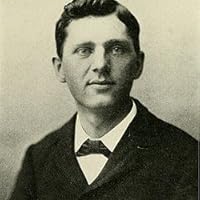
This is the first book-length biography of the author of the celebrated Spoon River Anthology . Masters was a partner in a law firm when, at age 46, his dream of literary success suddenly came true. This biography conveys the internal contradictions that drove Masters throughout his life, looking at his writing, his law career, his marriages and numerous affairs, and his inability to distinguish between trash and treasure in his own work. Russell is the first scholar to be allowed to read and quote from all of Masters' diaries, letters, and the unpublished chapters of his 1936 autobiography. Includes b&w photos. Russell is director for college relations at John A. Logan College. Annotation c. Book News, Inc., Portland, OR (booknews.com)
I thoroughly enjoyed reading Russell’s immaculately researched, balanced and fast-paced biography of one of America’s premier poets, who in the second decade of the last century, wrote a book of poetry – “The Spoon River Anthology” – that has been a lasting icon in the history and Literature of the United States.
Russell’s Edgar Lee Masters is an accurate portrait of a man who had a first class mind, but who had severe character flaws that dogged him throughout his life, and ended up making him miserable, lonely and to a certain extent, destitute. I will list these flaws:
- Masters was brought up in a love-less family, his Father and Mother were mismatched and the Father was a philanderer as Masters would also become.
- Masters carried a stigma with him that he did not graduate from College as did many of the writers and critics which with he dealt. He did manage to become a successful lawyer, but the profession did not, at the time Masters entered it, require the extensive, competitive schooling that it now requires.
- Masters was a life long womanizer, that his two marriages did not diminish. He was an adulterer who seemingly had no control at all over his actions and had little concern for how they effected his 4 children and others close to him. And it was his adulteries that led to the Divorce law suit brought by his first wife that stripped him of all the material wealth that he had accumulated. This also had an effect on his art. After “Spoon River,” he wrote rapidly, with a minimal concern for re-writing, and mostly for money.
- Masters had little understanding on how the Publishing world worked and he made many bad decisions that would eventually rob him of royalties. He never followed up on his many anthologized poems and thus lost needed income that could have kept him financially afloat.
- He carried on feuds with many contemporary writers and publishers that eventually had an adverse effect on the reception of his post-“Spoon River” work. He was seen as an iconoclast who exploded many of the widely held beliefs. (His Biography of Lincoln was a case in point.!) An example of his vitriol against other authors: he referred to many young poets as “communist mathematicians,” Eliot as “a quack,” and anything from Carl Sandburg (a member of the Chicago poets, which included Masters and Vachel Lindsay, who, almost without precedent, ever said a bad word against, and also wrote his biography), he called “hogwash;” for Mark Twain, who he also wrote a biography of he wrote: “ I have combed that clown to the best of my ability.”
On the other side of the ledger, he had a prodigiously creative mind, he had good instincts about literature, created one of the great works in American Literature and was able to function as a successful lawyer while writing his best literary works.
- Masters wrote one of the great classics in American Literature and kept an uneven but amazing ability to wrote good poetry until well into his late 70’s
- He was able to practice a lucrative Law practice, partnering with Clarence Darrow famous for the Scopes trial. (He also knew the opposing lawyer and perennial Presidential candidate William Jennings Bryan.) He was earning $30,000 per year in the early years of the 20th century!
- Masters was amazingly prolific. He wrote over 50 books, which included, poetry, drama, novels, history and biographies and an autobiography.
- He had an interesting grasp of American history in general and Illinois history in specifics. He correctly identified the change in American governance because of the Spanish-American war which, he opposed and the imperialism that was a direct result. He longed for the days of Jeffersonian Democracy, although in my opinion, he should have written to de-mythicize Jefferson the way he had done to Lincoln.
I highly recommend this book to anyone interested in American poetry of the early 20th century. Before reading this biography, I had read “Spoon River Anthology and “The New Spoon River,” and Master’s biography of Vachel Lindsay, which I thought was a well done introduction to that poet and friend of Masters. I was not aware of how prodigious his accomplishments had been in poetry and other genres. I intend to follow up my reading with his books of poetry and poetical epics.
Fascinating account of the life of the author of Spoon River Anthology. Although I read this for my work on Sandburg (he and Sandburg were rivals throughout much of the 20th century) this would have been a fantastic story on its own.