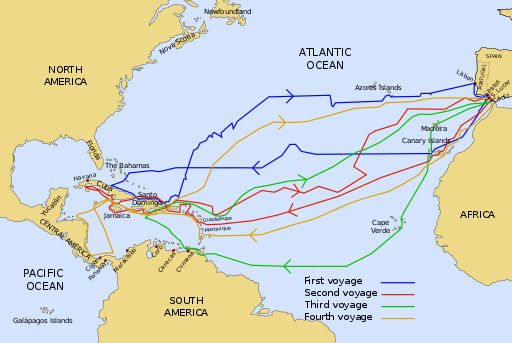
Pub. 2011 - This book is a heavily critical, revisionist narrative of Columbus’ four voyages to the New World. The author presents Columbus as distinct in his capacity for arrogance and stupidity, which, when taken within the context of his station, his time, his peers, his religion, temper somewhat. However, Bergreen doesn’t do this. He sits from his armchair as judge, sifting out context to present his own view of history. By only focusing on the four voyages and skimming over what took place before, after, and in between them, the author leans away from nuance and understanding, and into black and white moralistic thinking, and ultimately, misunderstanding. I am no Columbus apologist, but I do believe that all available information should be weighed when assessing the character of such a monumental historical figure. I don’t think Columbus is deserving of praise so much as recognition. He is certainly deserving of condemnation at times, and of sympathy at others. Unfortunately Bergreen seems to be more interested in selling a book with a contemporary popular framework than in shining light into a sequence of historical events, which changed the world forever, yet remains exceptionally controversial, driven more by opinion than fact.
I cannot recommend this book to anyone, even in the Columbus-vilifying revisionist crowd, because there are just too many omissions of fact, with an unhealthy amount of subtle disparagement. I have listed below several areas where I think the author gets things wrong.
P 6 - “Columbus conveniently concluded that he had reached an island or a peninsula on the outskirts of China, a leap made possible only by omitting the Americas and the Pacific Ocean from his skewed geography.”
Omission requires foreknowledge. It was a more reasonable position to think he had reached the thousands of islands of the East Indies, described by Marco Polo, than that there was a huge continent no one in the eastern hemisphere knew about.
P 7 - “No comparable figure in the age of discovery was so mistaken as to his whereabouts.”
Because he was the first. Everyone who came after him had the benefit of his information and discovery.
P8 - “His inability to control the men of this vastly expanded fleet” (2nd voyage)
The second voyage was populated by dozens of power-hungry opportunists. I’m not sure anyone could have exercised more, or even better control of his men, especially while continuing to explore other islands, having little knowledge or control over what went on behind his back. Columbus was “in charge,” so in the most basic sense, he is responsible for everything that happened before he was replaced as governor. But framing it as his “inability to control” suggests that this was a situation that could be controlled. As history proved out time and again, no one could control it.
P. 95 - “Symptoms of prolonged isolation from women crept into Columbus’s log. He confessed his fixation with the “island of Matinino,” said by the Indians to be inhabited by “women without men” - a prospect that answered the prayers of many a sailor and even enticed the more circumspect admiral.”
He was looking everywhere for confirmation of widely-held mythical beliefs about possible Antipodean people, including cannibals (which were confirmed) and the race of the Amazons. There is nothing to suggest he was looking for this island of women out of sexual lust.
P. 120 - “He omitted references to the menaced posed by the caribs, the difficulty of replicating his feat of navigation, the vagaries of weather, and of course the stupendous misunderstanding of the location of his discoveries. He was selective to the point of being deceptive.”
This is in reference to Columbus’ journals which were to be reviewed by the sovereigns. Columbus was trying to sell the idea of a fully funded second voyage. His prosperity, and that of his children, depended upon his success. Had he painted a more accurate picture, it’s possible, from the sovereign’s standpoint, the risks would have outweighed the rewards, and another voyage wouldn’t be allowed. Had he recorded more precise navigations, anyone would have been able to usurp his discovery and upend his livelihood, all of which came to pass anyway. Further, it’s fundamentally unreasonable to hold against Columbus the idea that he thought he had reached Asia. He was the first person in his culture to make contact with these peoples or these lands. Bergreen is relentless on this point, as if he really wishes the reader to view Columbus as a fool. To suggest Columbus’ misunderstanding is a deliberate omission is itself selective to the point of being deceptive.
P. 146 - “With the benefit of hindsight, Columbus realized his hasty choice of site on the first voyage had failed to take into account basic considerations such as the availability of water and food, and proximity to aggressive Caribs.”
The location of La Isabela was a hasty decision because the Santa Maria was shipwrecked there. The men were left behind to use the remnants of the ship as a means of building a trading post/living quarters. They were left behind because the other two ships would have been overpopulated, and it was a good opportunity to leave some men to learn the language and customs, and to locate gold mines.
P 176-177 “To avoid a confrontation [in Jamaica], Columbus entered another harbor, only to realize he had sailed straight into an ambush. Or was it? On these islands, the Indians desire to fight, to trade, or just to make noise frequently overlapped, and Columbus resorted to guessing about their real intentions. His own stance was just as ambivalent; within the span of a few days he was capable of regarding the Indians as political allies, trading partners, converts, slaves, or deadly enemies. In the pages of his journal and letters they appeared as wise or primitive, indolent or resourceful, according to his judgment and whims.”
Yes, because Indians are just like everybody else in the world, in terms of the diversity of human behavior. These were several cultures, each with different tribes and subsequent bands of Indians, serving different leaders, living across a series of over 700 islands. And on any given island, as was the case on Hispañola, with the contrast between Guacanagarí and Caonabó, there could be different bands with different leadership, goals, cultural norms, priorities, and levels of tolerance. Columbus portrayed the Indians as varied in their attitudes and behavior because they were. This is an important aspect of anthropology that one cannot expect all ethnic peoples to behave the same as their neighbors. It was no different among the millions of European, African, Asian, and Australian peoples. Columbus had consistent learned experience with meeting new and distinct Indian groups. While he surely made mistakes at times (as would anyone meeting a vastly different culture, with a completely different language), I would grant that he was a better assessor of real threats than was the author, writing from the comfort of a climate controlled room, with more than half a millennium of hindsight.
P 180 “he remained befuddled about his global whereabouts and as reliant as ever on spurious sources, especially Sir John Mandeville.”
Because there were no other sources. He used what he had access to and tried to make best-guess assumptions. Oftentimes he was wrong - that’s what happens when you’re trying to navigate an unknown world. Ever get lost in the woods? It’s not as straightforward as it may seem to find your bearings and make good choices that to others might later seem obvious.
P 206 “at the time Columbus arrived on the scene, all three tribes - Taino, Carib, and Ciguayo - were trying to preserve peace and prevent mutual destruction with intertribal marriages, a strategy akin to the many liaisons between the royal families of Spain and Portugal. But the Spanish presence brought the Indian alliances to a halt, and pitched the Indian nations into turmoil.”
This directly contradicts the testimony of many Tainos who lived in abject fear of the Caribs, and ignores the inescapable element of human behavior. Yes, perhaps alliances were being formed through intermarriage among certain bands, but that doesn’t mean it was widespread. And suggesting the Spanish are solely responsible for some inevitable day when all Indians would learn to live together in peace and harmony not only contradicts the 20,000+ year history of the settlement of the Americas, rife with colonization, competition, and warfare, but also presumes some inhuman form of ultimate and complete benevolence to Indians themselves, that “the Spanish presence” is alone to blame for never materializing. The conduct of the Spanish in any modern sense is wholly terrible, but as Charles C Mann wrote, disease and factionalism among the Indians caused far more loss of life than slavery or warfare. This kind of assessment of Indian history is patronizing and reductionist, presenting the Spanish as the only problem Indian peoples ever had. The arrival of Europeans cannot be overstated in terms of its destructiveness. We had lands that gave birth to cultures as old as Mesopotamia and Egypt, which we are only just now discovering. We saw the largest concentrated loss of human life in history, and with it massive cultural and informational loss, to say nothing of the trauma felt by Indian peoples for centuries. But even with that said, it doesn’t mean that Indians would have necessarily found their way into a world of peaceful cohabitation. The Aztecs weren’t that old of a culture and they were displacing and enslaving thousands. The Tainos themselves were there because they had displaced another earlier group. It’s difficult to read about such devastating tragedy and not want to blame one person or a group of people, but blanket blame doesn’t lead to understanding, and understanding is (hopefully) what prevents such tragedies from reoccurring. History is complicated. If one is only interested in finding heroes and villains, one is not interested in learning.
P 236 “The topography persuaded him that he had arrived at the mainland, and the recognition marked the signal discovery of this or any other of his voyages, his first sighting of the continent whose size and location neither he nor anyone else on his ships fully understood or acknowledged. The mystic in him preferred to assume the Providence had led him closer to the entrance to paradise.
P 242 Still unwilling to accept the mounting evidence that he had arrived at a continent, Columbus took refuge in the thought that the coastline delineated an island…
P 243 … it led him, in this deceptively calm state of reflection, to the most radical hypothesis that he would ever make - more extreme, even, than his misguided belief that he had sailed to India. He believed that he had discovered the entrance to paradise.
P 244 He took solace in his reveries of inhabiting a world where magic is still possible even as he experienced a troubling sense of confronting the unknown.
P 248 He had given up on the idea that he was exploring Marco Polo’s ancient India, in search of the Grand Khan, and instead had stumbled across something entirely new and troubling. “I have come to believe that this is a mighty continent that was hitherto unknown.” That was a true discovery, something utterly unexpected. That singular fact did not automatically mean that he now realized that Hispaniola and the other islands of the “Indies” lay far distant from India. It meant that he was more perplexed than ever before. His voyages of confirmation had becomes voyages of doubt. He was equipped to confirm cherished myths, not explode them.”
The notion that Eden, or Paradise, was a real place that could be mapped if found, was not controversial at all to a group of people living in the 16th century, whose only lens through which to view the world was through their Catholic faith. To suggest that it is “radical” or “extreme” is as ignorant as it is presumptuous. Many learned people of that time believed that there was in fact a physical location of the earthly paradise, but it was said to exist upon a protuberance of the earth, and that the current of the water was so strong, it was impossible to reach. When Columbus reached the mouth of the Orinoco river, the force of the water was like nothing he’d experienced, he surmised that he had found Paradise, as it matched descriptions of what he had read and studied. We must be mindful that Columbus was an extremely devout Catholic, while the enlightenment and modern science were intellectual frontiers not to be explored for decades and centuries to come. It’s not radical to think you’ve found something you believe to exist, when you’ve found markers of what you think you know about its existence.
This is also what began to convince him that he had reached a continent, as any river that had that much force, would have to be quite long. Any reasonably intelligent person of any day, would proceed with radical notions slowly, gathering evidence so as to not be premature in a conclusion. The idea that he had possibly found the entrance to paradise was not radical. The idea that he had found an entire continent that no one knew existed absolutely was. Among Columbus critics there seems to be this insistence that he should have immediately realized he was nowhere near Asia, despite having never been to Asia, nor ever meeting anyone who had been to Asia (Columbus was basing his knowledge of Asia on The Travels of Marco Polo, published nearly 200 years prior to his explorations), and despite no one in Columbus’ known world knowing anything about one, let alone two, undiscovered continents. I fully understand the motive to present Columbus as a real-life, flawed man rather than a mythical hero-genius, especially because the former standpoint is more factual. But I do not understand the contemporary insistence to present Columbus wholly as a buffoon, as if these armchair historians could have performed any more competently had they been a Catholic man of no position, estranged from his country, suffering such a painful illness (likely rheumatoid arthritis) exploring lands and seas unknown to anyone, based upon centuries old writings he believed to be true, which turned out to be hypothetical at best.
P282-284 Bergreen presents the charges against Columbus more as fact than here say, offering no context as to the motives of those who complained or reported charges. Most historians today accept that despite Columbus’ many faults, the charges levied against him were inflated or invented by people seeking to displace him from power. Of course, this is the story of humanity wherever you go, across land and time. People segregate themselves into tribes, and fight with one another for power and control of resources. Alliances are formed as a means to these ends, and the horrors we inflict upon one another are so unspeakable, we often forget them, and history, written or oral, presents the people telling the history in the best light, so the younger generations have something to believe in and aspire to. Europeans were doing this with one another, along with North Africans and western Asian peoples before their discoveries of the western hemisphere, while American Indians were doing the same thing. Post-contact, Europeans and Indians fought against and made alliances with one another as well. For Columbus’ part, he was better than some and worse than others. The moral weight given to his actions are displaced when taken in context, but his discovery of the so-called New World is possibly the most consequential event in human or environmental history. Once the Old World became aware of the New, everything changed for every living thing in the world, forever. I’m not sure this is worth celebrating, so much as it is a candid acknowledgment of an unavoidable moment in history, which happened to occur in 1492, with a man named something like Columbus at the helm.