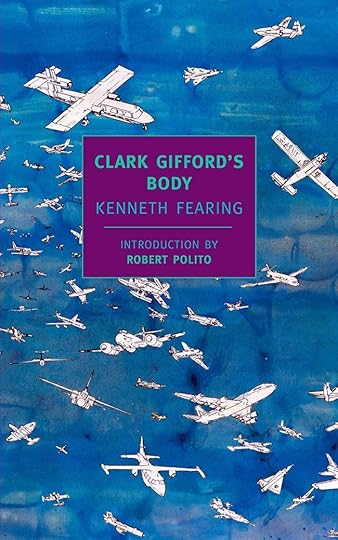
Clark Gifford? A cipher. A disaffected, vaguely idealistic politician in a nameless media-driven modern state where representative politics has dwindled to the corrupt transaction of business as usual and a new foreign war is always breaking out. One night Gifford and his followers seize some radio stations and broadcast a call for freedom—a rebellion that is immediately put down by the government and whose motive will remain forever obscure. Even so, it leads to twenty years of war.
A paranoid tour de force of political noir, Clark Gifford’s Body skips back and forth in time, interspersing newspaper clippings and court transcripts with the reactions and reminiscences of the politicians, generals, businessmen, journalists, waiters, and soldiers who double as the actors and the chorus in a drama over which, finally, they have no control. Who here is leading? Who is being led? Fearing’s novel is a pseudo-documentary of a world given over to pseudo-politics and pseudo-events, a prophetic glimpse of the future as a poisonous fog.
“I have not developed the habit of reading thrillers, but I have read enough of them to know that from now on Mr. Fearing is my man.”–The New Yorker
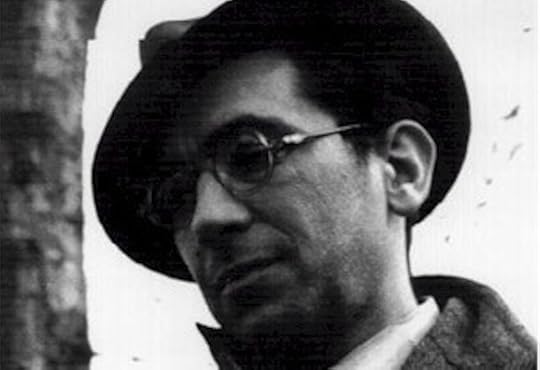
Kenneth Fearing (July 28, 1902 – June 26, 1961) was an American poet, novelist, and founding editor of Partisan Review. Literary critic Macha Rosenthal called him "the chief poet of the American Depression."
Fearing was born in Oak Park, Illinois, the son of Harry Lester Fearing, a successful Chicago attorney, and Olive Flexner Fearing. His parents divorced when he was a year old, and he was raised mainly by his aunt, Eva Fearing Scholl. He went to school at Oak Park and River Forest High School, and was editor of the student paper, as was his predecessor Ernest Hemingway. After studying at the University of Illinois in Urbana and the University of Wisconsin, Fearing moved to New York City where he began a career as a poet and was active in leftist politics.
In the 1920s and 1930s, he published regularly in The New Yorker and helped found Partisan Review, while also working as an editor, journalist, and speechwriter and turning out a good deal of pulp fiction. Some of Fearing's pulp fiction was soft-core pornography, often published under the pseudonym Kirk Wolff.
In 1950, he was subpoenaed by the U.S. Attorney in Washington, D.C.; when asked if he was a member of the Communist Party, he is supposed to have replied, "Not yet."
American novelist and poet Kenneth Fearing (1902-1961)
Clark Gifford’s Body is a forgotten classic of postmodernism, a novel not well received at the time of its first publication in 1942 and virtually unknown ever since. Thank you New York Review Books (NYRB) for this 2006 edition which includes an informative introduction by critic Robert Polito. And let me tell you folks, if you are interested in reading political noir in an experimental fictional style, this is your one-of-a-kind book.
As a way of underscoring "postmodern" and "experimental" below are several postmodern, experimental features of this story revolving around and hovering over one central event - the attack and takeover of a series of radio stations by Clark Gifford and his anti-government followers, a takeover leading to twenty years of war:
Reaction Against Established Forms Rather than telling the story in conventional start-at-the-beginning-and-move-forward linear progression, the novel hops and shifts back and forth in time, covering reflections, reports and events before, after, and during the attack, ranging from thirty years prior to thirty years after as well as including more than two dozen first-person narrators from military officers and executives to town residents and those actual participants in the attack.
Incorporates Many Varieties of Texts Directly Among the novel’s thirty chapters, we have a written proclamation, a letter, a monthly magazine article, a series of press service flashes and three different newspaper articles. Chapters focus anywhere from years before the attack to years following the attack. To take but one example, here is a quote from a monthly magazine: "What sort of man was he, this Clark Gifford who plunged a continent for twelve long hours into the abyss of terror and despair? What lay behind the philosophy that waked children screaming in their beds, set housewives to shuddering, and caused even strong men to falter -and as casually as you or I would push the button of a light switch secure in the safety and sanctity of our own home?"
Erosion of Boundaries Between Subjects Usually Studied Separately One would find it nearly impossible to approach Clark Gifford’s Body from distinct, self-contained perspectives, since, when it comes to history, social theory, philosophy or political science, the novel is an undifferentiated postmodern jumble. Here is a bit of philosophy from one General F. Johan Esteven: "I have no sympathy whatsoever with the terrorist methods employed by "Colonel" Gifford. In my opinion, Gifford should be tried by court martial and shot." Ha! Now that's very generous of you, General Esteven! Why not save the state some money and simply shoot Clark Gifford?
Postmodern Experience of Space and Time and the Leveling of Differences With all the shifting back and forth through time and place, a reader has the sense people and events of this novel are coated with a layer of hazy gray fog; there is the buzz of sameness about it all. Where are we? What was the year of the attack? Sure, there are a couple of sports references, a general is off playing golf, a standard fare kind of guy muses on how fall is the season for football, but there is nothing more specific. Welcome to postmodern country, a bland-land and flatland, to be sure; we could be anywhere at any time, since, after all, no one location is any different from all the others.
Pastiche Rather Than Parody Here is literary critic Fredric Jameson on the use of pastiche in postmodernism: “Pastiche is, like parody, the imitation of a peculiar or unique style, the wearing of a stylistic mask, speech in a dead language, but it is a neutral practice of such mimicry, without parody’s ulterior motive, without the satirical impulse, without laughter, without that still latent feeling that there exists something normal compared to which what is being imitated is rather comic.” This description fits Fearing’s novel like a custom made suit, a novel for the most part both humorless and free of satire, a novel that does anything but suggest there is an alternative, more "normal" culture and society anywhere else in the world.
All in all, there was something strangely compelling about Clark Gifford's Body that made me want to keep turning the pages. Perhaps it was the constant freshness of perspectives, each chapter offering a new voice, a different mode of communication, a new narrator with new expectations and challenges interlaced with all the other characters. But, whatever the reasons, this was an intriguing read, one with its own unique flare and a book I would wholeheartedly recommend.
Kenneth Fearing was a novelist ahead of his time. He was also a sensitive artist who suffered difficulty both as a child and then as an adult who eventually turned to alcohol. Other than his crime noir novel, The Big Clock, also republished by New York Review Books, Fearing’s fiction and poetry are all but forgotten.
The prosody is pulp, the structure and concerns (the construction of history, for one) are Modernist, and the act of reading it is, in retrospect, Borgesian. Borgesian in the sense expressed in the foreword to The Garden of Forking Paths: beside its own synopses and commentaries, the book itself is unnecessary. I loved the back cover.
Clark Gifford is an army Colonel who leads a coup to unseat the government of an unnamed country.
His assault on a radio station is called The Attack and all the chapters reference this event in terms of when they are set. For example 8 years before The Attack or 3 months after The Attack.
Each chapter is told from the viewpoint of different people affected by the event (some more directly than others) or sometimes via newspaper articles.
The narrative jumps forwards and backwards showing not just what happens on the day of the attack but what led up to it and the consequences afterwards.
The premise and the structure were interesting and the satire of political and revolutionary movements is still relevant. Clark Gifford's Body is the story of how a failed revolutionary act is co-opted and manipulated by various political groups whose agendas (Clark Gifford's included) seem to be based on plattitudes so amorphous and ambiguous as to make their differences almost meaningless and interchangable - making it easy enough for the characters themselves to change sides as they detect which way the wind may be blowing. What the country is left with is 20 years of war and hardship based on manipulation and the self-interest of a few. The story is told out of order through newspaper clippings and first person accounts, presented in a way that allows you to piece together the plot and motives of the characters gradually in a way that a hypothetical person living through these events might not. The technique is interesting but it didn't always grab me - the first person narratives were probably the most effective - but they were usually from the point of view of someone who wasn't one of the main actors. I was wishing the characters and some of the episodes were more compelling but the form limits this (and the unknowability of some of the characters through what they say and do is partly the point). I liked how language was used to manipulate. The use of broad, almost meaningless phrases by the military/political leaders (lots of talk about "freedom" and taking things back) to motivate people to violence without any concrete ideas or goals certainly rings a bell.
The final ending chapter is perhaps a bit too traditional in nature given the structure of the rest of the work, and there's no doubt, despite my enjoyment, that Fearing's reach once more exceeded his grasp with this one.
At the same time, however, this ambition (it's narrative structure is not just non-linear, but decidedly fractured, with over 2 dozen narrators) that elevates it above The Big Clock in my eyes. Whereas the latter was a 3/5, this one is more of a 3.5/5: still not without flaws, particularly in the plotting department, but interesting enough that I can see myself re-reading this work before Clock.
Strangely compelling and still 69 years after its initial publication, timely. A country (or is it the entire world?) is at war and the novel jumps back and forth in time before and after "the attack" that sets off the latest round of fighting. Different characters from each side are describe their involvement with restrained detachment. There are no good guys, no bad guys. Just people in a war.
Interesting book about a revolutionary in an unnamed (but in all pertinent ways the U.S. of A.) country, told from different viewpoints from many different time frames, for this kind of newsy, fractured style, which maybe felt bolder at the time than now. Pretty good, but also kind of distancing, and not always involving.
Genuinely an epic in so few pages. Very easy to get lost in the sheer amount of viewpoints but still a fun read. Simple prose, but very vivid nonetheless.
A book seemingly ahead of its time for its fake-news-account and jumbled chronological telling and for its political thematics about a mass mediated politics, it's a book I liked a little more in theory than in practice. But there are some evocative moments, particularly in its reflection on tourism and historical memory.
Clark Gifford's Body - Kenneth Fearing This has some major flaws, but still does some pretty amazing things. Fearing is not one to follow the crowd. Suppose you switch radio with the internet?
i'm sorry. nobody told me how trailblazing this book was before i started reading it. predating Nineteen Eighty-Four by seven years, Clark Gifford's Body takes place at an undisclosed time in an unnamed (though distinctly, noticeably British) country in the throes of nebulously political upheaval instigated by forces united by a largely unknown cause. this alone is pretty fun. an epistolary structure that only further muddies What's Going On is also fun.
there is an endlessly relevant point being made here about the nature of information and propaganda that cries out for a compelling story or central character arc to undergird and guide it. there are a lot of powerful people discussing the nature of ideology in deliberately vague terms without an end goal that cry out for a sort of O'Brien character to rein them in, flesh them out, give them purpose. i'm sorry; i just didn't really like any of it, but i understand how ahead-of-its-time it was.
Experimental, non-linear, and episilatory. Quite the ball of difficulty that also doesn't pay off. I may have liked it better if the satire wasn't so heavy handed. Can't believe this is the same guy who authored "The Big Clock." Both works criticize the rapaciousness and society poisoning tendencies of wealth/power, but "Big Clock" does so in a subtle and tense manner while "Clark Gifford's" just smacks you over the head.
This novel isn’t exactly about a civil war in the U.S. - it’s in an unspecified country that seems like a mix of North America and Europe- I think it gets the feeling of them right in its mix of tenses, sense of paranoia, the scattershot chronology. I was reminded at times of Biography of X, at others of Darkness at Noon. But it’s also its own thing. I liked it.
A remarkable nonlinear quality which matches with an absence of meaning. The political figures mostly melt together as merely distinctive power seekers with no distinct principles. Maybe that's the point.
An interesting mosaic novel of political turmoil. This could easily be confusing and fractured but it hangs together well with both separate a and combined voice.
What a curious book, a sort of experimental sci-fi noir. It's not like anything I've ever read before and I admit I am a bit flummoxed by it...but in a good way.