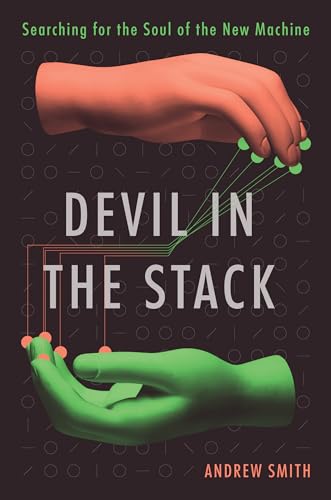
From internationally-bestselling author and journalist Andrew Smith, an immersive, alarming, sharp-eyed journey into the bizarre world of computer code, told through his sometimes painful, often amusing attempt to become a coder himself Throughout history, technological revolutions have been driven by the invention of machines. But today, the power of the technology transforming our world lies in an intangible and impenetrable cosmos of algorithmic code. So symbiotic has our relationship with this code become that we barely notice it anymore. We can’t see it, are not even sure how to think about it, and yet we do almost nothing that doesn’t depend on it. In a world increasingly governed by technologies that so few can comprehend, who—or what —controls the future? Devil in the Stack follows Andrew Smith on his immersive trip into the world of coding, passing through the stories of logic, machine-learning and early computing, from Ada Lovelace to Alan Turing, and up to the present moment, behind the scenes into the lives—and minds—of the new frontierspeople of the 21st those who write code. Smith embarks on a quest to understand this sect in what he believes to be the only way by learning to code himself. Expansive and effervescent, Devil in the Stack delivers a portrait of code as both a vivid culture and an impending threat. How do we control a technology that most people can’t understand? And are we programming ourselves out of existence? Perhaps most terrifying of Is there something about the way we compute – the way code works – that is innately at odds with the way humans have evolved? By turns revelatory, unsettling, and joyously funny, Devil in the Stack is an essential book for our times, of vital interest to anyone hoping to participate in the future-defining technological debates to come.
I was born in New York, but have lived most of my life in the UK and started out as a journalist, just writing and writing at Melody Maker, then The Face, Sunday Times and Observer. The engine of my work is always curiosity: my first book, 'Moondust', stemmed from me wondering what had happened to the 12 men who walked on the Moon between 1969 and '72; my second from bewilderment at the way Web 1.0, the wild first phase of the internet, imploded and vanished so mysteriously in 2000.
These days I also make the odd documentary film, most notably 'Being Neil Armstrong' and 'To Kill a Mockingbird at 50' for BBC4. I'm currently part way into a novel (based on copious research about real events) and into adapting 'Totally Wired' for TV.
Maybe if you know nothing about programming this book could be interesting. But to me it seemed both somewhat shallow and also trying to philosophically overreach at the same time. For example, liking Python because of it's "clean" syntax... Understandable from the perspective of a complete beginner, but not a very nuanced perspective. It doesn't take into account flexibility, scalability, modularity, performance etc... From an engineer's perspective, programming languages are primarily tools which are used to complete some objective. Similar to the way instruments are tools that are used to create music. Hearing an amateur's opinion on the color of your violin is not as interesting as listening and appreciating the music it can be used to create. I understand it's not an easy balance given that some technical knowledge is needed to appreciate the nuance. But maybe if you are actually interested in coding, you need to know it by doing it rather than by reading about it.
Cards on the table: I was part of Andrew's journey writing this book, and I've read several drafts, including the final version. Clearly I'll be biased about the work of a friend.
From my perspective Andrew engaged with the Python programming community - that part of coding culture in which I live - with an open mind, big heart and generous spirit (the Python community were but one of many coding cultures Andrew encountered). The book very much reflects his obvious amazement, intrigue and (at times) horror at what those of us in the world of coding get up to. To use a well worn phrase, he includes the good, the bad and the ugly (and I'd add, some pretty hilarious as well as some beautifully touching moments too).
Anyone already in the world of programming will be engaged by this book: Andrew successfully holds up a mirror in which we are able to see ourselves as others do - warts and all.
Those who are not programmers but interested in coding, those who want to fathom the rather opaque world of technology, or anyone who cares about how the world is tacitly changed by unaccountable coders will be joining Andrew on an entertainingly weird odyssey through the topsy-turvy world of computing. He covers a LOT of material, both technical and cultural, and does so in a very relatable, thoughtful and engaging way.
I love much of the programming work I do: the collaborative creativity of coding, the joy of exploring the potential for technology to enlarge our culture, and the knowledge that one could be putting something into the world that others find helpful or delightful is a wonderful privilege. Yet the tech world contains much that is unpleasant. Many of those who inhabit it often have an over-inflated sense of their "world changing" and "revolutionary" work, while at the same time exhibit crass logical cleverness and hubris, combined with a staggering lack of intelligence, compassion and cultural awareness.
Andrew identifies and engages with all these complicated aspects of the world of coding. It means this book is a delightfully pointed yet entertaining exploration of such a deeply paradoxical, irrational and surprising world.
I’m heartbroken. I really, really enjoyed this book. However, as a diagnosed neurodivergent woman who recently graduated from a Psychology degree and read up extensively on neurodivergence, I wish the topic had been broached differently. Baron-Cohen is the last person you want to cite when attempting to define autism. Nevertheless appreciated the book, but to other readers: please take the autism section with a grain of salt.
"During the late 1980s, a Dutchman named Guido van Rossum decided to write a programming language that would be clear, concise, and as easy to learn as possible, in which simplicity was paramount and transparency to other coders had the imperative force of a covenant. He named it Python after the British TV show 'Monty Python's Flying Circus.' Brilliant computing minds had dreamt of such a language for decades without success, even if the breadth and invention of their attempts turns out to be one of the great untold stories of the last eighty years, existing at the nexus of math, linguistics, philosophy, psychology, engineering, literature, neuroscience, as spectacular in its way as our first forays into space."
"Anyone with access to a computer can try this now: go to Google's home page, right click anywhere and select "Inspect" from the resulting pop-up menu: this will open an inspection bar at the bottom of the screen. From the menu at the top of the bar, click "inspector" to see HTML (Hyper Text Mark Up language) code appear immediately underneath, while CSS (Cascading Style Sheets) will show in a sidebar to the far right. Now click the mouse icon immediately to the left of the "Inspect" button and hover your own mouse over any element you want to mess with, go to the CSS and look for keywords like "color," or "font," or "height" and the values bound to them by a colon. Double-click the value (say, a blue color given as "#003eaa") and type an alternative of your choice (maybe type the word red or gold or aquamarine)."
Don't worry. You won't destroy Google or the world. The changes you make will be strictly temporary and will only be seen on your screen. Give it a try. Go crazy. Experiment with changing numerous elements on Google's home page and elsewhere. Abandon, at least for a while, being led around the Internet like a bull with a ring through its nose.
What is code? What is programming? Hint: it's the definition of extreme abstract concepts vs concrete concepts such as beetle, butterfly, or pressed flower collections (not unlike comparing modernism art to post modernism art). It is not human-like. There are many ways to approach programming. Maybe you are in the mood to learn some programming language skills? Why not? It can't be harder than learning a new human language or learning to play a Christmas song on an accordion, right?
Are you ok with "being on a path pointing to an Orwellian future of industrial scale intrusion and forfeiture of privacy, in which no facet of your life is too intimate to be colonized by anyone with the right programming skills?"
This "older" author decides to stop behaving like a sheep being raised strictly for profit by someone else. Read this book to learn with the author and avoid common pitfalls. What coding and programming language(s) should you learn? Answering "straightforward questions like this, one of many, normally wastes gobs and gobs of time.
Even if you stopped learning new things long ago, reading this book is an informative trip. The "coding rush" of today is comparable to the "gold rush" of 1849. I mean, consider the concept of cryptocurrency, like Bitcoin. Maybe, it's a good idea to become informed before it's too late. Baa, Baaa, Baa, Baa!
I have a lot of mixed thoughts on this book. On one hand, it provides a perspective of a newcomer to programming that is both engaging and insightful. On the other hand, it attempts to cover way too much ground with explainers on CS 101 fundamentals, history, and current buzzword-y topics.
I wish there was more time devoted to learning or discussion of programming language; what was there was good, but it seemed to fall on the wayside for philosophizing on the impact of computers on modern society, which varied for me from actually thought-provoking to oddly concerning. In particular, there's a decently long diatribe into neurodivergence and autism as it relates to folks working in software, suggesting that certain tech companies consciously or otherwise filter for those traits because they may correlate with strong programming skills, but then implying that this is leading to all kinds of problems in tech (and by extension, society) due to insufficient empathy. This part was clumsily handled at best, especially because it seemed to stem from an interaction with a single individual.
Being a professional developer myself, this book was a very interesting and thoughtful book.
I resonated a lot with the narrative, and found a lot of similarities between how the author and I code and learn.
Smith has an engaging way of writing, and I like how the personal experiences are interwoven with technical insights as well as history on the subject.
I found the book humorous at times, which made the book fun and lighthearted.
I would recommend checking out this book if you are interested in the future of technology and code, and/or are curious of how we started!
unnecessarily complicated sentence structure used to make the simples of computer science concepts seem like something that’s impossibly hard to grasp. this book was absolutely nothing of what i had hoped.
I spotted across this book while browsing my local Boookmobile; first the title, then the cover, then the back cover. I happily retired 6 months ago after some 45 years of programming, and had mixed feelings about diving back in to the tech field. My perspective would certainly be different this time, having already known much of the story. I thought it would be interesting to read about a journey through my field from a researcher's perspective.
Devil is a very wide-ranging historical sweep, from the origins of computing hardware and software to the challenges of AI, from a beginner's perspective. Smith's 5-year foray into programming was impressive, but the niggling thought that kept returning was, "How is he qualified to philosophically critique when he's a literal n00b?" Sure, he had the benefit of many long conversations with some key players in his journey, which few ever have the chance to do. However, many of the his high-level analyses weren't tempered enough by real world experience. Quick to paint with a very broad brush, Smith often over-simplifies. He ignores - perhaps unintentionally - wide swaths of software history during his travels. Too quick to jump to conclusions based on a very limited data set, Smith tarnishes his credibility among readers who have traveled myriad paths through this territory themselves.
There were numerous bits and pieces., however, that I found fascinating, that fleshed out my own historical assumptions, particularly prior to the 1950's. Not a lot of references mentioned there, so I have to trust what he says are facts. I hope they were. The direct words of icons are always interesting to me, and I found those recorded conversations fascinating, and they again helped fill out pictures I'd built in my own mind from other reading. I found the brain studies fascinating, and would like to learn more on that subject.
Often I follow up with books referenced by an author in his text. And I found a number of them to add to my "To Read" list, mostly in the first quarter of the book.
I suppose "interesting" would be a good conclusive word for me. I would only recommend the book to someone with experience in software, else I'd fear that a non-programmer would blindly accept Smith's conclusions as definitive. Were I back at work, I'd love to take this book apart with friends.
Smith provides an omnibus history and personal account of coding from the early logic arguments of George Boole to current cryptocurrency’s block chain communal data-sharing.. He wheels through philosophy, art, music, artificial intelligence [machine learning], neurology…and home appliance repair. He reads voraciously and learns to code. You can learn more than you may want to about the pros and cons of different coding languages. You’ll meet some eccentric figures, delve deep into tech giant cultures. More importantly you’ll learn where tech helps and its limitations, because the universe and its creature’s behaviors cannot be defined by bits and bytes. As one wit opined centuries ago, “You cannot legislate morality” because you cannot write enough rules to cover all contingencies.
Likewise, you cannot write decision-making schemes for unexperienced scenarios, such as a tragic self-driving car incident hitting a bicyclist with grocery bags on both arms of the bike’s handle. As Daniel Kahnemann, Tversky and Thaler have taught us, humans don’t make rational decisions and thus, our algorithms might be irrational as well. Smith quotes many others including the author of “Weapons of Math Destruction,” that some unintended, ugly consequences occur when our biases and prejudices are not questioned or held in check. We might rely on “seeing is believing” when we actually make rules based on “believing is seeing.” We ignore contrary data that doesn’t fit our models, conceptions and rules of thumb.
Meanwhile, our brains adapt to the environment we’re immersed in. And so, the author acknowledges that he’s even started to think and behave differently since starting to work on programming projects. So can machines learn, adapt, trust some intuitive feel, for example, that someone is lying in an ever-changing world? Smith explores this in this readable romp through the computing industry.
Smith is an excellent writer: accessible, engaging, warm, chatty, humane, creative, funny. I'd probably want to read anything he writes.
But this specifically? It is interesting. Smith tells us what it was like (for him) to learn to code, while also giving us some history of computing, descriptions of various coding languages and how coding works, and explorations of the neuroscience and ethics of coders and coding.
In my view, the neuroscience stuff is unconvincing except to the extent to which it addresses the idea that autistic personalities excel at it - not true, if this account is to be believed, at least once one gets past the initial stage of learning a language to actually putting it to use on a project that is likely to involve a team. But we don't really need neuroscience for that - just a reliable reporter, which Smith seems to be.
The ethics is more compelling, and although at times I felt Smith was going to draw daft conclusions, those he ends up making are akin to what the EU is in fact trying to do with its AI Act - albeit facing opposition from US Big Tech, with the backing of Trump. Things like banning predictive policing and imposing stricter regulations on higher-risk uses of AI.
Whether you'll find this as interesting as I largely did might depend on what you've already read. There's stuff on AI biases and intransparency that you've likely read elsewhere, but even so you'll also likely get a new perspective on topics, like how interdependent software is.
Mostly, it's Smith himself who makes this so readable: his humour, his range of interests, his concerns. He's a great guide and companion, asking interesting questions and trying difficult things. It works rather well.
While this book is ostensibly about coding—that is, writing software—in Python, it’s much, much more than that. This book is data dense; it contains a lot of history about computing and computers; discussions about computers, operating systems, languages, and code; about the ramifications of writing software and some of the failures of companies whose assets are primarily software; and some of the cultural flaws brought about by individuals and those companies that are creating moral and ethical problems in the world. The author’s efforts to learn to code form the initial basis for this book. But he branches off to discuss many code- and computer-related topics that eventually circle back to writing code. This is not a book about how to code in Python, although the author does present a very few examples that highlight some of the complexities in writing good code. Because it’s dense (416 pages excluding Acknowledgements and the Index) and contains many ideas that require some time to think about, this book will understandably take a while to read (it’s taken me 3+ weeks, reading mostly over lunch as I needed time to digest it!). The book is worth the effort; highly recommended.
As someone who learnt to program at an early age (and has spent a lot of his life exercising those skills), it was interesting to read about the experiences of a beginner so clearly expressed. It is particularly useful perspective when teaching others who may not approach this space with enthusiasm.
What I appreciated less was the philosophical aspects of the project and the whipsawing between optimism and pessimism. Andrew Smith is searching for the 'devil' in the stack. This search appears to be a kind of search for the essence of computer technology, perhaps in a similar vein to Heidegger's The Question Concerning Technology. This isn't a neutral search, as Smith is in search of a 'devil', an essence of computer technology which explains negative aspects of the world we inhabit.
But I think many of the problems being caused in our world by computer technology are really the impacts of already existing power relationships being amplified.
There are interesting ideas (and some naive ones) in the book but they aren't as fully developed as I would've liked. It is however entertainingly written.
The author, who began as a non-coder, dove deep into the culture of computers and computer programmers ("coders"). The book describes coding in simple terms as he himself learned how to write code and what the cultures of the coding communities are like. I use the plural because the different computer languages seem to carry their own cultures. He settles into the Python world and despises C. He spent over four years researching and writing the book. It is filled with interviews with iconic coders around the world and the industry. After moving through what it's like to learn to code, he moves on to how software has changed our lives for both good and bad and describes the promise of artificial intelligence (AI) to produce even greater good and greater evil. He prefers the term machine learning (ML) to AI as he explains why he thinks AI is a misleading term. The book is well-written and readable, even for those outside the computer/coding world.
I can see a lot of work went into this book. I have been a participant and observer of most of the computer goings on covered in the book (Grace Hopper delivered some lectures to my college classes). I have to say it was a fun read, albeit a little snarky at times and philosophical at others. But as a personal journey of coding, it is very good. He does try to give examples of computer languages at different levels of abstraction, but I don't think a novice will be able to understand them, but will still get the gist of what he was trying to convey.
He does interview a lot of the well known people in the field and has some new information or perspectives I wasn't aware of that I found interesting, such as an opinion that most senior google engineers are autistic,
The field of computing has evolved into many sub-specialities and it would be impossible to cover most of them in a single book, but he does cover a lot of what a new coder would encounter starting out. Recommended.
A forced DNF because the advance copy was archived mid-listen. Hm! Providers should allow a much longer timeframe. Since I made it quite a way through, I'll consider it "read."
This is a thick and compelling entry on entering the world of programming. I was surprised at the amount of history and detail here. I kept wanting to go back and re-listen and look up this and that ... which is difficult to do with an audiobook.
On that point, the narration by the author was perfect. Still, a glaring issue was the narration of the code. I just don't think this works for most folks. Rather, I'd prefer an online text that one could read while listening, just with the code, as a reference.
Thank you to NetGalley and HighBridge Audio for the advance copy of the audiobook ... but please allow people enough time to listen to it, especially such a long volume.
I began this book because a quick survey of the early pages convinced me that Smith would represent my own confusion about coding very well, and maybe trace a path for me in understanding it more. By the end I hadn't gained the grasp I'd hoped for. Oh, there are a number of illuminating moments, culminating in a convincing argument for abstraction being the "medium" of computing, but the now familiar (for popular books of this kind) pendulum swing between ideas and anecdotes left me bored on the one hand and uncomprehending on the other. The conclusions of the book - largely about how to limit the scope of coding's abstractions - stuck me as rather bathetic.
“Devil in the Stack”, is thorough research into the world of coders and the pioneers that made an industry of technology professionals. Andrew Smith, the author, illustrated the pros and cons of open-source code and technology. Since no one owns the technology and anyone can modify it, how can we, the end users, make any predictions about where technology is going? This is a rhetorical question that no one can answer, not even the professionals. The future is bright for the tech industry and there’s room for concern, since no one can really predict what’s next. The evolution of tech truly is a one day at a time endeavor.
While the book was interesting and made some very good points overall, some of it was a case of losing the forest because of the trees. I am retired after 30 years in programming/systems analysis and my even my eyes glazed over while reading through the excruciating and long winded details of some of the author's coding "adventures."
I think the major points could have been made much more clearly and strongly in a book about half the length of this one. The main points were somewhat lost in the midst of all the details and could have been presented more clearly in a shorter and less technical form.
The good: I appreciated the fact Mr. Smith dove deep into the coding community and tried things out for himself, and I enjoyed the parts where he wrestled with the underlying ways that humans might change after being exposed to computer programming.
The bad: The book's length needed to be cut in half, and the narrative is disjointed at best. There are way too many sections of Mr. Smith explaining the technical details of how he learned to code - which added nothing to the larger narrative, were too detailed for the lay person, and I am sure too simplified for actual programmers.
The start was interesting-an aged writer trying to become a programmer. Unfortunately, after 1/3 of the book it mostly became a book of extreme wokiness, snowflakiness (author almost died from it when his acquaintance in Google didn’t agree that you should give all your money to homeless people) followed by “left/right hemisphere” hypothesis of a British psychiatrist, which the author is using to explain all ills of programming
Finished this book [on April 2, 2025], was pretty good. It's about a guy who decided to learn how to code because he wanted to know what the skill of coding does to the brain and how algorithms have affected our society. The first 300 pgs or so were a bit slow but historically informative on the history of computing but I think the last 100 are very insightful/literally stuff I've been saying on the topic, especially about AI.
This is an honest account of a non-coder becoming a coder, and all the things they learned along the way. I felt like a voyeur of my own history doing the same for the past 30 years. Smith does a wonderful job not only in his writing, but in all the research of going to tech conferences, finding people to interview, and spending the late nights and weekends it took to make his first real contribution to open source software.
Honestly this should be 2 or 3 different books. The learning to code part was interesting, and the exploration of the implications of our coded world was interesting, and the brain psychology stuff was interesting, but I think the book was taking on too much and trying to be the answer to everything and also a memoir. I found myself antsy to just finish the thing at the end. Honestly, it needed a strong editor’s eye to focus this ambitious project.
I've been a programmer, sys admin, IT projecte manager for ages so I was very curious about this book. Even if I worked with different languages and softwares (sometimes it matters) I was able to recognize some of the mind processes and experiences. It's thought provoking and entertaining at the same time. Highly recommended. Many thanks to the publisher for this ARC, all opinions are mine
I learned so much! This book could have been shorter, but, it was good. Mostly I now feel less bad when it takes me a long time to learn coding things or get bogged down in computer workings. That's part of the deal...
Enjoyed this story. It was cringy at points, at least when you have been doing this for a living for decades, but his discussions of learning to code and engaging in communities was interesting and engaging.
Started off well, but became long winding and woke. Overly long travel descriptions and quotations of british people. I was hoping it would have been more like "the philosophical programmer" book. But this was not as interesting.
I tried hard to plug through this but DNF. Not a bad book necessarily, just not what I thought it was gonna be. For that reason I will spare it a star rating so as not to skew numbers from my lack of due diligence.