Jump to ratings and reviews
Rate this book

A Judgment in Stone

Rate this book
What on earth could have provoked a modern day St. Valentine's Day massacre?On Valentine's Day, four members of the Coverdale family--George, Jacqueline, Melinda and Giles--were murdered in the space of 15 minutes. Their housekeeper, Eunice Parchman, shot them, one by one, in the blue light of a televised performance of Don Giovanni. When Detective Chief Superintendent William Vetch arrests Miss Parchman two weeks later, he discovers a second the key to the Valentine's Day massacre hidden within a private humiliation Eunice Parchman has guarded all her life. A brilliant rendering of character, motive, and the heady discovery of truth, A Judgement in Stone is among Ruth Rendell's finest psychological thrillers.

224 pages, Mass Market Paperback

First published May 2, 1977

451 people are currently reading
7719 people want to read

About the author

Ruth Rendell

454 books1,624 followers
A.K.A. Barbara Vine

Ruth Barbara Rendell, Baroness Rendell of Babergh, CBE, who also wrote under the pseudonym Barbara Vine, was an acclaimed English crime writer, known for her many psychological thrillers and murder mysteries and above all for Inspector Wexford.

Ratings & Reviews

What do you think?
Rate this book

Friends & Following

Create a free account to discover what your friends think of this book!

Community Reviews

5 stars
2,392 (29%)
4 stars
3,137 (39%)
3 stars
1,898 (23%)
2 stars
472 (5%)
1 star
139 (1%)
Displaying 1 - 30 of 717 reviews
Profile Image for Bill Kerwin.
Author 2 books84.3k followers
April 2, 2020

Often deemed the greatest work of one of the world's great crime novelists, A Judgement in Stone is justly famous for its arresting first sentence: “"Eunice Parchman killed the Coverdale family because she could not read or write." But it is not often appreciated that, however straightforward and revelatory it may appear, this sentence—and the upper-class narrator who utters it—suggests an artful and deceptive interpretation of a socially complex crime.

Sure, Eunice kills because she is illiterate, but there are many contributing factors: suppressed lower-class rage, lower-class shame, aristocratic arrogance and paternalistic meddling, the general obliviousness of employers and their objectification of “the help,” familial reticence that conceals essential information, the fear of village gossip, the effect of religious enthusiam on individual lunacy, and—perhaps most important of all—how two people can perpetrate a hideous crime neither would be capable of completing on her own.

This is an absorbing tale told by a distinctive voice, a cold voice which keeps us aware of the march toward inexorable death, and yet pauses on crime's road—oh so briefly!—for moments of pity and elegy. The ending, too, is a particular pleasure. I was certain the thirty pages or so after the murders would be anti-climactic and perfunctory, but they are not: they are crisp, ironic, and one of the joys of the book.

Oh, if you like great movies: Claude Chabrol's La Ceremonie, starring Sandrine Bonnaire and Isabelle Huppert as the two partners in crime, is at least as good as the book. And that is saying something.
Profile Image for BlackOxford.
1,095 reviews70.2k followers
December 21, 2020
Revenge of the Deplorables

We have learned recently that the union of the illiterate and the evangelical is a powerful political coalition. As Rendell notes “illiteracy is a kind of blindness.” And evangelicalism is a form of egomania, a public selfishness that “is not living as one wishes to live, it is asking others to live as one wishes to live.” The mashup of the two is a perennial phenomenon, but nevertheless it is surprising when it occurs... and somewhat dangerous. The ignorant leading the self-righteous. Could Rendell have been channeling Trump as early as 2000?

A Judgment in Stone has one of the most arresting first lines in English fiction, rivalling even Dickens: “Eunice Parchman killed the Coverdale family because she could not read or write.” Of course Eunice’s illiteracy is a consequence of a complex set of circumstances; just as the Cloverdales’ upper middle class lives are more or less determined by theirs. Yet everyone gets on. Neither Eunice nor the family she murdered could therefore be said to be in control, or driven by compulsion. The designation of ‘victim’ depends on how far into history one wishes to go.

But the catalyst, the source of the flame that lights the fuse of homicide is a different story. Joan Smith is a religious fanatic by choice not circumstances. “She suffered from a particular form of paranoia. She projected her feelings on to the Lord.” She is thus justified by her privileged access to the divine will, which of course happens to coincide with her own on every occasion. She is the disenfranchised wannabe, the self-identified victim whom the world hates. She prefers to attribute that hate to her beliefs and so can claim righteous motivations for every action.

The sub-text is important. The Cloverdales are defenseless because they have no experience of Eunice’s world or Joan’s depravity. They lack the imagination to understand what the coalition of the two is capable of doing. Respectability is a vulnerable mode of life. It limits one’s imagination. As usual in all her work, Rendell’s literary mission here is to ensure that middle class smugness has just a touch of insecurity added for piquancy.
Profile Image for Phrynne.
4,022 reviews2,718 followers
June 26, 2020
Short, smart and remarkably well written, Ruth Rendell turns things upside down by telling the reader exactly who is going to die and at whose hands right at the beginning of the book. All we have left to discover is why and the explanation is fascinating.

All the characters and their relationships are well drawn and the big house in the English village is the perfect setting. Best of all are the many occasions in the tale when the narrator tells the reader that the murders would never have occurred if this character had said something different at the time or if that one had acted on an impression instead of ignoring it. Tiny things can alter earth shaking events.

The best part of the book is saved for the end after the murders have occurred. Will the murderer get away with it or not? Read it and see.

Profile Image for Beverly.
950 reviews458 followers
March 19, 2023
A chilling, psychological portrait of a woman with no conscience, A Judgment in Stone is one of Ruth Rendell's best books. I have been reading a lot of mysteries lately, of my favorite sort, in which the why is the most important part. People fascinate me. Those who kill without remorse are unfathomable. Eunice Parchman is one such stone-cold killer.

Her reasons why, what lead up to the massacre and what finally tipped her over the edge are all rendered here. The murders are talked about from the first sentence, so these are not spoilers. What is here is how the clash of class, well-meaning, but wrongheaded gestures and clumsy attempts at bridging those gaps could end up destroying a while family. Even ideas about beauty and it's effect on our behavior is discussed.

This is one of the finest discussions about how kindness can have the opposite effect on those who are the unwilling and misunderstanding recipients of those efforts. No good dead goes unpunished and middle and upper class condescension is also on display here. The murders are brought about with a series of abstract threads weaving a horrific design.
Profile Image for LTJ.
220 reviews857 followers
March 2, 2023
“A Judgement in Stone” by Ruth Rendell started out with one of the most incredible and creepiest opening sentences I’ve ever read in a novel. I thought it was a great way to start this murder mystery with that out of the way and then try to figure out exactly what happened. When you start out with the murder of an entire family, needless to say, it immediately draws you right in.

I’ve never read anything by Rendell before but I will say, I very much enjoyed her classic and elegant way of writing. It’s old-school and fascinating all at the same time, especially with the characters she created.

Needless to say, this novel is all about Eunice. She was terrifying and I loved reading about what went through her mind during all the events and situations she found herself in due to being illiterate. It really puts things into perspective how someone can go their entire life without knowing how to read or write and how they handle everything that comes their way.

This angle around illiteracy and what Eunice conjured up in her mind in every interaction was what I enjoyed most in this novel. It’s a crazy psychological look into the mind of a murderer but unfortunately, there were various parts while reading that dragged on a bit.

It took me out of the reading experience to a degree and at times, with the main angle of this novel being around illiteracy, it didn’t feel all that believable. I can only imagine how frustrating it would be for an adult that isn’t able to read or write but to murder an entire family due to it doesn’t make sense to me. It just didn’t feel real and was too hard to believe once everything started falling into place.

As I said, it’s an interesting novel and Rendell is a solid writer but that and combined with some mundane parts while reading just didn’t check all the boxes for me. The writing is solid but there were too many parts that were boring to me, unfortunately. Eunice was the star of the novel but in the grand scheme of things, this was just an overall decent read. When it comes to the ending, I did enjoy how everything ultimately went down to finally explain the murder so that was another highlight that bumped up my final rating an entire Star.

I give “A Judgement in Stone” by Ruth Rendell a 3/5 as I wanted it to be more of an exhilarating murder mystery ride and not just bits and pieces of it here and there. I enjoyed the writing style, the incredible opening, and even the first 25% of this novel. It started to get dull from that 30% - 70% mark as it interrupted the kind of natural flow I enjoy in mystery novels. This wasn’t a terrible read but it wasn’t an extraordinary one in my opinion. It was original, interesting, and even some parts downright scary but it wasn’t enough to make this anything higher than a 3/5 for me.
Profile Image for Rachel (not currently receiving notifications) Hall.
1,047 reviews85 followers
April 26, 2017
Although it is the opening line of A Judgement in Stone which is most widely known and reveals the murderer of the Coverdale family, it is perhaps Ruth Rendell's second sentence which speaks volumes about the murderess:
"There was no real motive and no premeditation; no money was gained and no security."

Written and first published in 1977, this tightly woven and suspenseful slice of eloquence is just over two-hundred-pages in length but it offers an excellent social examination of the class difference so entrenched in England at the time. It takes just nine months of employment at the country house of the upper-middle class Coverdale family for Eunice Parchment to wreak havoc and the ensuing massacre of the four members of the household still resident within the walls of a fine East Anglian village dwelling. A second marriage for both fifty-seven-year old George Coverdale, now managing director of a family firm and forty-two-year old Jacqueline Mont sees the union bestowed with a resident stepson for George in the form of a eccentric and studious Giles. Of the three children from George's first marriage, it is only university student Melinda who returns home in between academic terms. Overwhelmed at the work involved in running the household and doing the daily chores, an advertisement for a housekeeper at Lowfield Hall brings just one reply, itself a bleak letter which does not leave the lady of the house keen to engage the services of Miss Eunice Parchment. A combination of vanity and snobbishness sees Jacqueline engage the services of a plain woman easily ad old as herself it not older and with a humble regard for her lowly position. In fact, so keen does Mrs Coverdale become in offloading her burden of daily chores, within the course of a twenty minimum interview she is pretty much selling the Coverdale home and family to Eunice Parchment.

The inability of Eunice to read or write and her outright hostility to ever admitting it sees her an odds with the tomes that line the bookshelves and the leisure hours of the family. Permitted to a black and white television, free of the need for purchasing a license or filling in a hire purchase form, Eunice is content with her lonely evenings of viewing. Quickly she finds a favourite in an American LAPD cop and devoid of interference she would have no reason to wish for any different life. Sent away to the country in the days of WWII, Eunice's illiteracy is the result of her sporadic schooling and a resulting oddly incurious nature:
"Illiteracy had dried up her sympathy and atrophied her imagination. That, along with what psychologists call affect, the ability to care about the feelings of others, had no place in her make-up."

Contented knitting and "enthralled in innocent childlike excitement" in front of the television, Eunice has no wish to explore the surround area or makes friends. It is the well intentioned Melinda who first raises the treatment of Eunice with her elders and keen to engage the hired help in conversation she quickly makes a nuisance of herself and shatters the tranquility of life at Lowfield Hall. Soon offers to learn to drive and opticians tests are being booked for Eunice and the family seem to go out of their way to interfere and readily subscribing to the inclusivity and harmony within the workplace. It is the breakdown of the television which Eunice has become so reliant upon that sees her branch out from Lowfield Hall and unfortunately encounter local gossip, former prostitute and now religious convert, Mrs Joan Smith. Running the village post office, steaming open mail and seeing in Eunice a potentially malleable and green friend Joan Smith quickly asserts her leverage over the Coverdale's housekeeper. However, Eunice is no fool and understands that she can reap the benefits of this alliance and as the burgeoning union flourishes, the seeds of resentment at her own misfortune in working for such a family and quickly planted and frequently brought out for examination. Rendell does flirt with a deeper examination of the situation perhaps showing how television violence has come to stimulate Eunice's "own latent violence and waves of aggression", but never ponders in true depth thereby leaving the interpretation that it is the meeting of two malicious souls each intent on using a friendship to further their own causes that causes the bloodbath into the denouement. As Detective Chief Superintendent William Vetch from Scotland Yard is sent to deal with the case and quickly institutes,a 'murder room' of the village hall, it falls on his shoulders to dole out blame and retribution. Will a policeman of twenty-six years standing overlook efficient housekeeper and see behind her reticent demeanour? Admittedly it is a close call but in a piece of final Rendellian magnificence, be prepared for a last gasp resolution. As the novel closes the inevitable squabble over the inheritance and whom predeceased whom, leaving Lowfield Hall uninhabited and falling into state of sorry disrepair.

Succinct and enlightening, A Judgement in Stone a masterpiece in eloquence. As the lady of the house when in conversation with her stepson Peter's wife attests:
"I don't want to make a friend of my servant, I want her the way she is, marvellously efficient and unobtrusive. I can tell you, she really knows her job."

"So do boa constrictors," said Audrey
My inspiration for reading this novel was a forthcoming theatre production which was too expensive for me to purchase a ticket for, but in hindsight I think reading the actual text allows readers to appreciate the true range of Ruth Rendell's skills in clearer depth.
Profile Image for Christi M.
345 reviews85 followers
June 26, 2020
By the end of the first sentence we know that Eunice Parchman is the murderer. In truth, the first sentence is one of the best first sentences I have read in a book. It is clear, concise, and straight to the point. Not only do we learn who the murderer is, but we also know who she murdered and why. This novel does not question her guilt because that is clear. Nor does it question whom she murdered. What it does do is take a closer look at what led up to that moment.

This is a true psychological thriller that takes a look at the makeup of the killer – her motivations, what shaped her life, and what she did to hide what embarrassed her. Who was she when no one was looking or cared to look? But there is more to this story than the murderer. There is a family involved and this book also lays out all the choices the family made along the way. Those moments of hesitation they felt about her character, but never acted on. Moments when they had a clear choice to change the direction their life was about to take in ‘what if’ conversations.

Judgement in Stone at times feels like a mix between an in-depth TV murder investigation and the narration of the Twilight Zone with its hindsight commentary of specific events that might have prevented their deaths. At times the narrator even implores the character to take another course of action. But they can’t change the past; instead the narrator can only show us how the character failed themselves. We can only see where the victims should have listened to their own doubts about incongruous behaviors.

The majority of the book is the lead up to the murders, but equally fascinating were the events following. The narrator once again tells you what her downfall is, but until there is an arrest doubts linger in my head. Eunice is so smug and self-satisfied in her belief that she’ll get away with it. She has taken care of everything and the investigators are none the wiser. This is the smallest part of the book, but is one of my two favorite sections. The other favorite being any time the narrator breaks the fourth wall.

A Judgement in Stone is one of Ruth Rendell’s best, if not the best work. The psychological motivations of both the Eunice and the family were expertly portrayed. The in-depth discussion within the story at what Eunice considered a weakness was fascinating. All in all, this is a thought-provoking book that will stay with me for quite a while. I am also certain that I will be hard pressed to find another equal to it.

Rating: 5 stars
Profile Image for aPriL does feral sometimes .
2,180 reviews532 followers
January 17, 2021
'A Judgement in Stone' by Ruth Rendell is an amazing psychological study of characters! While nominally a mystery, there really is no mystery. It is more of a study, or a dissection, of why a murder of several members of a family happens. The murderer had no intention or plan of committing the murders. The story reminded me of In Cold Blood. by Truman Capote because of the author's style of writing for this novel. But in Rendell's book the author shows and explains to readers everything, unlike what happens in real-life crimes...

Eunice Parchman murders four members of a wealthy upper-class family, the Coverdale's. Only some of the Coverdale's were home when the murders occurred. As this fact is told in the first chapter, there is no spoiling in telling of the part of the plot that people were murdered. The mystery is in why. While Eunice's illiteracy is a factor, the illiteracy is revealed also in the first chapter, and it was only one of many factors involved.

Parchman was the Coverdale's housekeeper. While an excellent maid, she is illiterate and very very ashamed of this. After several months, one of the family discovers Eunice cannot read. Several other things had happened which had begun to sour the relationship between Eunice and some of the Coverdale's as well. But after Eunice is shocked in having her secret exposed, she tries to keep her illiteracy a secret by blackmail.

It doesn't go over well.

'A Judgement in Stone' was written in 1977. Illiteracy was easier to hide for a longer time then but it was still often found out eventually especially in a literate society.

Those who are murdered are listening to 'Don Giovanni', the Opera by Mozart. If this was symbolic - which I suspect is - it might be a little oblique for readers. Don Giovanni was a wealthy person character who knowingly took advantage of the innocent and underprivileged for rape and advantage. I don't think the Coverdales were knowing or actively aware of their privilege, except for one character. Jacqueline Coverdale was definitely someone who felt superior over the servants and had a problem with them if she felt they were getting above what she thought of as 'themselves'. Melinda, the young happy daughter, did try to build a bridge to Eunice. However, she could not undo the damage of a lifetime of ignorance.

I liked this book.


To more personal observations:

I once was a volunteer in an organization which sought out illiterate and foreign-language-speaking adults and matched them with amateur tutors - "Each One Teach One". People who never had schooling or who had never learned to read or write in any language have unmolded brains. No amount of political correctness can paper over the profound lack of knowledge of illiterate adults. The ignorance of illiterate adults floored me. The brain is barely working. I don't know how else to describe the lack of thinking or ideas. It was eye-opening.

I met these adults at libraries and taught them in rooms the library had for studying and tutoring. I discovered most of these adults preferred 'How To' books over fiction. Fiction was an unknown territory they could not navigate with understanding. When I showed them books of maps, textbooks, DVDs, travelogues, etc., they got frightened. I did not expect that. One said, "I had no clue so many different ideas and things to know existed."

Illiteracy isolates people. People who are illiterate do not go on Instagram or Facebook or message friends on cellphones. They don't read magazines or newspapers. If they are also too poor to own a television, and they had a deprived childhood, devastating social and knowledge blindnesses are inevitable.

Social mores are transmitted to illiterates in a scattered truncated fashion, which is especially true in a literate society. People who are illiterate miss a large number of cultural memes, knowledge and understandings. If such a person never watches television and has had a cultural desert of a locked-in childhood because of poverty, such an individual might be severely undereducated in a vast number of things. Especially in emotional development and judgement. Small things can look large if there is no ability to properly judge importance or relevance of an issue. Ignorance limits options. Sophistication is something attained through familiarity of the wide bandwidth of human doings and with a widespread social knowledge of what happens culturally. Otherwise, people tend to rely on more basic and narrowed responses to social interactions which loom disproportionately BIG in their mirrors, magnified out of actual importance.

One of my thirty-year-old students (I had several male thirty-year-old white Americans who had high school degrees - serendipity) had some brain damage caused by alcoholism. His short-term memory was impaired. As my relationship with him unfolded, I learned his worldview was only a square yard of land so to speak. A small enclosed closet of awareness was as far as he could envision what reading was for, or for what he could possibly set goals since he had no idea of what was all out there to know about anything. He did construction work or restaurant labor when he could work. Alcoholism got him fired a lot. The State Office for Unemployment and other types of social workers connected him to the "Each One Teach One" organization. Eunice Parchman, the fictional character in this novel, reminded me of him, although he was nicer and more earnest. He shot his girlfriend and hung himself from a bridge near our library seven months after I started tutoring him.

Profile Image for Aditya.
276 reviews107 followers
June 6, 2020
A Judgment in Stone is really a character driven drama. Calling this a crime would be like calling a marital drama science fiction simply because one half of the couple happens to be a scientist. Genre does not decide what works but don't walk in with the wrong set of expectations.

It opens with the Coverdale family being gunned down by their housekeeper Eunice Parchman as they discovered she is illiterate and then goes on to show the circumstances leading to the tragedy. Eunice befriends a religious nut job - Joan Smith who is like the unlucky spark to her can of gasoline. Insecurities drive the narrative, how they breed shame and guilt, that leads to isolation and insularity. Coverdales who pride themselves on being open-minded, liberal and intelligent never understand that what they perceive as insolence is essentially a defense mechanism.

The trouble here is the inconsistent writing. As a recreation of a mindless crime, it is comprehensively detailed. It offers nice tidbits of occasional insights (quotes at the end). And gives the reader an insider's look into the lives of the characters. Three-Fourths of the Coverdale clan are harmless if irritating do-gooders who never realize their desire to meddle in other people lives may be condescending. While the youngest member is a lost little boy, high on pseudo-intellectualism and low on practicality. It is also realistic how Mrs. Coverdale is willing to put up with a lot when it comes to Eunice. If my mother had a maid as efficient as Eunice, she would tolerate a lot of impudence before she even thought of firing her. But it also has a long laundry list of problems.

The omniscient third person narrator is like a bored newscaster who would rather be anywhere but reading the news. The narrative voice jumps from melodramatic pity to thinly disguised contempt. The characters are not layered. Eunice is too laconic, too impassive. Tell her she has won a billion dollars or humanity will be extinct in the next two days and in both the cases she would rather be watching TV than talking to you. So we never know how she justifies her actions or what she is thinking most of the time. It is a book that might be saying something profound about the English class structure. But it sure is not interesting to read. It is something a creative writing student will write. Professionally written, realistic handling of characters, brimming with thematic aspirations yet often leaves the reader disinterested.

Read Dorothy B Hughes. She would put you in the head of the killer and explain his actions. Read Tana French. She would explain how the killer's past influenced her present decision making. Rendell does none of that. She can write but this is not well written. Opening with the ending robs it of the suspense, it desperately needed. And I am still not sure how Eunice went from slightly stupid and scared to a homicidal maniac. She is obviously angry at the world but that final jump still feels contrived. So it is essentially a character study where the character motivation can be summed up by she went bat shit crazy. My first Rendell thus remains a bit of a disappointment. It also reiterates my belief that the best of American crime fiction wipes the floor with the best of British crime writing. Rating - 3/5

Quotes: About Eunice - She had the awful practical sanity of the atavistic ape disguised as twentieth-century woman.

Like all true eccentrics, he thought other people very odd. Spot on.

Selfishness is not living as one wishes to live, it is asking others to live as one wishes to live
Profile Image for Alan (the Lone Librarian rides again) Teder.
2,692 reviews250 followers
February 22, 2023
Maid to Murder
Review of the Arrow Books/Cornerstone Digital Kindle eBook edition (2010) of the original Hutchinson hardcover (May 2, 1977)

This continues my 2023 binge read / re-read of Ruth Rendell (aka Barbara Vine) and it is my first non-Inspector Wexford book of the binge. A Judgement in Stone is one of the classics of the crime/mystery genre due to its inverted structure where the murderer, the crime and the motive are revealed in its very first sentence (which I won't spoil here). The tension and suspense of the book is then gradually spun out in flashbacks and flashforwards as we wonder how can such a motive possibly be the reason for the crime.

The omniscient third person narrator reveals all as they go along and the repressed and secretive natures of the villains are gradually exposed. There are some bizarre twists before the police investigation finally catches up to the perpetrators.


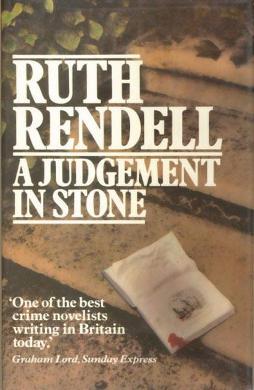
Cover image for the original Hutchinson (UK) hardcover edition from 1977. Image sourced from Wikipedia Spoiler Note if you click through to Wikipedia as the article reveals the entire plot.

Trivia and Links
Read about Five Key Works by Ruth Rendell in The Guardian, May 2, 2015. A Judgement in Stone is considered 1 of the 5 key works. Spoiler Note that this article reveals the first sentence of the book.

A Judgement in Stone has been adapted twice as a feature length film.
The first adaptation was The Housekeeper in 1986 directed by Ousama Rawi with Rita Tushingham as Eunice Parchman. You can watch the entire movie here. This version transplants most of the story to America and sensationalizes it into more of a horror film.


Publicity poster for "The Housekeeper" (1986). Image sourced from IMDb.

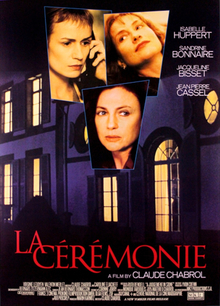
The second adaptation was the French language film La cérémonie in 1995 directed by Claude Chabrol with Sandrine Bonnaire as Sophie (renamed from Eunice Parchman) and Isabelle Huppert as Jeanne (renamed from Joan Smith). Ruth Rendell said that this was one of the few film adaptations of her work that she was satisfied with. You can watch a French language trailer (without subtitles) for the film here.


Publicity poster for "La cérémonie" (1995). Image sourced from Wikipedia.
Profile Image for RJ - Slayer of Trolls.
990 reviews191 followers
June 9, 2020
We know about the crime right from the opening pages: a man, his wife, and two of their children will be slain by their illiterate housekeeper and her friend, and we spend the rest of the short book learning how it happened and why, as well as the investigative aftermath. This short but sweet novel - one of Rendell's most noted books, adapted as a movie twice - is not for those with short attention spans or a need for lots of action and noise. The narrative is wonderfully patient and nuanced, poking insistently at the British class system, deftly capturing each character and the minor details that led to the crime and nearly allowed the perpetrators to escape justice.
Profile Image for Nick Pageant.
Author 6 books932 followers
August 22, 2015
Great book! It's not a mystery or particularly suspenseful, but it is a very interesting character study of a murderer. I think what I enjoyed most were the fully developed characters - nobody was fully good or bad, including the killer.
Profile Image for Holly.
274 reviews6 followers
May 3, 2014
Count me amongst those who are not fans of this book. Ok, the characters were well drawn. Neither the characters nor the story were unbelievable. So, I guess that's good. And it was well written, in the sense that there was nothing trite or annoying.

But I didn't enjoy reading this book at all. I would actually go as far to say that it was an unpleasant experience. From the beginning, the reader is told the whole story: that Eunice kills the Cloverdale family because she is illiterate. I suppose the suspense of the book plays out in terms of how such a minor issue could lead to murder. But, knowing this end just leaves the reader to dread what is coming--the death of a family who fundamentally doesn't deserve it and, while somewhat shallow, are people with good intentions.

The only suspense in the end came from the dramatic irony of knowing what was coming, and I didn't like that, as I said above. The only interesting part of the story to me was the last 30 pages, once the inspectors from the police showed up and were trying to figure out what had happened.

On the cover, there are raves that Ruth Rendell couldn't write a better novel. I know she has written many more, so I hope this isn't true. The book was written in 1977, so I wondered as I read if, in the days before the true crime books and shows like 48 Hours Mystery, which outline all kinds of real life cases with bizarre circumstances and motives, this book might have been more appealing to the reader. At any rate, I wouldn't recommend it to anyone. I think I will give some of Ruth Rendell's other works a try--but those that concern police investigations as opposed to another like this one.
Profile Image for Teresa.
1,492 reviews
August 16, 2017
"Eunice Parchman matou a família Coverdale porque não sabia ler nem escrever."

Num romance policial, só um grande escritor ousaria subverter totalmente as regras, revelando, na primeira frase, a identidade do assassino, das vítimas e o motivo. Pois, a Baronesa Rendell fá-lo, porque o crime é somente um pretexto para analisar a mente humana; a do criminoso e a das vítimas.

"Há quem diga que a vida vale a pena, mas eu prefiro ler."
Profile Image for Eric_W.
1,952 reviews428 followers
November 30, 2008
Jacqueline and George are each in their second marriages; his first wife died, her husband deserted her. They are both very happy, and George, wealthy owner of a factory, has purchased a huge Victorian home that is just too large for Jacqueline to manage. Most of the children have left home except for Giles, Jacqueline’s son by her first marriage, a brilliant troubled eccentric, brilliant who hates living in the country, and Melinda, George’s youngest daughter, whom Giles has an incestuous passion for, envisioning her as the wasted tubercular love of his life. In order to lighten Jacqueline’s workload, George decides to hire a housekeeper, and Jacqueline is delighted to discover Eunice Parchman, who even addresses her as “madam.” Eunice, who fudges her references, turns out to be the ideal housekeeper with one exception: she cannot read, and it is this little detail that leads her to eventually kill the entire family. Not that they didn’t try to make her happy. Eunice had her own bedroom and the old telly, and a well-sprung bed; after all, they wanted her to be content and to stay. But they never considered her as a person. They knew nothing of her background, never asked, and if they had, they probably would not have believed it. That she could have attended school without having become literate and learned to love opera. Heavens! Ironically, it’s Melinda’s attempt to learn the truth that initiates the catastrophe.
This entire review has been hidden because of spoilers.
Profile Image for Kelly.
906 reviews4,860 followers
June 11, 2020
This was disappointing, given what huge fans some people are of her work! I was not excited about this letdown- I was really looking forward to cozying into this like a Christie, and I so so didn't get that. I did NOT understand the logic behind revealing the murder in advance and walking us through it. It took all suspense out of the novel. I guess it was meant to be kind of dramatic irony or something or some kind of weird anthropological study- which, see below-, but it did not work. Sucked all the life out of it.

Also, I was DEEPLY uncomfortable with horror of the villain of the novel being rooted in her illiteracy and what that supposedly does to a person. I mean, I get the shame part of it, but the way it described her was like she was some kind of savage due to it, and had less of an ability to be kind and compassionate. It was like not being able to read or write meant she never developed proper emotions? Which.... *stares in most of human history*.

A few heart pumping moments at the end when the thing actually happened, but that was about it.
Profile Image for Barb H.
709 reviews
February 22, 2022
This is one of Rendell's most amazing, suspenseful books!
************************************
We members of Goodreads could scarcely imagine what it would be like to be unable to read. Much has been written about illiterate adults. We are aware of the efforts these people utilize in order to conceal this deficit from those around them. Many have developed coping strategies or employ artifice. This book, written earlier in Ruth Rendell’s career, has deftly described such an individual, Eunice Parchman. It is especially interesting to note that the behaviors of this woman surround her fears of detection, causing her to erect an icy, impenetrable barrier from others.

Rendell’s chilling plot, written with her elegant prose, builds in intensity, gripping the attention of the reader. Her main character and her closest associate act in ways that would strain ordinary belief. In viewing these arrogant and self-serving exploits, one can begin to analyze and comprehend their roots as this author has so brilliantly rendered them in her narrative.

I continue to feel awe with Rendell’s ability to devise such pathological human nature, to delve so deeply in her character developments and to demonstrate such insight and tension in her plots. Perhaps others would not view this as a mystery, nor so suspenseful, but for me, her skills remain unsurpassed in this genre.
Profile Image for S.P. Aruna.
Author 3 books75 followers
May 24, 2019
After hearing so much about Ruth Rendell, I was more than disappointed with this one, so I almost gave it only 2 stars. It is an eccentrically British psychological suspense novel, except there wasn't much suspense for me. The murderers are two middle aged women, one a lunatic, the other, the main character, a sociopath. Having read Patricia Highsmith's handling of sociopathic characters (the most famous being Tom Ripley), Ms Rendell's attempt falls way short of this standard.

What bothered me most about the book was that there was hardly any dialogue, and character development was the author telling us about them, which for me, is extremely boring. As a consequence they seemed two dimensional and even cartoonish at times. The last part of the book, which describes how the police caught on to the killers, was written in such a hurried way it seemed like an outline an author might make when first formulating the story.

And here is the very last line of the novel
Dust, Ashes, Waste, Want, Ruin, Despair, Madness, Death, Cunning, Folly, Words, Wigs, Rags, Sheepskin, Plunder, Precedent, Jargon, Gammon and Spinach.

What on earth is that?
Profile Image for Karl Marx S.T..
Author 9 books57 followers
August 23, 2012
I discovered Rendell’s work when I was browsing The Top 100 Crime Novels of All Time. Many of her works are included on the list that I came to the realization of maybe she's that good. Since then, I became a fan of Mrs. Rendell after reading this particular title.

The story is about a wealthy family (wealthy in the sense that they’re all educated) who hires a spinster, Eunice Parchman to serve as their housekeeper. There isn’t much problem about her at first for the family starts to like their new house-proud helper as the days passed. They even encourage her to take a day off from work since she does nothing but clean. Until they start to notice something different. Eunice’s secret that will drive her to kill the concerned family. The first sentences of the novel are so revealing that you wonder what would happen in the next couple of pages. I don’t want to spoil some interested reader but the story is about the effects of something important in our lives that if one’s deprived of, will make living a difficult journey. And particularly for Eunice, to resort to something drastic thus the meaning behind the title.

Rendell is known not for whodunits but for her whydunnits. With the presence of murder, there’s always a reason. But there was more to it than that. Everybody has reasons especially when one is compelled to do something unimaginable. The novel is adapted twice for screen with English (The Housekeeper) and a French adaptation (La Cérémonie). I’ve watched both films and in my opinion, the French one's better as Mrs. Rendell also liked it. I suggest you read the book first before watching the movie, not only because it’s the original, but it’s also complete.

Profile Image for Toby.
861 reviews372 followers
November 4, 2016
Read because of the selection in the HRF Keating list of 100 best crime & mystery novels. I only got 30 pages in before getting far too exasperated to keep on reading.

It started off in a similar vein to one of those wonderful Simenon roman durs but quickly went downhill as I was introduced to the soon to be murdered family.

The main characters are all incredibly awful people and whilst I am a fan of reading about offensive people these were not the type for me. Keating described them as nice people, as well meaning, but everything about them screams awful snob. Perhaps I am a product of a different time and a different place and a different social situation and that accounts for it but I failed to spot anything nice in Rendells caricatures.

The first real washout from the highly thought of Keating list, I can't say I'm too disappointed based on my previous knowledge of Ruth Rendell however.
Profile Image for Piper.
321 reviews89 followers
April 25, 2019
Meh!! I can’t say I loved this at all. The narrator really annoyed me with the voice of one of the characters although I understood where she was coming from. As the majority of the reviews stated - the murderer is revealed in the first sentence or two of the story. I honestly thought there would still be a decent plot though. I was wrong. The bright side is that this is not a lengthy book so I didn’t have to suffer very long. Bottom line... don’t waste your time or money.
Profile Image for İlkim.
1,467 reviews11 followers
December 19, 2022
Çok gıcık bir karakteri vardı bu kitabın. Evde bulup ince diye okumuştum ama kitaba dalıp kadını boğasım gelmişti hala hatırlıyorum. Cehalet gerçekten kötü bir şeymiş yani, okuyamadığı için bütün bir aileyi öldürüyor, kendini ezik hissettiğinden felandı. Birisi bir şeyi oku diyince çıldırma derecesine geliyordu vs. Sinir bir kitap kısaca.
This entire review has been hidden because of spoilers.
Profile Image for Peter Swanson.
Author 21 books12.9k followers
April 21, 2017
Excellent last paragraph to a compelling novel.
Profile Image for Bruce Beckham.
Author 84 books459 followers
November 16, 2019
I was half intrigued and half dismayed by the opening of this novel, because with little ado it tells you what is going to happen. To paraphrase, a newly appointed housekeeper, Eunice Parchman, will murder in cold blood her employer, his wife, and two of their children. Eunice is illiterate, and it seems this will prove to be the causal factor in the tragedy.

Clearly sociopathic, and with a backstory that includes the blackmail of neighbours and murder of her father (who lingered inconveniently), it certainly comes as no surprise that Eunice will be capable of the despicable deed. What seems more unlikely as the tale begins to unfold – the marathon-like build up to the Valentine’s Day massacre – is that she should cut off her nose to spite her face, having achieved extremely comfortable circumstances, in service on her own terms at a magnificent country property.

The trigger (oops) proves to be a ‘friendship’ that develops with the somewhat unhinged wife of the local postmaster. I place ‘friendship’ in parentheses, for it is plain that Eunice does not make friends; she does not have feelings for other humans. Eunice is a classic Rendell creation.

For the most part, this was one of those books that I thought, if I left it on the bus, or it fell down the back of the sofa, or the dog decided to take a dislike to it, then I should probably not have been too bothered. I knew what was coming; it was just a matter of time before the finish line hove into sight.

But there I did Ruth Rendell a disservice. It is easy to forget that she was as much a mystery writer as a purveyor of suspense – and in this regard the story has a veritable sting in its tail. Had my copy suffered any of the above-mentioned misfortunes after I had entered the home straight, I would undoubtedly have been found searching buses and sofas, and wrestling with the dog.

(ps. I listened to the audiobook; I thought narrator Carole Hayman’s characterisations were both incisive and entertaining; a positive enhancement.)
Profile Image for Ana.
230 reviews92 followers
October 4, 2016

Sentença em Pedra é um romance de crime no qual a primeira frase desvenda a identidade das vítimas e do assassino, e o motivo que conduziu ao crime.
Eunice Parchman matou a família Coverdale porque não sabia ler nem escrever.

É assim que começa, e aquilo que à partida é uma revelação é também algo que aguça a curiosidade do leitor. Por que vias é que não saber ler nem escrever se transforma em motivo para matar alguém?

A partir da revelação inicial a narrativa vai-se desenrolando sustentada sobretudo pelas personagens que são muito bem delineadas. Trata-se pois de um policial de cariz mais psicológico em que a história não está centrada num detective ou numa investigação mas sim nas características humanas de vítimas e agressor que conduzem ao crime.

A leitura prende porque queremos saber mais sobre o funcionamento da mente e do indivíduo sociopata, porque vamos avançando na expectativa do "clique" que fará desencadear o acto, e porque o final em suspenso dos capítulos, que são curtos, ajuda a manter a tensão ao longo de toda a narrativa.

Entretenimento garantido para quem aprecia policiais vintage e lê-se de uma assentada.
Profile Image for Ann M.
346 reviews
December 11, 2011
This is well written but a bit heavy handed. I think it's interesting that an illiterate woman WHO IS ALSO ALREADY A MURDERER, can find solace with a nutjob fundamentalist who dresses like a whore and can conspire with her to commit murder, but I think the emphasis was too much on Eunice's illiteracy. The result is some of the reviews here actually say that the book shows how illiteracy can lead to murder. Actually, the book shows how having a shameful secret can lead a psychopath to murder (again) with the help of a mentally ill but "helpful" friend. It's more of a Dick and Perry story than anything about illiteracy. FWIW, the only illiterate person I knew was a classmate's neighbor in high school. She was not shy and dishonest, she was a heartbreakingly underconfident but still reasonably well adjusted teenaged girl. She probably had some undiagnosed problem, and I hope she eventually found help.

I found the structure unappealing. I didn't want to read any more about the Coverdales and what led up to their murders. I read to about page 90 then skipped to the end.
Profile Image for miledi.
114 reviews
April 15, 2019
Il buio nella mente

Un giallo di gran classe, che travalica il genere. Si apre con una strage: una famiglia (madre, padre, figlia e figlio) viene ritrovata in un lago di sangue. L’assassina è Eunice, la loro domestica. Nessuno spoiler: la Rendell ci spiattella tutto in faccia fin dalla prima pagina. Ciò nonostante, attraverso un lungo flashback che ci racconta l'evolversi dei fatti che hanno portato alla strage, il libro tiene incollati alle pagine fino alla fine, in un crescendo di tensione che si fa via via più spasmodica.
Disturbante e sgradevole, Eunice, l’assassina analfabeta, è un personaggio che si imprime nella mente e rimane nella memoria. Qui Ruth Rendell è bravissima.
Profile Image for Thomas.
215 reviews129 followers
October 14, 2022
I’m not a fan of murder mysteries, but this psychological thriller lets you know right up front what happens and who did it. And it’s so good. Rendell’s sly wit really had me savoring every page.
Profile Image for Jersy.
1,195 reviews108 followers
September 14, 2025
It's suspenseful and interesting and there are some observations and character aspects I enjoyed, but it sometimes reads more like a report than a novel, there are some weird characterisation conclusions drawn, especially in the beginning, and the murder happens pretty sudden, like the events didn't perfectly lead to it.
Displaying 1 - 30 of 717 reviews

Can't find what you're looking for?

Get help and learn more about the design.