Jump to ratings and reviews
Rate this book

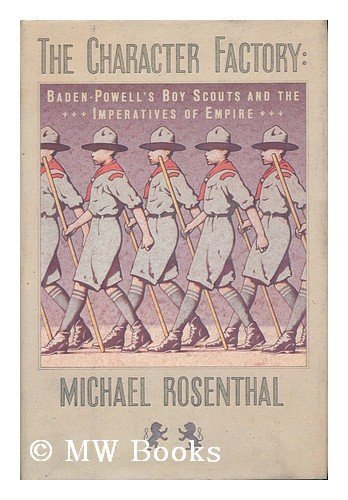
The Character Factory: Baden-Powell and the Origins of the Boy Scout Movement by Michael Rosenthal (1-May-1986) Hardcover

Rate this book
Describes the origins of scouting in Edwardian England, and explains the reasons why Baden-Powell established the Boy Scouts

Unknown Binding

39 people want to read

About the author

Michael Rosenthal

39 books5 followers

Ratings & Reviews

What do you think?
Rate this book

Friends & Following

Create a free account to discover what your friends think of this book!

Community Reviews

5 stars
1 (9%)
4 stars
6 (54%)
3 stars
4 (36%)
2 stars
0 (0%)
1 star
0 (0%)
Displaying 1 - 2 of 2 reviews
Profile Image for Quo.
343 reviews
May 26, 2020
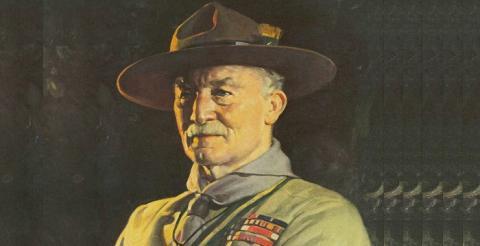
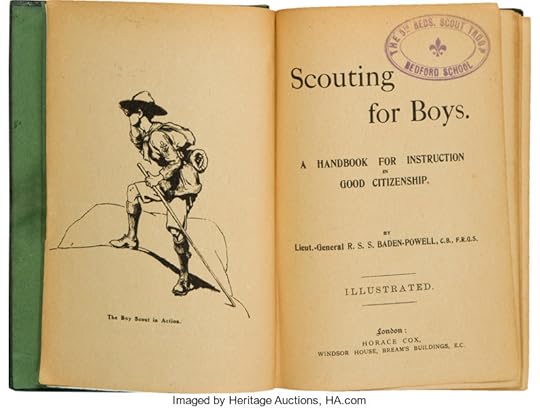
At some point I read that the Boy Scout Handbook, more officially known as The Handbook For Boys has through the years outsold every book ever published, with the exception of the Bible. It is also claimed, that apart from Shakespeare, Baden-Powell may be the most read British writer. The late author & academic, Paul Fussell, wrote an essay on the Boy Scout Handbook some 30 years ago, finding this century-old book by Baden-Powell to be a remnant of "a simpler time when bracing outdoor activities & the Victorian virtues of bravery & reverence were all a boy needed" to become a man and presumably to succeed at almost any endeavor. Fussell went on to suggest that the often-revised "manual about goodness" has somehow managed to hang on to values of real worth to mankind, in spite of radical changes within society at large.


While I am not sure how I initially learned about Michael Rosenthal's The Character Factory: Baden-Powell & the Origins of the Boy Scout Movement, it is a rather fascinating look at Scouting's founding father & his rationale for the movement, essentially to restore pride in all things British at a point when the empire seemed to be at low ebb.

Most do not have a great level of detail about Baden-Powell's life but at some point after retiring from a military career, he began a program in part to engage young boys physically & morally and thus to keep them away from less worthy behavior, from potential gangs to idleness & in so doing, to rather ambitiously provide "the greatest moral force the world has ever known".

Ernest Thompson Seton, the American naturalist, always felt that he & not Baden-Powell deserved the major credit for founding the Boy Scout movement but Colonel Robert Baden-Powell, who it was said had virtually invented his hero status while holed up during the Boer War at Mafeking, a British outpost in present-day Botswana, proved far superior at marketing the embryonic program and its tenets to the world.

Seton promoted woodcraft skills, camping and American Indian lore but Baden-Powell quickly sensed a universal appeal to his particular brand of youthful idealism & without him, the Boy Scout movement would likely never have existed. Baden-Powell remains the author of Scouting for Boys & the sole founder of the Boy Scout movement but Scouting remains a very hybrid program, particularly in the United States, where unlike the U.K. & elsewhere, there is still a strong legacy of Native American lore that frames many ceremonies.

Rosenthal contends that from its very beginning Scouting was meant to be a "character factory" for boys and there have long been accusations that it models itself overly on the military, with boys in short pants & boasting lanyards instead of weapons, still somehow representing junior soldiers. However, Baden-Powell fashioned for himself the role of "universal teacher" and what he meant to impart to boys was a strong moral & intellectual direction while giving boys the ability to make decisions and eventually chart their own course in life, not necessarily to graduate into military uniforms.

In truth, Baden-Powell, like Rudyard Kipling, grew to maturity as a child of empire & never really repudiated Britain's imperial status but while fearing Bolshevism and socialism, Baden-Powell also never renounced his official insistence that Scouting has no political bias.


Rather, scouts were encouraged to "be a brick" and to "play the game hard" and Baden-Powell attempted to reach out to boys regardless of their class or social status, even in very stratified Edwardian England. Interestingly, the late Edward Said, no fan of imperialism, encouraged Rosenthal in the writing of The Character Factory and the author Paul Theroux found the book to be a "fascinating study not merely of the Boy Scout movement but of a violent & bewildered age, being among other things, a key to the imperial mind."

From the very beginning, there have been caricatures aplenty of Baden-Powell & the Scouting movement, including one by George Orwell suggesting that all scoutmasters (as well as all tobacconists) were pederasts. However, most of the initial astronauts were not just former Boy Scouts but had gained the status of Eagle Scout, the highest rank boys can achieve. This I believe demonstrates Baden-Powell's desire to motivate young boys to become self-sufficient, to work hard at mastering skills and to succeed by continuing to expand their boundaries as adults.

As long ago as 1913, it was written that:
The World is to the young and whoso captures the imagination & the allegiance of the young achieves a conquest wider than any of Caesar or Napoleon.
That is what Sir Robert Baden-Powell has done & his enduring dominion is one that emperors might envy.


After a long & distinguished career, including his time with the British Army in southern Africa during the Boer War, Lord Robert Baden-Powell, the founder of the Scouting movement, returned to Africa in retirement & is buried at Nyeri in the Kenyan Highlands.
Profile Image for Len.
710 reviews22 followers
May 6, 2025
The author sets out to provide a revisionist view of Robert Baden-Powell and the Scout movement. As he points out in his introduction: “...Scout accounts of Scouting (which are effectively the only ones) are all marred by a strong hagiographical impulse, the insistence on seeing Baden-Powell in all his selflessness as a secular saint, forging an organization perfect in all its parts.” Well, he really does something of a demolition job.

Hinting, through Baden-Powell's devotion to his mother and his late marriage at the age of fifty-five, that his fascination with boys may have been deeper than altruism, and plastering on his racist views with a trowel by means of quotations from his many books, the author produces a personal attack that is almost hamartographic. The man certainly had his faults, but perhaps many of them were the faults of the British upper class in a time of unquestioning loyalty to the Empire and unlimited class snobbery and, whatever our opinions may be, Baden-Powell saw little wrong in his own or in the way he expressed and applied them. It is a fascinating book and certainly balances the scales when examining the Scout movement and its founder.
Displaying 1 - 2 of 2 reviews

Can't find what you're looking for?

Get help and learn more about the design.