

What do you think?

The Winthrop Woman: A Reader's Digest Condensed Book Selection
“The Winthrop Woman is that rare literary accomplishment — living history. Really good fictionalized history [like this] often gives closer reality to a period than do factual records.” – Chicago Tribune In 1631 Elizabeth Winthrop, newly widowed with an infant daughter, set sail for the New World. Against a background of rigidity and conformity she dared to befriend Anne Hutchinson at the moment of her banishment from the Massachusetts Bay Colony; dared to challenge a determined army captain bent on the massacre of her friends the Siwanoy Indians; and, above all, dared to love a man as her heart and her whole being commanded. And so, as a response to this almost unmatched courage and vitality, Governor John Winthrop came to refer to this woman in the historical records of the time as his “unregenerate niece.” Anya Seton’s riveting historical novel portrays the fortitude, humiliation, and ultimate triumph of the Winthrop woman, who believed in a concept of happiness transcending that of her own day.
238 pages, Paperback
First published January 1, 1958
About the author
Anya Seton
46 books990 followersAnya Seton (January 23, 1904 (although the year is often misstated to be 1906 or 1916) - November 8, 1990) was the pen name of the American author of historical romances, Ann Seton.
Ann Seton was born in New York, and died in Old Greenwich, Connecticut. She was the daughter of English-born naturalist and pioneer of the Boy Scouts of America, Ernest Thompson Seton and Grace Gallatin Seton-Thompson. She is interred at Putnam Cemetery in Greenwich.
Her historical novels were noted for how extensively she researched the historical facts, and some of them were best-sellers.[citation needed] Dragonwyck (1941) and Foxfire (1950) were both made into Hollywood films. Two of her books are classics in their genre and continue in their popularity to the present; Katherine, the story of Katherine Swynford, the mistress and eventual wife of John of Gaunt, and their children, who eventually became the basis for the Tudor and Stuart families of England, and Green Darkness, the story of a modern couple plagued by their past life incarnations. Most of her novels have been recently republished, several with forewords by Philippa Gregory.
Her novel Devil Water concerns James, the luckless Earl of Derwentwater and his involvement with the Jacobite rising of 1715. She also narrates the story of his brother Charles, beheaded after the 1745 rebellion, the last man to die for the cause. The action of the novel moves back and forth between Northumberland, Tyneside, London and America.
Anya Seton stated that the book developed out of her love for Northumberland. Anya certainly visited her Snowdon cousins at Felton. Billy Pigg, the celebrated Northumbrian piper played 'Derwentwater's Farewell' especially for her. The novel shows her typical thorough research of events and places, though the accents are a little wayward. Anya Seton said that her greatest debt of all was to Miss Amy Flagg of Westoe Village in South Shields, her father's birthplace.
Ann Seton was born in New York, and died in Old Greenwich, Connecticut. She was the daughter of English-born naturalist and pioneer of the Boy Scouts of America, Ernest Thompson Seton and Grace Gallatin Seton-Thompson. She is interred at Putnam Cemetery in Greenwich.
Her historical novels were noted for how extensively she researched the historical facts, and some of them were best-sellers.[citation needed] Dragonwyck (1941) and Foxfire (1950) were both made into Hollywood films. Two of her books are classics in their genre and continue in their popularity to the present; Katherine, the story of Katherine Swynford, the mistress and eventual wife of John of Gaunt, and their children, who eventually became the basis for the Tudor and Stuart families of England, and Green Darkness, the story of a modern couple plagued by their past life incarnations. Most of her novels have been recently republished, several with forewords by Philippa Gregory.
Her novel Devil Water concerns James, the luckless Earl of Derwentwater and his involvement with the Jacobite rising of 1715. She also narrates the story of his brother Charles, beheaded after the 1745 rebellion, the last man to die for the cause. The action of the novel moves back and forth between Northumberland, Tyneside, London and America.
Anya Seton stated that the book developed out of her love for Northumberland. Anya certainly visited her Snowdon cousins at Felton. Billy Pigg, the celebrated Northumbrian piper played 'Derwentwater's Farewell' especially for her. The novel shows her typical thorough research of events and places, though the accents are a little wayward. Anya Seton said that her greatest debt of all was to Miss Amy Flagg of Westoe Village in South Shields, her father's birthplace.
Ratings & Reviews
Friends & Following
Create a free account to discover what your friends think of this book!
Community Reviews
Displaying 1 - 30 of 528 reviews

September 28, 2017
I have given 3.5★ . Just can't quite push my rating up to 4.
While I loved Katherine which is supposed to be Seton's best work, I am starting to think that in most of her books, Seton lacks the ability to make me care about her characters. & Seton shares the heavy foreboding style of Jean Plaidy where you start to wonder if all these real life characters had the gift of second sight!
The most interesting parts of the story were Elizabeth's early life in England and right at the end with Elizabeth's third husband. There Elizabeth shows some normal human frailties & Seton having her in love with For a lot of the book Elizabeth was just too perfect for me where in real life she must have been a truly remarkable, flawed & strong willed woman who defied a lot of conventions. I think Seton tried to show this but wimped out. But a big plus for showing the unfairness to the native population, but then a big minus, for the way Seton shows secondary character Anneke's heavily accented English.
Just painful.
A lot of research went into this book. Unfortunately Seton wanted to use all of it.
While I loved Katherine which is supposed to be Seton's best work, I am starting to think that in most of her books, Seton lacks the ability to make me care about her characters. & Seton shares the heavy foreboding style of Jean Plaidy where you start to wonder if all these real life characters had the gift of second sight!
The most interesting parts of the story were Elizabeth's early life in England and right at the end with Elizabeth's third husband. There Elizabeth shows some normal human frailties & Seton having her in love with For a lot of the book Elizabeth was just too perfect for me where in real life she must have been a truly remarkable, flawed & strong willed woman who defied a lot of conventions. I think Seton tried to show this but wimped out. But a big plus for showing the unfairness to the native population, but then a big minus, for the way Seton shows secondary character Anneke's heavily accented English.
"Ve can do nothing..."
Just painful.
A lot of research went into this book. Unfortunately Seton wanted to use all of it.

October 10, 2008
What an incredible story of an amazing woman. Elizabeth Fones, married into the Winthrop family, the leader of that being John Winthrop who took his family to New England to govern the Massachusetts Bay Colony. Elizabeth was a rare woman indeed, going on to being one of the few women of her times to be a large landholder, married three times and finally finding great happiness and love in the last one to Will Hallet.
This book has it all -- passion, madness, bigotry, ignorant superstitions and religious persecution. The author beautifully weaves her story so that you feel you are there, from terrors of sailing the Atlantic, small pox, the sights, sounds and smells of the times, everything is perfectly melded to entertain and educate you about this period. I was also sorrowed at the eventual treatment of the Native Americans, from originally friendly terms, then to end so tragically. I found out much about a period in our nation's history that I only had the briefest of recollections from those long ago history lessons in school.
Anyone who enjoys historical fiction should put this one on their list. Highly recommended.
This book has it all -- passion, madness, bigotry, ignorant superstitions and religious persecution. The author beautifully weaves her story so that you feel you are there, from terrors of sailing the Atlantic, small pox, the sights, sounds and smells of the times, everything is perfectly melded to entertain and educate you about this period. I was also sorrowed at the eventual treatment of the Native Americans, from originally friendly terms, then to end so tragically. I found out much about a period in our nation's history that I only had the briefest of recollections from those long ago history lessons in school.
Anyone who enjoys historical fiction should put this one on their list. Highly recommended.

October 16, 2009
Finally, I have chugged through Winthrop Woman. It is Laura Ingalls Wilder’s The Little House Collection, but for adults. I did like these books, but then I was a kid! Indians and witches and cute, super sweet romance, romance and more romance. The romance is so clean it whistles. Forget a spark of passion. Yes, the history is there, and it is all accurate, but it is too cute, too predictable, too romantic, and too moralistic. The writing is accurate, but not beautiful and not intriguing. Maybe to really love this book one has to have deep religious faith. I envy those who possess that.
I am not saying this book is bad. It just did not fit me.
I am not saying this book is bad. It just did not fit me.

October 22, 2016
It is a masterpiece of the genre (a historical fiction). Anya Seton was a master. I am speechless. I couldn't sleep last night I just had to read it to the end. Even now, by noon, I am enchanted.
On the cover of my copy is written:
I couldn't agree more.
Seton was a great storyteller and she made wide and deep historical research for her books. Furthermore, she seemed to know human nature and she definitely wasn't biased to different religions, different views, different thinking, and so on. Thus her stories are more truthful, more real because she wrote them as she would have lived in those times.
What could I add? I have been part of Elizabeth's life for the last week. She became to me a real person. And I think she will remain in my memory as my friend who lived and died. Although she lived long ago, in my heart she lived yesterday. I feel the same toward Katherine from the other novel of Seton.
I must add too, that this book could be a textbook. I have learned more about the history of the beginning of the USA, about the first colonists, about clashing between them and Indians, about Indians. Hard life, hard decisions, consequences of political changes. We are not so different from the people who lived four centuries ago. We have the same dreams and fears. And our life depends also not only on our decisions but also (often more than we would like) on the decisions of many other people. Reading this book I thought often how accidental our existences are and how full of influence by circumstance.
If you are fan of a good historical fiction you must try Seton's books. If you try with 'The Winthrop Woman' you will fall in love with Seton as a writer.
On the cover of my copy is written:
"Perhaps the greatest gifts Anya Seton brings to her historical novels are the zest of her narrative, the life she breathes into the most insignificant characters, and the atmosphere of the era she evokes around them."
I couldn't agree more.
Seton was a great storyteller and she made wide and deep historical research for her books. Furthermore, she seemed to know human nature and she definitely wasn't biased to different religions, different views, different thinking, and so on. Thus her stories are more truthful, more real because she wrote them as she would have lived in those times.
What could I add? I have been part of Elizabeth's life for the last week. She became to me a real person. And I think she will remain in my memory as my friend who lived and died. Although she lived long ago, in my heart she lived yesterday. I feel the same toward Katherine from the other novel of Seton.
I must add too, that this book could be a textbook. I have learned more about the history of the beginning of the USA, about the first colonists, about clashing between them and Indians, about Indians. Hard life, hard decisions, consequences of political changes. We are not so different from the people who lived four centuries ago. We have the same dreams and fears. And our life depends also not only on our decisions but also (often more than we would like) on the decisions of many other people. Reading this book I thought often how accidental our existences are and how full of influence by circumstance.
If you are fan of a good historical fiction you must try Seton's books. If you try with 'The Winthrop Woman' you will fall in love with Seton as a writer.

July 20, 2011
A sleazier, sexier, version of THE WITCH OF BLACKBIRD POND.
Elizbeth is sexy. Elizabeth likes luxury, fancy clothes, and handsome men. Elizabeth is not a perfect fit for Puritan New England, but thanks to several lucky marriages and husbands who all seem to conveniently die at the right moment, she ends up a woman of substance . . . respected, admired, and tolerated in spite of her open defiance of sober Puritan customs.
Typical moment . . . the whole colony is fasting, going without food for a day to try to get the Almighty to help them stay humble. Elizabeth, who is on her second or third husband already and has a very hearty appetite, can't wait for the fast day to be over. She sneaks into the larder and grabs a nice big chicken leg . . . only to be caught red-handed by Governor Winthrop himself. Even though she wants to hide the chicken leg behind her back, she ends up confessing to her crime and making the governor laugh in spite of himself . . . and comes out better off than if she'd not been caught at all. It's that kind of book, Elizabeth breaks all the rules and men either indulge her or look the other way. And any man who challenges her usually ends up scalped or dead of plague!
A fun book, but Elizabeth isn't exactly the martyr type. She tries to be good, but she always gives in and gets what she really wants instead!
Elizbeth is sexy. Elizabeth likes luxury, fancy clothes, and handsome men. Elizabeth is not a perfect fit for Puritan New England, but thanks to several lucky marriages and husbands who all seem to conveniently die at the right moment, she ends up a woman of substance . . . respected, admired, and tolerated in spite of her open defiance of sober Puritan customs.
Typical moment . . . the whole colony is fasting, going without food for a day to try to get the Almighty to help them stay humble. Elizabeth, who is on her second or third husband already and has a very hearty appetite, can't wait for the fast day to be over. She sneaks into the larder and grabs a nice big chicken leg . . . only to be caught red-handed by Governor Winthrop himself. Even though she wants to hide the chicken leg behind her back, she ends up confessing to her crime and making the governor laugh in spite of himself . . . and comes out better off than if she'd not been caught at all. It's that kind of book, Elizabeth breaks all the rules and men either indulge her or look the other way. And any man who challenges her usually ends up scalped or dead of plague!
A fun book, but Elizabeth isn't exactly the martyr type. She tries to be good, but she always gives in and gets what she really wants instead!

November 12, 2010
This is the story of Elizabeth Fones with a historical background of the Massachusetts Bay Colony.
Elizabeth was a nice of John Winthrop and she marries Harry Winthrop, her first cousin.
When the Winthrop family decides to move the New World, they become founding members of the Massachusetts Bay Colony, situated around the present-day cities of Salem and Boston.
The population of this colony was governed by the Puritanism and John Winthrop is elected as the Governor of this colony.

According to Wiki , “the word "puritan" is often used to describe someone who adheres to strict moral or religious principles.” In this context, John Winthrop and the other main leaders of emigration to New England in 1629 were non-separating Puritans. In other words, they were “puritans who were not satisfied with the Reformation of the Church of England, but who remained within the Church of England advocating further reforms.”
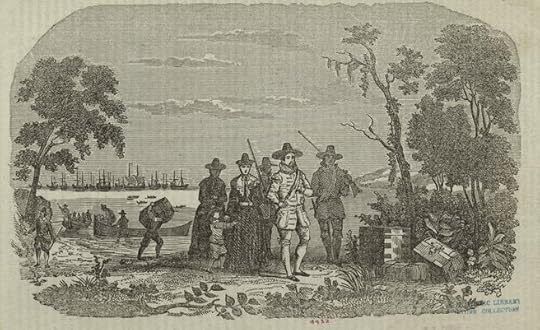
Engraving showing Winthrop's arrival at Salem.
As soon as Elizabeth lands in Massachusetts, she learns that Henry had drowned in a boating accident - they travelled in different ships to America.
Elizabeth will marry twice until the end of the book. During her second marriage, she and her Indian servant Telaka are accused of being possessed by the devil. As consequence, Elizabeth’s family is banished from the colony and moved to Greenwich, which was governed by the Dutch law.
However, Elizabeth’s misfortunes doesn’t end there, on the contrary: by falling in love with her third husband, she is accused of adultery since “divorce” at that time was inadmissible within this Puritan society.
Some hints about the Pequot War is given during the narrative.
Since Anya Seton is one of the best historical fiction authors in my humble opinion. this book may be considered as another masterpiece written by this author.
Another unforgettable classic masterpiece about this subject is the book The Scarlet Letter by Nathaniel Hawthorne.
4* Katherine
4* Green Darkness
5* Dragonwyck
5* Avalon
4* The Winthrop Woman
TR Devil Water
Elizabeth was a nice of John Winthrop and she marries Harry Winthrop, her first cousin.
When the Winthrop family decides to move the New World, they become founding members of the Massachusetts Bay Colony, situated around the present-day cities of Salem and Boston.
The population of this colony was governed by the Puritanism and John Winthrop is elected as the Governor of this colony.
According to Wiki , “the word "puritan" is often used to describe someone who adheres to strict moral or religious principles.” In this context, John Winthrop and the other main leaders of emigration to New England in 1629 were non-separating Puritans. In other words, they were “puritans who were not satisfied with the Reformation of the Church of England, but who remained within the Church of England advocating further reforms.”
Engraving showing Winthrop's arrival at Salem.
As soon as Elizabeth lands in Massachusetts, she learns that Henry had drowned in a boating accident - they travelled in different ships to America.
Elizabeth will marry twice until the end of the book. During her second marriage, she and her Indian servant Telaka are accused of being possessed by the devil. As consequence, Elizabeth’s family is banished from the colony and moved to Greenwich, which was governed by the Dutch law.
However, Elizabeth’s misfortunes doesn’t end there, on the contrary: by falling in love with her third husband, she is accused of adultery since “divorce” at that time was inadmissible within this Puritan society.
Some hints about the Pequot War is given during the narrative.
Since Anya Seton is one of the best historical fiction authors in my humble opinion. this book may be considered as another masterpiece written by this author.
Another unforgettable classic masterpiece about this subject is the book The Scarlet Letter by Nathaniel Hawthorne.
4* Katherine
4* Green Darkness
5* Dragonwyck
5* Avalon
4* The Winthrop Woman
TR Devil Water

March 10, 2011
The #8 top bestseller of 1958 was another door stopper but also an excellent piece of historical fiction. It made my list of Best Books Read in 2010. Elizabeth Fones, the woman of the title, was the niece of John Winthrop who became the first governor of Massachusetts in 1630. Elizabeth married her cousin Henry, one of John Winthrop's many sons, although she was really in love with John Jr. All of these characters actually existed and I saw that the plots of romance novels are truly drawn from real life.
The book follows Elizabeth's life from age seven in 1617 England to her third marriage in 1655. She was a strong willed, beautiful and sturdy woman. Strong willed women were not in demand in those Puritan times but sturdiness was a requirement for the first settlers in New England. Women were expected to exist in complete obedience and servitude to their husbands while having a new baby every year.
Anya Seton brings to life the harsh conditions, the Indian attacks and massacres, as well as the intense quarrels of various Puritan ministers and polticians. Though we now have material comfort, birth control and women's rights, the ridiculous power struggles of life and the slander of persons by rumor are unchanged. Whenever I start feeling too freaked out about the world going to hell, I read history and see that not much has changed in human relations, yet somehow we manage to muddle through.
Another key female character in The Winthrop Woman is Anne Hutchinson, who managed to have fifteen children while she wrote and spoke about true religious freedom. The Puritan ministers and leaders felt threatened by her views about faith and one's personal relation with God, envisioning their control over women slipping away. She was eventually banished to the wilderness and finally slaughtered by Indians.
Besides being a fine adventurous love story, The Winthrop Woman showed me how the Puritan beliefs and values set the tone for early American civilization and how these factors were the roots of many of our current views of life. I highly recommend it, especially for women. Because we may have come a long way, baby, but we are not there yet.
A couple days ago I read The Lace Reader, by Brunonia Barry, which takes place in contemporary Salem, MA, has witches and women who can "see" more than meets the eye, women who are harmed by men and women who save women from harm. I will review it soon, but it made me remember The Winthrop Woman.
The book follows Elizabeth's life from age seven in 1617 England to her third marriage in 1655. She was a strong willed, beautiful and sturdy woman. Strong willed women were not in demand in those Puritan times but sturdiness was a requirement for the first settlers in New England. Women were expected to exist in complete obedience and servitude to their husbands while having a new baby every year.
Anya Seton brings to life the harsh conditions, the Indian attacks and massacres, as well as the intense quarrels of various Puritan ministers and polticians. Though we now have material comfort, birth control and women's rights, the ridiculous power struggles of life and the slander of persons by rumor are unchanged. Whenever I start feeling too freaked out about the world going to hell, I read history and see that not much has changed in human relations, yet somehow we manage to muddle through.
Another key female character in The Winthrop Woman is Anne Hutchinson, who managed to have fifteen children while she wrote and spoke about true religious freedom. The Puritan ministers and leaders felt threatened by her views about faith and one's personal relation with God, envisioning their control over women slipping away. She was eventually banished to the wilderness and finally slaughtered by Indians.
Besides being a fine adventurous love story, The Winthrop Woman showed me how the Puritan beliefs and values set the tone for early American civilization and how these factors were the roots of many of our current views of life. I highly recommend it, especially for women. Because we may have come a long way, baby, but we are not there yet.
A couple days ago I read The Lace Reader, by Brunonia Barry, which takes place in contemporary Salem, MA, has witches and women who can "see" more than meets the eye, women who are harmed by men and women who save women from harm. I will review it soon, but it made me remember The Winthrop Woman.

November 12, 2014
My mother recommended this book to me so I confess I was reluctant from the beginning since our reading tastes seldom match. But I quickly became caught up in Elizabeth's story and the way it was told. As much as the book is about one woman's life, it is also about the beginnings of a country's life. I learned details about the Puritans that were never mentioned in my school history classes so many years ago. They left England in search of religious freedom was pretty much all I remember: turns out the Puritans were just as intolerant and judgmental as the people they ran away from, and Elizabeth paid dearly for being an intelligent woman who dared to think for herself and tried to follow her own higher standards. I doubt if I would have had her endurance during her many years of disappointments and difficulties.
Overall the book left me sadly wondering: How did America manage to get past all of that Puritanical blindness....or did the country ever really leave it behind? Is it still there under a thin veneer of supposed tolerance, waiting its chance to take charge again? I hope not, for the sake of all of Elizabeth's descendants and kindred spirits living today.
Overall the book left me sadly wondering: How did America manage to get past all of that Puritanical blindness....or did the country ever really leave it behind? Is it still there under a thin veneer of supposed tolerance, waiting its chance to take charge again? I hope not, for the sake of all of Elizabeth's descendants and kindred spirits living today.

November 7, 2015
I loved this book. I did the audio and the narrator did an amazing job. The different accents were nicely done. The audio was long....27 hours, but not once did I do the page math. This rolled along at an even pace. I was pulled in from the beginning.
This book covers the life of a woman, Elizabeth (Bess) Winthrop. She was a Puritan and left England with her family to strike out a new beginning in the Colonies of America in the 1600's. The historical fiction was nicely done. The research was woven into the story where it didn't feel like info overload. The characters were also well drawn. Well done.
This book covers the life of a woman, Elizabeth (Bess) Winthrop. She was a Puritan and left England with her family to strike out a new beginning in the Colonies of America in the 1600's. The historical fiction was nicely done. The research was woven into the story where it didn't feel like info overload. The characters were also well drawn. Well done.

September 15, 2026
Well-researched and well-written. Seton just might be my favorite historical fiction author. She excels at bringing women from the past to life without modernizing them.

February 17, 2015
A for narration / B+ for content.
Originally published in 1958, The Winthrop Woman is a richly detailed piece of biographical fiction based on the life of Elizabeth Fones Winthrop Feake Hallett, niece of John Winthrop, one of the founders of the Massachusetts Bay Colony, and its first Governor.
The book opens at Christmas 1618 when Elizabeth is just seven years old and she is travelling with her family to visit her well-to-do relatives, the Winthrops, at Groton in Suffolk. (Incidentally, most of the locations featured in the first part of the book are near where I live, which adds an extra layer of interest!)
Even at such a young age, it’s clear that Elizabeth is spirited and independent of mind – most certainly not qualities greatly appreciated in the women of the Puritan society in which she lives. Elizabeth grows into a beautiful young woman, and although betrothed to a worthy young man who is a friend of her cousin Jack (with whom she has been in love since she was a child), she instead marries Jack’s brother, Harry, a handsome but unreliable young man who spends a great deal of his time in London carousing with his friends.
Elizabeth and Harry have a passionate marriage, but she’s not quite content – especially when Jack returns from his travels in the Levant, and she discovers that the torch she’s been carrying for him burns as brightly as ever. Not only that, but Jack is attracted to her, too – even though he’s far too honourable a man to ever do anything about it.
Elizabeth’s uncle, John Winthrop, is an influential and respected man in the community, as well as a devout Puritan. Like many others, he is becoming increasingly disenchanted with the way England is being run. Charles I has dissolved Parliament, and the Puritans are suspicious of his Catholic queen; and when John loses his influential position as attorney of the Court of Wards and Liveries, he is persuaded to emigrate to the New World to lead a colony to be founded by the Massachusetts Bay Company.
Winthrop heads a party of around two hundred people crossing the ocean, although Harry – who has sailed on a different ship – dies on the voyage, so by the time Elizabeth embarks on her journey, she is a widow with an infant daughter, and Jack is married to her sister, Martha.
In New England, conditions are harsh, the living quarters are primitive and the scarcity of servants means that Elizabeth and the other women have to undertake a variety of menial tasks for which they are unprepared. But Elizabeth is made of stern stuff and doesn’t shrink from doing what she must. She is, however, dismayed to learn upon her arrival that her uncle has already made arrangements for her remarriage to Robert Feake, a young man she had once briefly met in London and who has never forgotten her. Relieved to find he is a rather biddable young man, Elizabeth agrees to the marriage, even though she had hoped to live a freer, more independent life away from England.
The Winthrop Woman is a real “saga” of a novel, following Elizabeth from early childhood through to her third and final (and happy) marriage in 1655. She was a woman ahead of her time in many ways, wanting to control her own life, owning property and even refusing to attend religious services. She did eventually manage to achieve her desire of living life on her own terms, but it didn’t come without a cost. Her second husband suffered bouts of insanity, she was charged with adultery and witchcraft, ignominiously stripped of her property and suffered the loss of her beloved sister and a child as well as enduring the difficult living conditions faced by the settlers, attacks by the native Indians and the ever-present – for women – risks of childbirth.
The author’s research and attention to historical detail are impeccable. Not a great deal is known of Elizabeth’s life other than the basic facts, and Ms Seton has fleshed out the bare bones to present a fully-rounded portrait of a fascinating woman. In fact all the characters – whether real or imagined – are brought strongly to life as the author vividly depicts the detail of life in rural England and in the early New England settlements across the Atlantic.
It’s been a long time since I read the book, but although I remember there being a few places where I found the pacing a little slow, I didn’t find that to be the case when listening to the audiobook. I always enjoy listening to Corrie James, and her expressively delivered narrative together with her strong character portrayals kept me engaged throughout the twenty-seven-plus hours of this audiobook. Her voice is pitched in the contralto range, and is smooth and easy to listen to, and while I spotted the odd mispronunciation or hesitation there really is nothing else to criticise about her performance here. The Winthrop Woman has a large cast, and I can imagine it quite a difficult task to find suitable voices for all of them but Ms James nonetheless differentiates very clearly between all the main recurring characters, and her portrayals are consistent throughout. Jack, for instance, comes and goes, as he travels frequently, yet he is recognisable every time he appears. Robert Feake sounds suitably frail, and Will Hallett, the younger man with whom Elizabeth eventually finds happiness sounds like the piece of beefcake he is (!) with hearty, deep tones that accurately depict his youth and strength.
The Winthrop Woman is a real treat for fans of historical fiction. In Elizabeth, Anya Seton has created a flawed, complex and compelling character and she comes vibrantly to life in Corrie James’ expert portrayal. The book is extremely well-researched and while sometimes rather slow moving in the earlier stages, Ms James’ impressive performance allows the listener to thoroughly soak up the author’s meticulous scene-setting.
Originally published in 1958, The Winthrop Woman is a richly detailed piece of biographical fiction based on the life of Elizabeth Fones Winthrop Feake Hallett, niece of John Winthrop, one of the founders of the Massachusetts Bay Colony, and its first Governor.
The book opens at Christmas 1618 when Elizabeth is just seven years old and she is travelling with her family to visit her well-to-do relatives, the Winthrops, at Groton in Suffolk. (Incidentally, most of the locations featured in the first part of the book are near where I live, which adds an extra layer of interest!)
Even at such a young age, it’s clear that Elizabeth is spirited and independent of mind – most certainly not qualities greatly appreciated in the women of the Puritan society in which she lives. Elizabeth grows into a beautiful young woman, and although betrothed to a worthy young man who is a friend of her cousin Jack (with whom she has been in love since she was a child), she instead marries Jack’s brother, Harry, a handsome but unreliable young man who spends a great deal of his time in London carousing with his friends.
Elizabeth and Harry have a passionate marriage, but she’s not quite content – especially when Jack returns from his travels in the Levant, and she discovers that the torch she’s been carrying for him burns as brightly as ever. Not only that, but Jack is attracted to her, too – even though he’s far too honourable a man to ever do anything about it.
Elizabeth’s uncle, John Winthrop, is an influential and respected man in the community, as well as a devout Puritan. Like many others, he is becoming increasingly disenchanted with the way England is being run. Charles I has dissolved Parliament, and the Puritans are suspicious of his Catholic queen; and when John loses his influential position as attorney of the Court of Wards and Liveries, he is persuaded to emigrate to the New World to lead a colony to be founded by the Massachusetts Bay Company.
Winthrop heads a party of around two hundred people crossing the ocean, although Harry – who has sailed on a different ship – dies on the voyage, so by the time Elizabeth embarks on her journey, she is a widow with an infant daughter, and Jack is married to her sister, Martha.
In New England, conditions are harsh, the living quarters are primitive and the scarcity of servants means that Elizabeth and the other women have to undertake a variety of menial tasks for which they are unprepared. But Elizabeth is made of stern stuff and doesn’t shrink from doing what she must. She is, however, dismayed to learn upon her arrival that her uncle has already made arrangements for her remarriage to Robert Feake, a young man she had once briefly met in London and who has never forgotten her. Relieved to find he is a rather biddable young man, Elizabeth agrees to the marriage, even though she had hoped to live a freer, more independent life away from England.
The Winthrop Woman is a real “saga” of a novel, following Elizabeth from early childhood through to her third and final (and happy) marriage in 1655. She was a woman ahead of her time in many ways, wanting to control her own life, owning property and even refusing to attend religious services. She did eventually manage to achieve her desire of living life on her own terms, but it didn’t come without a cost. Her second husband suffered bouts of insanity, she was charged with adultery and witchcraft, ignominiously stripped of her property and suffered the loss of her beloved sister and a child as well as enduring the difficult living conditions faced by the settlers, attacks by the native Indians and the ever-present – for women – risks of childbirth.
The author’s research and attention to historical detail are impeccable. Not a great deal is known of Elizabeth’s life other than the basic facts, and Ms Seton has fleshed out the bare bones to present a fully-rounded portrait of a fascinating woman. In fact all the characters – whether real or imagined – are brought strongly to life as the author vividly depicts the detail of life in rural England and in the early New England settlements across the Atlantic.
It’s been a long time since I read the book, but although I remember there being a few places where I found the pacing a little slow, I didn’t find that to be the case when listening to the audiobook. I always enjoy listening to Corrie James, and her expressively delivered narrative together with her strong character portrayals kept me engaged throughout the twenty-seven-plus hours of this audiobook. Her voice is pitched in the contralto range, and is smooth and easy to listen to, and while I spotted the odd mispronunciation or hesitation there really is nothing else to criticise about her performance here. The Winthrop Woman has a large cast, and I can imagine it quite a difficult task to find suitable voices for all of them but Ms James nonetheless differentiates very clearly between all the main recurring characters, and her portrayals are consistent throughout. Jack, for instance, comes and goes, as he travels frequently, yet he is recognisable every time he appears. Robert Feake sounds suitably frail, and Will Hallett, the younger man with whom Elizabeth eventually finds happiness sounds like the piece of beefcake he is (!) with hearty, deep tones that accurately depict his youth and strength.
The Winthrop Woman is a real treat for fans of historical fiction. In Elizabeth, Anya Seton has created a flawed, complex and compelling character and she comes vibrantly to life in Corrie James’ expert portrayal. The book is extremely well-researched and while sometimes rather slow moving in the earlier stages, Ms James’ impressive performance allows the listener to thoroughly soak up the author’s meticulous scene-setting.

November 28, 2014
I enjoyed this so much more than Katherine which I did not especially care for. For many readers, my enjoyment may be exactly opposite of theirs. Elizabeth was a much more accessible character to me. I could empathize with her. Strong-willed in a time when women were only expected to be obedient, she was often in opposition to the men in power. All of the characters in this were real people.
It is also set in a time period with which I am somewhat familiar. It isn't just the history I was taught in school decades ago, but that I have became more familiar with it also researching my own family history. I am not related in any way to the Winthrop family and my family resided in other parts of New England. I think the Pilgrims of the Winthrop fleet did not imagine the raging wilderness they set out to tame. I live just a short distance from true wilderness. I cannot imagine spending more than 10 weeks crossing 3000 miles of ocean, hungry and showing the first signs of scurvy, only to find no shelter and no food with which I was familiar. I am definitely too soft, but many of these people were simply not ready for the hardships in front of them.
Seton seemed occasionally to wander away from her story. But the path to true love is sometimes a crooked one, and this story was more than just the title character. Eventually, I came to appreciate that I was being given more than just a love story, though a very good one. I became wholly invested in these characters and for that reason I'm reaching across the 4/5-star line, but I think most would settle on the lower number.
It is also set in a time period with which I am somewhat familiar. It isn't just the history I was taught in school decades ago, but that I have became more familiar with it also researching my own family history. I am not related in any way to the Winthrop family and my family resided in other parts of New England. I think the Pilgrims of the Winthrop fleet did not imagine the raging wilderness they set out to tame. I live just a short distance from true wilderness. I cannot imagine spending more than 10 weeks crossing 3000 miles of ocean, hungry and showing the first signs of scurvy, only to find no shelter and no food with which I was familiar. I am definitely too soft, but many of these people were simply not ready for the hardships in front of them.
Seton seemed occasionally to wander away from her story. But the path to true love is sometimes a crooked one, and this story was more than just the title character. Eventually, I came to appreciate that I was being given more than just a love story, though a very good one. I became wholly invested in these characters and for that reason I'm reaching across the 4/5-star line, but I think most would settle on the lower number.

June 6, 2023
Adventure, adversity, passion and drama, all in an historical colonial setting of Puritans, Native Americans and Dutch, to name the major players.
My native New England roots are well satisfied by this immersive story, and yes, it is more romantic and sentimental than I usually read, but the characters and settings provided me with a glimpse into a world long gone.
My native New England roots are well satisfied by this immersive story, and yes, it is more romantic and sentimental than I usually read, but the characters and settings provided me with a glimpse into a world long gone.

August 11, 2019
Years ago I read Seton's Dragonwyck and although I don't remember details of that story, I do remember how much I loved it. I've been meaning to read another Seton novel for years, and on a whim I decided on The Winthrop Woman.
Heavily historical, The Winthrop Woman is inspired by the lives of the early settlers in Greeenwich, CT, where the author herself lived. I'm sure that Seton took some historical liberties, as all writers of historical fiction do, but overwhelmingly this novel felt like reading actual history. For me, that wasn't a turn off; it just helped explain things like why a husband we didn't like needed to stick around for so long (hint: because in real life he did stick around that long!). Although the main character is a woman, there is actually a good amount of biographical information about her life because she was from such prominent Massachusetts Bay Colony family.
I'd say what will stick with me longest was the atmosphere Seton created. It made me feel even more like a witness to history. Another fun takeaway: By sheer coincidence, I put two and two together and discovered that one of my direct ancestors is a minor character in this book. So I unintentionally got to know my 9th great grandfather!
Heavily historical, The Winthrop Woman is inspired by the lives of the early settlers in Greeenwich, CT, where the author herself lived. I'm sure that Seton took some historical liberties, as all writers of historical fiction do, but overwhelmingly this novel felt like reading actual history. For me, that wasn't a turn off; it just helped explain things like why a husband we didn't like needed to stick around for so long (hint: because in real life he did stick around that long!). Although the main character is a woman, there is actually a good amount of biographical information about her life because she was from such prominent Massachusetts Bay Colony family.
I'd say what will stick with me longest was the atmosphere Seton created. It made me feel even more like a witness to history. Another fun takeaway: By sheer coincidence, I put two and two together and discovered that one of my direct ancestors is a minor character in this book. So I unintentionally got to know my 9th great grandfather!

December 19, 2016
I've learned so much from this book....I knew the basics about the settlers who left their English roots behind to make a new life for themselves in America, but really, I had no idea of what life was like for these people, both on the long, often perilous sea voyages, or in the new settlements they lived in once they arrived in the new world.
I found this book totally fascinating....I liked how it began in England giving such a good background to those who were to travel to a new life, the descriptions of the voyage seemed so realistic, and the many trials, triumphs and tribulations of Elizabeth and her contemporaries gave a believable insight into the life they encountered their new home.
The author obviously put a huge amount of research into her preparations for writing this book....having real people to write about obviously helps enormously, but she certainly made me care about these brave and tenacious individuals.....or in some cases dislike them, and I now want to know much more about this period in history.
I found this book totally fascinating....I liked how it began in England giving such a good background to those who were to travel to a new life, the descriptions of the voyage seemed so realistic, and the many trials, triumphs and tribulations of Elizabeth and her contemporaries gave a believable insight into the life they encountered their new home.
The author obviously put a huge amount of research into her preparations for writing this book....having real people to write about obviously helps enormously, but she certainly made me care about these brave and tenacious individuals.....or in some cases dislike them, and I now want to know much more about this period in history.

December 29, 2008
What a wonderful book! So well written and so engaging, I loved it.
I don't know why books like these aren't assigned to High Schoolers. It brought early American history alive in a way that textbooks never did for me. Seton's research is impeccable, and this book was more fact than fiction - but was interesting!
The main character, Elizabeth Fones, is one that I think almost any woman would be able to identify with. Although her thoughts and feelings are ahead of her time, her struggle between what she feels, what others expect of her, and what she expects of herself is timeless.
Throughout her life she fights who she might be against who she should be, eventually coming to peace with who she is.
I loved this book.
I don't know why books like these aren't assigned to High Schoolers. It brought early American history alive in a way that textbooks never did for me. Seton's research is impeccable, and this book was more fact than fiction - but was interesting!
The main character, Elizabeth Fones, is one that I think almost any woman would be able to identify with. Although her thoughts and feelings are ahead of her time, her struggle between what she feels, what others expect of her, and what she expects of herself is timeless.
Throughout her life she fights who she might be against who she should be, eventually coming to peace with who she is.
I loved this book.

April 4, 2021
This is a long historical novel of the groups of early settlers coming over from England to New England. It not only paints a picture of the religious and political upheaval of the mid to late 1600s. The author portrays a fictionalized version of Elizabeth Fones, a real historical figure, from her childhood in London to her death in Newtown, Queens County New York. The history comes alive in the telling of her story. It never fails to entertain.

November 27, 2008
This novel about Elizabeth Winthrop, niece of Gov. John Winthrop of the Massachusetts Bay Colony, was extremely well-researched. The book follows Elizabeth's life starting with her years in England and through all the drama she went through in the New World. I knew I was in good hands when I read Anya Seton's author's note and she wrote: "My determination to present authentic history has necessitated a scrupulous adherence to the findings of research. And I felt that this woman, with her passionate loves, dangers, tragedies, and courage, lived a life sufficiently dramatic without fortuitous inventions." Amen! If only there were more authors like Seton who felt this way about the subjects and people they tackle when they write historical fiction (ehem, Philippa Gregory). Speaking of Gregory, I knew I was in even better hands when I completely disagreed with parts of her forward to the book: "As a crafted novel rather then a linear historical narrative, perhaps the only thing that can be said against The Winthrop Woman is that in its honoring of the recorded history the novel seems to lose shape. Perhaps it is a question of when the novel finishes. Some readers might prefer the happy ending when [xyz - edited to avoid a spoiler]. [Seton] takes the reader to the logical end of biography: the death of the heroine...." Yes, some people might prefer to wear rose-colored glasses and float around on pink clouds all day and believe that real people living real lives over 350 years ago suffered no hardship without a happy ending to follow it. But come on, even J.K. Rowling killed off Dumbledore and other beloved characters in Harry Potter! Does Gregory want us to spare the lives of Marie Antoinette, Lady Jane Grey and Mary Queen of Scots as well? Send the Little Princes of the Tower home with their mother? Do we always need a happy ending? Personally, I prefer to know the real story which is why I enjoy well-researched historical fiction more than just regular fiction, and if there's a sad ending, so be it. That's life, and I prefer it to the dribble that Gregory writes (Lord save us from her upcoming Plantagenet books)!

June 22, 2021
A long read, but an excellent and detailed piece of historical fiction. For it's historical relevance, I'd give it 4.5 stars, but for readability? It's a bit exhausting. It's like getting up and being knocked down 42 times. That said, this was Elizabeth Winthrop's life, and it was a hard one. Compliments to Anya Seton for really giving a taste for the horrors of living in colonial America and this really does touch on many aspects of our history that don't get taught in the schools. I'm a huge fan of Anya Seton, and I'd recommend this book to any true history buff, especially for those interested in early British puritan colonies, with the added interest of how involved the Dutch were in early settlements (I should have known this, but that memory must have flew out my left ear years ago). Overall, despite it's length and chronicling hardship after hardship? It still gets 4 stars.

September 23, 2017
I sure enjoyed my second reading of this book which was fascinating to me and I would give it 6 stars if I could. I especially enjoyed the ending which was a big surprise for me. I recommend it for everyone.
I have enjoyed all her books but one did give me screaming nightmares and it was Green Darkness!
I dare not read it again but I have also read Katherine twice.
I have enjoyed all her books but one did give me screaming nightmares and it was Green Darkness!
I dare not read it again but I have also read Katherine twice.

August 28, 2022
Extremely interesting book.

May 19, 2023
Terrific historical fiction based on real people who were early settlers in U.S.A. I have read many of this author’s books and this one is as good as “Katherine” which is one of my favorite books and I have read multiple times. Anya Seton brings her characters to life and makes you feel as though you are living along side them in another time.

September 19, 2019
It is so evident from teh very beginning, how much research Anya Seton did to be able to together this superbly well-written and well-tol story of onw young woman's plight in leaving England for America and religious freedom, only to find the Puritans of the new country were even ruthless Law-keepers and persecutors. People came lookig for freedom from religious heavy-handed religious rules and persecution, only to find themselves no better in many ways. I could not put this book down!
I also had personal interest in reading of this time period, as my husband's roots go back to the arrival of a family with 3 sons, into Portsmouth MA in 1640.
If you're a fan of historical fiction, I highly recommend Anya Seton as an author and this book as well.
I also had personal interest in reading of this time period, as my husband's roots go back to the arrival of a family with 3 sons, into Portsmouth MA in 1640.
If you're a fan of historical fiction, I highly recommend Anya Seton as an author and this book as well.

June 13, 2013
This is historical fiction at its best. Anya Seton's research uncovers a remarkable woman who was one of America's first colonists.

Read
May 3, 2019I gave this up before the halfway mark. It was tiresomely slow with nothing else to hold my attention. Wrong book, wrong person.


December 29, 2020
Una muy buena novela histórica que no se ha quedado nada viejuna. Apasionante la vida de Elizabeth Fones, personaje real con unas vivencias que no te creerías de ser ficción. Muy bien documentada y correcta desde el punto de vista de la Historia. A veces me ha recordado a Diana Gabaldon en cuanto a lo exhaustivo del rigor histórico, pero para bien, ya que es mucho menos engorrosa. Me estreno con Anya Seton esperando que caiga para Reyes "Dragonwyck" y ya puedo afirmar que me va a gustar. Y me parece que "Catalina, la Duquesa de Lancaster" la leeré también. Qué pena que esta autora no esté más traducida.

November 6, 2025
It took me a while to get into this, because it reminds me so much of Gone With the Wind (but make it Witch of Blackbird Pond). But eventually the setting of Puritan New England grew on me, and I enjoyed it, even though the characters never really drew me in.

December 28, 2013
It is good to immerse oneself in Historical Fiction in order to find out about one's own area. The Winthrop family is pictured with some of them living on an estate and the poorer cousins including the tale's heroine who visits now and then. Visiting in the early 1600's was a rough deal for her patriarch is extremely religiously repressive person. About 200 people relocate to the Massachusetts Bay Colony (Boston area) with John Winthrop (who later becomes the colony Governor) to begin new lives. Their view of their new life is one of living in religious freedom. Our poor heroine, Elizabeth, never believes that religious freedom has come to her. She wishes a freer life. She hates marrying as told so runs off with a reprobate cousin. She wants love and adventure and works to overcome pioneer adversity.
Finally Elizabeth during a 2nd marriage (which she made as told to do)moves away to Greenwich, Connecticut (where I used to be library director). Greenwich goes back and forth between the British and the Dutch (who are not as repressive as the English). Finally she marries a person she loved from afar but that too gives her grief for it was impossible for her to get legally divorced from her 2nd husband who becomes crazy. The people in the neighboring British community of Stamford revile her.
The intolerance of the time is strongly depicted with detail so one can really understand how it felt. It was as repressive as some current Muslim regimes that our country decries. Our culture seems determined to forget our beginnings as a strongly repressive place. We seem to think other places are uniquely bad while we are and have always been uniquely good. This is a needful reminder of our past.
Finally Elizabeth during a 2nd marriage (which she made as told to do)moves away to Greenwich, Connecticut (where I used to be library director). Greenwich goes back and forth between the British and the Dutch (who are not as repressive as the English). Finally she marries a person she loved from afar but that too gives her grief for it was impossible for her to get legally divorced from her 2nd husband who becomes crazy. The people in the neighboring British community of Stamford revile her.
The intolerance of the time is strongly depicted with detail so one can really understand how it felt. It was as repressive as some current Muslim regimes that our country decries. Our culture seems determined to forget our beginnings as a strongly repressive place. We seem to think other places are uniquely bad while we are and have always been uniquely good. This is a needful reminder of our past.
July 8, 2017
I was expecting great things from this novel. A heroine based on a real life person. The location (the Massachussetts Bay Colony), and so forth. But as is often the case with Anya Seton's novels - I either really like them or don't like them at all. This book falls into the second category. It started off well enough for me; but as I kept reading, I felt my interest starting to flag. I thought the cliches were just too simple and occurred too often. The Indians are all "noble savages" and too good to be true,which (historically speaking) was sometimes the case and sometimes not. Not every native American was good and unselfish and not every settler was a monster of bigotry and intolerance. Nevertheless, she really does pull out all the stops when it comes to Puritan bashing. There is practically nothing courageous or noble to be seen in these people - which of course- (without in any way idealizing them) is absurd. But no, they're Puritans, so they have to be the bad guys. I wish more authors would present historical situations in a more realistic and above all more nuanced context and let the reader decide for themselves. This novel made me feel as if I was a third grader, being talked down to and being told who to like and who to hate. Give me something more historically balanced anytime. After reading about 3/4 of "The Winthrop Woman" and Ms Seton's moralizing, I gave up. Historical novels need a certain amount of imagination and speculation,but is it really necessary to always twist history around to suit contemporary attitudes ?
Displaying 1 - 30 of 528 reviews