An unsung classic of nineteenth-century Russian literature, Karolina Pavlova’s A Double Life alternates prose and poetry to offer a wry picture of Russian aristocratic society and vivid dreams of escaping its strictures. Pavlova combines rich narrative prose that details balls, tea parties, and horseback rides with poetic interludes that depict her protagonist’s inner world—and biting irony that pervades a seemingly romantic description of a young woman who has everything.A Double Life tells the story of Cecily, who is being trapped into marriage by her well-meaning mother; her best friend, Olga; and Olga’s mother, who means to clear the way for a wealthier suitor for her own daughter by marrying off Cecily first. Cecily’s privileged upbringing makes her oblivious to the havoc that is being wreaked around her. Only in the seclusion of her bedroom is her imagination each day of deception is followed by a night of dreams described in soaring verse. Pavlova subtly speaks against the limitations placed on women and especially women writers, which translator Barbara Heldt highlights in a critical introduction. Among the greatest works of literature by a Russian woman writer, A Double Life is worthy of a central place in the Russian canon.
Karolina Pavlova, born Karolina Jaenisch in 1807, was a Russian poet and translator and presided over a famous Moscow literary salon. She died in Dresden in 1893, having abandoned Russia not because of tsarist oppression but because of hostile criticism of her poetry and her personal life. A Double Life is her major work.
Written in 1848, A Double Life voices sharp observations on the mentality, attitudes and morals in Russian high society with regard to marriage and the position of women in a patriarchal society. The story revolves around Cecily von Lindenborn, a eighteen year old naïve, dreamy and romantic young woman who becomes the object of marriage plotting – Cecily’s best friend Olga together with Olga’s mother cunningly will trap the ingénue (and her parents) into a to Cecily not so favourable marriage with a spineless (and worse, not rich!) man– to have her out of the way as a rival for Olga, who hopes to seize a far better match, the wealthy Prince Victor.
Each of the ten chapters of the novel is structured along ‘the double life’ of Cecily – the events taking place during conventional, brainless and banal society life at daytime (balls, dresses, jewels, carriages, tea-drinking) are recounted in prose and are followed by oneiric, poetical almost mystic outbursts closing the day, dreamlike sequences expressed in verses musing on nature, the moon and the soul when Cecily is alone and touched by the ‘melodious thoughts’ and ‘improper delights’ of the muse (Pavlova was mostly a poet; A Double life is her only novel). The juxtaposition of the prose and the poetry structuring the novel by symbolising the stark contrast between Cecily’s outer and inner life is intriguing, but also slows down the pace of the story and as I cannot say the lofty Romanticism of the poetry enthralled me, I had to withhold myself from rushing through those parts.
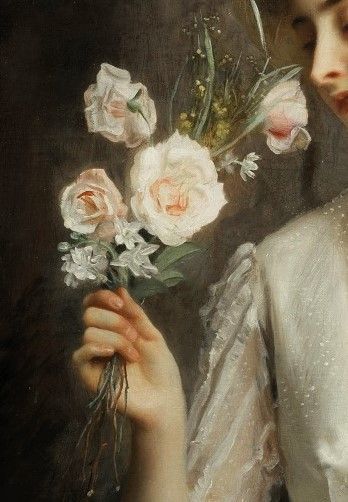
(Gustave Jean Jacquet)
As this was the first work of a female Russian author from the 19th century I have come across so far, I was curious to get a glimpse on this period from a Russian woman’s perspective. As a story, A double Life didn’t captivate me much. In my humble opinion, it is interesting to read as a proto-feminist manifesto denouncing in a satirical, almost vitriolic way both the hypocrisy and pretence of the aristocratic class (which Pavlova makes obvious by the frequent use of the word ‘lies’) and their insensitivity to art and poetry as the blatant injustice to deny young women a more proper upbringing and the freedom to live a fulfilling life instead of just preparing them for marriage. Pavlova criticizes how women are turned into docile domestic geese who are merely destined to be ornaments for potential husbands and who, once they have become mothers themselves, don’t know any better than to repeat the same patterns with their own daughters all over again and so essentially sustain patriarchal society – a vicious circle of narrow-mindedness which is also manifest in an indifference to art and poetry:
Although Vera Vladimirovna greatly respected and loved poetry, she still considered it improper for a young girl to spend too much of her time on it. She quite justly feared any development of imagination and inspiration, those eternal enemies of propriety. She molded the spiritual gifts of her daughter so carefully that Cecily, instead of dreaming of the Marquis Poza, of Egmont, of Lara and the like, could only dream of a splendid ball, a new gown, and the outdoor fete on the first of May.
Because of the marriage plotting and the revolting manipulations in that respect of Olga’s cunning mother, I was reminded of the scheming of Jane Austen’s Lady Susan and particularly of the villainous Lady Susan’s plan to marry off her poor daughter to some (rich) nitwit – but where Austen’s sarcasm and irony made me laugh, Pavlova’s razor-sharp wit leaves mostly a bitter and pessimistic aftertaste (which sadly seem to reflect her own experiences).
Pavlova choses hyperboles, repetition and sweeping statements rather than subtlety to vent her obvious anger and indignation. The contrast between the angelic, refined, hypersensitive femininity of Cecily and the almost caricatural depiction of crude masculine boorishness, weakness and flaws (particularly Cecily’s future husband, Dmitry Ivachinsky is mercilessly bestowed with sins - Suggestible! Gambling! Drinking! Debauchery! Double-faced!) annoyed me rather than fuelling my sympathy for her. Even if Cecily is facing a bleak future, the way Karolina Pavlova portrayed her and her sad situation weren’t able to move me much, such unlike the very few lines in which Dostoevsky evoked a young Russian woman’s deplorable situation with regard to marriage in the poignant ending of his The Christmas Tree and the Wedding.
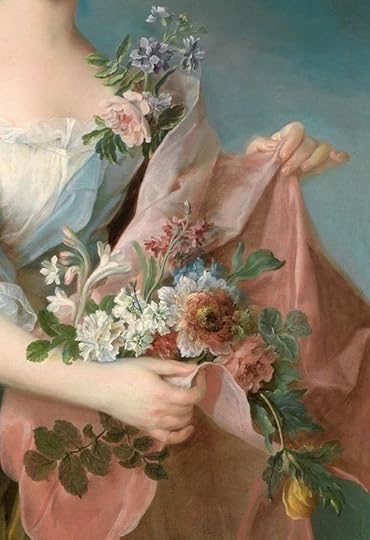
(François Hubert Drouais)
Both the introduction from the translator (Barbara Heldt) and the afterword are greatly worth reading and enlightening, as these texts situate Karolina Pavlova’s life (1807-1893) and work among her Russian contemporaries and discuss her vocation as a woman poet in 19th century Russia, her work as a translator (she knew eight languages), the literary salon she held and the reception of her work by her male counterparts and critics (a lot of scorn and ridicule were her part). As some of the autobiographical elements are candidly echoed in this novel (Pavlova’s – née Karolina Karlovna Jaenisch - partly German descent, her disastrous marriage) I’d nevertheless wished I had steered clear from the preface and had read the novella first, as it added a layer of resentment and a veering to self-pity to the story that rather stimulated a dislike of the author’s (apparently theatrical) personality than winning sympathy for poor Cecily’s fate.
Now, at eighteen, Cecily was so used to wearing her mind in a corset that she felt it no more than a silk undergarment that she took off only at night.
However understandable Karolina Pavlova’s anger about the constraints of a woman’s life at that time, I was reminded of what Virginia Woolf wrote about Charlotte Brontë (in A Room of One's Own):
That is an awkward break, I thought. It is upsetting to come upon Grace Poole all of a sudden. The continuity is disturbed. One might say, I continued, laying the book down beside Pride and Prejudice, that the woman who wrote those pages had more genius in her than Jane Austen; but if one reads them over and marks that jerk in them, that indignation, one sees that she will never get her genius expressed whole and entire. Her books will be deformed and twisted. She will write in a rage where she should write calmly. She will write foolishly where she should write wisely. She will write of herself where she should write of her characters. She is at war with her lot. (…) Now, in the passages I have quoted from Jane Eyre, it is clear that anger was tampering with the integrity of Charlotte Brontë the novelist. She left her story, to which her entire devotion was due, to attend to some personal grievance. She remembered that she had been starved of her proper due of experience—she had been made to stagnate in a parsonage mending stockings when she wanted to wander free over the world. Her imagination swerved from indignation and we feel it swerve.
Revenge is a dish best served cold and I wonder if both Karolina Pavlova’s searing rage as well as the society she lived in might have encumbered her creativity.
160 years after this novella was published, now a proper education fortunately is open to more people regardless of gender, I wonder if we – men and women alike – could boast we have become so much wiser. Like Cecily, we might not be immune yet from the risk to throw away our lives in the tunnel of love. We don’t have to fear to be forced into the straitjacket of marriage anymore but might still hope and dream of love. Which doesn’t have to be bad thing.
Dreams fly away faster than the years!
(I received an ARC of this book from the publisher through NetGalley).
A very early (1848) feminist work from an author that the jacket calls Russia’s first important woman writer.
There’s not a lot of plot. Basically we follow a young woman for a year or so before she gets married. There is a twist in which man she marries because her mother initially agrees to the marriage not quite understanding which young man has asked for her hand. The mother’s best friend was involved in the confusion and the ‘plot.’
The story reminds me of an Edith Wharton novel. The most important thing is knowing the societal rules and not transgressing them. For example: “In general in society gatherings they don’t like to speak about vice….” But, of course, everyone already knows all the dirt on everyone else. Their life is one of required daily visitations, back and forth, dinners and galas. Should we pity these aristocrats who say “Oh I’m so fed up with conversations! You can’t escape from them.” “….it seemed they all found amusing themselves a bit boring.”
We’re among the uppermost class of Russia in the days of the serfs. When the young woman thinks of poverty, she thinks of a relative who hangs out with the social group but is spoken of as having limited resources. When she sees serfs in rags at a distance, they don’t count as real humans.
When her daughter reads and attempts to write poetry, her mother “…considered it improper for a young girl to spend too much of her time on it. She quite justly feared any development of imagination and inspiration, those eternal enemies of propriety.” Her mother was “…very proud of her daughter’s successful upbringing, especially perhaps because it had been accomplished not without difficulty, since it took time and skill to destroy in her soul its innate thirst for delight and enthusiasm.” And “Now, at eighteen, she was so used to wearing her mind in a corset that she felt it no more than the silk undergarment that she took off only at night.” “Her morals and intellect were improved upon as arbitrarily and thoroughly as were the poor trees in the gardens of Versailles when people were trimming them mercilessly into the shape of columns, vases, spheroids or pyramids so that they might represent anything other than trees.”
The introduction tells us that the author was a poet in her soul but haunted by the Russian attitude that poetry was male-only territory. She tells us this in the novel through the young woman reflecting “She knew that there were even women poets, but this was always presented to her as the most pitiable, abnormal thing, as a disastrous and dangerous illness.”
The upper classes are fixated on Europe. They go see the latest French theater production. The women buy clothes from Paris and the men buy theirs from Germany. It is de rigueur for a young girl to have an English nanny. Not all the elites were so oriented. The introduction tells us that the author ran a literary salon for five years but ended it because of the acrimonious disputes between the Slavophiles and the Westernizers.
Really a novella with each chapter ending in poetry that reflects the young woman’s dreams and daydreams as she nods off. Or, as the translator tells us, the poetry follows the prose of each chapter that tells of the day’s vanities and cruelties. Often her dreams are more pleasant and interesting than her daily life – thus the title (I think).
An interesting book. Short – really a novella – about 105 pages.
Image of Moika Palace, St. Petersburg in the 1850's from tbn0.gstatic.com/images The author from tls.co.uk
A Double Life centers on the divided existence of women in 19th-century society. The protagonist, Cecily, inhabits a mundane, conformist “daytime” life dictated by social conventions and the pursuit of a suitable marriage. In stark contrast, her “nighttime” life unfolds in lyrical dream-verses, revealing her imaginative, unacknowledged inner self and her longing for freedom. Through sharp irony, Pavlova critiques aristocratic Russian society, particularly its marriage market. The prose sections depict a world consumed by wealth, appearances, and superficial conversation, where mothers maneuver their daughters into financially advantageous yet soulless unions. The narrator’s biting tone underscores the hypocrisy and absence of genuine feeling in this environment. The novel’s distinctive structure—alternating between prose chapters for the waking world and poetic interludes for the dream world—serves as a central analytical point. The prosaic realm is shallow and restrictive, a kind of spiritual “death,” while the poetic dream world brims with emotional intensity and emergent consciousness. This formal choice dramatizes the divide between external reality and internal experience. At its core, the novel protests the constraints imposed on women and their creative potential. Cecily’s education has “mutilated” her natural talents, teaching her that true self-expression, or even the act of being a poet, is an “abnormal condition.” Her dreams provide the only space where she can voice suppressed feelings, suggesting that a woman’s authentic self is often forcibly silenced by societal expectations. A Double Life thus reads as a Romantic manifesto, exploring the interplay of life and art, reality and dreams, earthly imprisonment and celestial freedom. It contrasts the soulless realism of society with the profound possibilities of the inner life. Cecily carries an unconscious awareness of her divided identity throughout the story, and the novel culminates in her impending marriage—a union she already senses will not bring happiness. This moment does not empower her but instead crystallizes the painful recognition of what has been lost by suppressing her true self under societal demands.
Modern Resonance
A Double Life remains strikingly relevant in the modern era, as its themes illuminate the pressures that compel individuals—particularly women—to present different “selves” across social media, professional environments, and consumer culture. The novel’s central conflict—the divergence between authentic inner life and the performance demanded by society—echoes powerfully in the 21st century. The most direct parallel to Cecily’s split existence is the curated persona displayed on platforms such as Instagram or TikTok. Today’s “prose” chapters are our feeds—carefully selected images of perfect meals, successful careers, idealized relationships, and aspirational aesthetics. This is the socially acceptable self, crafted for public consumption and validation. Behind the screens lies the “poetry” of modern life: anxiety, stress, loneliness, and the mundane realities excluded from the highlight reel. Like Cecily’s dreams, these hidden experiences represent the authentic self, often dismissed as unsuitable for public display. The pressure to maintain an aesthetic persona enforces a similar psychological split. Although arranged marriages for wealth are less common in Western societies, the pursuit of a “high-value” partner persists in new forms, often mediated by dating apps. Dating profiles function like 19th-century social résumés, emphasizing job titles, financial stability, physical appearance, and hobbies that signal status. The emphasis on optimizing for the “best match” can erode genuine emotional connection, echoing the transactional nature of relationships in Pavlova’s aristocratic milieu. The workplace demands its own performance, often requiring individuals—especially women striving for advancement—to suppress their true passions or emotions. Success is frequently equated with relentless optimism, assertiveness, and constant availability. This persona becomes the “prose” of professional life. The exhaustion, anxiety, and eventual burnout that result from sustaining this façade mirror Cecily’s muted inner world. Creativity and personal fulfillment are sidelined in favor of productivity and conformity. Today’s “double life” contributes directly to rising rates of anxiety, depression, and imposter syndrome. The gap between projected and authentic selves is a source of profound psychological distress. In a culture built on curated performances, integrating the “prose” and “poetry” of life becomes an act of resistance against dehumanizing social and digital pressures. Pavlova’s novel encourages us to challenge external definitions of success—wealth, status, followers—and instead pursue an integrated, personally meaningful life.
A Woman’s Voice
Karolina Pavlova’s status as a woman writer is central to the significance of A Double Life. Composed during the mid-19th century—the “Golden Age” of Russian literature dominated by male giants such as Tolstoy, Dostoyevsky, Turgenev, and Goncharov—the novel offers a rare and invaluable insider’s critique of female oppression, a perspective largely absent from the mainstream canon. Male authors of the era often portrayed women as either idealized saints, like Turgenev’s noble heroines, or manipulative villains. However sympathetic, their perspectives remained external. Pavlova, by contrast, wrote from lived experience: as a recognized intellectual, poet, and translator, she endured public and critical mockery for her professional ambitions. This background deeply informed her work. Pavlova understood firsthand the societal mechanisms that forced talented women to conceal their intelligence and creativity. She herself faced the same criticism that ultimately silences Cecily’s spirit in the novel. By centering Cecily’s conflict not on romance but on society itself, Pavlova subverted the male-centric narrative. The “marriage plot” is exposed not as romantic destiny but as a suffocating economic transaction. Through the metaphor of a woman’s “double life,” Pavlova articulated a proto-feminist argument long before organized feminist movements gained traction in Russia. She gave voice and structure to the silent psychological suffering of aristocratic women, making visible the invisible walls of convention that confined them to gilded cages. Her unconventional use of alternating prose and poetry was criticized as “unwomanly.” Yet by insisting on this form to represent female consciousness, Pavlova made a radical statement about women’s intellectual and artistic capacity, defying critics who denied women’s ability to handle serious literary forms. While male writers of the Golden Age focused on serfdom, political philosophy, and the “superfluous man,” Pavlova turned her attention to the “superfluous woman”—a figure of intellect and feeling with no meaningful outlet for her talents within society. Her importance lies in providing a foundational text for later Russian women writers and for modern scholars seeking a complete picture of 19th-century Russian society. Without voices like Pavlova’s, our understanding of the era would lack the perspective of half the population, leaving a significant gap in a literature otherwise celebrated for its psychological depth. She inserted the female voice into a conversation that was actively attempting to exclude it.
We all know the names of those great 19thC Russian authors, even if we haven't read any of their works. Their names are part of our cultural zeitgeist. They're all men, though! So I was delighted to discover that there were women authors working in 19thC Russia, too - and rather less than delighted to learn that their names and their work have been suppressed.
Karolina Pavlova is one of those women authors, and I very much enjoyed reading her novel A Double Life (1848), translated by Barbara Heldt (1978). I found the novel very accessible and easy to read - in fact I read it twice in succession in order to appreciate better its depths. It's not half so daunting as some of the other Russian masterpieces can seem! And there are aspects of the story and the characters that we readers of English literature will find familiar.
Pavlova is as clear-sighted as Jane Austen, for instance, and the novel considers similar subject matter to Austen - specifically, the very limited options available to a gentleman's daughter, and the many ways in which the one choice they're allowed in life can often go very wrong. Though I must say that the manipulative mothers of Cecily and her friend Olga make Mrs Bennet look like a lovable goodhearted blunderer!
Cecily has been repressed and stunted into nothing more than a marriageable young woman, but at night her true nature reveals itself as she dreams in poetry. This reminded me in some ways of the character Katharine in Virginia Woolf's Night and Day, who pours tea for her mother's "at homes" in the afternoon, and works secretly on mathematics in her room at night. Cecily isn't conscious yet of her true nature, but she does start growing into more self-awareness as the story progresses.
I can't really talk about how the story ends without spoilers, but I will note that Austen and Woolf were working within a more optimistic worldview than we tend to expect from Russian novels. So there is plenty in here that we will find familiar, but it doesn't necessarily play out as we might wish.
Meanwhile, there are some terrific observations and clever wordplay to delight in along the way, such as a gentleman making a remark "with an unbearably meaningful laugh". Ugh! But what a clever way to convey his insinuation! Then there's the ironic "well-lighted and enlightened drawing room". And Cecily, of course, "so used to wearing her mind in a corset". Brilliant stuff.
Recommended for anyone interested in 19thC literature. You really can't go wrong!
#
The publisher kindly gave me an ARC of this book via NetGalley. The views expressed are my own, and are (always) still evolving.
It is tempting to believe that Karolina Pavlova read Jane Austen. After all, the wealthy nineteenth century families of "A Double Life" have English governesses. But Pavlova had a darker vision. The first line "A Double Life" is "But are they rich?" They are, in fact. The wealthy Cecily von Lindenborn is of marriage age, and plots abound, based on love, money, or competition. Appearances are of the utmost importance in this world, where people are not above remarking of a woman who has just died that she loved her husband too much. Cecily's problem is that, even though her mother is someone "who quite justly feared any development of imagination and inspiration, those eternal enemies of propriety", even though she is almost completely given over to this society that values clothes, jewels and balls, she still harbors a love of poetry and a secret romanticism. The novel contains poetry, which is always hard to evaluate in translation; Pavlova herself was an esteemed poet. But, gushing poetry aside, this is a world in which almost everyone has riches and those who don't aspire to marry into it. Yet it is a competition without winners. Marriage plots are foiled. The marriage that occurs is doomed before it starts because of the groom's weakness. On the night before the wedding, the bride-to-be "lay for some time stretched out like a marble effigy on a tomb." This is the Marriage Plot, not just skewered but in shreds.
An absolute classic of the women writing genre, that ought to be read alongside A Room of One's Own... which I haven't read. I'll admit that here, since few of us have read A Double Life.
Or that's the way I saw it. My interpretation emphasized that Cecily's nightly episodes, which are written in verse after each day's social life in prose, indicate she is as much a poet as her author. But she'll never know it except in these glimpses at the end of the day -- pre-marriage -- because she has been so straitjacketed, de-individualised, by her polite upbringing. Pavlova pulls no punches about how ruinous this upper-class socialisation is for the human being. She's compared to Austen, and I see that, but she is more at odds, at battle, with society -- not a reformer but a bomb-throwing protester. This is more tragedy than satire, though it's both.
The verse sections are necessary for the story: they have story in them, they have Cecily's underground reactions to her daytime life and its news. She talks to her muse, who is a random dead society acquaintance (as far as I can make out), reinvented as her voice of truth to herself, and who must leave her on her marriage, for there's no point after that.
This new edition from the Russian Library at Columbia University Press -- the Barbara Heldt translation, previously published -- has a biographical introduction and an afterword on translation: on Pavlova as a working translator, and on translation of her text. I thought the biography at the front was worth getting the book for in itself. Rarely has the question 'Why wasn't there a woman Tolstoy, Dostoyevksy?' been answered in this devastatingly real way, simply through a frank look at Pavlova's life, without avoidance tactics.
Pavlova knew how much it cost to become 'a woman writer'. She knew that the vast majority, like Cecily, who have the potential, cannot pay. It isn't Cecily's fault, either. Her subconscious poet struggles. To be stifled in marriage at the end.
her ne kadar o dönemlerde geçse de kitabın sonuna gelene kadar 1800'lerde yazıldığını anlamadım, kesinlikle modern yazarlara taş çıkartacak bir üslubu var, üstelik hiç görmediğim şekilde her bölüm şiirle bitiyor, şiirleri nesirden ayrı okuyacağım bir de...
her ne kadar doğdukları yer ve zamanın kadınları kısıtlaması üzerine konuşmanın sonu gelmeyecek olsa da insan bu kadının gereken saygıyı görmesi halinde yazabileceklerini düşünmeden edemiyor...
the way the woman’s narrative turned into poetry when expressing her inner feelings was so beautiful something I had never experienced in my past reads before
I enjoyed this 19th-century comedy of manners about the marriage market, translated from the Russian by Barbara Heldt. Witty and bleakly humorous with an intriguing style. The prose and poetry sections depict young Cecily's "double life"—her corseted/cosseted real-life, interspersed with the verse that she writes alone at night when she feels free. The comparison to Jane Austen is inevitable, but the anger Pavlova feels about the condition of women is more readily felt in the writing.
It also has the distinction of being a particularly short Russian novel!
oh my god this was so well done. this book is a masterpiece, karolina pavlova is a genius I feel like screaming and crying after finishing this, last two chapters are perfection. Im absolutely obsessed.
a feminist and satirical book, with the blend of prose and poetry, made this my favourite read. through the protagonist, the author explores the character of women in society; how they’re told to suppress their true selves and to marry well and rich. Cecily embodies this struggle, living a double life: by day, she conforms to society’s expectations, corset and all; by night, she escapes into the world of poetry and dreams.
“…They rely totally on their maternal efforts. They are extremely consistent with their daughters. In place of the spirit, they give them the letter; in place of living, feeling a dead rule; in place of holy truth, a preposterous lie. And they often manage through these clever, precautionary machinations to steer their daughters safely to what is called “a good match.” Then their goal is attained. Then they leave her, confused, powerless, ignorant, and uncomprehending, to God’s will.. And this is the very same daughter whom at the age of six, they could not bring themselves to leave alone in a room, lest she fall off a chair. But that was a matter of bodily injuries—bloodshot eyes, frightening, physical pain—not of an obscure, mute pain of the spirit.”
Although of course Russian literature is the best literature, or something like that, it does have a significant flaw, which is the dearth of female authors, especially from the Golden Age when Pushkin and his Pleiad were writing. Some have claimed that the brilliance of Karolina Pavlova makes up for the lack of other female authors. I wouldn't go so far, since one person, no matter how brilliant, cannot make up for all the other people who should be writing, but there's no question that Pavlova's brightly shining star should have had pride of place in the Pleiad, instead of being shunted off to the side and largely dismissed by her male counterparts.
Sadly, the situation has only slightly improved in the intervening century and a half. Pavlova was revived by the Silver Age poets, and served as a source of inspiration for Tsvetaeva in particular, and she has sparked some interest in contemporary scholars, both for her unusual status as a female writer from the early 19th century and for the daring formal features of her work, but she remains tragically understudied and under-read. The existence of only one English translation is a case in point; while Barbara Heldt's translation is perfectly serviceable, a figure as important as Pavlova should have multiple translations of her work available in and print.
This is especially the case since "A Double Life" is so formally experimental, with chapters opening in prose, to describe the protagonist's waking life, and ending in verse, as she slips into dreams. There are numerous translation approaches that could be taken, but thus far English readers only have the option of one. Which again, is perfectly serviceable, but the text cries out for annotation, discussion...all the critical apparatus that works by male authors have received, but "A Double Life" has not.
That being said, both the English edition and the original Russian are must-reads if you can get your hands on them. "A Double Life" tells the story of Cecilia, a young upper-class Russian girl of German heritage, rather like Pavlova herself. Cecilia is approaching that interesting age when the only thing for girls of her time and class to do is to seek out a suitable husband. This is her mother's biggest concern, and Cecilia is easily persuaded to believe herself in love and agree to a marriage to a not-very-suitable, as it happens, man.
Pavlova, whose personal life was not of the happiest, can be compared to Jane Austen, but she is much more pessimistic--and much more stridently critical of a society that pushes young women into ill-advised marriages. In fact, some of Pavlova's statements sound shockingly feminist even today, as she presents a story that focuses almost entirely on women--the men are largely there as sexual and marriage objects, although she does get in a few digs about the lightmindedness of Cecilia's intended--and yet shows how these women act to perpetuate the system of oppression that they are all mired in. Because in truth, there are few options for Cecilia other than marriage, and her mother may be right in pushing her into it...but not that marriage, not at such a young age, with such an ignorant mind that wears an invisible corset, just as her body wears a visible one. In one of the sharpest and most insightful critiques of social oppression, Pavlova notes that, "If it were only bad mothers who acted such, the problem would not be so very great. There are not very many bad mothers. But these are the best mothers."
Indeed. There are not very many bad people in the world. Most of the time, they are the not the ones we have to fear. It's the best ones, with the best intentions, who can do the most damage. Pavlova's observations remain as pointed now as they did in 1848. If you have not yet read this book, run, don't walk to wherever you can find a copy.
First published in 1848, Karolina Pavlova's 'A Double Life' was unfairly dismissed by male literary critics who found the very idea of a woman writer ridiculous, if not repugnant. Each chapter follows the daily life of Cecily, a young Russian debutante, and her rigidly structured if shallow existence. She and her friend Olga are manipulated by their mothers with the aim of marrying them off to wealthy and idle young bachelors. However, Cecily's repressed sensibilities are awakened by an encounter with a young poet, who appears to her in dreams (and in verse) at the end of each chapter, warning her of the spiritual imprisonment meted out to such outwardly privileged women of her class. Unfortunately, her waking self has no defences and, oblivious to the machinations of others, she risks ending up with the worst of all worlds. Stylistically, it's a cross between the marriage plots of Jane Austen (albeit rendered with savage irony), and the darker visions of Romantic poetry. One of the first novels to address feminist issues, it also has autobiographical resonance because Pavlova, like Cecily, was tricked into a bad marriage. Furthermore, the young man whose poetry is scorned also recalls her own mistreatment by Russia's literary elite. She also hints at the parallels between herself another underappreciated woman writer of the era, France's George Sand, who (like the Bronte sisters, and later George Eliot, in England), had to adopt a male pseudonym to be published at all. Unlike her heroine Cecily, Pavlova finally escaped her profligate spouse but was cut off by the same literary circle she had nurtured by translating Russian writers and hosting a celebrated salon. She spent the rest of her days living in Germany, her fortune lost and her work all but forgotten, but she never gave up on her art even if doomed to obscurity.
A Double Life by Karolina Pavlova is an exploration of societal constraints and personal liberation through the medium of prose and poetry. As is always the case with Russian literature, it’s the way in which its writers place a lens on the human condition in such a profound way through observation that I find almost addictive to read. You sense that through their fictional writing a sense of truth that can only come from lived experience exists. This is certainly true with Pavlova.
Karolina Pavlova is an intriguing woman and I now include her in my dream literary dinner party. Born into a noble Russian family in the early 19th century, she like some of the protagonists in her book was well-acquainted with the societal constraints and expectations placed upon women of her time. It feels so unjust that throughout her life, she was so often criticised for being a woman who wrote. The injustice here feels so aggravating and yet we should high-five Columbia University Press and Barbara Heldt for bringing it back on all of our radars because it would be a travesty to have this hidden away forevermore.
Undoubtedly, Pavlova’s frustrations influenced her decision to focus this story on women’s roles within society and their quest for intellectual fulfilment. It sounds heavy but her humour shines throughout and I found myself chuckling away at certain points; particularly in the way in which the aristocratic families interacted with one another and it reminded me very much of Austen in a way.
In a world in which critics were predominantly male, their view was heavily influenced by the way in which socialisation had taught them about appropriate gender roles. Pavlova had barriers to expressing her genius due to these predetermined social codes but she never gave up. She knew she had talent and I love to imagine her sitting at her writing desk, defying opinion and criticism by putting words on a page that thank goodness continue to have a lasting impression even now. I think they were scared witless and in reading some of their critiques it is glaringly obvious that this was very much the case.
The page count doesn't leave much room for subtlety and indeed Pavlova's sadness, cynicism, and grief for lost innocence are patent. "Sorrow, you enter hourly / Into woman's heart as into your own home." Despite this, the book is not dreary. Pavlova allows Cecily what little escape she has - the refuge of her imagination and dreams, rendered as poetry.
A lovely, poignant little volume, which should be on the radar for any reader of Russian literature.
Beautifully written but disturbing. It's a powerful commentary on women and society's rules. I enjoyed it as much today as I did in my 20s and think I have a deeper appreciation of the subject today. Women plotting and scheming to marry off a young girl for their own selfish reasons and her so well trained in the art of being a proper lady she may as well not exist but in her dreams.
This was a refreshing interlude in my long-term project of Russian classics, as Karolina Pavlova blends prose and poetry to probe the role of society women in a way that feels vital. Labeling her as a feminist probably goes too far (this is 1840s Russia) but she wrote passionately and interestingly about women whom male Russian writers tended to stereotype and invalidate.
An easy read, except for the poetry which I started skipping near the end, but a disappointing story in the end. I did like how it ended, leaving you with all sorts of unanswered questions, but on the whole, I found the atmosphere and characters stifling and the lives of these upper-class people boring and out of touch with reality.
This novel has a both prose and poem components - where every chapter starts with the story in prose and ends with (presumably) the protagonist's reflections in verse. The prose parts take on a comedy vibe, while the the verses are a bit more bleak and depressing, lamenting of entrapment and yearning for freedom. Interesting juxtaposition, I'd say!
This is an overlooked great work from an overlooked great author of the 19th century Russian tradition. Part poetry, part prose, insightful gender commentary especially. Read Chapter 6 as part of Books Behind Bars.
Beautiful poetic prose, and most of the actual poetry was evocative as well. It feels much more modern than mid-1800's. The story has elements of War & Peace with its focus on the Russian aristocracy, and also The Makioka Sisters with its focus on finding and arranging marriages. I was impressed by the author's personal history and how she brought her intelligence and independence to the page.
My "mission" when starting this blog was to spread my literary horizons and read more authors from other countries and cultures. A large part of this has been reading novels in translation and publishers liek Columbia University Press and Pushkin Press have been incredible helpful to me in spreading my wings. The latest translated read was A Double Life and it had an incredibly impact on me. Thanks to Columbia University Press and NetGalley for providing me with a copy of this book in exchange for an honest review.
As this translation comes from Columbia University Press, it has a solid introduction which is great. Karolina Pavlova was a fascinating poet and author who has not received the kind of praise she deserves. From an early age she showed incredible talent and, after her marriage, hosted a literary saloon at her home, gathering there with brilliant authors from both Western and Eastern European countries. After her marriage ended she first lived in what is now Estonia, and then Dresden, Germany, continuing to write and translate Russian fiction. Throughout her life she struggled against the criticism she received, not for her poems but for being a female poet. Poetry and literature belonged to the men and so they critiqued her publicly and viciously, even if they privately admired her work. And so she disappeared from the list of of great Russian writers of the 19th century. A Double Life seems to rise from a lot of Pavlova's own experiences, but above all her love for poetry.
In A Double Life we get to know Cecily von Lindenborn, a girl growing up in the Russian elite. Her world has been so restricted to make her proper that to us she seems an almost stunted creature. As Pavlova writes: 'Now, at eighteen, she was so used to wearing her mind in a corset that she felt it no more than she did the silk undergarments that she took off only at night.' She can only do as she has been told, except at night, when her mind unravels itself and spreads out in the most beautiful poetry. See, in A Double Life Pavlova brings together both prose and poetry, the latter used solely for Cecily's dreams. It is at night that she can rise out of her restraints and her dreams warn her of what is truly happening around her, how she is being played with and how truly unprepared she is for it. Initially I looked at Cecily as a silly girl, distracted and naive, until Pavlova's truth really hit home. This is how we raise girls, not knowing how restrained they are, unaware of the tests they're being set up to fail. A Double Life is heartbreaking, as Cecily's mind clamors at night while completely barred away during the day. She is set up for pain and doesn't seem to realize it until it is way to late. A Double Life is a feminist novel, even if that may not have been Pavlova's attention in mid-1800s. It's message that women suffer under repression, not just physically but especially mentally and emotionally. That not allowing them to express themselves truly cuts off a part of them. That having a daughter only to marry her off is cruel. And we know these things, but the fact that it hurts to read it means it is as true as ever.
Pavlova is a masterful writer. Although A Double Life is typical in many ways, following a young girl in love as she moves between social engagements towards a marriage, it goes much deeper. There is a sharp analysis of the society she is describing. An especially painful passage looks at the poorer relatives kept around as servants, desperate to stay near the glow of the rich. Pavlova finds that sore spot most of us have and isn't afraid to press it, which makes it even more outrageous her work was described as clinical and cold by her contemporaries. There is anger here, and pain, and a thirst for freedom of mind. A Double Life is a novel I will be rereading, often. From the soaring poetry to the honest prose, this is a brilliant, feminist even, novel that should be much more prominent than it is.
A Double Life blew me away in a way I hadn't expected. Set aside the dresses, the mansions and the carriages and you have a story about a girl who's mind is rebelling and in pain, who is unaware of what path she is on because she has never been taught to think of her life critically. A Double Life is an important and beautiful novel I would recommend to everyone.