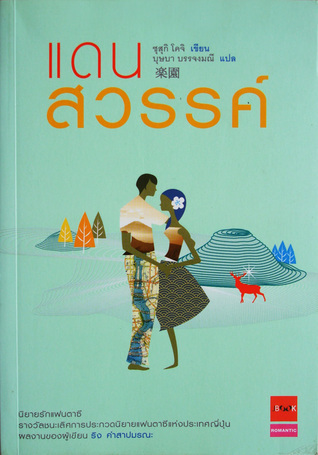
Suzuki Kōji (鈴木光司) is a Japanese writer, who was born in Hamamatsu and currently lives in Tokyo. Suzuki is the author of the Ring novels, which has been adapted into a manga series. He has written several books on the subject of fatherhood. He is currently on the selection committee for the Japan Fantasy Novel Award.
I'm not new to Koji Suzuki's work, but, aside from buying from Amazon, it can be somewhat difficult to find. I prefer to hunt my books in the wild, which means that coming across one is a rare gem. This is the fourth book by Suzuki that I've read, and given that the other three were horror, I wasn't quite sure what to expect from this one. I loved it. Words cannot begin to express the ephemeral qualities of this book. It's a beautifully evocative story. It's a story that transcends space and time, intentionally so. Without giving anything away, I can only say three words, "read this book!" It's nothing like his other works. It's an epic. It gave me the same feeling of being a part of something more that I experienced for the first time reading LOTR as a child. It has adventure, drama, pirates, love, loss, destruction, creation. It is more than the sum of its parts.
ผมรู้จักซุสุกิ โคจิเป็นครั้งแรกจากเรื่อง The Ring หนังสือที่สร้างปรากฏการณ์ยอดขายถล่มทลาย และได้รับความนิยมอย่างต่อเนื่องยาวนานไม่เว้นแม้แต่ในประเทศไทย The Ring ทำให้นิยายสยองขวัญสไตล์ J-Horror ที่น่ากลัวขนลุกแบบเงียบเชียบไม่โหวกเหวกโวยวาย ได้รับความนิยมเป็นอย่างสูงและมีนักเขียนอีกหลายๆ คนที่สร้างผลงานโดยมีบรรยากาศของวรรณกรรมของซุสุกิ โคจิเป็นเบื้องหลังและแรงบันดาลใจ
แต่ตอนอ่าน The Ring ไตรภาคจบ ผมเริ่มรู้สึกลึกๆ ว่าจริงๆ ซุสุกิ โคจิมีความสนใจในแนวคิดอภิปรัชญาและพยายามถ่ายทอดมันออกมาในนิยายของเขามากพอสมควร แต่ในไตรภาค The Ring ความเป็นอภิปรัชญากลับถูกกลบหายไปในบรรยากาศสยองขวัญเสียหมด
หลังจากนั้นผมได้อ่านนิยายเรื่องใหม่ของซุสุกิ โคจิเมื่อปีที่แล้วที่มีชื่อว่า แสงสว่างกลางทะเลลึก (光射す海) หน้าหนังสือไม่ค่อยน่าสนใจตอนแรกกะจะไม่คิดหยิบมาอ่าน แต่ด้วยความอยากรู้อยากเห็นว่านักเขียนเรื่องสยองขวัญมาเขียนเรื่องดรามา จะเป็นยังไง สุดท้ายหลังอ่านจบผมกลับชอบ แสงสว่างกลางทะเลลึกมากกว่า The Ring ทุกภาคของเขาเสียอีก
Having read the Ring trilogy, and being more than satisfied to say the least, I wanted to explore mor of Suzuki's literature.
Paradise is not in the same genre-department as any of the Ring books, and yet it incorporates much of the same atmosphere of them, due to Suzuki's writing style. I will say that Paradise is a bit slow, for lack of better wording, throughout the whole book, and at times seems rather mundane, but I cannot stress enough just how this should not be a reason to put it down. There's something about the story that just left me, personally, with something that I'm very satisfied with. Almost as if I had heard Beringia myself, I suppose.
This was basically three separate stories tenuously linked together. The first story was the best, 4 stars, the second took a while to get going, and then just ended 3.25 stars; and the final story started well but ended up disappointing me, 2.5 stars.
Before I proceed, I must firstly make a confession here. Prior to my attending the World Horror Convention in San Francisco in ’06, I did not know the name. Oh, I was familiar enough with The Ring from all the hoopla generated from its American theatrical and subsequent video release, and at the time it was all the rage. I never saw it at that point, am not certain if its sequel had yet emerged at that time. At that convention, I was prowling about the dealer’s tables, and I came across a young Japanese lady sitting alone at a table displaying several stacks of the same unattractive-looking books she was literally giving away. I say unattractive, from the point of view of a guy with an eye for something offbeat and twisted and appealing to me, cool covers depicting creatures or zombies or a maniac holding a severed head, and not, rather, a skyscraper photograph below an Arizona mountaintop photograph. But that’s just me. Aside from that, it was a historical love story and not my typical reading material of choice, or so I assumed, at least not something that would in itself attract me into buying it at a local book store. The lady was most gracious, and I was nonetheless grateful, adding it to my collection of books I would soon afterwards read and review. Throughout the course of the convention, I found myself spending time with Koji, first accidentally spilling my drink all over his shoes and making an ass of myself, then for the longest time conversing and laughing with him and his interpreter over a few drinks at my table on the balcony of a publisher’s private party. He was mild-mannered, cordial, remarkably intelligent and possessed about him a rare wit. The man truly impressed me, and I’ll never forget that time with him. It goes without saying but I’ll say it anyway…..if you’re going to be introduced to an exciting author you’ve never previously heard of before though has been accomplished enough as to produce a pop culture horror sensation, that’s the way to do it. Almost immediately upon returning home from the convention I set out to purchase Ringu on DVD (and not yet the Americanized The Ring, since I prefer to see the original foreign production before any Hollywood remake), and put Paradise on my reading schedule. Ringu, the literary masterpiece itself (which I’m reading any day now) has been highly regarded as Mr. Suzuki’s first novel, but not so. It’s this one. The tale reads like an epic though has an easy 200 or so pages to it, and is divided into three parts, each linking together with the other, each taking place in historical periods hundreds of years apart from the other, progressively. Over this vast timescape, two souls long to be with one another, only to find loss and separation even after death. Firstly belonging to a prehistoric Mongolian tribe, the man sets out to achieve his manhood by hunting a legendary red deer. When he succeeds, the deer becomes his strength, and he becomes not only able to wed the woman he loves and be a father to their son, but is on his way to becoming chief of the tribe. That is, until terrible things happen which shake their world. The two meet again on an uncharted island centuries later, the man washed ashore from the aftermath of his sea ship going under in a storm only to be taken in by the peaceful inhabitants of the island paradise he’s inadvertently discovered, and by an exotic maiden who leads him into a cave where someone long ago had inscribed the image of a magical red deer. Not long afterwards, terrible things happen which shake their world. Again. The final act takes place in modern times, set first in New York and then the vast Arizona desert, where the man is a successful composer of symphonies that wears the images of a red deer around his neck for good luck, who crosses paths with a woman journalist frustrated with her life and who has longed for true love for so very long…… I’m so grateful for having this book handed to me despite my initial disinterest. It read like a masterpiece, was a breath of fresh air and reminded me of all of those important masterworks I grew up reading in school for good grades and book reports. You know the same ones. Steinbeck, Ken Kesey, Faulkner, Fitzgerald, Hemmingway, Twain, London. Stuff I wouldn’t likely have ordinarily read unless I had to under those circumstances, classic works which actually ended up inspiring me and enhancing my life and my love for literature. Paradise reminded me of this love, and of the fact that even now I should broaden my reading horizons. It was thrilling, overflowing with emotion and poetic genius, the sort of book you find yourself reminiscing over in your mind weeks after you put it down. This book should be required reading at any high school or college here in America, and I say this, with the urgency to actually start a campaign. I think, just like me, if more readers who otherwise wouldn’t be drawn to it were exposed to its pages, Suzuki would be well on his way to achieving the sort of status that all great names in world literature share.
"Cuando seas mayor te darás cuenta de que el mundo es un misterio. No hace falta que lo investigues ahora. El mundo se te irá revelando a medida que afrontes las dificultades y te abras al futuro"
La primera obra del autor... Ha sido una experiencia interesante. Después de haberme aterrorizado y al mismo tiempo maravillado con sus trabajos en el género del horror, quedé enamorado de la escritura de Suzuki, tanto así que con sólo los primeros 2 libros suyos que leí (Ring, Dark Water) supe que se había convertido en mi escritor favorito. Pero entonces, cuando cuando terminé de leer sus obras más populares, me quedé con la intriga por saber que más había escrito este autor. Entre tantas de sus obras me llamó la atención que pese a que Ring fue la obra que verdaderamente lanzo al éxito al autor, en realidad no era su obra debut... Ahí descubrí esta pequeña rareza... Paradise, una historia tan menospreciada y olvidada al punto en que su única edición en inglés es casi imposible de conseguir... Pero si algo me llamó todavía mas la atención es el hecho de que no fuera una obra de horror. Hasta entonces solo había leído de este autor cosas dentro de aquel género. Y bien... ¿Valió la pena aventurarme en la lectura del Génesis del llamado "poeta de la humedad"? Bueno... En general ha sido una buena experiencia. Este autor definitivamente no tiene malos trabajos en su bibliografía, ya me he convencido de eso... Aún así se notan los típicos tropiezos que suelen haber en la mayoría de las obras debut de cualquier novelista (Adelantar lo que va a pasar más adelante, extender bastante las descripciones y explicaciones etc) Pero al mismo tiempo también se pueden notar los temas qué el autor exploraría de forma más increíble en sus obras posteriores, como el funcionamiento del mundo y sus misterios o las tribus americanas y sus mitos... Por momentos podía recordar cierta tercera parte de cierta saga con esos 2 temas como punto central... Pero no eran los únicos... Si hay algo que caracteriza a Suzuki es sin duda alguna la presencia del agua en sus historias... Caray, ¿Es que acaso no existe alguna historia suya donde el agua no juegue un rol importante? Pues ya desde Paradise esa manía se nota de inmediato y yo como lector no podría estar mas impresionado... Puesto que esto se trata de una antología prefiero calificar cada uno de los relatos por separado:
Mitos: La primera historia y la mas simple a nivel de escritura pero no por ello menos interesante. Supongo que al contar una historia ambientada en la prehistoria esa forma simple de contarla era incluso necesaria. Arranca bastante bien, pero poco a poco decae. El final no me pareció malo pero sentí que pudo haber sido mejor.
El paraíso: El relato que le da nombre a la antología y para mi el mejor de todos. La historia se ambienta a finales del siglo XVIII en una isla remota donde pronto ocurrirá algo que cambiará la historia de ese lugar... Si bien empieza bien y poco a poco decae al igual que el relato anterior, aquí la historia si que remonta a lo grande con ese final tremendo.
El desierto: Tristemente este relato si que me aburrio casi totalmente. Para mi es el peor de todos y por mucho, aunque sigue teniendo sus momentos... Básicamente la historia transcurre en los años 90's donde hay historias de amor de esas cliché que odio tanto y situaciones bastante convenientes, pero al menos los personajes siguen teniendo su gracia.
En general se me hizo curioso como el autor mezcla misticismo con análisis racional en las tres historias. Tambien fue interesante ver como las 3 historias estan interconectadas y el hecho obvio de que aunque en ningún momento se aclara, se nota bastante que los protagonistas son reencarnaciones de los protagonistas de los relatos anteriores. Mención especial para Tahune, Tyler y Gilbert... Los 3 personajes representan la figura del maestro que ilumina los secretos del mundo a los protagonistas de su respectivo relato como solo Suzuki saber hacer... No me arrepiento para nada de haberlo leido. Una obra ignorada que merece mas reconocimiento.
A Native American novel starting from back before the land bridge between Asia and what is now Alaska carried people to the new land and ending in 1990.
Suzuki split his novel into 3 different parts, each with their own chapters, and each with their own time periods, all to come together in part 3. It’s a sort of spiritual journey, not just for the characters but for the reader as well. As someone who shares some similarities in spiritual beliefs to that of the characters, I felt I could understand relate to them at times.
I might have given a higher rating to this novel had I not lost interest in some parts (mainly in part 2). I found that I had to push myself forward in order to finish reading, rather than being swept along by an enthralling story. However once I got to the final part of the book, I found the story more captivating; and not only that, but it started to come together and link parts 1 and 2, which originally didn’t seem to have much to do with each other.
Overall, I’m happy I read this novel, and I’d read more from this author in the future. It was above average, yet not amazing.
I think this may be my first review on Goodreads, but I thought as I've just finished this book it would be fresh in my mind. First of all I thought this was rather good for a first novel. An intriguing mixed bag of a plot, and quite unique in it's genre. In fact what genre is this? Is it romance, adventure, historical fiction, contemporary, spiritual fiction? It's a tricky one to label. For that alone I like it's individual quality. As a story in three parts I think it works really well. Each time the characters reincarnated spirits reunited with their loved one again. The second one I thought was especially exciting reading. I do love a good sea story. I think the last part may have been the weakest of the three, but as a person who often finds such tragic and grim endings to most books I read this made a refreshing change. You may not shed any tears with this one folks! But it's enjoyable with a cup of tea and some cake, (the last part anyway.....I'd leave off any yummy consumptions till after the second story!)
When my son handed me this book, he said you could tell it was the author's first novel and that if I had something better to read (always the case, of course), not to bother. But since we'd read Suzuki's other books, I decided to read this one, since I like to see how a novelist develops. Here, you can see concepts and themes emerging that he uses to greater effect in his later novels.
It's an okay, though very flawed, book. I esp. liked part 2 (compulsive reading in that section - the other 2 sections bog down) and though the author telegraphs everything that's about to happen from the very beginning, he holds back on an important element in part 2, which makes it that much more effective when you realize it in the last section.
Chắc hẳn nhiều người đã biết Suzuki Koji qua huyền thoại Ring リング, một cuốn tiểu thuyết đã tạo nên một hiện tượng kinh dị toàn cầu, nội dung của The Ring cũng tạo cảm hứng lớn cho các nhà văn kinh dị và các nhà làm phim. Có người đã thấy Koji thực sự có hứng thú đáng kể với siêu hình học và cố gắng thể hiện nó trong tiểu thuyết của mình. Nói về Rakuen, đây là tiểu thuyết debut của Koji đã ẵm giải Japan Fantasy Novel Award Winners năm 1990, nội dung chính là fantasy và ít yếu tố kinh dị, được dựng thành anime 満ちてくる時のむこうに (Beyond the Time).
Cốt truyện chính trong Rakuen là về tình yêu và sự gắn kết vượt thời gian với những điểm kết nối của con người ở 3 thời đại, từ tổ tiên là những người du cư trên sa mạc đến các bộ lạc trên quần đảo Polynesian vào thế kỷ 18 và đỉnh cao là ngày nay (1994). (Sa mạc Gobi trong quá khứ xa xôi, một hòn đảo ở Nam Thái Bình Dương, một hồ nước ngầm ở Arizona... 3 câu chuyện sử thi về cuộc gặp gỡ tình yêu giữa một người đàn ông và một người phụ nữ.) Với một người không có hứng thú với bộ lạc và sự kỳ ảo truyền thuyết sử thi bộ tộc thì bạn Min không ấn tượng cuốn này nhiều lắm, nhưng không thể không nói rằng Koji đã xây dựng một cuốn tiểu thuyết đầu tay ổn áp. Như mấy tập dài Doraemon về thời tiền sử các thứ nhưng phiên bản dark bủn lmao hơn.
Không chỉ là một cuốn tiểu thuyết fantasy bộ tộc với linh hồn hươu đỏ tưởng như dành cho trẻ con, Rakuen có một số vấn đề cần bàn luận. Đầu tiên là nghịch lý đạo đức (moral paradox) trong đây, liên quan đến phong tục nam nữ có thể tự do quan hệ tình dục, và đôi khi ngoại tình. Koji cố gắng truyền đạt rằng độc giả không thể chấp nhận điều này là do chính độc giả cố gắng áp dụng các chuẩn mực của một xã hội văn minh để phán xét xã hội của người dân Polynesia, một sự can đảm khi sẵn sàng đưa quan điểm này một cách trần trụi trong ngay tác phẩm đầu tay. Do nghịch lý đạo đức đã đề cập ở trên mà tác giả cố tình giảm bớt những mâu thuẫn nhỏ trong chương thứ hai và cũng cố gắng bỏ qua vấn đề này trong chương thứ ba khi Flora đang cố gắng cứu Leslie.
Thứ hai là những dẫn chứng về lịch sử loài người của các nhân vật trong truyện dựa trên bằng chứng địa chất.Giả thuyết cho rằng tổ tiên người Ấn Độ đã di cư từ châu Á vào cuối Kỷ băng hà bằng cách băng qua eo biển Bering. (kết nối bờ biển cực đông của Siberia với phía tây Alaska với nhau trong Kỷ băng hà) nơi biển vẫn đóng băng trong khoảng 60.000-25.000 năm TCN là một chủ đề thú vị. Theo câu chuyện trong chương 1, Fayao bị các bộ lạc từ phía bắc xâm chiếm (được cho là người Mông Cổ) và phải di cư qua eo biển Bering đến Alaska, thực chất là tổ tiên của người da đỏ ở chính châu Mỹ. Điều đó có nghĩa là Suzuki tin rằng người Mông Cổ ở châu Á là tổ tiên của người da đỏ ở châu Mỹ.
Đối với Bokudo, không thể vượt qua eo biển Bering, nó phải đi về phía nam để cố gắng tìm một tuyến đường từ Châu Á qua tới Châu Mỹ. Mà khi đi xa hơn về phía Nam thì sẽ phải đi qua Hàn Quốc, Hồng Kông, Thái Lan, Malaysia, nhưng khi Bokudo đi về phía Nam thì không thấy Malaysia mà vẫn tìm được điểm nối từ châu Á sang Châu Mỹ. Vì vậy, Bokudo quyết định chết bằng thanh kiếm. Có một con tàu vượt đại dương, chương 1 kết thúc mà không nói rằng cuộc hành trình Bokudo có thành công hay không, nhưng đã quay trở lại để trả lời trong chương 2 tại bức tượng hươu đỏ của Bokuto xuất hiện trên đảo Polynesia. Có nghĩa là cuộc hành trình của Bokudo không phải là đã thành công. Cuối cùng là Bokudo sống ở Polynesia và để lại di chúc cùng con cháu vượt biển vào lục địa Mỹ để thành công (Sau đó, Jones và Laia nhận ra giấc mơ của Bokudo.) Điều này phù hợp với lý thuyết di cư của nhà nhân chủng học Thor Heyerdahl về người Polynesia đến châu Mỹ thông qua dòng chảy của Bắc Thái Bình Dương với một chiếc bè. Một số bộ lạc ở British Columbia và người Polynesia Zia giống nhau đến khó tin.
Có người nói rằng đọc cuốn Rakuen này như được tiếp thêm rất nhiều kiến thức về dân tộc học, và quả không sai.
「たやすく得られるものに、人は命をかけるはずがないからだ。」 Bởi con người không nên liều mạng vì những thứ dễ dàng có được.
For me, this book is tied together by how the past influences the future. How the past, present and future are always intertwined. How everything that already was still is. And how love can transverse far far into the future.
I thought about giving up on this book. Somewhere around page 30 I thought, "I've enjoyed other books by Suzuki but maybe this one just isn't for me." I kept going anyway and I'm really glad I did. I picked up this book knowing very little about it other than who wrote it. This books is separated into 3 different stories and isn't quite your average novel.
At once, it seemed like a love story starting off in prehistoric Asia as we follow a boy whose time has come to enter 'manhood.' He goes on a journey to prove his worthiness to the tribe and the strength of his soul. Later the tribe is showered with misfortune and an even longer journey. However as we move along we're then following a group sailors fighting the Pacific Ocean, finding love and understanding their fate. This story really unravels into thrilling page turning and a love story. And finally in part 3 we meet modern times while exploring something very old yet and naturally magical that becomes somewhat a survival thriller and of course a love story.
All 3 stories are interlinked with one another and to me it feels like the writing style of each story reflects the time period.
Part One: Takes place in prehistoric Asia. A little slow to start and thereon well paced, not overdone with lengthy descriptions which I appreciate. However, it feels dry. I don't necessarily dislike this style, as it leaves some room for imagination but it does read kind of like a child's fairy tale, with short sentences, lack of depth, and simple emotions. Exploring love, destiny and loss. Overall it feels like it reads pretty objectively. Later on, I thought that perhaps this style is to reflect the time period, as each part becomes more and more detailed, involved, and developed.
Part Two: Takes place in the 1800's. Great pacing. There was much more depth to everything and the characters we're fleshed out much better to where I could actually get a sense of their personalities, aspirations, values, and so on. I was able to connect and latch on to and route for these characters. The development of these characters were wonderful to read. This story is very exciting and thrilling with adventure and of course more misfortune, love and fate. (Honestly, I could have just read a full book of this and loved it. This was probably my favorite story out of all of them)
Part Three: Takes place in the 1990's. We follow a composer and a reporter into the empty desert. Decent pacing. A bit more detailed than the previous stories. Like the first two stories it takes us on a journey to discover something natural and beautiful that links to the soul, to earth, to human, animal, past and present. And of course with that undercurrent of love and fate.
I wouldn't normally choose a book like this to read, but I'm really glad I stuck with it. It's unique and almost feels like Suzuki is fleshing out tid bits of history. It's like he's taken little tid bits about events throughout history and filled in the story as to what that would have been like, not just a few sentences in the news paper or history book, but a much for detailed account their experience, their journey and how all of these peoples journeys are connected by love & fate...if that makes any sense. Lol. Just read it :)
Simple, but effective. The first two parts gave the vibe of a story that's told through generations about people past, and it made me think of the origins of stories and why we tell them. The third part was more like a modern speculative fiction novel, and that felt good and familiar to me, which is why I liked it the best.
The comparisons between this book and Cloud Atlas are pretty apt, and I think if intergenerational linkages constituted a genre of literature, this would fall squarely within that. I think that it's fun to link people across multiple generations by similar themes, but it does fall on the audience to do a lot of explaining away and rationalizing. These stories are driven by our desires to have them connect, as opposed to the more realistic acknowledgement that the world is chaotic and noisy and rarely fits neatly together. I'd feel better about this if there was a reason why this particular story coalesced in this way, but there really isn't. But I suppose it is still statistically possible, so I can't be that much of a hater.
I think the book would also be helped by having a stronger romantic connection between the initial two lovers. I felt like I had a stronger sense of his struggle to kill the red deer than of his connection with his lover. If a love is going to last over tens of thousands of years in order to be reincarnated into your descendants, I'd expect it to be pretty strong and well developed. At least well-developed enough for the descendants' subsequent stories to not feel like insta-love, which it did. I think there was powerful potential here to be a multi-generational struggle of love and triumph against impossible odds, but it fell a little flat.
Overall, I enjoyed the book. I actually think it would be helped by being serialized into a series of books with a similar idea of the links between people across generations. Some loves lost, some loves found, it would really be a fun exploration of our human connections across time. Koji Suzuki (or anyone really), hope you read this and write that.
I didn't know this was Suzuki's first book when I got it. Now, looking back I can understand better my experience with it. I really didn't like this book and was very surprised about it, because I usually love his works. Someone said maybe it was because this is not horror, but truth be told, my favorite texts by him are not horror. I thought it was bland, kinda boring and, actually, pretty corny, which is what bothered me the most, I hate corny stories, and reincarnation can serve pretty well that purpose if it's not done right. Still, you can already see glimpses in here of the themes and concerns that haunt his oeuvre until today, there's that darkness always waiting even in the most daily things, which is something I truly believe in, as well as the concept of chaos as destruction but also as creative potential. Paradise follow the story of a couple that is separated in three different times, so each chapter is a different period and the one I enjoyed the most was the one in the modern times, even though I'm pretty sure I read a short story really similar to it, which I also suspect was by the same author, I might be confused though, but with the same detail of the subterranean cavern with water and people trapped there (just checked and I was right, it's in the Dark water collection) Anyway, I recommend this book to Suzuki fans as it's still interesting considering its his first work and you can see the evolution, also to those who like reincarnation romantic stories with some mysticism.
I really enjoyed the writing style of "Paradise" and the idea that love can last for thousands of years, but this novel did make me feel really weird. On one hand, it's an accurate depiction and critique of colonialism. On the other hand, I really didn't like that the major conflicts in the novel are all because men saw women who were so beautiful and so sexy that they just NEEDED to have them and were willing to slaughter entire tribes of people to get what they wanted. I think that wouldn't leave such a bad taste in my mouth if I didn't know that Suzuki constantly does a subpar job at writing female characters.
I did enjoy reading the book though. I loved the continuing image of the red deer and how its original meaning is lost to time but its significance persisted nonetheless. I also liked when Tyler pointed out that Jones didn't really want to reject their old societal norms and fully assimilate. He wanted to stay and enjoy all the best of the local culture but he still wanted to force his original cultural ideals for his own benefit. He could CLAIM that he saw it as a sort of paradise but that's not how he really felt about it if he wanted to enforce his own ideals. I always enjoy media where people from different cultures meet and there's a disagreement about morals/norms because morality is such a relative concept.
"Paradise" definitely isn't Suzuki's best work, but it was still an enjoyable read and I'm glad to have a physical copy for my collection. In writing my review I marked down my rating from 4 to 3 stars but it's by no means a bad book. I liked it but I wouldn't recommend anyone spend too much money or time searching for a copy.
A charming story, but I really feel it could have kept moving through more iterations to give us more fragments of the shattered story. A good story in the same subgenre as The Ice People or Time and Again.
Found this book in Alaska, I read it. I enjoyed it. Nothing too deep, too special. But this is the guy that wrote the ring. So, a love story that spans generations and continents and genres is a solid read from me.
Readers may be familiar with Koji Suzuki primarily for his j-horror Ringu books which were made into highly successful films first in Japan and then in the United States. What readers may not realize is that Mr. Suzuki's first novel was not The Ring, but the 1990 fantasy novel Rakuen (translated as Paradise), which won the Japan Fantasy Novel Award. Fortunately, Koji Suzuki's award-winning fantasy novel has now been translated into English by Tyram Grillo and published by Vertical, Inc.
Paradise is an epic romance divided into three parts spanning several millennia. The first part, Legend, tells the love story of Bogud and Fayau, two members of a prehistoric Mongolian tribe called the Tangad. Bogud is a talented artist, a drawer of horses and other animals that were so incredibly lifelike it was rumored they would slip off the cave walls and secretly graze down by the lake while the tribe was sleeping. Bogud limited his drawing to animals, never drawing images of people because of a deeply held tribal taboo. Bogud had never been told the reason for the taboo, but it was a strongly held and unquestioned belief. As Bogud approached adulthood, he fell in love with Fayau and became overwhelmed by the desire to immortalize her image. The desire became so overwhelming that he sneaked away from the village and created his masterwork down by the riverbank. It was only once he had created the monument to his love that he thought to ask a tribal elder the reason for the taboo and the consequences of breaking it. Upon finding out that drawing a person meant he would lose that person forever, Bogud attempted to correct his error on his spirit quest, hunting the strongest totemic animal, the elusive red deer. Unfortunately, the spirit of the red deer was not enough to keep Bogud and Fayau together. A warlord from another tribe saw Bogud's portrait of Fayau and decide he must have her for his own. The Tangad village was attacked and destroyed and most of the tribe killed. Fayau, already pregnant by Bogud, was taken by the warlord and has a daughter the warlord thinks is his own. Bogud followed unsuccessfully and was forced to turn back. Fayau and her daughter, along with the warlord's people, crossed the ice bridge to North America. At the end of the first portion of the book, Bogud, having gone back to the ruins of the Tangad village to help the last remaining tribal elder bury and mourn for the dead, set out to cross the Pacific Ocean in an unsuccessful attempt to reunite with his love.
In the middle portion of the book, Paradise, set in the late 1700s, Jones, an able seaman from Providence aboard the doomed whaling ship Philip Morgan meets Laia, a Polynesian girl from the island of Talofa. The two fall in love and Laia shows Jones the statute of a red deer that has been on the deerless island since as long as anyone can remember. Jones gets the image tattooed on his arm. The two marry and have a son. Unfortunately, their idyll is disrupted by the return of the psychotic captain of the Philip Morgan who is determined to enslave the islanders. Jones and Laia and others attempt to flee the island on a small boat during a tidal wave. It is not clear whether Jones and Laia are descendants of Bogud and Fayau or reincarnations of their spirits. Either way, the lovers are not successfully reunited.
In the last third of the book, The Desert, the lovers meet again in the form of a composer and a journalist. The composer has just written an epic symphony, entitled Beringia, named for the land bridge between Asia and America. The journalist is a big fan of his music, which speaks to her on a deep, emotional level. The composer is about to explore a cavern in Arizona in order to gain inspiration for a new piece commissioned by a religious mystic, and feeling a connection to the journalist, asks her to secretly follow him and mystic. Will the spirit of the red deer allow the lovers finally to reunite?
Although it was not entirely clear to me in the third section which character was meant to have the link to Bogud and which to Fayau, Suzuki does a good job of linking the three disparate sections of the book together and bringing them to an appropriate conclusion. Paradise should satisfy those readers who prefer their fantastic romances to be without elves or swords
A unique love story that spans centuries. Two lovers are separated on the wild steppes of Mongolia, yet their undying love wanders the unknown parts of the world, only to meet again thousands of years later incarnated in the bodies of two strangers.
This novel shows a side of Suzuki that is little known. His writing of love is that of high, spiritual immortality. In 'Paradise', Suzuki teaches us a thing or two about soulmates. He allows us to travel from one moment in time to the next, visiting different people, and watching how the destiny of two souls finally converge to fulfil the promise they made to each other.
A very powerful novel, and perfect for those who do not care for the soppy type of romanticism. Definitely worth a read.
Intriguing premise. A love story that transcends time and parallels the migration of Native American and Polynesian, tracing it back to their common Asian ancestors. Story is told in three parts. A story of love and longing starting in Asia, marked with separation. The second part, moving closer to North America, and the last finally meeting.
First two parts are good, but I felt the last part is where the story falls apart. Took certain themes too literally and the conclusion kind of descended into the absurd, taking away from the actual events of the scenes.
Writing style is pretty simple, nothing to write home about. The basic story is good, but the characters are still pretty flat.
A captivating read. What I liked about Suzuki-san was that he wasn’t afraid to deal with issue of immaterial world. There are things we don’t understand, things we can’t explain, yet we know they are real for us. Modern people tend to stay away from this subject, for fear of persecution of being old-fashioned, superstitious, even stupid.
Tafune, Tyler, Gilbert. Were they less important than Bogud-Fayau, Jones-Laia, and Leslie-Flora? Would there even be a story without them? To the few people who dared to tread this lonely road, my deepest respect.
Only Koji Suzuki's genius mind can conjure such story line. I'm a great fan of the Author but I'm not sure that I could say the same thing about the book. Though divided in to 3 different connecting stories, Part 1 is what I enjoyed the most. Writing Love stories may not be his forte but his unusual thinking manifested how a good love story is not always a boy meets girl scenario. Whilst reading this book I found myself asking whether such great love is possible, something that lasts through various lifetimes... amazing, but really who am I to know?
A decent book marred by a mediocre translation. The sentences had a very similar cadence throughout, making for a bit of a dull read. This coupled with a story that never quite hung together despite its best efforts. Three storylines in three different ages are related by a vague reincarnation type theme (shades of Cloud Atlas) but never cohere or manage to achieve any emotional resonance.
Two stars for the fact that I wanted to see how the story turned out, and so finished the book. It's a quick read, and others may like it more than me.
The first two parts were so interesting and fun. They made reading the book worth it. I unfortunately really didn’t like the third part and its conclusion lessened the book’s rating.
PROS: The entire plot should feel like a conceit, but it was marvelously executed. Sweeping, romantic, unpredictable. You see where it's going, but not how it'll line things up to get you there. The three stories and their characters feel hauntingly real and relatable.
CONS: There is a bit of a psychic element in the third story that feels like a plotting compromise, but it's so brief that it doesn't derail everything.
Though its three parts have seemingly little to do with each other, certain motifs in each are woven together to create the overlying plot: while it is never actually stated within the text, it becomes clear that the three couples, from three different times and places, are each reincarnations of the last, and in each story fate, destiny or chance conspire to push them together, culminating in an underground rescue in the American desert.
This mystical story starts out in the prehistoric Asia, then goes to the South Pacific in the late 1700's and ends in New York in the 1990's, It follows the genetic link through the centuries--interesting.