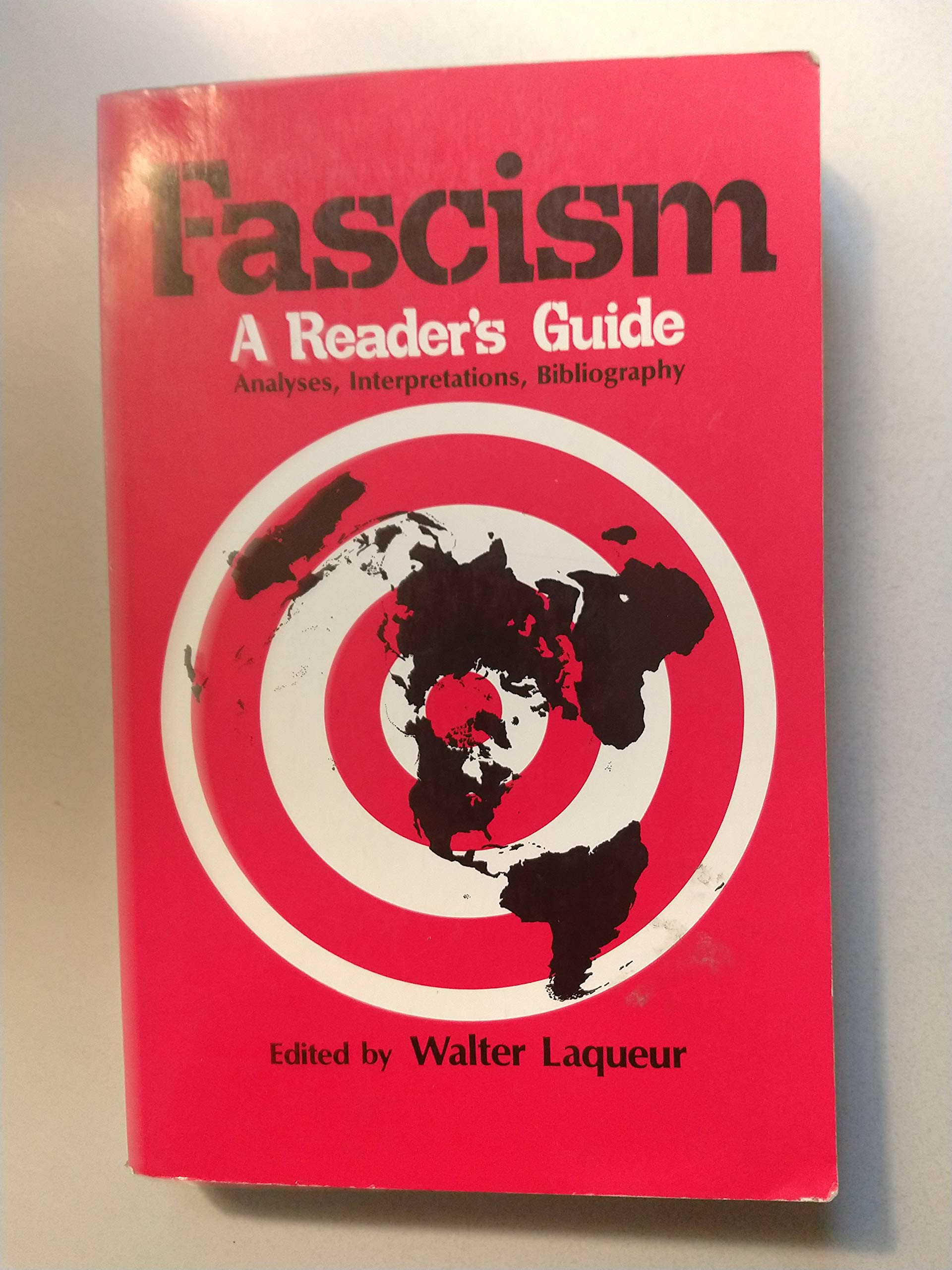
An interdisciplinary study of fascism investigates the sociological, ideological, and economic aspects of Italian fascism and German national socialism and analyzes the fascist movement in countries in which it failed to come to power
Walter Ze'ev Laqueur was an American historian, journalist and political commentator. Laqueur was born in Breslau, Lower Silesia, Prussia (modern Wrocław, Poland), into a Jewish family. In 1938, he left Germany for the British Mandate of Palestine. His parents, who were unable to leave, became victims of the Holocaust.
Laqueur lived in Israel from 1938 to 1953. After one year at the Hebrew University of Jerusalem, he joined a Kibbutz and worked as an agricultural laborer from 1939 to 1944. In 1944, he moved to Jerusalem, where he worked as a journalist until 1953, covering Palestine and other countries in the Middle East.
Since 1955 Laqueur has lived in London. He was founder and editor, with George Mosse, of the Journal of Contemporary History and of Survey from 1956 to 1964. He was also founding editor of The Washington Papers. He was Director of the Institute of Contemporary History and the Wiener Library in London from 1965 to 1994. From 1969 he was a member, and later Chairman (until 2000), of the International Research Council of the Center for Strategic and International Studies, Washington. He was Professor of the History of Ideas at Brandeis University from 1968 to 1972, and University Professor at Georgetown University from 1976 to 1988. He has also been a visiting professor of history and government at Harvard, the University of Chicago, Tel Aviv University and Johns Hopkins University.
Laqueur's main works deal with European history in the 19th and 20th centuries, especially Russian history and German history, as well as the history of the Middle East. The topics he has written about include the German Youth Movement, Zionism, Israeli history, the cultural history of the Weimar Republic and Russia, Communism, the Holocaust, fascism, and the diplomatic history of the Cold War. His books have been translated into many languages, and he was one of the founders of the study of political violence, guerrilla warfare and terrorism. His comments on international affairs have appeared in many American and European newspapers and periodicals.
There was a time, apparently, where such a collection of crucial essays would retail for £3.50 - new. That's the RRP on my 1976 pocket edition. Nowadays, we have 'Fascism: Critical Concepts in political science' edited by Griffin and Feldman, going on the editor's website for a mere £1.040.00. I know, idle talk, to complain the prices of academic publisher, but my point is that this 'Fascism: A Reader's Guide' is first of all great value: it's literally packed with great essays that provide the eager reader with not only the bibliographies the title allow you to expect, but also with excellent overviews of various fields and key issues by leaders of the field. It is striking in this regard to see what has changed, and the many have not, in regards to more recent scholarship on this question; Few would nowadays bother to rebuke the orthodox Marxist interpretation as some do in the reader, but otherwise questions of fascism's revolutionary character, of its transnational aspects, or the kinship between Central and East European types remain as far as I can tell, much discussed. The emphasis is probably less on culture than on politics, maybe because of the surprising absence of Mosse, leaving to Sternhell the task of exposing the intellectual roots of the phenomena. Economics also receive a special treatment, as well as the different geographic areas whose XXth century politics can lay a claim to the phenomenon. The two movements that reached power are examined in more detail and their respective social composition is discussed in some depth. All in all the book is hardly dated and delivers beyond expectations.
This book, a now very outdated “state of research” anthology, suffers from something of an identity crisis in addition to its age making it irrelevant for most modern researchers. The subtitle “A Reader’s Guide” seems to have been interpreted in wildly differen ways by its various authors, apparently with inadequate guidance from editor Walter Laqueur, and so the articles are ultimately at cross-purposes. Some regard “reader’s guide” as meaning little more than an annotated bibliography, while others add more critical narrative comments, placing bibliographic information in the notes, and still others create original works of synthesis or “think pieces” that speak only obliquely to the existing literature. The huge variance in page length also speaks to a lack of guidelines for contributors and bears against the editorial process.
For those who are not familiar with the historiography of fascism, it is worth noting the time when this book was produced, and the state of the field as it existed. This paperback edition of this volume was published in 1978, apparently unchanged the original hardcover in 1976, but judging from the content, many of these essays were written two or three years earlier than that, so it was already a tad dated even by the time it came out. There are two features that this influences: the lack of a common definition for “fascism” and the types of scholarship represented, which leans heavily towards historians rather than sociology or political science. The opening essay, ironically, addresses both these issues, being a sociological study that makes a real effort to provide a working definition of terms, but it is not addressed at all by any of the other writers. Despite the lack of a clear definition, there isn’t too much debate about what is or isn’t “fascist” – all seem to discount Franco, Salazar, Tojo, and Peron as exemplars. Some debate over Brazilian “Integralism” and, as today, one voice speaks against using the term for National Socialism.
That constitutes the bulk of this review, for those interested, below are some notes on each of the essays presented:
Juan J. Linz: “Some Notes Toward a Comparative Study of Fascism in Sociological Historical Perspective.” A 100-page essay that attempts to “define” the problems of this book, although none of the others refer to it at all. Discusses the unsatisfactory existing definitions of fascism and offers some ideas about its status as a “new” political movement, looking to carve out space within electoral groups not otherwise claimed. His definition of fascism (p12-13): “a hypernationalist, often pan-nationalist, anti-parliamentary, anti-liberal, anti-communist, populist and therefore anti-proletarian, partly anti-capitalist and anti-bourgeois, anti-clerical, or at least, non-clerical movement, with the aim of national social integration through a single party and corporative representation not always equally emphasized; with a distinctive style and rhetoric, it relied on activist cadres ready for violent action combined with electoral participation to gain power with totalitarian goals by a combination of legal and violent tactics.” Gives considerable demographic data, using groups throughout Europe and also Brazilian “integralism.” Not really bibliographical, but heavily footnoted with some lengthy discussions in the notes.
Adrian Lyttleton: “Italian Fascism.” Only 25 pages devoted to the national origin of the term “fascism;” mostly a review of Italian literature, with bibliography described in 76 footnotes. Assumes the reader already has a general understanding of the historical events.
William Carr: “National Socialism – Foreign Policy and Wehrmacht.” First essay on NS covers a very specific field quite well for the time, in 28 pages with 32 footnotes. Acknowledges the changes in approach to study during and since WWII. Good discussion of then-existing source base and limitations in terms, for example, of discovering if Hitler planned to conquer the world or if he was simply improvising.
Hans Mommsen: “National Socialism – Continuity and Change.” More of a survey of German literature about NS, much more bibliographical than some of the essays, and up to date on historical debate (from the pov of the mid-1970s). Only about 24 pages but with over 100 footnotes, so strong on sources.
Karl Dietrich Bracher: “The Role of Hitler: Perspectives of Interpretation.” Probably the most opinionated of the NS essays, Bracher argues both for a “totalitarian” perspective and that calling “NS” a variety of “fascism” is misleading or uninformative. Seems to come from a right-wing perspective, but not bad in that it challenges common assumptions. 13 pages, not many notes.
Bela Vago: “Fascism in Eastern Europe.” Says not enough has been written. Focuses mostly on Arrow Cross and Iron Guard. Mentions a lot of material written by former members and sympathizers – not uncritically. 25 pages, almost 100 footnotes.
Alistair Hennessey: “Fascism and Populism in Latin America:” Says there have been few true fascist groups in Latin America, but that populist movements have, with some success, incorporated fascist elements at times. Includes among these Peronism and Integralism, also some organizations that adopted the term “Falangé” into their names were fundamentally liberal. Essay largely in style of annotated bibliography, hence very few notes at end. 39 pages.
Stanley G. Payne: “Fascism in Western Europe:” Brief, and not surprisingly focused mainly on Spain. Finds that fascist parties had little success in most of Western Europe. Does not consider Salazar remotely fascist. Discusses failure of Falangé to achieve electoral success or mass support until it was integrated into the military, by which time it was co-opted into non-fascist authoritarianism. 14 pages, limited notes, most bibliographic data in bulk of the essay.
Zeev Sternhell, “Fascist Ideology.” One of the most interesting “state of research” articles, with 177 footnotes and a 11-page narrative bibliography out of its 68-page length. Although he argues that National Socialism was so extreme as to effectively metastasize into something else, he still at various times discusses sources that examine or are sources of Nazi ideological study. Seems to find Nolte and Gregor the most important scholars, even as he questions some of their conclusions. Argues that nationalism and socialism (and corporatism) are fundamental to fascist ideology.
Alan S. Milward: “Fascism and the Economy.” This is a fairly fascinating essay that I’d have liked to see expanded. 35 pages, only one note: however much of the article is itself a narrative bibliography. Milward points out that fascism as a regime really never addressed most of its ideological economic goals, forced as it was to confront a reality that didn’t jive with its theory, and also beholden as it was to various economic interests within society. The one thing it did do was to increase spending on the military and re-armament; he even suggests that the War was critical to its economic policy. This may be the most valuable article for modern students, as this side of fascism is often skimmed over in current literature.
Francis L. Carsten: “Interpretations of Fascism.” 20 pages, 83 notes. This was a serious contender for worst essay in the volume (but see Weber, next). Sets up a straw man in the form of mostly Marxist and psychological “Interpretations” and then “proves” that no interpretation to date is satisfactory, ignoring among others every contributor to this book. Shockingly poor sources – no one in the fields of political science or psychology was taking Wilhelm Reich seriously at this point, and while Rauschning wasn’t yet completely discredited, he shouldn’t have been treated uncritically either.
Eugen Weber, “Revolutions? Counterrevolution? What Revolution?” 34 pages, 65 notes. While this is probably the worst essay in terms of content, its saving grace is that Weber’s disingenuous polemics are at least entertainingly written – it might be the most “fun” essay here, even if it has absolutely no business in any kind of “reader’s guide.” Essentially a “think piece” about the use of the terms revolution and counterrevolution, it goes even further than Carsten in ignoring the then-current state of research to make truly ridiculous arguments which seem to assume that everyone but Weber adheres to a Marxist position. His sources therefore draw almost entirely from Marxist writers, many of whom would’ve been obscure at the time, and are completely forgotten today. Amusing, but a waste of time.
Written by several scholars, but more sequential and logical by its very nature than a "reader" text. Discusses some thing which Aristotle Kallis text doesn't deeply, namely, latin american fascism. But its not as rich with ideas.