

What do you think?

The Complete Peanuts #17
The Complete Peanuts, 1983-1984
As Peanuts reaches the mid-1980s, Charles Schulz is still creating and playing with new characters, and in this volume Snoopy's deadpan, droopy-mustached brother Spike takes center stage: Surrounded by coyotes in the desert where he lives and who are attacking him with rubber bands, he sends a frantic message to Snoopy who launches an expedition to save him. Then, he makes the long trek back to Snoopy's neck of the woods accompanied by his only friend (a cactus, of course) and throughout the rest of the book, pops up in hilarious, Waiting for Godot-style vignettes set in his native Needles.
In romantic news, the Peppermint Patty-Marcie-Charlie Brown love triangle of overlapping unrequited love heats up (well, kind of), while Linus continues to vociferously deny that he is Sally's Sweet Babboo; of course, Lucy's unsuccessful pursuit of Schroeder remains unabated. Also, a romance blossoms between two of Snoopy's Beagle Scout birds. (We will pass over Spike's brief attraction to one of the coyotes.)
In what is probably his most baroque and hilarious baseball-involved humiliation yet, Charlie Brown agrees to join Peppermint Patty's team, the Pelicans, only to discover that he's wanted not as a player but as a mascot. Linus gives up his security blanket and forms a support group for other kids who are trying to do the same, and Peppermint Patty manages to be held back in school (leaving a snoring ghost to take her place in the rest of the class that has advanced), and yet gets to go on a European trip with her dad, sending back periodic dispatches from the road. All this, plus appearances from Franklin, Rerun, and the rest of the gang in these strips from a period of Peanuts that's far less well-known than the endlessly-collected 1960s and 1970s eras.
In romantic news, the Peppermint Patty-Marcie-Charlie Brown love triangle of overlapping unrequited love heats up (well, kind of), while Linus continues to vociferously deny that he is Sally's Sweet Babboo; of course, Lucy's unsuccessful pursuit of Schroeder remains unabated. Also, a romance blossoms between two of Snoopy's Beagle Scout birds. (We will pass over Spike's brief attraction to one of the coyotes.)
In what is probably his most baroque and hilarious baseball-involved humiliation yet, Charlie Brown agrees to join Peppermint Patty's team, the Pelicans, only to discover that he's wanted not as a player but as a mascot. Linus gives up his security blanket and forms a support group for other kids who are trying to do the same, and Peppermint Patty manages to be held back in school (leaving a snoring ghost to take her place in the rest of the class that has advanced), and yet gets to go on a European trip with her dad, sending back periodic dispatches from the road. All this, plus appearances from Franklin, Rerun, and the rest of the gang in these strips from a period of Peanuts that's far less well-known than the endlessly-collected 1960s and 1970s eras.
325 pages, Hardcover
First published April 3, 2012
About the author
Charles M. Schulz
3,040 books1,671 followersCharles Monroe Schulz was an American cartoonist, whose comic strip Peanuts proved one of the most popular and influential in the history of the medium, and is still widely reprinted on a daily basis.
Schulz's first regular cartoons, Li'l Folks, were published from 1947 to 1950 by the St. Paul Pioneer Press; he first used the name Charlie Brown for a character there, although he applied the name in four gags to three different boys and one buried in sand. The series also had a dog that looked much like Snoopy. In 1948, Schulz sold a cartoon to The Saturday Evening Post; the first of 17 single-panel cartoons by Schulz that would be published there. In 1948, Schulz tried to have Li'l Folks syndicated through the Newspaper Enterprise Association. Schulz would have been an independent contractor for the syndicate, unheard of in the 1940s, but the deal fell through. Li'l Folks was dropped from the Pioneer Press in January, 1950.
Later that year, Schulz approached the United Feature Syndicate with his best strips from Li'l Folks, and Peanuts made its first appearance on October 2, 1950. The strip became one of the most popular comic strips of all time. He also had a short-lived sports-oriented comic strip called It's Only a Game (1957–1959), but he abandoned it due to the demands of the successful Peanuts. From 1956 to 1965 he contributed a single-panel strip ("Young Pillars") featuring teenagers to Youth, a publication associated with the Church of God.
Peanuts ran for nearly 50 years, almost without interruption; during the life of the strip, Schulz took only one vacation, a five-week break in late 1997. At its peak, Peanuts appeared in more than 2,600 newspapers in 75 countries. Schulz stated that his routine every morning consisted of eating a jelly donut and sitting down to write the day's strip. After coming up with an idea (which he said could take anywhere from a few minutes to a few hours), he began drawing it, which took about an hour for dailies and three hours for Sunday strips. He stubbornly refused to hire an inker or letterer, saying that "it would be equivalent to a golfer hiring a man to make his putts for him." In November 1999 Schulz suffered a stroke, and later it was discovered that he had colon cancer that had metastasized. Because of the chemotherapy and the fact he could not read or see clearly, he announced his retirement on December 14, 1999.
Schulz often touched on religious themes in his work, including the classic television cartoon, A Charlie Brown Christmas (1965), which features the character Linus van Pelt quoting the King James Version of the Bible Luke 2:8-14 to explain "what Christmas is all about." In personal interviews Schulz mentioned that Linus represented his spiritual side. Schulz, reared in the Lutheran faith, had been active in the Church of God as a young adult and then later taught Sunday school at a United Methodist Church. In the 1960s, Robert L. Short interpreted certain themes and conversations in Peanuts as being consistent with parts of Christian theology, and used them as illustrations during his lectures about the gospel, as he explained in his bestselling paperback book, The Gospel According to Peanuts, the first of several books he wrote on religion and Peanuts, and other popular culture items. From the late 1980s, however, Schulz described himself in interviews as a "secular humanist": “I do not go to church anymore... I guess you might say I've come around to secular humanism, an obligation I believe all humans have to others and the world we live in.”
Schulz's first regular cartoons, Li'l Folks, were published from 1947 to 1950 by the St. Paul Pioneer Press; he first used the name Charlie Brown for a character there, although he applied the name in four gags to three different boys and one buried in sand. The series also had a dog that looked much like Snoopy. In 1948, Schulz sold a cartoon to The Saturday Evening Post; the first of 17 single-panel cartoons by Schulz that would be published there. In 1948, Schulz tried to have Li'l Folks syndicated through the Newspaper Enterprise Association. Schulz would have been an independent contractor for the syndicate, unheard of in the 1940s, but the deal fell through. Li'l Folks was dropped from the Pioneer Press in January, 1950.
Later that year, Schulz approached the United Feature Syndicate with his best strips from Li'l Folks, and Peanuts made its first appearance on October 2, 1950. The strip became one of the most popular comic strips of all time. He also had a short-lived sports-oriented comic strip called It's Only a Game (1957–1959), but he abandoned it due to the demands of the successful Peanuts. From 1956 to 1965 he contributed a single-panel strip ("Young Pillars") featuring teenagers to Youth, a publication associated with the Church of God.
Peanuts ran for nearly 50 years, almost without interruption; during the life of the strip, Schulz took only one vacation, a five-week break in late 1997. At its peak, Peanuts appeared in more than 2,600 newspapers in 75 countries. Schulz stated that his routine every morning consisted of eating a jelly donut and sitting down to write the day's strip. After coming up with an idea (which he said could take anywhere from a few minutes to a few hours), he began drawing it, which took about an hour for dailies and three hours for Sunday strips. He stubbornly refused to hire an inker or letterer, saying that "it would be equivalent to a golfer hiring a man to make his putts for him." In November 1999 Schulz suffered a stroke, and later it was discovered that he had colon cancer that had metastasized. Because of the chemotherapy and the fact he could not read or see clearly, he announced his retirement on December 14, 1999.
Schulz often touched on religious themes in his work, including the classic television cartoon, A Charlie Brown Christmas (1965), which features the character Linus van Pelt quoting the King James Version of the Bible Luke 2:8-14 to explain "what Christmas is all about." In personal interviews Schulz mentioned that Linus represented his spiritual side. Schulz, reared in the Lutheran faith, had been active in the Church of God as a young adult and then later taught Sunday school at a United Methodist Church. In the 1960s, Robert L. Short interpreted certain themes and conversations in Peanuts as being consistent with parts of Christian theology, and used them as illustrations during his lectures about the gospel, as he explained in his bestselling paperback book, The Gospel According to Peanuts, the first of several books he wrote on religion and Peanuts, and other popular culture items. From the late 1980s, however, Schulz described himself in interviews as a "secular humanist": “I do not go to church anymore... I guess you might say I've come around to secular humanism, an obligation I believe all humans have to others and the world we live in.”
Ratings & Reviews
Friends & Following
Create a free account to discover what your friends think of this book!
Community Reviews
Displaying 1 - 30 of 58 reviews

August 29, 2023
The collects the Peanuts strips from 1983-1984. The strip is no longer in its prime but still good. There's too much Snoopy for my taste but a lot of Peppermint Patty and Marcie so it evens out. The best storyline was Peppermint Patty getting left back a year, although Sparky wussed out in the end and moved her back into her old class with Marcie and Franklin.
Speaking of Peppermint Patty, I think's one of the richer characters in the cast. As opposed to Charlie Brown's hell of his own making, Patty has a lot going on. Patty's from a single parent household, her dad is never home, she's self conscious about her nose, and is a D minus student, probably because she sleeps in class all the time.
Four out of five stars.
Speaking of Peppermint Patty, I think's one of the richer characters in the cast. As opposed to Charlie Brown's hell of his own making, Patty has a lot going on. Patty's from a single parent household, her dad is never home, she's self conscious about her nose, and is a D minus student, probably because she sleeps in class all the time.
Four out of five stars.
February 18, 2023
Reading these Peanuts comics from the 80s was nostalgic. Schulz's work in the 80s was not as sharp as his work from the 60s, but they are still a lot of fun to read. The production quality of this paperback is quite high. This book will stand the test of time and survive multiple readings. Fantagraphics Books really knows how to make a quality printing.

July 7, 2014
This volume is very Spike heavy. I was all set to write that as my review, but before I did, I put this one on the shelf and pulled out Volume 18 to read next, only to find Spike is the cover subject, so I can only imagine how much Spike will be in that one. Don't get me wrong, I like Spike, this is just a LOT of Spike.
There are some great ones in here, too: Peppermint Patty gets left back in school and goes to Paris for the summer, Schroeder actually kisses Lucy when she remembers Beethoven's birthday, and aerobics features in many strips (it is 1984, after all). Thirty years (!) in, and Charles Schulz has still got it.
There are some great ones in here, too: Peppermint Patty gets left back in school and goes to Paris for the summer, Schroeder actually kisses Lucy when she remembers Beethoven's birthday, and aerobics features in many strips (it is 1984, after all). Thirty years (!) in, and Charles Schulz has still got it.

September 16, 2012
As we're in the early 80s, I realize that I—as a high school student—read each of these on the day they came out. And yet, I don't remember any of them! That troubles me somewhat but hey, who cares, because I get to enjoy them all over again. It's fun to notice the occasional "modern" reference (Victoria Principal!). And as a kid of course I didn't notice the times when it was really Schulz speaking, from an older man's perspective, rather than the characters themselves. Anyway, this is another delightful volume, filled with oddness, depression, goofy jokes, and sweetness. Onward to 1985!

May 16, 2019
So when I review volumes of
The Complete Peanuts
I just share my favorite strip from the collection I have just finished, because you don't need me telling you how great Peanuts is--you already know.
There is a small setup for this strip from October 13, 1984. In the previous three strips, Peppermint Patty has been trying to teach Marcie how to play football and Marcie sucks at it. This leads to Patty calling Charlie Brown to get him to commiserate:
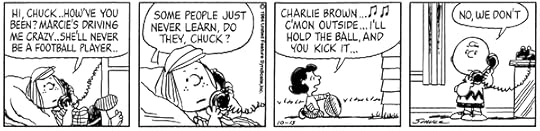
This strip is the epitome of Schulz's genius. By late 1984, Peanuts had been going for almost 35 years, and yet he is still able to get fresh comedy from a gag that by all rules of comedy should be completely played out. At this point we don't need to see Charlie Brown eat shit at the hands of Lucy--we know that it's inevitable and that's why it works. I don't need to tell you that Peanuts is great when your eyes tell you all you need to know.
There is a small setup for this strip from October 13, 1984. In the previous three strips, Peppermint Patty has been trying to teach Marcie how to play football and Marcie sucks at it. This leads to Patty calling Charlie Brown to get him to commiserate:
This strip is the epitome of Schulz's genius. By late 1984, Peanuts had been going for almost 35 years, and yet he is still able to get fresh comedy from a gag that by all rules of comedy should be completely played out. At this point we don't need to see Charlie Brown eat shit at the hands of Lucy--we know that it's inevitable and that's why it works. I don't need to tell you that Peanuts is great when your eyes tell you all you need to know.

February 22, 2018
When I was a kid, I obsessively collected as many of the Peanuts books I could get my hands on. By the time these strips were coming out, I wasn't following along so closely, occasionally reading new strips whenever I got hold of the newspaper at my grandmother's house, so most of these are new to me now. Maybe it's the lack of nostalgia on my part, or maybe the fact that this was a life-long endeavor for Schulz meant the moments of brilliance were more diffuse, but in either case, I found this volume less compelling than earlier ones. I did laugh out loud several times, just not as consistently as with the strips from the 50's and 60's. It does seem that Schulz was getting repetitive at this stage in his career, recycling the same jokes, many of which were more just character reactions or situations, rather than actual jokes, but from another perspective, one might argue that he was exploring the boundaries around various themes. In any case, although I'm moving towards lukewarm on these later collections, I'll probably still keep going for a bit.
August 25, 2021
As with my review of the last volume, I have never seen the vast majority of these strips before. Snoopy is as wonderful as ever, especially with his book titles. His brother, Spike, features a lot. Peppermint Patty and Marcie (wake up Charlie Brown, Marcie fancies you) are also prevalent. Charlie Brown is asked to join Patty's baseball team, albeit as a wonderfully surreal pelican mascot. Love the new character, Harold Angel, too. Love Peanuts.

January 16, 2019
Always good, but more and more of the punchlines aren’t necessarily funny but just kinda odd.

September 6, 2021
Charlie Brown: "Tell me something..."
Linus: "Okay."
Charlie Brown: "Did you ever steal apples from a neighbor's tree when you were young?"
Linus: "I'm just a kid... I'm not young yet!"
Linus: "Okay."
Charlie Brown: "Did you ever steal apples from a neighbor's tree when you were young?"
Linus: "I'm just a kid... I'm not young yet!"

August 18, 2025
I wish I could give Spike a forever home, I feel bad for him living among all the cacti and coyotes!

September 11, 2026
The comic broadens its focus a bit; quite a bit of Snoopys cousin Spike, Woodstock and the flock, Peppermint Patty and Marcie. Once Schulz found his groove, he basicallly stayed there.

Read
April 19, 2026ur adorable snooepyey

January 8, 2020
Like his line drawings the themes explored by Mr. Schulz in The Peanuts strip are not as simple as they might at first appear.

March 30, 2012
I missed out on the 80s seemingly so a lot of new strips here for me.
One of my favorites was a dialogue between Sally and Charlie Brown:
Sally: "I hate everything! I hate the whole world!"
Charlie Brown: "I thought you had inner peace."
Sally: "I do. But I still have outer obnoxiousness."
Copied and hanging on my fridge.
One of my favorites was a dialogue between Sally and Charlie Brown:
Sally: "I hate everything! I hate the whole world!"
Charlie Brown: "I thought you had inner peace."
Sally: "I do. But I still have outer obnoxiousness."
Copied and hanging on my fridge.

January 7, 2014
Would anyone here like to talk about the New Year's strip of 1984? I can't get it out of my head.

May 21, 2025
Peanuts had about fifteen years to go when these strips appeared. I've read "Complete Peanuts" books from later years and they're actually a little better than what's in this installment. Still it's remarkable that Schulz came up with Peppermint Patty and Marcie about twenty years into the strip, and they're the highlight of this collection. I don't know what Schulz was thinking about when he created those characters, but it was quite the late-career coup.
If you blink you might miss it, but Lucy (uncharacteristically) does something nice for Schroeder and he (uncharacteristically) responds affectionately.
If you blink you might miss it, but Lucy (uncharacteristically) does something nice for Schroeder and he (uncharacteristically) responds affectionately.
November 4, 2023
(3.5 stars) Not the greatest of the Charles Schultz works, but still funny and amusing. There are signs that Schultz got a little bored/tired and tried to introduce some characters that didn’t really stick, but at this point, he had been at it for nearly 30+ years. Still, a Schultz at 60-70 percent is better than most at 100 percent for comics.

May 3, 2020
The highlights of this volume for me were poor Peppermint Patty's troubles at school. She has a terrible issue with her 3 ring binder, she fails a grade, and tries wearing erasers for shoes. Her desk is haunted with the sound of her snore. Poor girl. She never gives up tho!

September 12, 2022
Going to camp, Snoopy's brother Spike, Peppermint Patty goes to France, school, dance lessons, Beagle Scouts, baseball, Marcie, and haunted, snoring desks. Charles Schulz was pulling out all the stops in 1983-84.

March 28, 2023
These strips are ones I read in the paper at 12/13 years old.
Schroeder kisses Lucy because she remembered Beethoven's birthday but Lucy mistakenly thinks it was Snoopy and never gets her moment. Like "kicking" the football, it's the peanuts' vibe, disappointment. This is the way.
Schroeder kisses Lucy because she remembered Beethoven's birthday but Lucy mistakenly thinks it was Snoopy and never gets her moment. Like "kicking" the football, it's the peanuts' vibe, disappointment. This is the way.

December 28, 2023
I love the Peanuts and ever since they’ve released these volumes in hard bound and paperback, my husband gives them to me as gifts. I needed this after finishing Maurice’s book! It makes me laugh out loud!

May 8, 2026
Book 130 of 365 ~ 2026
🌟🌟🌟🌟🌟
Peanuts = Happiness = Love
The Peanuts' Christmas cartoon is based on two different series of strips. Squeals.
This is my favourite collection to date.
#book130of365 #amreading #thisbookfairyisreading #theSGtrekkiereads
🌟🌟🌟🌟🌟
Peanuts = Happiness = Love
The Peanuts' Christmas cartoon is based on two different series of strips. Squeals.
This is my favourite collection to date.
#book130of365 #amreading #thisbookfairyisreading #theSGtrekkiereads

August 18, 2017
Peppermint Patty fails a grade. Lots more of Spike. And many that are simply laugh-out-loud funny.

September 14, 2017
I love Charlie Brown and the gang!

June 12, 2018
10 out of 10

March 13, 2019
WAY too many Spike strips! One of the weakest of the two-year anthologies. Hoping for a stronger collection in 1985/1986

September 10, 2019
Fun read!

November 13, 2020
I love all Peanuts, but as the years go by, there is sometimes sharpness without the same cleverness as the earlier comics.

June 30, 2022
There are some weak strips in this collection for sure, but overall it’s still great enough to warrant five stars. I’d say 4.5 to be exact.

April 16, 2024
It's Peanuts, enough said.
Displaying 1 - 30 of 58 reviews