Jump to ratings and reviews
Rate this book

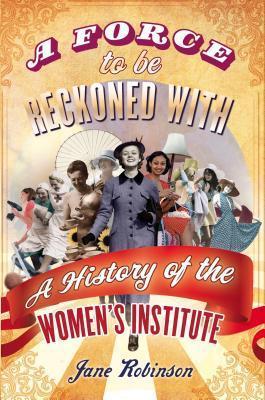
A Force to Be Reckoned with: The History of the Women's Institute

Rate this book
Everyone knows three things about the Women's that they spent the war making jam; the sensational Calendar Girls were WI; and, more recently, that slow-handclapping of Tony Blair. But there's so much more to this remarkable Movement. Over 200,000 women in the UK belong to the WI and their membership is growing. They cross class and religion,include all ages -from students and metropolitan young professionals, such as the Shoreditch Sisters,to rural centenarians -with passions that range from supporting the 1920s Bastardy Bill (in response to a wartime legacy of illegitimate babies) to the current SOS for Honey Bees campaign.It was founded in 1915, not by worthy ladies in tweeds but by the feistiest women in the country, including suffragettes, academics and social crusaders who discovered the heady power of sisterhood, changing women's lives and their world in the process. Certainly its members boiled jam and sang ' Jerusalem ', but they also made history. This fascinating book reveals for the first time how they are - and always were - a force to be reckoned with.

299 pages, Kindle Edition

First published October 1, 2011

8 people are currently reading
124 people want to read

About the author

Jane Robinson

50 books31 followers

Ratings & Reviews

What do you think?
Rate this book

Friends & Following

Create a free account to discover what your friends think of this book!

Community Reviews

5 stars
23 (25%)
4 stars
30 (32%)
3 stars
32 (34%)
2 stars
5 (5%)
1 star
2 (2%)
Displaying 1 - 13 of 13 reviews
Profile Image for Claire Huston.
Author 5 books156 followers
June 20, 2016
Interesting, but only occasionally fascinating. 3 stars.

This review was originally posted on my book blog.

This book was perched on one of those devilishly tempting library display stands and caught my eye as I was on the way to check out the books I had actually gone to the library to get. Apart from having watched (and enjoyed very much) the movie Calendar Girls and having a vague awareness of their existence, I knew nothing about how the Women’s Institute or how the organisation came about, so I thought “why not?” Besides, I do try to remember to read non-fiction occasionally.

Unfortunately, this book reminded me why I have to nudge myself away from the cosy embrace of fiction. I find non-fiction so much more difficult to “get into” than fiction and my experience with this book was no exception. I found my mind wandering in the middle of chapters and had to force myself to concentrate.

That said, there is plenty of interesting information in this book and anyone who reads it will come away convinced of the significant contribution the WI has made to English and Welsh society over the last 100 years.

A Force to Be Reckoned With is extremely well-written in a clear, light-hearted prose style which is accessible and not at all dry. However, as good as the writing is, it isn’t gripping. And, once we get past the two World Wars, it’s sad to see that the 40-year period from the 1950s to 1990s is covered in one chapter, as if the WI didn’t really do all that much of interest in that long period.

The highlights for me were small nuggets of information which were truly surprising and which often had nothing to do with the WI. For example, did you know there was a “revolt of the housewives” in England in 1795? Or, during the Second World War, The Times ran a headline which encouraged its readers to ‘Convert British Bunnies into Bombs’ (p.155)? (you’ll be pleased to know the headline was metaphorical and no rabbits were blown up).

The portraits of the women who were the early founders of the movement are also wonderful. It’s these “characters” who make the earlier chapters of the book interesting. For example, for her going-away outfit after her wedding, Lady Gertrude (“Trudie”) Denman, the greatest Chair of the WI, “wore a hat on which sat an entire brown owl, stuffed and staring blankly into space.” (p.86) I felt the loss of these tremendous figure in the later chapters.

Finally, this book has given me my new motto and excuse for reading rather than doing housework. As a correspondent to the WI’s Home and Country magazine wrote in 1954: “Better a dusty house than a dusty mind.” Indeed, Madam. Indeed.

Overall: this would be best enjoyed by anyone with a previous interest in the WI or women’s organisations. However, for me it served as a valuable reminder of how much can be achieved by a group of disparate women coming together to improve themselves and their communities. And, of course, how essential tea and cake is to the success of any group enterprise.
Profile Image for Susan.
3,009 reviews570 followers
July 4, 2014
Having loved Jane Robinson's previous books, particularly the excellent Bluestockings: The Remarkable Story of the First Women to Fight for an Education, I was looking forward to reading this book. Again, the author looks at history from a women's perspective - in this case she turns her attention to the Women's Institute. Described as the most important body formed in the UK in the 20th century, it has suffered from stereotyping and is seen as a group of, somewhat frumpy, women who bake cakes and make jam. In fact, the Women's Institute was founded in 1915 by suffragettes, academics and social crusaders, to give women a voice.

The roots of the Women's Institute actually begin in Canada, with Adelaide Hoodless, whose youngest child died from drinking contaminated milk. She wanted to give girls practical training in household science. She supported the Women's Institute all her life and died on the speakers platform in 1910. There were already early forms of the WI in England, all described in this excellent book. However, it was not until Madge Watt arrived in the UK from Canada in 1913, committed to establish the movement, that it really became widespread in England. It was a long road, but the autocratic, impatient and overbearing, Mrs Watt was determined. She wanted to transplant the WI from Canada to the Motherland, but struggled with the class system and trying to stop the wide range of women from "bickering themselves out of existence."

The WI was extemely important in both the World Wars. In WWI, when German submarines blocked imports into Britain, they were literally needed to help feed the country. There was a real risk of malnutrition and every ounce of food that could be grown had to be grown. With the men at war, the women became the greatest asset the Home Front had. They ploughed the land, bottled and canned fruit, knitted, taught First Aid, had a rabbit club to produce meat and skins (and not just any rabbits, patriotic ones!) and helped in numerous other ways. From 1917-1918 membership more than doubled and they began their own magazine in 1919.

Between the wars they concentrated on business, education and social help. Friendship and company were important in rural areas and they did much for the people in their communities, including agitating for playing fields for children to keep them safe from traffic, requesting public lavatories in places of interest frequented by visitors and adopting unemployed families in the depression.

In WWII it is said the WI tipped the balance between victory and defeat, which is a major claim. However, the vast efforts of the WI helped in many ways. Apart from the famous Dig for Victory campaign, the WI organised the evacuation of children, made jam (in one centre in Kent, five women were responsible for 1500 jars), housed billeted serviceman, provided foster homes for orphans, wrote to British prisoners of war, collected salvage and fed the Home Guard, among many other things. It is actually incredible what these women achieved and what a major asset they were for the country cannot be underestimated.

The book looks at the modern years too. The opening of Denman College, the WI's own adult education centre, the Special WI's set up in homes for the disabled or the mentally ill. The campaigns and activists among the members, the famous Calendar Girls and the slow clapping of Tony Blair, who underestimated the audience before him. In fact, it seems many people underestimate the Women's Institute, usually at their peril. These are a marvellous group of women, whose core spirit is cooperation, mutual support and a good cup of tea! They gave (and give) women an air of sanctuary in women meeting without men. At times, the author admits, the WI's has lost its way, but they have changed, adapted and continued. They have given women a voice and, when they speak together, they are heard.

This is a wonderful read. Interesting, informative and full of marvellous characters. I recommend it highly, as I would anything by this author. Lastly, I read the kindle edition of this book and the illustrations were included at the very end.
Profile Image for Penny.
342 reviews90 followers
June 7, 2013
3½ stars
Enjoyable history of the WI - I'm half inclined to investigate joining our local branch, but won't be posing for calendars........
Profile Image for Mollie.
39 reviews
July 27, 2017
This was a fun book. The author wrote it with obvious love for and a sense of humor about the Women's Institute. I had never heard of the Women's Institute! (well, I am American) And had picked up the book randomly at a library book sale to read for a minute while I was waiting for my partner to finish studying.
Profile Image for Steph Hay.
88 reviews
August 21, 2020
A little drier than her other books but still kind of interesting.
Profile Image for Shirley.
394 reviews
November 27, 2022
A very interesting, readable and at times funny history of the WI
Profile Image for Josie.
1,864 reviews39 followers
February 3, 2013
[Audiobook version]

I felt that there was too much emphasis on the World War years of the WI. The blurb promised tales of suffragettes, bluestockings, and feminists, and they were given short shrift. I was particularly hoping to hear about how the WI evolved during the swinging 60s and the rise of second-wave feminism, but there was little (if anything?) about that.

However! I did like hearing about how the WI was founded, and I was very impressed with the list of campaigns that the WI has backed (often before such issues became widely known).

And as with Bluestockings, another women's history book by Jane Robinson, I enjoyed the individual stories most of all:

Edith Rigby had been a notorious public menace: a militant suffragette whose past offences included sprinkling acid on a golf course, setting fire to the industrialist Lord Leverhulme’s bungalow and to Blackburn Rovers’s football ground, and hurling first black puddings and then bombs (both commendably home-made) at Winston Churchill when he visited the Liverpool Cotton Exchange in 1913. She had been imprisoned seven times, had been on hunger strike and force fed – and subsequently founded Lancashire’s first Women’s Institute, believing the movement to be utterly inspirational. “A pillar supporting the temple of national enlightenment,” she declared.

In 1917, the year before the vote was won for women of property over the age of 30, and the year she joined the WI, she remembered her militant past with some pride: “It feels quite odd to think that possibly – even probably – before long people will neither shout with laughter nor throw things at one if one mentions women voting. I am glad to belong to a generation which has been stoned – not because I like being stoned (it is tiresome, and often messy), but since some women had to go through that to win the thing, it is a bit of luck not to have been out of it entirely.”
Profile Image for Beth.
487 reviews7 followers
July 5, 2015
Having just joined the WI with little to no prior knowledge about it (apart from the big news stories and cultural references) I thought I better learn a bit more! It was quite interesting in the beginning, I enjoyed learning how it actually started in the very early beginning, but I started getting bored around the middle (between the 2 picture sections) so I started scanning through fairly quickly. I was definitely more interested in the more recent history and thoroughly enjoyed the last couple of chapters.
Profile Image for Jools.
367 reviews2 followers
January 6, 2013
I listened to this as a talking book, and was absolutely fascinated by it. The fact that the first WI in the UK was set up not too far from where I live astounded me, as did many of the other facts and anecdotes. I'm not a WI member, but it's equally as enjoyable whether you are or not - highly recommended!
228 reviews3 followers
April 6, 2013
Some periods were rather skipped over, but this is a thoroughly enjoyable and informative summary of the WI through the years.
Profile Image for Sheila Howes.
611 reviews29 followers
October 17, 2015
Very interesting to start but became heavy and dull as it progressed.
Displaying 1 - 13 of 13 reviews

Can't find what you're looking for?

Get help and learn more about the design.