

What do you think?

惡の華 [Aku no Hana]
The Flowers of Evil, Vol. 1
Takao Kasuga is a bookworm. And his favorite book right now is Baudelaire's Flowers of Evil. While the young man may often be seen lost in thought as he rabidly consumes page after page, Takao is not much of a student. Actually when we are first introduced to the middle school teen, we find him sneaking some reading as he receives and F on a recent language exam.
Nakagawa is known as the class bully. When she is not receiving zeros she is usually muttering profanities to those around her. While she doesn't care for books or their readers, she does have a thing for troublemakers. Takao may not be one, but having read over his shoulder a few times, she knows he is not very innocent. If anything he is bored and aware of it.
Together, by chance, they shake up their entire rural community as Takao tries to break out of his shell in a random moment of passion and affection...not directed towards Nakamura. And contrary to Takao's predictions, the girl he was falling for, Nanako Saeki, responds by eventually accepting the bibliophile for who he is. Or at least, who she thinks he is.
And therein lies the conflict. Takao is not a hero. He is not trouble-maker, either. He is a regular teen who through equal moments of cowardice and chivalry takes a long step towards adulthood as he desperately tries to cover up a dark secret. Takao Kusuga has stolen an item precious to someone he is attracted to, and if he doesn't form a "contract" with his new best friend, she is going to tell.
Nakagawa is known as the class bully. When she is not receiving zeros she is usually muttering profanities to those around her. While she doesn't care for books or their readers, she does have a thing for troublemakers. Takao may not be one, but having read over his shoulder a few times, she knows he is not very innocent. If anything he is bored and aware of it.
Together, by chance, they shake up their entire rural community as Takao tries to break out of his shell in a random moment of passion and affection...not directed towards Nakamura. And contrary to Takao's predictions, the girl he was falling for, Nanako Saeki, responds by eventually accepting the bibliophile for who he is. Or at least, who she thinks he is.
And therein lies the conflict. Takao is not a hero. He is not trouble-maker, either. He is a regular teen who through equal moments of cowardice and chivalry takes a long step towards adulthood as he desperately tries to cover up a dark secret. Takao Kusuga has stolen an item precious to someone he is attracted to, and if he doesn't form a "contract" with his new best friend, she is going to tell.
203 pages, Paperback
First published September 9, 2009
About the author
Shuzo Oshimi
150 books1,170 followersShuzo Oshimi (押見修造, Oshimi Shūzō) is a Japanese manga creator.
Drawn in a realistic art style, his comics tend to be psychological dramas exploring the difficulties in human relationships and often touching on disturbing situations and perversions.
Oshimi debuted in 2001 with the manga series Avant-Garde Yumeko, appeared in Kodansha's 'Monthly Shōnen Magazine.' Most of his works since then have been published by Kodansha and Futabasha.
Among his first successes the single volume manga Sweet Poolside (2004), later adapted into a live-action film, and the series Drifting Net Café (2008–2011), also adapted for TV.
Oshimi reached international acclaims with The Flowers of Evil (2009–2014) and Inside Mari (2012–2016), both adapted into successful anime. Other notable works are Blood on the Tracks (2017–2023) and Welcome Back, Alice (2020-2023) .
Drawn in a realistic art style, his comics tend to be psychological dramas exploring the difficulties in human relationships and often touching on disturbing situations and perversions.
Oshimi debuted in 2001 with the manga series Avant-Garde Yumeko, appeared in Kodansha's 'Monthly Shōnen Magazine.' Most of his works since then have been published by Kodansha and Futabasha.
Among his first successes the single volume manga Sweet Poolside (2004), later adapted into a live-action film, and the series Drifting Net Café (2008–2011), also adapted for TV.
Oshimi reached international acclaims with The Flowers of Evil (2009–2014) and Inside Mari (2012–2016), both adapted into successful anime. Other notable works are Blood on the Tracks (2017–2023) and Welcome Back, Alice (2020-2023) .
Ratings & Reviews
Friends & Following
Create a free account to discover what your friends think of this book!
Community Reviews
Displaying 1 - 30 of 467 reviews

June 27, 2013
"These kings of the sky, clumsy, ashamed."
—Baudelaire
The young teenage years are pretty much rough on everyone. Forget all the body weirdness—the growing boobs, getting hairy nuts, the changing voice, the blood, the acne. Forget all that awful, awkward business about having a body that's transitioning from its sensible kid form into what will eventually come to be the slightly more stable form of the adult person. And forget the fact that with your new limbs and protrusions, your balance is completely off and even the way you used to walk has to be relearned and reapplied because you're in a different chassis than you were, and because you haven't quite caught up, you're clumsy as a yak in an America shop. Forget all that because as traumatic as that can be and almost certainly is, it's amateur hour when stood against the wall in a police line-up with the psychological and ideological shifts that govern that same period of our lives.
Or at least that govern the lives of people who are like me. And like the principal characters of Shūzō Oshimi's Flowers of Evil. I don't believe we're special either. I suspect these shifts time their approach as arm-in-arm escorts of puberty, honoured guests to the marriage of the self-consciousness and self-awareness that mark our first steps toward adulthood.

[Self-awareness vs self-consciousness! Now fight!]
At some point along the winding path between immaturity and maturity, the human child (with few exceptions) becomes first cognizant of themselves as unique person and then of themselves as they may be viewed by others. Often, the time that passes between "Hey wait! I am totally unique and a person in my own right and I can do and believe as I want!" and "Omigosh, probably everyone will hate me!" is pretty slim. For me, it was a near instantaneous revelation. I mean, I knew before that point that some people didn't like me, but it was always distanced from who I was inside. Up until that shift in self-awareness, that some people picked on me just seemed like bad luck—like some people got the raw end and that was just kind of a matter left to the Norns. Or something. Obviously, as I wasn't yet entirely self-aware, I wasn't thinking in these kinds of terms. But regardless, I didn't recognize a huge connection between how I was treated and who I was.
"Those damaged products of a good-for-nothing age."
—Baudelaire
Simultaneously, many of us struggle with the recognition that the world is messed up and suddenly we have minds that will someday (maybe even tomorrow) be able to grasp some of the reasons why. We see, at least in part, the errors and hypocrisies of the older generations. We see parents who aren't doing anything to make things better, who aren't rocking the boat for change. (Because they're likely too busy paying for our food and our clothes and our schooling and our housing and our entertainment, but we're not yet aware enough to see how that sucks the soul out of even the best of us.) We see these atrocities against the idealist human spirit and we reject at least a portion of what came before us. This is why so many junior high fantasies turn toward what we on the outside perceive as darkness.(1) There's this sensed need for the razing of the inequities and absurdities of the present age so that we might, even if only accidentally, emerge with something closer to utopian.

Part of this often impotent dissatisfaction with the way the world is manifests in teens finding (or believing they find) value in things that others do not. This can take the form of pursuing what are perceived to be fringe trends or marked interest in something old and off the cultural radar. Readers tend to take the latter path and so tend to express down more interesting lines—if no more rigourous or effective. There's something deliciously elitist about quote-unquote discovering some forgotten book or author, some writer of ideas that nobody you know is familiar with. When I was younger I read a biography of Rommel, a 700-page book of moralistic principles by Richard Baxter, and a Japanese novel by a first-time female author about a kid who killed his dad with a katana and hid the body. I felt awesome. I mean, what non-military-historian reads Rommel's biography? I had Arrived.
I mean, of course I was a moron. But that's part of growing up, right—the journey of learning that being elite just means that you have an unrealistic understanding of your own personal value and tastes. And just as I grew up and out of much of my small-mindedness and ridiculous sense of self-worth, so too will Flowers of Evil's protagonist, Takao Kasuga. At least, if Nakamura lets him live that long. In a way, though, Kasuga's relationship with Nakamura has put him on a bit of a fast track for moving toward maturity. He won't get there the normal way, but barring the cataclysmic, he'll likely get there sooner than the average bear.
"Ennui, the fruit of dismal apathy,
Becomes as large as immortality."
—Baudelaire
Flowers of Evil is a mix between romcom and bildungsroman (as most bildungsroman are). Kasuga finds himself struggling to adulthood on the social outskirts of acceptable junior-high society. He's still well-within the fold, careful not to step too far out of line, but his adoration of literature (especially foreign literature) sets him apart from his classmates. Behind him sits Sawa Nakamura, a girl with little regard to the manner of the world around her. She stares down teachers, calls them shit-bugs in front of the class, and delights in the possibility of what she sees as true perversion—not that amateur-hour sexual deviancy stuff, but the real deal: a twisting rejection of all that her society deems acceptable and normative. Kasuga falls under the misanthropic tutelage of Nakamura when she witnesses him nearly accidentally steal the gym clothes of Nanako Saeki, on whom he's had a monster crush for over a year. Kasuga begins capitulating to Nakamura's ludicrous demands under threat that his indiscretion will be revealed to Saeki. Buoyed by the strength he finds in the writings of Baudelaire, Kasuga follows the rabbit hole as far as he can, and soon enough Saeki herself is inevitably involved—forming a kind of insane love triangle. The whole thing is just bazonkers.

Oshimi's unwary protagonist finds satisfaction in an elitism marked especially by his love for Baudelaire's Les Fleurs du mal. Kasuga looks out over his rural town and pities it for its lack of sophistication. Of all the places he looks, he can find no one whom he believes would have read Baudelaire.(2) He even has to travel to a distant neighbourhood to access a worthwhile bookstore that will carry the highbrow imports he revels in.
When I first approached Flowers of Evil, I suspected that Kasuga's infatuation with Baudelaire was incidental to the French author himself and to the specifics of the referenced work, Les Fleurs du mal. Oftentimes, the name-dropping of authors or exterior works fulfills the singular function of giving a character an air of pretension. And certainly Kasuga is pretentious. He adores Les Fleurs du mal primarily for how it makes him feel at odds with (and so, better than) the society in which he finds himself. But for that goal, any author obscure to a fourteen-year-old in the Japanese countryside could have worked. Kierkegaard, Pascal, Cicero, Hume, Joyce. It needn't have even been an author. Kieślowski or Eisenstein or Malick for film. Sienkiewisc or Gauguin or Man Ray for art. If all that was needed was a name to drop, any of these would have sufficed.(3) Oshimi does, however, seem to be aiming at more than mere pretension and his use of Baudelaire seems more nuanced.
I now speak as an expert on Les Fleurs du mal who had read neither it nor anything of Baudelaire until yesterday afternoon. Since then, I read the SparkNotes analysis as well as about five of the hundred-or-so poems included in the controversial collection. So I know what I'm talking about, clearly.
Nevertheless, reading that analysis and several poems did a lot for governing my understanding of the foundation from which Kasuga is operating at the book's start. It goes a long way toward both explaining why he often reacts the way that he does to Nakamura's and Saeki's actions and enforcing Nakamura's ideological plane as a natural place of safety for Kasuga.(4)

One of the primary themes Baudelaire plays with is the ground between what he terms Ideal and Spleen. The Ideal is basically what it sounds like, the inviolable purity of nobility and love and passion. The ideal is beautiful and honourable and, in Baudelaire's sense, fantasy. The Spleen is perhaps more easily represented by a sense of malaise. The Spleen is anger and filth and human muck. Weakness, greed, cowardice, lust, all the negative traits of the human spirit that rule us while ever preventing the Ideal from becoming reality. Baudelaire seems (so far as my expert limited reading implies) to be concerned with the tension between the two.
And as a bit of a dilettante, Kasuga seems less concerned with or even aware of that tension. He begins the book entranced by the darkness he sees swirling within it. Just reading Baudelaire's words at his desk at school feels to him subversive. Kasuga is drawn to the Ideal certainly, as evidenced by the positioning of Saeki (his crush) as his muse—wholly pure, incorruptible, sexy but without either sexual volition or sexual desire. The stark unrealism he indulges with relation to the girl seems ludicrous apart from the filter of Les Fleurs du mal's influence (and maybe even with that influence). Simultaneously, Kasuga wallows in his sense of the world's "evil." He doesn't so much recognize the troubles that plague humanity as he finds the concepts of evil (including rebellion and darkness and perversion) attractive—so long as they aren't in any way tied to Saeki, his muse.

"Adorable sorceress, do you love the damned?"
—Baudelaire
Nakamura seems a kind of bridge across the tension that Baudelaire expresses. She rejects Baudelaire and the contents of Les Fleurs du mal out of hand. She finds in Kasuga a good kind of clay to sculpt with, but wants to free him from his reliance upon one more of what she would deem a shit-bug—those people trapped by smallness of mind in a world that could be so much more if perversion could reign.(5) Over the course of the series, Kasuga more and more finds Nakamura to be a marriage between Ideal and Spleen. Something glorious and beyond what he or Baudelaire may have conceived. Of course, he's just a naive fourteen-year-old, so what does he know?
Of the three characters, Saeki seems the most out of her depth. She's lived in quiet desperation for a long time but doesn't understand Nakamura's ideology or Kasuga's growing infatuation for it. In a way, she's the most level-headed of the group, but that leaves her the most vulnerable.(6) She also is the one with the most to lose if her play into these floral "evils" fails her. She's the good-looking girl at the top of the class, highly popular and destined to have a good future for all the connections her family can afford her. Kasuga on the other hand was never destined for greatness and Nakamura has, in a social sense, nothing to lose.
I don't know where Oshimi is going to take his story, but unless these characters succeed in remaking the world in a new image, they're bound to come out the other end damaged and perhaps beyond recognition. The series is still ongoing in Japan and I don't know how many volumes are intended. The arcs seem to move in threes (if the cover groupings are any indication) so the series may end with volume 9 or 12. In any case, that's plenty of time for the tone to shift dramatically in any direction. Maybe volume 7 will shoot us twenty years into a post-apocalyptic future in which Nakamura is an establishment nun for the Christian overchurch that governs all nations, Saeki is a part robot dominatrix, and Kasuga only exists as an embedded consciousness implanted in all sentient beings as part of a terrorist protocol initiated by Nakamura before her conversion. Or maybe things will continue hard-driving down a road paved on the bones of angels and we'll get to see the doom of three kids who relish the rejection of the normal so deeply that they alienate all around them. Really, anything kinda goes and I'm looking forward to seeing what happens and reading probably too much into it. I'm enthusiastic about this series even if it occasionally gives me the oogly-booglies (as in volume 5's crescendo).
There are a couple more things to discuss before I close. They just didn't fit so neatly in the stream of thoughts I had above, so I'll append them here.
Oshimi's art is kind of a chimera. In some ways it's brilliant. In others it's awkward and amateurish. I never don't like it, but it's got some rough edges. I'll talk about some of them before moving onto how awesome the art is. Easiest way is to show the big splash opener for volume 1.

Oshimi sometimes struggles with perspective and so renders his characters, like Nakamura here, with impossibly short limbs or too-large heads. If you're a fast reader, you can easily blow by these without concern, but those of us who like to luxuriate in an artist's choices might be stopped cold here and there while trying to understand what's going on and whether the figures are really disfigured. And here's a close-up on Kasuga's ears from the same page:

I don't know if Oshimi's own ears feature extreme protrusion of the antihelix, but he does this a lot with his characters as if it were normal. Every time a new character appeared with such aggressive antihelixes, I was stopped cold. It's not so much that I don't believe a bunch of unrelated people could have ears like that—but more just that I become deeply curious as to the motive behind the artistic choice.
Okay, so that's it for my complaints about Oshimi's illustrations. His choices otherwise all work spectacularly. Oshimi does a solid job conveying a breadth of emotions from boredom to suspicion to fear to anger to madness to anguish to cold criminal intent. Part of the reason I continued after the not-super-impressive first volume was Oshimi's ability to convey characters with depth and breadth. Half the story is told in words, but the better half perhaps is told in looks and body language. Oshimi, for the most part, nails this. Nakamura gives looks that exult in her moral superiority. We see Kasuga's soul die a little bit and resurrect as a new species of spirit. Saeki, when she is coy but clued in, looks exactly that.
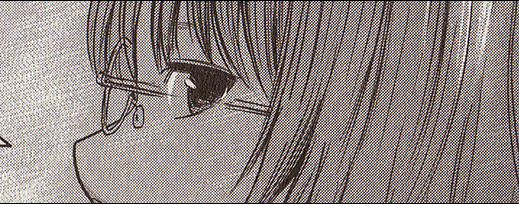
Incidentally, with the importance of facial expression to the work, Oshimi makes an important design decision with regard to Nakamura. Nearly constantly wearing glasses could have easily saboutaged her entire character's visual strength, as glasses very neatly hide or obscure the eyes. And because the eyes play such an important role in Oshimi's manner of conveying expression, a Nakamura with diminished access to that method of facial storytelling would have been disastrous. Instead, Oshimi hides portions of the glasses that might interfere with Nakamura's expression. Often this will be the top rims of her frames, but sometimes he'll abolish other bits of the glasses' structure—as in this example in which Nakamura looks through one of the glasses' arms so that she can look from profile and the reader still knows exactly what she's expressing.
"The lady's maids, to whom every prince is handsome,
No longer can find gowns shameless enough
To wring a smile from this young skeleton. "
—Baudelaire
Oshimi also uses art to heighten the sexual tension of the book and thereby includes and indicts, pressing the reader to share Kasuga's perspective. It's not fan service, meant to titillate the low-class kind of minor perverts that Nakamura dismisses with so much disgust. This is an entirely different kind of thing and, while it may be common, I hadn't personally seen the technique used before. Oshimi uses aspect-to-aspect panel transitions to paint the scene of interpersonal space in a setting. Very, very often, the reader will encounter a couple talking head panels followed by a panel featuring only Nakamura's bust or maybe the hem of Saeki's skirt. These are not generally remotely lurid—Nakamura's bust, for instance, usually features no cleavage and is almost formless in terms of detail—and seems present in order to convey Kasuga's awareness of sexual characteristics more than anything. Here's a two-page example in which Kasuga is having a conversation with Saeki on her sickbed while she is dressed in pajamas.


The presence of the panel featuring Saeki's crotch doesn't seem in place to spur the fantasies of Flowers of Evil's readership but instead to prompt us to empathize with the turmoil Kasuga is experiencing and give us a clue as to its ————....
[Review exceeds Goodreads' character limit. To continue reading the review from which this was excerpted, refer to Good Ok Bad, Home of the 3 Star Review]

December 1, 2014
The Story of a Filthy Fucking Pervert
This review is for the entire series - spoilers ahead!
Like many young adolescents, Kasuga has lofty notions of altruistic and platonic love. He has constructed a fantasy world for himself in which he shares this noble kind of love with his popular classmate Saeki, the girl of his dreams. When, to his great surprise, an actual romantic relationship with Saeki starts to develop, Kasuga is not only thrilled but also terrified. His romantic ideals are finally put to the test, and it immediately becomes clear that love is not as pure an emotion as he had made it out to be. Greed, lust, and plain old cowardice are integral parts of it - a fact that Kasuga's favorite author, Charles Baudelaire, had pointed out all along.
Not ready to leave his rather naïve ideals behind, Kasuga initially denounces anything that interferes with them as "perverted." Gradually, however, he develops a darker concept of love, one that leads him to the mysterious, confrontational, supremely unpopular Nakamura. Unfortunately, Nakamura only seems interested in convincing the world that, as she puts it, "Kasuga's a filthy fucking pervert." Why is she so keen on denigrating poor Kasuga? Does she feel that, by "normal" people's standards, she herself is a "filthy fucking pervert" as well? Does she want to leave the "normal" world behind together with Kasuga? Is she, in her own unconventional ways, really looking for love? Or is she a much more troubled and troubling character who simply takes sadistic pleasure in torturing somebody as confused and manipulable as Kasuga?
The mystery that surrounds Nakamura's bizarre behavior quickly becomes the story's focal point, and it makes for a great hook! Once the mystery has been resolved, however, there are still five volumes to go. The protagonists spend them... "maturing," I guess: Kasuga moves to another town, falls in love again, learns to develop more balanced and stable relationships, leaves behind the fatalistic and ultimately self-destructive attitudes of his youth. Good for him, but not for the story. The shift from manic over-the-top drama to subtle character psychology does not play to Shuzo Oshimi's strengths as a storyteller, and Flowers of Evil thus gradually loses its punch and vigor until it finally ends with a whimper.
This review is for the entire series - spoilers ahead!
Like many young adolescents, Kasuga has lofty notions of altruistic and platonic love. He has constructed a fantasy world for himself in which he shares this noble kind of love with his popular classmate Saeki, the girl of his dreams. When, to his great surprise, an actual romantic relationship with Saeki starts to develop, Kasuga is not only thrilled but also terrified. His romantic ideals are finally put to the test, and it immediately becomes clear that love is not as pure an emotion as he had made it out to be. Greed, lust, and plain old cowardice are integral parts of it - a fact that Kasuga's favorite author, Charles Baudelaire, had pointed out all along.
Not ready to leave his rather naïve ideals behind, Kasuga initially denounces anything that interferes with them as "perverted." Gradually, however, he develops a darker concept of love, one that leads him to the mysterious, confrontational, supremely unpopular Nakamura. Unfortunately, Nakamura only seems interested in convincing the world that, as she puts it, "Kasuga's a filthy fucking pervert." Why is she so keen on denigrating poor Kasuga? Does she feel that, by "normal" people's standards, she herself is a "filthy fucking pervert" as well? Does she want to leave the "normal" world behind together with Kasuga? Is she, in her own unconventional ways, really looking for love? Or is she a much more troubled and troubling character who simply takes sadistic pleasure in torturing somebody as confused and manipulable as Kasuga?
The mystery that surrounds Nakamura's bizarre behavior quickly becomes the story's focal point, and it makes for a great hook! Once the mystery has been resolved, however, there are still five volumes to go. The protagonists spend them... "maturing," I guess: Kasuga moves to another town, falls in love again, learns to develop more balanced and stable relationships, leaves behind the fatalistic and ultimately self-destructive attitudes of his youth. Good for him, but not for the story. The shift from manic over-the-top drama to subtle character psychology does not play to Shuzo Oshimi's strengths as a storyteller, and Flowers of Evil thus gradually loses its punch and vigor until it finally ends with a whimper.

February 3, 2016
Kasuga is a schoolboy obsessed with Saeki, his classmate. One day after school he spies her gym clothes at the back of the empty classroom and steals them - but bad girl Nakamura saw him and is gonna blackmail him with his dirty secret!
Shuzo Oshimi’s The Flowers of Evil explores teen sexuality from the perspective of early pubescent kids who’re just beginning to experience it. But it’s also a very Japanese book in that sex is so repressed over there (have you seen their pixelated porn?! I mean, me neither...) that these kids, understandably already confused with their desires, express them in ways some might consider perverted - stealing gym clothes or blackmailing someone because they’re too shy to tell them they like them.
Unfortunately there’s not much else to this book. I suppose it’s a worthwhile subject but the material isn’t enough to fill a 200-page comic. I’m not even sure why it’s called The Flowers of Evil besides the facts that the author is a Baudelaire fan and Kasuga reads his poetry in the story - otherwise there’s no connection that I can see here. But then, not being one for poetry, I’ve not read Baudelaire so maybe I don’t know that he wrote a poem about horny Japanese schoolkids?
Oshimi didn’t hook me with the premise and this first volume didn’t wow me either - maybe teens will get something out of this? For a supposedly racy topic The Flowers of Evil is pretty dull stuff.
Shuzo Oshimi’s The Flowers of Evil explores teen sexuality from the perspective of early pubescent kids who’re just beginning to experience it. But it’s also a very Japanese book in that sex is so repressed over there (have you seen their pixelated porn?! I mean, me neither...) that these kids, understandably already confused with their desires, express them in ways some might consider perverted - stealing gym clothes or blackmailing someone because they’re too shy to tell them they like them.
Unfortunately there’s not much else to this book. I suppose it’s a worthwhile subject but the material isn’t enough to fill a 200-page comic. I’m not even sure why it’s called The Flowers of Evil besides the facts that the author is a Baudelaire fan and Kasuga reads his poetry in the story - otherwise there’s no connection that I can see here. But then, not being one for poetry, I’ve not read Baudelaire so maybe I don’t know that he wrote a poem about horny Japanese schoolkids?
Oshimi didn’t hook me with the premise and this first volume didn’t wow me either - maybe teens will get something out of this? For a supposedly racy topic The Flowers of Evil is pretty dull stuff.

March 19, 2024
Not sure where this is going, but I feel like it has the potential to be really anxiety inducing.
Update: I will not be continuing this series, I think it’s too YA/not for me.
Update: I will not be continuing this series, I think it’s too YA/not for me.
February 19, 2018
This was a really weird book. However, it's from Japan, so I expect no less.
A nerdy dude who reads a lot of books and hangs out with other losers in school has a huge crush on a girl. One day after school he goes back to grab his book and finds her gym bag on the floor. He decides to steal it and take it home because, well it has her school uniform that she wore that day at gym, and he'd like to do some nasty things (Boy lingo for jerking off). However, the news comes out that her stuff is stolen and someone must be a huge perv! Then we find out the girl who sits behind the boy knows he stole it and becomes to play with him. Creating a "contract" that he must do whatever she says or she's going to tell on him. However, she might be more of a perv than him.
Good: It's goofy and funny and weird and it all somehow is interesting. The main girl who is toying with the main character (sorry names are slipping me) is a real weirdo and kind of hot in the way she uses him to get what she wants. Also the art is pretty solid as well.
Bad: The dialog can sometimes be confusing. Like the way they talk, I'm like, who the fuck talks like that? Also the main character is a giant pussy, and that seems to be the general rule of character for 50% of manga and it's annoying but yeah.
Overall this was fun, weird, and I want to read more. So it sums up most Manga for me haha. A 3 out of 5.
A nerdy dude who reads a lot of books and hangs out with other losers in school has a huge crush on a girl. One day after school he goes back to grab his book and finds her gym bag on the floor. He decides to steal it and take it home because, well it has her school uniform that she wore that day at gym, and he'd like to do some nasty things (Boy lingo for jerking off). However, the news comes out that her stuff is stolen and someone must be a huge perv! Then we find out the girl who sits behind the boy knows he stole it and becomes to play with him. Creating a "contract" that he must do whatever she says or she's going to tell on him. However, she might be more of a perv than him.
Good: It's goofy and funny and weird and it all somehow is interesting. The main girl who is toying with the main character (sorry names are slipping me) is a real weirdo and kind of hot in the way she uses him to get what she wants. Also the art is pretty solid as well.
Bad: The dialog can sometimes be confusing. Like the way they talk, I'm like, who the fuck talks like that? Also the main character is a giant pussy, and that seems to be the general rule of character for 50% of manga and it's annoying but yeah.
Overall this was fun, weird, and I want to read more. So it sums up most Manga for me haha. A 3 out of 5.

August 29, 2019
Four and a half.
I've gone over many lists of favorite mangas in order to find a next series, and yet I had never heard of this one. The summary trapped me immediately: it's about an introvert with a hard-on for Baudelaire's work, and who believes that nobody in his small town in some mountain foothills could reach his level of intellectual sensibility. The kid has a crush on a naïve, pretty classmate of his, and one time that he was alone in the classroom in the afternoon he steals that girl's gym clothes on impulse. Really unfortunately for him, he wasn't completely alone: his classmate Sawa Nakamura, the closest thing to a straight up sociopath I've come across in fiction recently, was spying on him. She finds in the protagonist an exciting new toy, and if he does whatever she wants, she won't tell a soul.
That didn't sound too far off from a sleeper hit I enjoyed some time ago, "Onani Master Kurosawa". In that one, the protagonist was a malicious loner that spent his afternoons jerking off in the girls' bathroom while fantasizing about raping them. He's also found out by a female classmate of his, who also turns out to be weird enough to not tell anyone else, yet in the case of that story that classmate was a mostly ugly girl who was being bullied by other girls. The protagonist of that story avenged her, out of the kindness of his heart, by coating in semen the possessions of some of those bullies (the most memorable panel of that manga for me was a shot of a catenary of semen hanging from a flute and the lips of the girl that had attempted to play it), and the bullied girl and the protagonist form a bond based on blackmail that will cause havok in the local community. However, the girl in that story was someone mostly frayed from being unpleasant looking and having been bullied. The further she went into revenge the more she suffered.
In the case of this series I'm reviewing, the blackmailing girl is, as mentioned, a straight up sociopath, and as such she's less interesting. Once you've had to deal with sociopaths you know how it goes: they act in order to avoid boredom, and they get their kicks from stirring up mayhem and hurting people. It's not just that they lack empathy, but they actively intend to make others suffer. However, the author did a great job depicting how this girl suffered for being alone, even if the reason of her loneliness was that nobody else had such a disdain and malicious intent towards the whole of humanity.
Like "Welcome to the NHK", a series I absolutely adore and that I will probably revisit over the years, this one is about young people who realize they have no place in this world, and who have to carve themselves some kind of tolerable path instead of killing themselves. However, while "Welcome to the NHK" is mostly sad and pathetic, this one is mean spirited and creepy. Although I can understand the protagonist, I can't be on his side.
At its core, this is a sort of psychological horror story. The protagonist regrets from the get-go having stolen those gym clothes from such a sweet, innocent girl, and the guilt and shame consume him. Unfortunately he's also quite spineless, at least in the first four volumes. He spends most of his time crying, yelling or shitting himself. His actions are mostly driven by blackmail or fear.
I expected an entire arc in the vein of the aforementioned "Onani Master Kurosawa": it would handle the shame and blackmail and there would be some sort of redemption arc in the second half. This one is quite different: .
.
The author subtly built that naïve, sweet classmate that the protagonist has a massive crush on. She is forced to fill her time with piano lessons and studying. She wishes for freedom, and the way she has been straightjacketed into fulfilling her parents' expectations has destroyed her self-esteem. Just the protagonist, a boring loner, paying attention to her warmed her heart; during a few clingy episodes the poor girl states how happy it made her to be thought of that way by someone. She's a pretty girl that not only doesn't know it, but believes herself on the level of dirt, and simultaneously trusts that everybody is a good person. Anyone with a modicum of common sense would have realized that that male introverted classmate with dead eyes and burying his face in fancy books is not "interesting" or "mysterious", but someone to stay away from. The poor girl is prey, and as a reader I feared the hurt that would inevitably come.
The art is surprisingly good, particularly against the obvious comparison of "Onani Master Kurosawa". It has the kind of detailed, well framed panels that you wouldn't really expect in a story about a kid and a sociopath pushing each other to reach their peak pervertedness.
In the back pages of a couple of chapters, the author goes as far as explaining his inspiration for this story. He was that kind of loner, somewhat deranged kid who spent his time reading complicated foreign literature. He also used to go into girls' bathrooms and slide small mirrors to peek at their vaginas. And yet this kind of raw, honest deep dive into abnormal psychology many of their works display is one of the things for which I admire Japanese fiction so much.
I'm about 18-20 volumes in, of around sixty something. I have no idea what route this series is going to take from this point.
I've gone over many lists of favorite mangas in order to find a next series, and yet I had never heard of this one. The summary trapped me immediately: it's about an introvert with a hard-on for Baudelaire's work, and who believes that nobody in his small town in some mountain foothills could reach his level of intellectual sensibility. The kid has a crush on a naïve, pretty classmate of his, and one time that he was alone in the classroom in the afternoon he steals that girl's gym clothes on impulse. Really unfortunately for him, he wasn't completely alone: his classmate Sawa Nakamura, the closest thing to a straight up sociopath I've come across in fiction recently, was spying on him. She finds in the protagonist an exciting new toy, and if he does whatever she wants, she won't tell a soul.
That didn't sound too far off from a sleeper hit I enjoyed some time ago, "Onani Master Kurosawa". In that one, the protagonist was a malicious loner that spent his afternoons jerking off in the girls' bathroom while fantasizing about raping them. He's also found out by a female classmate of his, who also turns out to be weird enough to not tell anyone else, yet in the case of that story that classmate was a mostly ugly girl who was being bullied by other girls. The protagonist of that story avenged her, out of the kindness of his heart, by coating in semen the possessions of some of those bullies (the most memorable panel of that manga for me was a shot of a catenary of semen hanging from a flute and the lips of the girl that had attempted to play it), and the bullied girl and the protagonist form a bond based on blackmail that will cause havok in the local community. However, the girl in that story was someone mostly frayed from being unpleasant looking and having been bullied. The further she went into revenge the more she suffered.
In the case of this series I'm reviewing, the blackmailing girl is, as mentioned, a straight up sociopath, and as such she's less interesting. Once you've had to deal with sociopaths you know how it goes: they act in order to avoid boredom, and they get their kicks from stirring up mayhem and hurting people. It's not just that they lack empathy, but they actively intend to make others suffer. However, the author did a great job depicting how this girl suffered for being alone, even if the reason of her loneliness was that nobody else had such a disdain and malicious intent towards the whole of humanity.
Like "Welcome to the NHK", a series I absolutely adore and that I will probably revisit over the years, this one is about young people who realize they have no place in this world, and who have to carve themselves some kind of tolerable path instead of killing themselves. However, while "Welcome to the NHK" is mostly sad and pathetic, this one is mean spirited and creepy. Although I can understand the protagonist, I can't be on his side.
At its core, this is a sort of psychological horror story. The protagonist regrets from the get-go having stolen those gym clothes from such a sweet, innocent girl, and the guilt and shame consume him. Unfortunately he's also quite spineless, at least in the first four volumes. He spends most of his time crying, yelling or shitting himself. His actions are mostly driven by blackmail or fear.
I expected an entire arc in the vein of the aforementioned "Onani Master Kurosawa": it would handle the shame and blackmail and there would be some sort of redemption arc in the second half. This one is quite different: .
.
The author subtly built that naïve, sweet classmate that the protagonist has a massive crush on. She is forced to fill her time with piano lessons and studying. She wishes for freedom, and the way she has been straightjacketed into fulfilling her parents' expectations has destroyed her self-esteem. Just the protagonist, a boring loner, paying attention to her warmed her heart; during a few clingy episodes the poor girl states how happy it made her to be thought of that way by someone. She's a pretty girl that not only doesn't know it, but believes herself on the level of dirt, and simultaneously trusts that everybody is a good person. Anyone with a modicum of common sense would have realized that that male introverted classmate with dead eyes and burying his face in fancy books is not "interesting" or "mysterious", but someone to stay away from. The poor girl is prey, and as a reader I feared the hurt that would inevitably come.
The art is surprisingly good, particularly against the obvious comparison of "Onani Master Kurosawa". It has the kind of detailed, well framed panels that you wouldn't really expect in a story about a kid and a sociopath pushing each other to reach their peak pervertedness.
In the back pages of a couple of chapters, the author goes as far as explaining his inspiration for this story. He was that kind of loner, somewhat deranged kid who spent his time reading complicated foreign literature. He also used to go into girls' bathrooms and slide small mirrors to peek at their vaginas. And yet this kind of raw, honest deep dive into abnormal psychology many of their works display is one of the things for which I admire Japanese fiction so much.
I'm about 18-20 volumes in, of around sixty something. I have no idea what route this series is going to take from this point.

May 1, 2013
I can't recommend this manga because I found what little I read of it distasteful...but so far I think the anime version is fantastic. The rotoscope animation, the deliciously creepy music, the moody atmosphere that's been created -- everything in the anime has helped to put a spotlight on the biggest strength of the manga: the psychological studies of these deeply flawed teenagers. To anyone who was disappointed in the manga (as I was), give the anime a try since, no matter what the manga purists (or rotoscope haters) say, the anime really helps this story be told in one of the best ways it could be.
May 27, 2021
nope :(
the description isn't true to the book at all, and felt purposefully deceiving.
i don't want to read about 12 year olds being gross pervy humans. it all made me very uncomfortable.
it also felt like the author made excuses for his own perverted behaviour in his afterwords, saying every person has tendencies, but sir...no. not everybody wants to hide in the bathroom to look at the next stall with a mirror ! it showed me the author doesn't have a normal view on these things which makes writing about them and drawing them only more disgusting.
the description isn't true to the book at all, and felt purposefully deceiving.
i don't want to read about 12 year olds being gross pervy humans. it all made me very uncomfortable.
it also felt like the author made excuses for his own perverted behaviour in his afterwords, saying every person has tendencies, but sir...no. not everybody wants to hide in the bathroom to look at the next stall with a mirror ! it showed me the author doesn't have a normal view on these things which makes writing about them and drawing them only more disgusting.

December 11, 2018
🤦🏻♀️ dumb and disgusting

January 11, 2023
Very strange..

February 18, 2015
I've said this before and I'll say it again: Adults who want to be young again must not remember how hard growing up can be.
This graphic novel series is a semi-autobiographical story about Takao Kasuga. He is in middle school, an avid reader, failing a class or two, and puberty comes knocking. Nakagawa, the class bully and all around strange girl, sees Takao do something that he is deeply ashamed of, and uses this power to make his life hell. Nanako Saeki is the beautiful and smart girl Takao has a crush on.
On the surface, this is a simple coming of age story, about a boy, a crush, a bully, and peer pressure. What I loved is the honesty with which the story is told. Like most of us, Takao is neither a hero nor a villain. He is just an average kid, who loves books, especially one by Baudelaire, and cannot find anyone in his little town who understands his passion, which makes him feel trapped and lonely. The tsunami of emotions he experiences in this first volume are those that can only be felt by the very young - the highest highs and lowest lows.
I really liked the art, and this black and white manga needs to be read back to front, and each panel reads right to left, which takes a little getting used to, but is quite fun. I'm not sure if this series is targeted at middle school kids, but this volume would certainly stir up some great conversation with kids that age. There are ten volumes in this series, and I've already got the next two in the series on hold at my library.
This graphic novel series is a semi-autobiographical story about Takao Kasuga. He is in middle school, an avid reader, failing a class or two, and puberty comes knocking. Nakagawa, the class bully and all around strange girl, sees Takao do something that he is deeply ashamed of, and uses this power to make his life hell. Nanako Saeki is the beautiful and smart girl Takao has a crush on.
On the surface, this is a simple coming of age story, about a boy, a crush, a bully, and peer pressure. What I loved is the honesty with which the story is told. Like most of us, Takao is neither a hero nor a villain. He is just an average kid, who loves books, especially one by Baudelaire, and cannot find anyone in his little town who understands his passion, which makes him feel trapped and lonely. The tsunami of emotions he experiences in this first volume are those that can only be felt by the very young - the highest highs and lowest lows.
I really liked the art, and this black and white manga needs to be read back to front, and each panel reads right to left, which takes a little getting used to, but is quite fun. I'm not sure if this series is targeted at middle school kids, but this volume would certainly stir up some great conversation with kids that age. There are ten volumes in this series, and I've already got the next two in the series on hold at my library.

May 24, 2022
Feels suspicious and indecent—but I've yet to see if this is nastily noble
Another sexual awakening series from sensei. I really enjoyed Happiness so I'm giving this one a try seeing this is more popular. Scandalous as it is—this is really a good one. And when I found out he's referencing french literature, I just lost my shit. I need to see the ending of this series!! But my heart's set on Ace of the Diamond series so I gotta finish that classic one first! After all kindle subscription only lets you at least 20 books in your library—not very "unlimited" huh
Another sexual awakening series from sensei. I really enjoyed Happiness so I'm giving this one a try seeing this is more popular. Scandalous as it is—this is really a good one. And when I found out he's referencing french literature, I just lost my shit. I need to see the ending of this series!! But my heart's set on Ace of the Diamond series so I gotta finish that classic one first! After all kindle subscription only lets you at least 20 books in your library—not very "unlimited" huh

Read
May 5, 2020My original review here wasn't very good. I'll be giving this manga another go in the future.
August 27, 2026
before i started reading this volume, i had heard a review that mentioned this manga is for a specific type of person. i feel like if i was thirteen years old again, at a more edgy time in my life, i would’ve liked this more. however, reading this as an adult and skimming through the next couple of volumes makes me think that this story doesn’t go as far as i would want it to. there are more perverse, weird stories out there that i would rather be dedicating my time to, therefore i will be dnf’ing this series.

June 28, 2013
See Seth Hahne's more complete and great review. But I liked this a lot. Made me smile. Middle school horrors book. Kashuga is a bookworm whose favorite book is Baudelaire's Flowers of Evil. One day on a whim he steals the gym clothes of a girl he likes; another girl who seems to like him observes this, blackmails him, ah, the anguish…. Baudelaire doesn't figure in too much in this one, except maybe in a mock-epic way, or maybe all the despair and anguish of the young poet are somehow equated with middle school melodrama, I don't know… But this feels real in some ways and fun squirmy in other ways. I guess the more I think of it Baudelaire focused on beauty and its changing nature, and one's changing relationship with and definitions of it, so that fits for middle school or for desire, generally. Fleeting, ephemeral experiences… hmm, maybe it fits better than I had initially thought! I recommend it; a very fast read but worth looking at.
PS: Okay, now I read Seth's more thoughtful review on the Baudelaire point and agree with him completely, it's not random, it's thoughtful, and I like the collection even more than I did….
PS: Okay, now I read Seth's more thoughtful review on the Baudelaire point and agree with him completely, it's not random, it's thoughtful, and I like the collection even more than I did….
July 27, 2022
It's been a challenge for me to categorise Flowers of Evil using the same categories and topics that are frequently used to categorise every other anime and manga under the sun.
This manga actually has the potential to be classified as a "horror-manga" because everything unfolds like a bizarre, never-ending nightmare. Mind you, not the kind of nightmare where you're being pursued by a killer on the loose. Instead, it's more like the kind of nightmare where you realise you forgot to pack clothing for school. The genre (which I would call "social-horror").

If not for that, I would like to refer to it as a dark comedy because it occasionally made me giggle.
This manga actually has the potential to be classified as a "horror-manga" because everything unfolds like a bizarre, never-ending nightmare. Mind you, not the kind of nightmare where you're being pursued by a killer on the loose. Instead, it's more like the kind of nightmare where you realise you forgot to pack clothing for school. The genre (which I would call "social-horror").
If not for that, I would like to refer to it as a dark comedy because it occasionally made me giggle.

October 17, 2012
This is a very bizarre manga! This has a lot of abuse and dominant/submissive situations all centered around middle schoolers! Actually its compelling, creepy and totally odd all at the same time. You feel for Kasuga even as you are bowled over by the simply crazy situations he gets himself into.
I simply don't know what to say about Nanako and the things she does to Kasuga, the things she calls him too! Yet he does the things she asks.
BOTTOM LINE: Not for everyone, maybe not me either...
I simply don't know what to say about Nanako and the things she does to Kasuga, the things she calls him too! Yet he does the things she asks.
BOTTOM LINE: Not for everyone, maybe not me either...

April 23, 2022
4.5 ★ i first read the mangaka's work "blood on the tracks" and it was soo good, this one didn't disappoint 😭 that endinggg, i'll be reading the analysis of this manga 🤌

March 12, 2016

Manga: The Flowers of Evil Vol. 1 (The Flowers of Evil 1#) by Shuzo Oshimi.
Genre: Coming of Age, Drama, Slice of Life, Seinen, Young-Adult, Horror, Psychological.
Age: Young-Adult, Mature, defiantly not for your kiddies.
Pages: 208 pages.
Format: Kindle.
Publication: December 8th 2015 by Kodansha
Final Rating: 3.5/5
"This heavy burden to uplift,
O Sysiphus, thy pluck is required!
And even though the heart aspired,
Art is long and Time is swift.
Afar from sepulchres renowned,
To a graveyard, quite apart,
Like a broken drum, my heart,
Beats the funeral marches' sound.
Many a buried jewel sleeps
In the long-forgotten deeps,
Far from mattock and from sound;
Many a flower wafts aloft
Its perfumes, like a secret soft,
Within the solitudes, profound." - Charles Baudelaire, Flowers of Evil, Ill Luck.
You know, some mangas can only be truly appreciated once you encounter it on the big screen. In this case, I didn't like the Flowers of Evil Anime only because of the use of rotoscoping. If you don't know what rotoscoping is, it's basically an animation by using frame by frame work which a lot of creators use in life-actions to animations films. So watching that adaption was both weird and just... odd. I loved the story, the characters seems interesting but then when I finished it, I just wanted to understand. Understand why everyone I knew hated that thing, telling me constantly, 'drop it! it's not like the manga. READ THE MANGA!'
And finally, I did it. I decided why not read the entire manga? I already did once, so why not again, since I am feeling nostalgic at the moment. Boy, did I forgot how whacky this series started... I actually kinda scared to go beyond this volume since I remembered how off putting and bizarre it was the first time I saw and read it. I suppose like time that drifts and pass so is my view on things. Which when I reread stuff gives me a whole new perspective on the subject at hands.
Oh, by the way before I start my ranting, I highly recommend that if some of you folks are sensitive to certain "subjects" should not read this. It can be... unpleasant sometimes.
STORY AND WORLD BUILDING:

The story starts simply. Takao Kasuga is a timid regular boy with no particular interest besides reading. He's life goes on with no care in the world, the only thing on his mind it's books. He barley give attention to his studies nor his friends, nothing matter. Well, that is except a certain individual that caught his eyes. The class favorite and most loveable person, Nanako Saeki. He immortalized her, desiring her but he doesn't have the courage to confess his feelings to her. Which truly is sad...
Days passes on and Takao by accident forget to take his recent read with him home. He straight goes back to the school hoping to find at his desk. He finally finds his book only for his mind to get distracted by a a very strange bag. On this day, Takao's easygoing life are going to become a massive pain in his back.
To tell the truth, when I first saw the anime and how the story was presented like many I thought this was going to be a school comedy. But oh boy, was I wrong. In fact, this story is nothing like that. There's nothing funny about it. The Flowers of Evil is a story introducing us to a boy who gets in the wrong place in the wrong time, and then it leads to certain situations that god knows why he letting this happening.
You will either abandon this story or be frighten or disgust by it since it can be sometimes through the story come offs as unsettling. But it does fit with what this story is about. A teenager growing up in a world and basically meets somebody that will change and shatter his world. Whatever it is for the worst or bad is up to him...
Although even though this story is good, this story has have certain problems. Like the characters motivations or the fact that nobody besides our protagonist or Nakamura doing anything relevant. Maybe in the next volume things will changed for the better!
On another note, like the title of the manga there is the book that inspired it. Flowers of Evil is a Charles Baudelaire poem collection he wrote about his painful life and struggles. You can pretty much see by reading the poems of Sir Baudelaire that Shuzo Oshimi has took several inspirations from the poems which we will later see in other volumes. I love it. It gives you this uncertain desire to know more about the inspiration that Shuzo Oshimi used for his work and how Baudelaire's book has whatever relevance on the plot or the characters.
CHARACTERS:

"I don't know if 'good' is the right word. I just... Books changed my world. I guess not everybody would understand."
Takao Kasuga is basically a generic shy person who has no charisma or special qualities except he surround himself with books nobody heard about. He thinks he is superior in a way comparing to other adolescence crowed. He has a huge crush on Nanako and let me just say at first I thought it was a stupid hormone teenager silly fantasy. I am sure everyone had those, but let's say it takes it to a whole new level.
The guy is so head over heels on Nanako he made her the freaking holy grail in his eyesight. Doing even the slightest thing that might be "sinful" will never be right in her book. And when he finds her gym clothes beg things just get worse. At first we see how it breaks him, he wants to come clean and return the clothes but the situation gets out of hand thanks to not only his classmates but Nakamura who now basically has complete control over him.
Takao start as a good boring character struggling with the guilty, trying to atone for his sins but eventually is starting the evil Nakamura lulls him in her song. I won't explain what happenes much next, but if you really want to know... Well, let's say she is making him, Yeah. You heard me right. Remember what I said before? DON'T READ IF YOU ARE NOT MATURE ENOUGH. It actually kinda new and interesting where his new development will take him.

"I'll let it go, Kasuga. I won't tell anyone. In return you'll make a contract with me."
Sawa Nakamura is an outsider not having a care in the world to anybody nor to her academic life. She is keeping to herself until Takao does what he does and Nakamura witness it all and from here things gets complicated. Nakamura wants Takao to make a contract with her, to obey her commands, to tell her all his darkest most vilest thoughts and last but not least forcing him to unimaginable situations.
She is clearly sadistic or in her mind helpful to Takao. Trying to free him, to unshackle his perverted thoughts and rendered him into something he clearly isn't. I have no idea why she does it or what her intentions are, but I really am interest how things will develop later onw with those two.
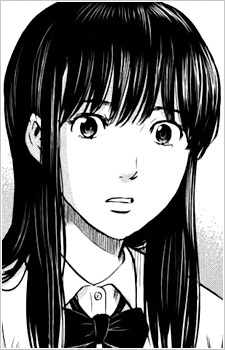
"You were really cool, Kasuga."
Nanako Saeki is the Force Love Interest aka the FRY. She is only here to served as Takao supposed love interest and his desires but I actually sees something else to her. I don't know why, but the way she unlike her classmates who alienated Nakamura or treats Takao differently she is actually reacts better then them. In a way I think she was created as the foil to Nakamura's evil, serving as Takao's light. If he can continue living with her on the light or in the dark is up to him. I do hope she will step up and take a lead and realize Takao is not really as cool as she thought he was.
Of course there's other minor characters like Takako's parents that don't do much but seems interesting to explore about but despite that, the character serve so little to the plot itself except the main trio. If you thinking they might have any purpose in the plot, I am sorry but I cannot be sure, maybe they will maybe they will not and in all honestly I don't care at all about their opinions. I only care to read more about Takao's struggle, Nakamura cunning charisma and Nanako involvement in the story.
WRITING & ARTWORK:

Shuzo Oshimi has a very interesting story to tell. Of course I feel that perhaps instead of a manga he might would have portrait better as a light novel, then we could have got better characterization in Takao to maybe in Nakamura and hack maybe even Nanako. It feels like a story that should have multiple POVs between the main trio and how each interact and grow in this world.However, despite that Mr Oshimi do get the pacing right with the story itself helping to flesh out the characters and the story moves perfectly regardless of my mixed feelings on it.
His artwork on the other hand is magnificent. It blends perfectly into the story, giving a innocent look yet grown up on the characters and it's story presentation, plus I love the flower of evil keeping popping out or Nakamura faces stares. They are the highlight of this book in my mind. Of course my problem lies in the cover art, it just so bland, but yet it does gives the wrong deception that this book is not the cutely comedic shonen manga you think you'd be reading. I guess Sometimes you better be careful what you wish for. Isn't it right, Takao? ;)
OVERROLL:

To be fair, I love this manga but i thought the beginning was a bit... slow. The pacing suppose to be slow which fits the story narration and how real life is like, things happening slowly but gradually growing into something truly intimidating that you do not know how to handle. The characters has potential to grow but the writing kinda scrutinized it with only Takao the only one showing us what's happening to him which leaves us in the dark about Nakamura's intentions or Nanako's feeling. But, there's so many stuff that makes me question why and how this is happening. I guess that's part of cultural differences, society, the school and basically what Japan is like. I do strongly suggest that if you do not like this type of regular fiction stories, then you won't be able to like this manga. Be it the creepy tone or the characters you better try to give it a fair trial by reading the first 5 volumes. If not I guess it just not your thing. I on the opposite hand cannot wait to see what Nakamura is planning next for Takao~

July 19, 2026
[volumes 1-11, chapters 1-56] Not a very “”””beginner”””” friendly manga, and I probably wouldn’t have kept reading if I hadn’t already read and enjoyed Blood on the Tracks, but Shuzo Oshimi has such a nuanced perspective on teenage anxieties and sexuality. The love triangle starts to feel a little School Days-y at a certain point (what if TWO crazy girls were in love with you???), but the third act character reflections make his work feel so mature, and I loved the ending. I’d easily recommend this to Oyasumi Punpun fans, with the caveat that the art will feel BAD at the beginning - but for a long stretch around volume 8 it’s genuinely beautiful, when he’s given the time to hatch lines by hand instead of timeline crunching digital screentones.
Genuinely excited to go watch the rotoscoped anime adaptation.
Genuinely excited to go watch the rotoscoped anime adaptation.

February 9, 2022
Man, just when I was beginning to forget how rough being a teen could be. If blackmail, a sense of impending doom, or teen romance are anything you're interested in then this will chill you to the bone!
November 2, 2024
Uważam to za wyższy poziom rozumowania mangi psychologicznej. Mogę tylko wypunktować, że kreska mocno mi nie siedzi (wyglądają jak dzieci). Jednak całość jest wybitna😞

June 20, 2012
The Flowers of Evil is a story about weirdness.
The author wants us to ponder on the definition of weirdness. Why are certain behaviors considered weird? And aren't we all some kind of weird, in a certain way, to a certain degree?
So, if you want to see some weird characters, this is the book to go for. The two main characters are most definitely weird. Why? For me, it qualifies as weird to force a guy to wear the (used) gym clothes of the girl he likes. It is weird for the guy to steal these clothes in the first place and even more to sniff them. It is weird for a guy to lie drooling on the floor with a completely out of it expression, because the girl he likes was friendly to him.
Main character Takao is also very awkward. He's so extremely shy, which is realistic, but a bit tiring to look at. Nakamura on the other hand is not only weird, but extremely manipulative, abusive and might turn into a downright psychopath.
I guess Nakamura's character is supposed to be charming or at least intriguing, plus she's a possible love interest for the main character. If she works for you, the series will probably work a lot better in general. I wanted to slap her and tell her to shut up most of the time.
The art is so-so. It's not bad, but somehow feels flat (three-dimensionally speaking). At times the characters look very small, with too short legs and arms.
I couldn't warm up to the characters at all and even more importantly, I'm really not sure whether the author will reach and sufficiently analyze the psychological depths he is trying to address here. For now I get the impressions that he is drawing something weird just for the sake of it. Which is fine, if that's your genre.
I can't recommend this series to just anyone. If you're interested in "weirdness" and if you like characters like Yuno from Future Diary, Flowers of Evil is worth a try. For me, it's too much.
The author wants us to ponder on the definition of weirdness. Why are certain behaviors considered weird? And aren't we all some kind of weird, in a certain way, to a certain degree?
So, if you want to see some weird characters, this is the book to go for. The two main characters are most definitely weird. Why? For me, it qualifies as weird to force a guy to wear the (used) gym clothes of the girl he likes. It is weird for the guy to steal these clothes in the first place and even more to sniff them. It is weird for a guy to lie drooling on the floor with a completely out of it expression, because the girl he likes was friendly to him.
Main character Takao is also very awkward. He's so extremely shy, which is realistic, but a bit tiring to look at. Nakamura on the other hand is not only weird, but extremely manipulative, abusive and might turn into a downright psychopath.
I guess Nakamura's character is supposed to be charming or at least intriguing, plus she's a possible love interest for the main character. If she works for you, the series will probably work a lot better in general. I wanted to slap her and tell her to shut up most of the time.
The art is so-so. It's not bad, but somehow feels flat (three-dimensionally speaking). At times the characters look very small, with too short legs and arms.
I couldn't warm up to the characters at all and even more importantly, I'm really not sure whether the author will reach and sufficiently analyze the psychological depths he is trying to address here. For now I get the impressions that he is drawing something weird just for the sake of it. Which is fine, if that's your genre.
I can't recommend this series to just anyone. If you're interested in "weirdness" and if you like characters like Yuno from Future Diary, Flowers of Evil is worth a try. For me, it's too much.

May 17, 2024
Well, it’s hard to give this series a review. I’m speechless..
It’s more like a psychological thriller stuff.
It’s more like a psychological thriller stuff.

August 6, 2012
When you pick up a book that takes its title from Baudelaire's poetry, you know you're in for something screwed up, but Jesus Christ.
Here's the short version. This story involves:
1) The main character stealing a girl's gym clothes for masturbatory purposes,
2) A girl blackmailing a guy over (1) and forcing him to
3) Go on a date with the girl he stole clothes from while,
4) Wearing said clothes under his normal outfit, during which time,
5) The blackmailer derives perverse pleasure from watching the whole situation. Oh, and,
6) The characters are all in, like 8th grade.
Sooooo ... yeah, weird.
Vertical's done an okay packaging this series. It's not as nice as some of their other manga, but the simple, austere cover art is fitting. I have to give the translator props -- the scanlation I read would render the foul language as, "fucker" or "asshole" with a footnote explaining that what she really said was, "shitworm," or "human-sized foreskin," while Vertical's translator just gives us the literal translations.
Here's the short version. This story involves:
1) The main character stealing a girl's gym clothes for masturbatory purposes,
2) A girl blackmailing a guy over (1) and forcing him to
3) Go on a date with the girl he stole clothes from while,
4) Wearing said clothes under his normal outfit, during which time,
5) The blackmailer derives perverse pleasure from watching the whole situation. Oh, and,
6) The characters are all in, like 8th grade.
Sooooo ... yeah, weird.
Vertical's done an okay packaging this series. It's not as nice as some of their other manga, but the simple, austere cover art is fitting. I have to give the translator props -- the scanlation I read would render the foul language as, "fucker" or "asshole" with a footnote explaining that what she really said was, "shitworm," or "human-sized foreskin," while Vertical's translator just gives us the literal translations.

April 23, 2021
J'étais pressée de commencer ce manga, étant donné que je lis "Les liens du sang" du même mangaka. J'adore la façon dont il travaille la psychologie des personnages, et la pression qu'il construit autour de ceux-ci ! C'est dérangeant, oppressant, mais c'est tellement différent de ce que j'ai l'habitude de lire que j'adore ! Hâte de lire la suite 👀

February 25, 2013
I've read the manga until the middle of volume 8 (still not fully published), and I'll keep on, but here's the review of the rest:
It's somewhat insane. And weird. And at some moments very dramatic, but it somehow manages to fit and not look stupid. A great read, but would be hard for most people.
It's somewhat insane. And weird. And at some moments very dramatic, but it somehow manages to fit and not look stupid. A great read, but would be hard for most people.

May 13, 2012
Clever and cunning little sleeper of a story about a kid who gets way in over his head with a predatory classmate.
http://www.genjipress.com/2012/05/the...
http://www.genjipress.com/2012/05/the...

June 27, 2021
Slightly reminiscent of Bataille’s story of an eye. Catalyst for an influx of inspiration.

May 14, 2022
ummm wtf
Displaying 1 - 30 of 467 reviews