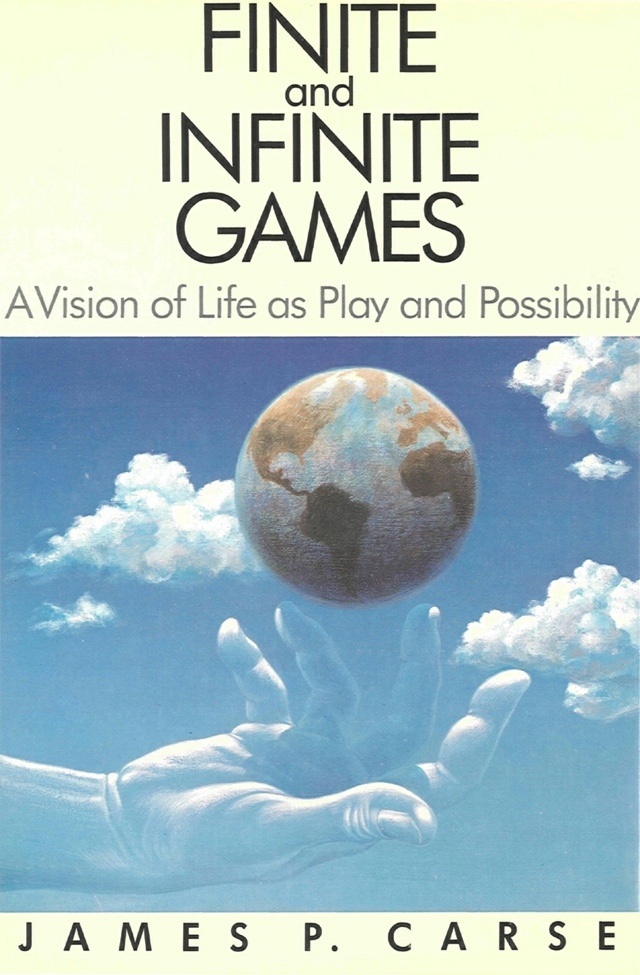
Some good stuff buried under a lot of messy writing and incoherent thought. Logical inconsistencies abound. I think his main problems come with infinite games - his rhetorical structure means he must always present binaries with respect to finite/infinite games, and with finite = bad and infinite = good. As an exploration of finite games, I think there is a lot to recommend here (though often it is simply that the obvious/trite is couched in the language of profundity), but it would have been better had he left infinite games as implied.
He also gets into problems due to his definition of "game" being something that must be voluntary. Which leads to:
" Society remains entirely within our free choice in quite the same way that finite competition, however strenuous or costly to the player, never prevents the player from walking off the field of play."
And
"There are, to be sure, games in which the stakes seem to be life and death. In slavery, for example, or severe political oppression, the refusal to play the demanded role may be paid for with terrible suffering or death. Even in this last, extreme case we must still concede that whoever takes up the commanded role does so by choice. Certainly the price for refusing it is high, but that there is a price at all points to the fact that oppressors themselves acknowledge that even the weakest of their subjects must agree to be oppressed."
Which made me think of Kanye...
But some things I liked:
"Every move an infinite player makes is toward the horizon. Every move made by a finite player is within a boundary. Every moment of an infinite game therefore presents a new vision, a new range of possibilities…What will undo any boundary is the awareness that is it our vision, and not what we are viewing, that is limited."
- the point here, of course, being that a horizon moves as I move, whereas a boundary stays fixed.
"Finite players play within boundaries; infinite players play with boundaries.”
"The outcome of a finite game is the past waiting to happen. Whoever plays toward a certain outcome desires a particular past. By competing for a future prize, finite players compete for a prized past."
"To be prepared against surprise is to be trained. To be prepared for surprise is to be educated. Education discovers an increasing richness in the past, because it sees what is unfinished there. Training regards the past as finished and the future as to be finished. Education leads toward a continuing self-discovery; training leads toward a final self-definition. Training repeats a completed past in the future. Education continues an unfinished past into the future."
You see some of the rhetorical issues he gets himself into in that last one. You can almost hear him getting carried away by the rhythm...
A quote to give an indication of some of the muddle re casual use of Wittgenstein and Heidegger:
“World exists in the form of audience. A world is not all that is the case, but that which determines all that is the case.
An audience consists of persons observing a contest without participating in it.
No one determines who an audience will be. No exercise of power can make a world. A world must be its own spontaneous source. "A world worlds" (Heidegger). Who must be a world cannot be a world.”
I get the sense here these references (one explicit, one by allusion) are intended to add weight to his pronouncements, but in the context of the work as a whole, I do not see how the work of either philosopher has much relevance. What Heidegger means by "world", and what Carse means by it, for example, are very different.
Another example of him getting into a mess, though for different reasons:
"Since being your own genius is dramatic, it has all the paradox of infinite play. You can have what you have only by releasing it to others. The sounds of the words you speak may lie on your own lips, but if you do not relinquish them entirely to a listener they never become words, and you say nothing at all. The words die with the sound. Spoken to me, your words become mine do with as I please. As the genius of your words, you lose all authority over them. So too with thoughts. However you consider them your own, you cannot think the thoughts themselves, but only what they are about. You cannot think thoughts any more than you act actions. If you do not truly speak the words that reside entirely in their own sound, neither can you think that which remains thought or can be translated back into thought. In thinking you cast thoughts beyond themselves, surrendering them to that which they cannot be."
I mean, either I am too dumb to understand the complexity of his thinking, or that is both muddled and wrong.
And then there is stuff like this:
"Sexuality is not a bounded phenomenon but a horizonal phenomenon for infinite players. One can never say, therefore, that an infinite player is homosexual, or heterosexual, or celibate, or adulterous, or faithful-because each of these definitions has to do with boundaries, with circumscribed areas and styles of play. Infinite players do not play within sexual boundaries, but with sexual boundaries. They are concerned not with power but with vision.... Infinite sexuality does not focus its attention on certain parts or regions of the body. Infinite lovers have no "private parts." They do not regard their bodies as having secret zones that can be exposed or made accessible to others for special favors. It is not their bodies but their persons they make accessible to others.”
To which I will just say, "ugh"....
And I would also say "ugh" to things like this:
"One is never ill in general. One is always ill with relation to some bounded activity. It is not cancer that makes me ill. It is because I cannot work, or run, or swallow that I am ill with cancer. The loss of function, the obstruction of an activity, cannot in itself destroy my health. I am too heavy to fly by flapping my arms, but I do not for that reason complain of being sick with weight. However, if I desired to be a fashion model, a dancer, or a jockey, I would consider excessive weight to be a kind of disease and would be likely to consult a doctor, a nutritionist, or another specialist to be cured of it."
All of which comes, I think, from his obsession with that dichotomy.
But, to end more positively, a couple more quotes I quite liked (though they do err too much on the side of the new-agey for my taste):
"To be playful is not to be trivial or frivolous, or to act as though nothing of consequence will happen. On the contrary, when we are playful with each other we relate as free persons, and the relationship is open to surprise; everything that happens is of consequence. It is, in fact, seriousness that closes itself to consequence, for seriousness is a dread of the unpredictable outcome of open possibility. To be serious is to press for a specified conclusion. To be playful is to allow for possibility whatever the cost to oneself"
"We are playful when we engage others at the level of choice, when there is no telling in advance where our relationship with them will come out-- when, in fact, no one has an outcome to be imposed on the relationship, apart from the decision to continue it."
“Because infinite players prepare themselves to be surprised by the future, they play in complete openness. It is not an openness as in candor, but an openness as in vulnerability. It is not a matter of exposing one's unchanging identity, the true self that has always been, but a way of exposing one's ceaseless growth, the dynamic self that has yet to be.”