Jump to ratings and reviews
Rate this book

Taschen Basic Art

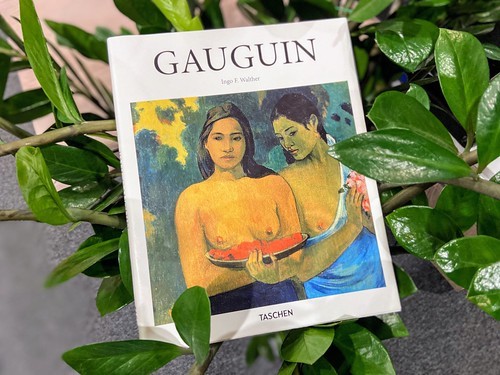
Paul Gauguin (Taschen Basic Art Series) by Ingo F. Walther

Rate this book
Traces the career of the post-Impressionist whose principles of color & composition strongly influenced modern painting, from his earliest works to his signature South Seas paintings of island life. Chronology. 9" x 11 3/4". Full-color plates & b&w illus.

Paperback

First published January 1, 1988

Loading...
Loading...

About the author

Ingo F. Walther

84 books60 followers
Ingo F. Walther was born in Berlin in 1940 and studied medieval studies, literature, and art history in Frankfurt am Main and Munich. He has published numerous books on the art of the Middle Ages and of the 19th and 20th centuries.

Ratings & Reviews

What do you think?
Rate this book

Friends & Following

Create a free account to discover what your friends think of this book!

Community Reviews

5 stars
130 (31%)
4 stars
152 (37%)
3 stars
105 (25%)
2 stars
18 (4%)
1 star
2 (<1%)
Displaying 1 - 30 of 32 reviews
Profile Image for Anna P (whatIreallyRead).
934 reviews579 followers
March 1, 2020
Gauguin by Ingo F. Walther

This book is part of the Taschen Basic Art series - I own a bunch of them, though I've only read 1 before this - Degas. Overall this book was okay but I couldn't help but compare it to Degas and find Gaugin installment lacking in comparison.

For one thing, in this one, the analysis of paintings often leaned toward judgment or personal preference and was, therefore less helpful and interesting. Example of what I mean:

In Anna the Javanese Gauguin was aiming at the same unforced, natural nakedness as in his portraits of Tahitian women. But this time the relaxed animal quality doesn't quite come off.


Dude, WTF? Instead of talking about composition, light, colors, structure, etc., pointing out techniques Gauguin used and to what effect - all of which would be helpful and appreciated - Ingo F. Walther presumes to know the artist's intention and if that impression "came off" or not. He's not quoting some critic or the reception of the painting by public. He's passing off his personal opinion as a universal fact. I don't know who you are and don't care about your opinion. I'm here for Gauguin. There some biographical descriptions sounded judgemental too. I found this inappropriate.

Secondly, the author sometimes did weird skips in time within a paragraph or even a sentence - and it was difficult to grasp the sequence of events and causality.

Thirdly, some sentences were too much to digest. Unnecessarily, I might add. Example:

“What emerges from the combination of a seemingly unambiguous expression of woe and decorative elements apparently devoid of meaning is an evocative portrayal of the enigmatic character of the artist”
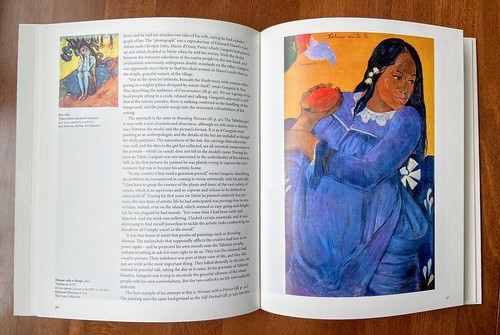

The book contains biographical facts, some analyses of Gauguin's works, some quotes by him and about him. The kind of book one would read to familiarize oneself with the artist. The paper and print are of good quality, there are lots of illustrations, all of them in full color.

Each illustration is accompanied by brief info - the year of painting, materials, name and current location/owner. Here's an example of the inside of the book:

Gauguin Taschen basic art inside

I read this along with The Moon and Sixpence (fiction based on Gauguin's life) and Gauguin's Intimate Journals. The point was to find out how the actual biography compared to the novel.
Profile Image for Brian Fagan.
452 reviews129 followers
September 23, 2021
I am a sucker for Gaugin's Tahitian women. Most of us have a handful of artists (or more) who excite us. Probably not their entire oeuvre, but a special phase of their work that just grabs our imaginations. I love Ansel Adams' photographs of the Sierra Nevada. Georgia O' Keeffe's flowers. Paul Cezanne's still lifes. Andy Warhol's celebrity and wildlife series. Mark Rothko's color field paintings. Andrew Wyeth's northeastern landscapes. Winslow Homer's Adirondack and Key West works. When I think of Gaugin, I think of portraits of dark-skinned women wearing and surrounded by bright tropical colors, composed in a flat geometric arrangement. As I have kept coming back to these paintings, I have actually developed an interest in visiting Tahiti. I know that Tahiti is not the same place now that it was 120 years ago for Gaugin. But I still dream of going there.

A few months ago, I put out a feeler on Goodreads for a book that focuses on Gaugin's work from Tahiti, and got some good recommendations from other readers. This book is not one of those. This is an introduction to Gaugin's art - all of it. I found it at a Half Price Bookstore, as an appetizer until I get my hands on one of the more detailed studies of his Tahiti works. It was written in 1997 by Ingo Walther, a prolific art historian from Germany. Despite the book cover that you see over the review, the full title is Paul Gaugin, 1848 - 1903: The Primitive Sophisticate.

Although I have probably close to a hundred art books, I don't know a lot about qualities of reproductions. The book is "printed on 100% chlorine-free bleached paper in accordance with the TCF standard". That may inform other readers. Regardless, I found the reproductions to be vibrant and clear and in parallel with other Gaugin reproductions that I've seen.

Gaugin actually spent his childhood with his family and grandfather in Peru. When he came of age, he became a sailor for a while, and then went into a more traditional business, which he detested. Once he had saved a good sum, he devoted himself to painting. He married and had five children. As one can imagine, lean years followed, and his wife left with the children to her homeland of Denmark.

He painted in the prevailing impressionist style for a while, but he had a gradual "awakening" that truth in life and in art revolved around removing oneself somehow from the artificial encumbrances of the modern world, and returning to a more primitive state of living and of the mind. His focus turned to the idea of the "noble savage". This was not his own concept, but one probably given credence if not birth by the ills brought about by the Industrial Revolution. It was a yearning to become a "primitive" who lives in harmony with others and with nature. Gaugin decided that living in Tahiti would be a realistic way to pursue this lifestyle, and at the same time kickstart something new in his paintings, which he knew were also tied down by the conventions of the time.

Gaugin lived in Tahiti from 1891 to 1893 and again from 1895 to 1901. I found it interesting that he did not explode with paintings right away after he arrived there. It took him some time to settle into the mood of his new surroundings, but as we know, the inspiration came, and a new Gaugin emerged. When he left the first time in 1893, he wrote that he was "two years older but twenty years younger". Unfortunately, Walther says the benefits of any "new lifestyle" were primarily limited to his art alone - it doesn't appear that he ever gained real happiness, because he had a serious ankle injury, a run of illnesses, and ongoing financial worries that continued to dog him.

Gaugin's masterpieces from Tahiti are stunning. He utilized the technique of Cloissonism, a descendant of Japanese woodcuts, that presents distinct areas of color separated by dark lines. The lines themselves create abstract shapes and intensify the sense of flatness and minimized depth. As I looked at these works, I wondered if Gaugin had been influenced by Rousseau, and the book confirms that. And although I didn't find direct comments on Gaugin being an influence on Matisse, Wikipedia does say that Matisse owned one of Gaugin's paintings. I'd like to learn more about Matisse. It is frustrating to discuss an art book without being able to post a painting within the review, and talk about its impact on me, but there you have it, I'm not that savvy.


1 review
December 9, 2018
The analysis of the artwork is really shallow and inadequate. Lacks the depth and insight seen in other books from the series. Maybe if the author wasn't so busy presenting us with his evaluation of Gauguin's life choices and had concentrated on the artwork this book would've made more sense.
Profile Image for AC.
2,396 reviews
March 21, 2010
This is, as I've implied, a very neurotic book -- but by the end, the author (for all his idiosyncrasies) won me over. It is the late Gauguin that accomplished this.

Gauguin first trip to Tahiti (the source of his most famous pictures) was in 1891-1893. He returned to Tahiti in 1895 after a disastrous interlude in Paris, during which he further broke relations with his wife, Mette, found his work mocked, abandoned by friends -- and during which he also contracted the syphilis that ultimately killed him (1903). It is on his return, however, that his most achingly beautiful work was produced.... and this is something I had never understood. In view of my earlier comments (below), consider this picture of his mistress and newborn son (his 7th). Both mother and child are crowned with a halo. the woman holding the child is supposed to be a nurse -- but she resembles the famous death head of an earlier portrait...., only facing left this time, instead of right.


Nativity. Te tamari no atua. 1896. Oil on canvas. Munich


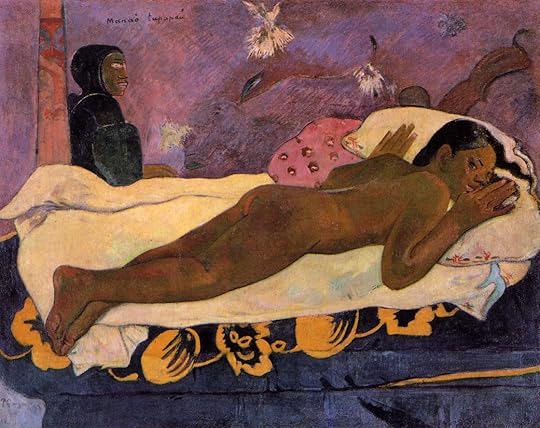
The Spirit of the Dead Keeps Watch. Manao tupapau. 1892. Oil on canvas. Albright-Knox, Buffalo, NY.


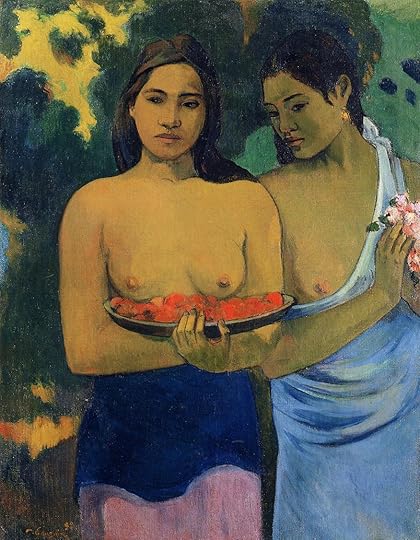
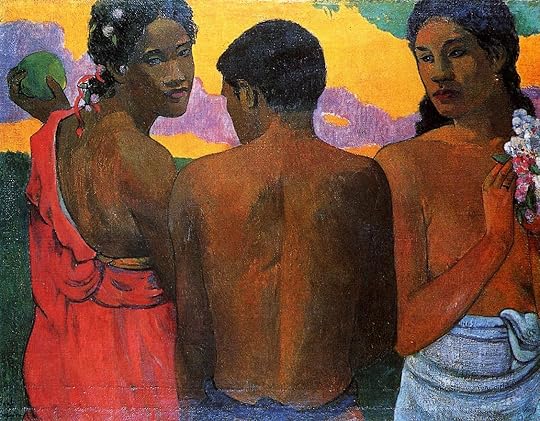
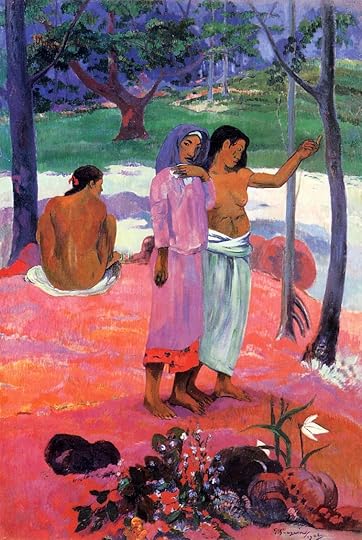
At any rate, here are some of the pictures from that last period....


Two Tahitian Women with Mango Blossoms. 1899. Oil on canvas. Metropolitan Museum of Art, NY


Three Tahitians. 1899. Oil on canvas. National Gallery of Scotland, Edinburgh


The Call. 1902. Oil on canvas. Cleveland Museum of Art
(The woman in the center, with the bonnet, is presumably syphlitic, and is probably one of the women whom Gauguin infected. These bonnets are known from the paintings of Picasso and others at the Asylum of Saint-Lazare.


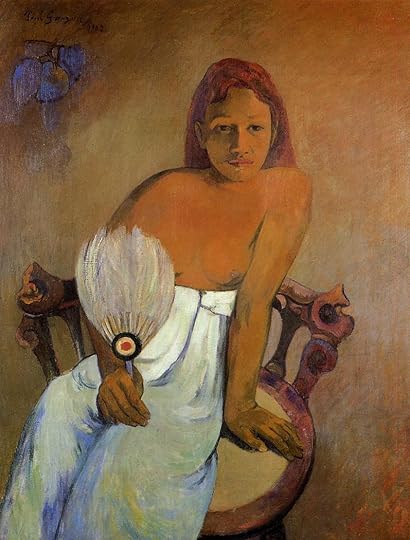
Girl with a Fan. 1902. Oil on canvas. Folkwang Museum, Essen


I am reading this book with great interest. The prints are very well done and the text and prints are presented in an integrated fashion so that one doesn't have to flip back and forth between picture and study. But the author, who is intelligent and informed, apparently despise the painter -- though he appreciates his art. He has a low opinion of Gauguin's character, thinks his flight into primitivism was delusional and hypocritical and inauthentic -- and does not hide his mocking tone. It's both refreshing and disorienting -- refreshing, because I hate nothing more than the hagiography that infects so many biographies; and disorienting, because his attacks on Gauguin (who did, of course, abandon his wife and five children) are -- on the artistic side, at least, not very persuasive.

I'm no great fan of the Symbolists -- but to reduce Verlaine and Mallarmé to nothing more than 'strutting dandies' is a bit facile.

Here is Ingo Walther
(http://www.taschen.com/pages/en/catal...). The book has been translated from German, and the translation itself is a bit stilted.


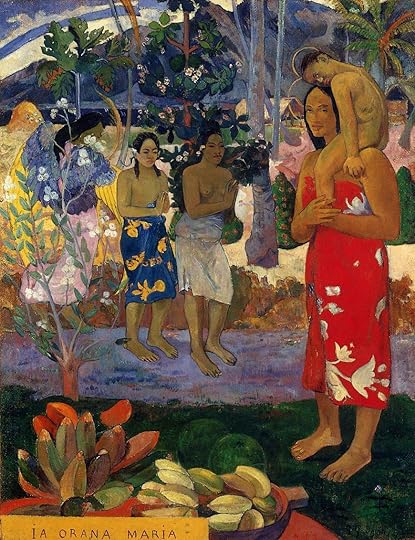
This is the painting (which is absolutely gorgeous) that Walther thinks is fraudulent and hypocritical -- because it assimilates the natives to christianity and is thus implicitly colonizing....


(Ia Orana Maria ['Hail Mary':], 1891)


Such a claim, it seems, is preposterous....

And yet...

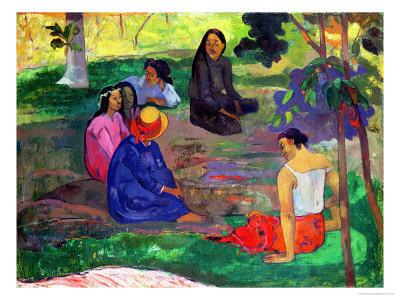
.... before we write-off the author of this little volume too quickly, compare the following picture (Les Parau Parau, 1891), where the women sit in a 'European' style and (apart from the one on the right, at least) with 'European' gestures.... with any of the well-known 'picnic' scenes of the Impressionists..., such as Manet's


Maybe Walther is less of a loon than I think....

Profile Image for Max “Big Lad” McLoughlin.
57 reviews1 follower
July 28, 2026
‘Van Gogh was in all things a man of feeling, passionately devoted to an art of expressive intensity. His impulsive will refused to pause before the fearful abysses in the soul of man. Gauguin's involvement with the human condition, comparatively speaking, was marked by distance. His watchwords were happiness and harmony, and he arrived at them not through any struggle within himself but by yielding to the alien promises of Edenic worlds. Gauguin's art was an art of suggestion, vividly conjuring up realms of alternative realities that lay beyond his ken. Van Gogh's was a more introspective art, an art of expression that was centred on his own personality and problems.’

Decent overview of Gauguin’s life, if a little superficial.
Profile Image for tiago..
514 reviews132 followers
September 12, 2024
Sempre controverso, se alguma coisa Gauguin soube provar é que a sua arte permanece intemporal. Este pequeno livro de Ingo F. Walther, que analisa a sua vida e obra, oferece uma excelente introdução ao personagem e à sua vida conturbada. Recomenda-se vivamente.
Profile Image for Bethan.
290 reviews86 followers
March 31, 2013
Fell in love with Gauguin's paintings as a teen from such an art book. The scenes and bright colours were mellifluous and seductive while keeping a touch of 'the primitive' about it. Most of them were from Gauguin's time in Tahiti and many were sensuous paintings of local women and landscapes.

Weirdly the paintings weren't so effective in person whenever I have been lucky enough to see one, but that sometimes happens (Schiele, for example, I never saw the appeal from books or prints but in-person the effect was unspeakable).
Profile Image for Prabhat Gusain.
138 reviews22 followers
June 20, 2024
The artistic avant-garde has always envisaged society as a straitjacket, imposing limits on the freedom of imagination. The avant-garde sees the possibility of creativity as existing only in opposition to the state's models and norms. The artist dons the garb of genius and proclaims a freedom that cannot be available to all. If he is to justify his demand for societal freedom, he must insist on his calling, his vocation. Gauguin too found himself manoeuvered into this position. And of top of it, he tended increasingly to give himself a martyr's airs: "What did it get me? Total defeat and enemies - that's all. Bad luck has been dogging my heels my whole life long, and the further I go on the deeper I sink."
Thus in his 'Self Portrait' we see Gauguin posing as Christ once again. This time, however, he attempted no self-satisfied comparion. The artist's gaze was one of the straightforward accusation. "This terrible society which we are forced to endure, where little men emerge triumphant at the expense of the great, is our Calvary," he wrote. But he was not attacking his favority enemy, the Old World of Paris & France. The portrait is set against a dark and impenetrable background where two vague figures are appearing, constant companions from the realms of the shades of death. The artist looks calm, resigned to his fate as an outsider, a man like any other: helpless and defenceless. After years of searching, Gauguin had at last found in this Janus face an emblematic portryal of life itself.
His sensitivity towards the special status of the artist who is certain of his visionary faculty merged with an admission of the frailty he shared with all the men, be they primitive or civilized. Caught between the loneliness and solidarity, Gauguin began to accept himself: "Laughing, you climb your Calvary, your legs shake under the weight of the cross; at the top you grind your teeth, and then, smiling, you take your revenge," he wrote cryptically in Avant et apre's, his memoirs of the closing years of his life.
Author 12 books10 followers
March 2, 2020
I always thought Gauguin was a pretentious prat who left his wife for underage girls in Tahiti. Now that I've read more about his life, my opinion of him is a little softer. His wife did the leaving first (not that that excuses the child brides though). And for all he was a product of his age, he did, at least, make a good faith effort to try and learn about other, non-European cultures. How well he succeeded may be up for debate, but he did what no other artist of his peer group did.

I'm still not a big fan of his art. However, getting to see all the reproductions, I have to say I like his coloring. His rendering, on the other hand, looks sloppy rather than 'primitive' (it reminds me of a potter I met once. If the pottery came out well, he sold it as is. If it came out sloppy, he labeled it 'Medieval' and sold it to Renaissance fairs. So you can call slipshod stuff primitive if you like, but actual 'primitive' art is much better). And he does render faces well. Overall, though, I'm partial to other artists of the time period. Per the book (p. 64), one contemporary said "Monsieur Gauguin, I said in a dream, you have created a new earth and a new heaven. But I do not like what you have created." For me, that sums it up - he did live for his art, but it's not my favorite. But the author conveyed his life well and interestingly.
29 reviews
June 17, 2025
-„ Moim zdaniem,wielki artysta to ten który obdarzony jest największą inteligencją.Jest on tym, który doświadcza zarówno uczuć, jak i również niezwykle subtelnych, a więc prawie niedostrzegalnych, poruszeń umysłu.”
- Prawdziwa sztuka nie może istnieć bez fantazji
- dam ci jednà radę- nie maluj zbyt wiele bezpośrednio z natury. Sztuka to abstrakcja- wyciągaj więc z natury, to co abstrakcyjne, kiedy snujesz marzenia, stojàc w jej obliczu, i więcej myśl o dziele, które ma powstać.
- „Dla nich nie ma czegoś takiego jak krajobraz, który sobie wyśnili, stworzyli z niczego. Swoje wysiłki skupiają wokól oka, a nie tajemniczym centrum myśli”
- Artysta zafascynowany pięknem przyrody, wlewa w swoje prace radośc, niemal bolesną w swej intensywności.
- pragnienie zajerestrowania stanów emocjonalnych nie poprzez zestawienie temat-materia, lecz za pomocą form plastycznych i kolorystkyki
This entire review has been hidden because of spoilers.
Profile Image for Inga Freiberga.
67 reviews17 followers
January 5, 2026
4 stars. Gauguin has been one of my favourite artists for a while, but I had completely missed or ignored the person who was creating this art. And I can say with certainty now that, at least based on this book, I do not like the person. It's the first book of this series I have read and it's the first biographic account on Gauguin I have read. I felt it was very factual, but at the same time descriptive about the times, artistic movements and the most important "players". It gave me a feeling that the author is not trying to portray Gaugin better than he was or hiding some things that would affect the reader's perception. The book shows the beauty of the art and the ugliness of the artist. Some would call this a book for a tea-table, in a way it is. You can easily just look at the paintings and enjoy the colors without paying much attention to the text.
Profile Image for Elizabeth Nordquest.
1,304 reviews4 followers
March 6, 2018
This was a really great, quick overview of Paul Gauguin and his art. Nice, large full color reproductions and I'm happy to report the author referenced page numbers when discussing specific paintings.

Gauguin seemed a bit insufferable at times with the way he romanticized Tahitian life for monetary gain and when it didn't work out for him he basically pouted. But I supposed he learned to appreciate Tahiti a bit more during his self-imposed exile later in life. I think? Regardless, the author called him out a few times, which I found amusing.
Profile Image for James F.
1,778 reviews135 followers
August 19, 2020
The book by Ingo Walther is in a slightly larger than normal format and has a high ratio of illustrations (all color) to text; there is also much more interpretation of the paintings than in the two previous books I read. It is published by Taschen and probably also belongs to a series.
32 reviews1 follower
April 18, 2018
A great quick guide to art and life. A very good quality of illustrations, as well.
Profile Image for Les Dangerfield.
268 reviews
May 15, 2018
The usual high standard of art reproductions in this Taschen series. The writing covers the ground but 8s not very engaging.
Profile Image for Jordan B Cooper.
Author 26 books456 followers
January 24, 2022
The book was informative, but the author's personal opinions and biases came across much more in this text than the other books in the series.
Profile Image for Miguel Quintana Muñiz.
69 reviews
March 19, 2022
Al principio no me gustaba mucho pero conforme avanza su carrera se pone más interesante y en mi opinión incluso los cuadros son más interesantes
4 reviews
April 2, 2026
I like this french painter
A very beautiful book; you learn a lot about Gauguin.
Profile Image for James.
980 reviews22 followers
December 30, 2017
An overview of Gauguin's life through his works, from his earlier work in Brittany to his development of synthetism and his self-imposed artistic exile on Tahiti, where he produced some of his best and most recognisable works.

Part gallery, part biography, this is another excellent introduction to the life and work of Gauguin by Taschen - clear and colourful reproductions of paintings and erudite commentary are standards. The author of this particular volume seemed rather hostile to Gauguin, but Gauguin's dissolute lifestyle and abandonment of his family do not do the artist any favours.

As one of the foremost primitivist painters and a post-impressionist, Gauguin's art remains alluring and attractive; his latter years on Tahiti and in the Marquesas exposed him, and by proxy his viewers, to an idyllic and yet non-existant paradise. Already damaged and distorted by French colonialism, the primitive idyll Gauguin sought only truly existed in his paintings and remain an eye-opening window on life in the South Pacific.
Profile Image for Anh Lê.
395 reviews13 followers
April 21, 2026
Hoạ sĩ 'exotic' nhất của trg phái ấn tượng/hậu ấn tượng. M thấy tranh của Gauguin khá hay, từ màu sắc, hình khối đến chủ đề
Profile Image for SA.
1,160 reviews
April 14, 2013
I don't recall why I picked this up to read, other than it was in my field of vision at the library and while I knew Gaugin's paintings and a bit of his life from Paris to the tropics, that was it. Walther gives a good biography of Gaugin, and does what I like with art books: balance the course of events with the creation or conception of the art that accompanied those events. The book was of a fine quality as well, and I was able to see some detail in the paintings as a result. It was effectively gallery and biography all at once, and well worth reading (though Gaugin's life was rather eyerolly).
Profile Image for Tiago.
89 reviews10 followers
April 12, 2010
After reading "Moon and six pence" I got curious to know more about Paul Gaugin works. I found the book great, describing the painter works and adding a bit context according to his life. I found it impartial and correct. The language used in the book is the bad example of art-language, saying too little with too much text. I was hoping to find more information about the time Gaugin spent with van Gogh and comparison of their techniques and styles.
Profile Image for Ralph.
301 reviews
Read
April 13, 2023
This book provides the reader with a fairly accounting of Gauguin’s life and the evolution of his painting style from early days in Paris to his travels, and eventual moving, to Tahiti. Gauguin was ever in search of a simple life or paradise which he most closely found in Tahiti. However, even there he realized that he could never completely escape the ingrained habits and monetary demands of what he had left behind.
713 reviews75 followers
December 28, 2020
“In art, one idea is as good as another. If one takes the idea of trembling, for instance, all of a sudden most art starts to tremble. Michelangelo starts to tremble. El Greco starts to tremble. All the Impressionists start to tremble.”
Profile Image for John  .
167 reviews
July 14, 2022
Gauguin the LARPer. "He had failed in his desire to become a savage." Good on him for trying; it's unusual for yearners to make the attempt e.g. Reddit's forum for people who travel in their vans has hundreds of thousands of readers of whom a fraction of a percent actually live that way.
Displaying 1 - 30 of 32 reviews