Jump to ratings and reviews
Rate this book

The Age of Alexander: Nine Greek Lives

Rate this book
Librarian's note: this is an alternate cover edition - ISBN 10: 0140442863

Plutarch's Lives of the great Greek statesmen amd men of action were designed to pair with the now better-known Roman portraits and contain many of his finest descriptions of war, revolution and heroic achievement. The nine Lives in this selection trace a crucial phase in ancient history, from the collapse of Athens to the rise of Macedonia.

443 pages, Paperback

First published January 1, 100

168 people are currently reading
6135 people want to read

About the author

Plutarch

4,281 books922 followers
Plutarch (later named, upon becoming a Roman citizen, Lucius Mestrius Plutarchus; AD 46–AD 120) was a Greek historian, biographer, and essayist, known primarily for his Parallel Lives and Moralia. He is classified as a Middle Platonist. Plutarch's surviving works were written in Greek, but intended for both Greek and Roman readers.

Ratings & Reviews

What do you think?
Rate this book

Friends & Following

Create a free account to discover what your friends think of this book!

Community Reviews

5 stars
1,238 (42%)
4 stars
1,011 (34%)
3 stars
549 (18%)
2 stars
92 (3%)
1 star
30 (1%)
Displaying 1 - 30 of 143 reviews
Profile Image for Glenn Russell.
1,509 reviews13.3k followers
December 6, 2018


The biographer/philosopher Plutarch (45 AD - 120 AD) begins his life of Alexander by stating, "It must be borne in mind that my design is not to write histories, but lives. And the most glorious exploits do not always furnish us with the clearest discoveries of virtue or vice in men; sometimes a matter of less moment, an expression or a jest, informs us better of their characters and inclinations, than the most famous sieges, the greatest armaments, or the bloodiest battles whatsoever."

I likewise share Plutarch's interest in character rather than straight history. Here are my brief comments following passages from the text:

"For being more bent upon action and glory than either upon pleasure or riches, he esteemed all that he should receive from his father as a diminution and prevention of his own future achievements; and would have chosen rather to succeed to a kingdom involved in troubles and wars, which would have afforded him frequent exercise of his courage, and a large field of honor, than to one already flourishing and settled, where his inheritance would be an inactive life, and the mere enjoyment of wealth and luxury." ---------- Alexander seeks action to prove his courage and gain his honor - necessary quality of a conqueror. The last thing he wants is an idle life eating and drinking in his palace. Perhaps if Alexander had Plato rather than Aristotle for a teacher, he would have considered a third choice: remaining in his country and taking on the role of the ideal philosopher-king.

Plutarch relates how in Athens, the great Alexander came upon Diogenes the famous Cynic philosopher. Such followers of the Cynic way of life lived outside on the street with no possessions. Anyway, Alexander asked Diogenes if he wanted anything. "Yes," he replied, "please move as you are standing between me and the sun." Alexander was so struck by Diogenes's answer that as he told his followers who were laughing at the moroseness of the philosopher, that if he were not Alexander, he would choose to be Diogenes.

"Then he went to Delphi, to consult Apollo concerning the success of the war he had undertaken, and happening to come on one of the forbidden days, when it was esteemed improper to give any answers from the oracle, he sent messengers to desire the priestess to do her office; and when she refused, on the plea of a law to the contrary, he went up himself, and began to draw her by force into the temple,until tired and overcome with his importunity, "My son," said she, "thou art invincible." Alexander taking hold of what she spoke, declared he had received such an answer as he wished for, and that it was needless to consult the god any further." ---------- Now here is a man keen on getting what he wants, both in the sphere of humans and the gods.

"But Alexander, esteeming it more kingly to govern himself than to conquer his enemies, sought no intimacy with any one of the women before marriage, except Barsine, Memnon's widow, who was taken prisoner at Damascus." ---------- The key here for Plutarch and other Greco-Roman philosophers is Alexander's prime value of controlling himself more than controlling others. All the schools of ancient philosophy, including two main schools, Stoic and Epicurean, esteemed self-control as the prime quality in living a good life. For such a king to possess such self-control - no wonder Alexander was held in such high regard.

"He would fall into a temper of ostentation and soldierly boasting, which gave his flatterers a great advantage to ride him, and made his better friends very uneasy. For though they thought it too base to strive who should flatter him most, yet they found it hazardous not to do it." ---------- Ah, even a virtuous, heroic king has his weakness. For Plutarch, Alexander fell into the trap of bragging and boasting about how great he was and insisted others around him agree wholeheartedly. Matter of fact, Plutarch wrote a lengthy essay on the dangers of flatterers and flattery.

"Alexander was naturally most munificent, and grew more so as his fortune increased, accompanying what he gave with that courtesy and freedom, which, to speak truth, is necessary to make a benefit really obliging." ---------- A reader can sense Plutarch swelling with joy as he relates how young Alexander's greatness of character increased as his conquests increased. All the more impressive since Alexander was doing his conquering in his 20s. What a golden boy!

"In this voyage, he took ten of the Indian philosophers prisoners. These men were reputed to be extremely ready and succinct in their answers, which he made trial of, by putting difficult questions to them, letting them know that those whose answers were not pertinent, should be put to death." ---------- Alexander values philosophy and has high expectations from philosophers. All ten answers to Alexander's ten questions are jewels. Here is my favorite: Which is the most cunning of beasts? "That," said the philosopher, "which men have not yet found out."

"When once Alexander had given way to fears of supernatural influence, his mind grew so disturbed and so easily alarmed, that if the least unusual or extraordinary thing happened, he thought it a prodigy or a presage, and his court was thronged with diviners and priests whose business was to sacrifice and purify and foretell the future. So miserable a thing is incredulity and contempt of divine power on the one hand, and so miserable, also, superstition on the other, which like water, where the level has been lowered, flowing inland never stopping, fills the mind with slavish fears and follies, as now in Alexander's case." ---------- Fear of the supernatural was an ever present reality among the ancients. Even the conqueror of the world was caught in the belly of fear. No wonder Epicurus was considered a savior by his followers when he stated in his Principal Doctrines that the gods are living in complete bliss, thus unconcerned with human affairs.

Plutarch's Lives are available on-line: http://www.documentacatholicaomnia.eu...
Profile Image for Paul Haspel.
723 reviews211 followers
September 1, 2022
The age of Alexander the Great was a splendid time for warlike kings and generals – for all those would-be emperors who liked nothing better than overrunning large stretches of other people’s territory, and spilling vast amounts of blood in the process. On the other hand, it was a terrible time for quaint, old-fashioned values like peace and democracy. Such were the times that the Greco-Roman historian Plutarch chronicles in these nine biographies, collected here under the title The Age of Alexander.

Plutarch’s name and work are familiar to students of classical civilization. Living in the first and second centuries A.D., at the peak of the Roman Empire, Plutarch was of Greek cultural background, but eventually became a Roman citizen. Small wonder, then, that when he took as his great subject the study of biography, he chose to compose and bring together paired biographies of eminent Greek and Roman political and military leaders.

Plutarch’s Lives of the Noble Greeks and Romans is the great classical work of comparison and contrast – Alexander is paired with Caesar among military leaders, Demosthenes with Cicero among orators, and so on. It would be as if a modern historian wrote a book titled Lives of the Noble Britons and Americans, and paired Churchill with F.D. Roosevelt, Montgomery with Patton, etc.

Implicit in Plutarch’s approach – and sometimes stated explicitly – is the idea that these biographies can teach readers what actions to emulate, and which to avoid, if they wish for their own lives to be worthy of being remembered and celebrated by future generations. As Plutarch himself puts it, the writing of these Lives “allows me to treat history as a mirror, with the help of which I can adorn my own life by imitating the virtues of the men whose actions I have described” (p. 151).

His work has been a staple of the classical education for centuries – William Shakespeare often drew upon Plutarch’s Parallel Lives for the plots of his plays, and the monster in Mary Shelley’s Frankenstein educates himself in his isolation by reading a pilfered copy of Plutarch.

Because modern readers cannot be counted upon to know the ancient Greek or Roman world as well as did the people of classical times, Penguin Books has organized Plutarch’s Lives into a series of books – half of them dedicated to the Greeks, the other half to the Romans. Earlier books in the Greek part of the series were titled The Rise and Fall of Athens and On Sparta, and chronicled the ascendancy of those two Greek city-states. With the nine biographies included in The Age of Alexander, we move on to the period of Macedonian dominance.

But before we get to the Macedonians, there are leaders of other Greek city-states to deal with. Agesilaus II of Sparta (444-360 B.C.) was “king of Sparta for forty-one years; for more than thirty of these he was the greatest and most powerful man in Greece, and had been regarded as the king and the leader of almost the whole of Hellas, down to the time of the battle of Leuctra” (p. 68).

The battle of Leuctra, in 371 B.C., in which Thebes led Boeotian forces against Sparta and her allies, was a devastating defeat for Sparta, and therefore it is appropriate that this volume then turns to Pelopidas of Thebes (403-364 B.C.), who commanded the victorious Theban forces in that battle. Pelopidas always conducted himself with conspicuous battlefield courage; Plutarch sums up the short life of this leader by writing that Pelopidas “spent the greater part of his life surrounded with honour and renown and finally…while engaged in a heroic action aimed at the destruction of a tyrant, he sacrificed his life for the freedom of Thessaly” (p. 102).

Dion of Syracuse (408-354 B.C.), was “a disciple of Plato who knew the philosopher personally” (p. 104); and when his military campaigning eventually helped him become tyrant of Syracuse, he sought to behave in the Athenian manner, with moderation and restraint. Unfortunately, Dion “possessed the kind of temperament which finds it difficult to unbend”, and he behaved toward his Syracusan subjects in an excessively grave and formal manner, “even though the times called for a more gracious demeanour” (p. 145). His enemies thereupon found it an easy thing to plot and carry out his murder. For Plutarch, Dion provides lessons in what not to do.

A more positive role model is Timoleon of Corinth (411-337 B.C.). He fought many battles in Sicily, defending the Greek colonies there from the Carthaginian enemy on the other side of the Mediterranean, and established a constitution for Syracuse. By the time of his death from natural causes, “He had come to be regarded as the father of the whole people,” and at the time of his death it was announced that the Syracusan people “resolve to honour his memory for all time to come with annual contests of music, horse-racing, and gymnastics, because he overthrew the tyrants, subdued the barbarians, repopulated the largest of the devastated cities, and then restored their laws to the people of Sicily” (pp. 186-87).

One of the few non-military men in this volume is the renowned orator Demosthenes of Athens (384-322 B.C.). Here, readers get to hear the famous story of how Demosthenes overcame a speech impediment: “He corrected his lisp and his indistinct articulation by holding pebbles in his mouth while reciting long speeches” (p. 197). Therefore, I suppose Eliza Doolittle from the musical My Fair Lady can blame Demosthenes for the way in which Professor Henry Higgins makes her speak with marbles in her mouth in order to improve her articulation. Demosthenes poisoned himself after the decisive Macedonian victory over an alliance of Greek city-states in the battle of Crannon (322 B.C.), and the Athenian people erected in his honour a statue bearing the inscription, “If only your strength had been equal, Demosthenes, to your wisdom/Never would Greece have been ruled by a Macedonian Ares” (p. 216).

Phocion of Athens (402-318 B.C.), according to Plutarch, “By nature…was one of the kindest and most considerate of men, but his appearance was stern and forbidding” (p. 221). Like Demosthenes, Phocion had the misfortune of living in the time when Athens and other city-states were falling under Macedonian rule; but Phocion’s humility and practicality were appreciated by the people of Athens, as with his response when he learned that the Athenians wanted to make war against Philip of Macedon: “he at first tried to persuade the people not to go to war and to accept Philip’s terms, in view of the fact that the king was peaceably inclined and greatly feared the dangers which were likely to ensue from a war” (p. 230). Traduced and betrayed by his enemies, Phocion was executed; but “only a short time elapsed before the course of events taught the Athenians how great a protector and champion of moderation and justice they had lost….Phocion’s fate reminded the Greeks once more of that of Socrates: they felt that in each case the wrong which the city of Athens had done and the misfortune she had suffered were almost identical” (pp. 250-51).

All of which brings us to Alexander the Great. Most readers of this volume will be more interested in hearing about Alexander than about any of the other eight subjects whose lives Plutarch chronicles. Some of the most famous stories about Alexander are here – for instance, the story of how he tamed the supposedly “untamable” horse Bucephalus, winning a bet with his father Philip. Alexander figured out what was bothering the horse – “went quickly up to Bucephalus, took hold of his bridle, and turned him towards the sun, for he had noticed that the horse was shying at the sight of his own shadow” (p. 258). Once Alexander had successfully tamed Bucephalus – the horse that would carry him through so many legendary campaigns – Philip wept with joy and told Alexander, “My boy, you must find a kingdom big enough for your ambitions. Macedonia is too small for you” (p. 258).

Alexander, famously, was tutored by Aristotle; but if you think that the future world-conqueror was overawed by taking lessons from history’s greatest philosopher, think again. When Aristotle published one of his treatises on topics that Alexander thought should remain a word-of-mouth matter, the pupil did not hesitate to upbraid his teacher:

Alexander to Aristotle, greetings. You have not done well to write down and publish those doctrines you taught me by word of mouth. What advantage shall I have over other men if these theories in which I have been trained are to be made common property? I would rather excel the rest of mankind in my knowledge of what is best than in the extent of my power. Farewell. (p. 259)

Among the other pre-eminent bits of Alexandrian legend set down here is the story of the “Gordian knot.” Plutarch records how, after Alexander’s conquest of Gordium in modern Turkey, Alexander “saw the celebrated chariot which was fastened to its yoke by the bark of the cornel-tree, and heard the legend which was believed by all the barbarians, that the fates had decreed that the man who untied the knot was destined to become the ruler of the whole world.” Seeing the elaborateness of the knot, Alexander “did not know what to do, and in the end loosened the knot by cutting through it with his sword” (271) – thereby providing a lasting metaphor for all those who end up solving a problem by not quite following the rules.

Alexander emerges as an enigmatic figure in the pages of Plutarch – always bold, always ready for a fight, but sometimes treating either friends or enemies in an unexpectedly merciful or harsh manner. I suppose that is how it is when one is the conqueror of worlds.

Incidentally, it is not in Plutarch’s Life of Alexander, but rather in Plutarch’s essay collection Moralia, that one reads the story of Alexander weeping when he hears the philosopher Anaxarchus discussing the possibility that there exist an infinite number of worlds, and then saying to his friends, “Is it not worthy of tears that, when the number of worlds is infinite, we have not yet become lords of a single one?” This is the quote that Alan Rickman’s villainous Hans Gruber character mangles, albeit stylishly, in the movie Die Hard (1988) – another example of Alexander’s enduring hold on our culture.

Demetrius I of Macedon (337-283 B.C.) had a great nickname – “Demetrius the Besieger” – but in a way his nickname seems to speak to his problems; he always had to be besieging some town or city. His restless spirit, which kept him going through one conquest-and-defeat cycle after another, is cited by Plutarch as expressing the truth of Plato’s declaration “that great natures produce great vices as well as great virtues” (p. 336). It is as if he wanted to out-Alexander Alexander; he couldn’t accept and consolidate a victory. Out would come the siege towers again, and off went Demetrius the Besieger to yet another besieging. Plutarch links Demetrius with Rome’s Mark Antony as leaders who “met with prodigious triumphs and disasters, conquered great empires and as easily lost them, rose to the heights of success as unexpectedly as they plumbed the depths of failure” (p. 336).

And appropriately, this volume ends with Pyrrhus of Epirus (319-272 B.C.), whose career shows the beginning of the end of Greek or Hellenistic ascendancy, and the beginnings of Roman power. Pyrrhus gives us the term “Pyrrhic victory”; for while he never hesitated to engage his Roman enemies, his battles with Rome resulted in Greek casualties that Pyrrhus could not replace. Nominally, the Greeks won the Battle of Asculum in 279 B.C., but Greek casualties were so high that “when one of Pyrrhus’ friends congratulated him on his victory, he replied, ‘One more victory like that over the Romans will destroy us completely!’” (p. 409)

After some unsuccessful campaigning in Sicily, Pyrrhus and his army decamped for the Italian mainland in 275 B.C. As they did so, “The story goes that as he was leaving, [Pyrrhus] looked back at the island and remarked to his companions, ‘My friends, what a wrestling ground we are leaving behind us for the Romans and the Carthaginians.’ And certainly it was not long before this prophecy of his was fulfilled” (p. 412), as the First Punic War between Rome and Carthage began just eight years later, in 267 B.C. In Pyrrhus’ words, we see the final eclipse of Greek power in the Mediterranean basin. Henceforth, it will be Rome, as republic and empire, that will dominate the Western world for the next six centuries.

These nine Plutarch biographies collected as The Age of Alexander are essential reading for any student of the classical world – or, for that matter, for anyone who wants to observe the process by which hegemony and supremacy pass from one great power to another.
Profile Image for Ave Timoleon.
8 reviews23 followers
February 3, 2016
Spengler once wrote that Mozart would cease to be heard not when his music was no longer played, but when its meaning was no longer understood. Something of this fate is also shared by Plutarch in an age where the study of history remains distorted by positivist ideology (see some other reviews on this site for examples of its largely unconscious perpetuation), coupled with the obvious temporal distance between Hellenic (pre-monotheistic) notions of virtue which Plutarch upheld, and today's neoliberal capitalism wherein virtue has been degraded to the empty rhetoric of the protestant work ethic and selfish profiteering. These kinds of prevailing reception practices mean that it is particularly important to approach Plutarch on his own terms and cognisant of the social and historical conditions in which he wrote.

Unlike Thucydides, Plutarch is not building a system, a philosophy of history - which also means that he is not in the habit of inventing speeches. Rather, he is interested in studying character, as may be reflected in chance remarks, habits, or idiosyncratic actions. His interest is in the understanding of virtue, perhaps indeed of reason conceived as an objective and divinely-mediated feature of social life that must be carefully cultivated and upheld against corruption, tyranny, and other forms of barbarism. His choice of subjects covered by those biographies included in this volume, reflects his emphasis on good statesmanship and the virtuous conduct of military endeavours - in essence moral themes that provide a stark contrast to Nietzsche's (in my view, very wayward) conception of Hellenic "amoralism." To be sure, his appraisal of democracy is certainly coloured by the aristocratic viewpoint that the majority of classical writers shared as a result of their social position. But this does not mitigate some of his carefully reasoned criticisms of unrestrained mob rule (particularly in the biography of Timoleon, which is fantastic!). For those that hold to the historical character of truth and reject the delusion of the so-called objectivity of the historian--a rejection put very well by E.H. Carr, for instance--it is not remarkable that Plutarch, like all historians and biographers, is writing for a particular purpose and for a particular end.

What is remarkable is that Plutarch constructs a highly dialectical account of Alexander as both a Dionysian-type character and, paradoxically, a paragon of virtue who is wracked by guilt for the sacking of Thebes and his belief that he has angered Dionysus, the patron god of Thebes, who as punishment for the sacking manipulates fate and prevents his army from advancing further into India. Although Nietzscheans would love to render him into a merely Dionysian character, Plutarch tends to emphasise that his "greatness" is founded not in the daring of his military conquests alone but also in his just treatment of Darius and his family, and various other smaller and greater episodes, such as his siding with an aristocratic woman who was raped by one of his soldiers and subsequently stoned the soldier to death. Through his perceptive and exciting narration of such events, Plutarch appeals to an idea of virtue that resembles something of the "just rule" that was a leitmotif of Aristotle's 'Politics.' Academic commentators nowadays tend to regard Plutarch as a Platonist, which may be true in certain respects, but I see his understanding of virtue as distinctly Aristotelean in orientation.

For the above reasons and more, this volume is well worth reading for those who wish to understand something of the social, economic and political values of the Hellenic world. The biography of Pyrrhus provides a portrait of emerging Roman power in Italy and their degree of militaristic ruthlessness, which Plutarch quite mercilessly contrasts to the luxuriousness of the Italian Greek cities.

Profile Image for Peter Bradley.
1,038 reviews92 followers
July 16, 2022
The Life of Alexander by Plutarch.

https://www.amazon.com/gp/customer-re...

This is another text I read for the Online Great Books program.

Alexander has had great press. In our OGB Zoom seminar, Alexander was picked as "favorite" by a plurality of the group. The general consensus was that he was "awesome."

Alexander certainly was awesome. He started his world-conquering career as a teenager. He died of either a fever or poisoning in his early thirties. In between, he beat the Persian Empire in three straight-up battles that resulted in the decapitation of the empire, which was then replaced by the Macedonian elite. Alexander took his army from one end of the empire to the other - Egypt, Afghanistan, and India.

The impression I got in my reading was that the Macedonians were like a motorcycle gang and Alexander was the leader of the gang. The Macedonians descended on the largely peaceful Persian empire like Marlon Brando's motorcycle taking over a sleepy rural town. The next thing you know, they are tearing up the gardens of Persopolis and sleeping with Persian women. The Macedonians were the barbarians at the gates in that reading.

Of course, to hear the Greeks tell it, they were the carriers of high culture, including philosophy. Alexander was depicted as the scion of that high culture. Aristotle, after all, was one of his instructors.

And, yet, Alexander was a thug. Aside from courageously throwing himself into tight situations in battle, he was not above killing Macedonians, e.g., Cletus the Black, in drunken fits. Alexander was responsible for the death of thousands for his personal glory, particularly in his gratuitous invasion of India.

A new thing I learned from Plutarch was the disputed issue of Alexander's death. Was Alexander poisoned or did he die of fever? Further, what was Aristotle's involvement in that death? Did he recommend the poison? Plutarch doesn't give any firm answers, and it isn't something I had heard before, but it is an interesting angle.
Profile Image for Locky.
134 reviews16 followers
April 21, 2019
It is such a joy to read Plutarch. Having lived 300 odd years after Alexander the Great's time, we cannot know for certain what is fact or fiction, but this biography reads as something a little more legitimate than other books of the time as it does not delve too deeply into mythology.

On a side note: I don't generally read introductions to books that aren't written by the author themself. I happened to read the introduction to this one, to my disappointment. Victor Davis Hanson uses both Marx and Freud to justify that Alexander is undeserving of admiration. What an absolute fool.
Profile Image for David Sarkies.
1,928 reviews379 followers
May 5, 2019
Conqueror of Persia
5 May 2019

Okay, I know I may be being a little particular here, but there is one thing that Plutarch gets wrong with Alexander and that is that he isn’t actually Greek – he is Macedonean. Look, that might be a much of a muchness, like suggesting that Tasmanians aren’t strictly Australian, however if you happen to know any Macedoneans, as I do since not only have I worked with them, but I also live a couple of doors down the road from one, you would know that one thing they do not want to be associated with are the Greeks. This of course creates something of a bone of contention when it comes to Alexander because the Greeks claim that he is Greek (and why wouldn’t you), while the Macedonians outright reject that. As for me, well, yeah, I label him as a Macedonian, even though I am not Macedonian, but I guess that might have something to do with my Classical education.

So, now that we have that out of the way it is interesting how Plutarch opens this biography, and that is by linking Alexander with the divinities of mythology. Sure, they aren’t necessarily going to say that he is the direct son of Zeus, particularly since we all know who is father, and his mother, happened to be. However, that doesn’t stop the historians from creating a lineage that sort of, well, traces him back to Achilles through his son Neoptolemus. Yeah, I guess the statement at the end of the biography where Alexander is speaking to an Indian philosopher who says that the best way to prove to people that you are a god is to do something that a mortal man cannot do proves to be true.

Well, I guess you can say he did that – he not only conquered Persia, but he pretty much conquered all of the territory between Greece and India, as well as achieving something that the Russians, Britains, and Americans have failed to do with all of their modern technology – conquer Afghanistan. In fact, I used to work with an Afghani and she told me that the Afghani people absolutely adore Alexander, probably because there happens to be quite a lot of people who can trace their ancestry back to the Bactrian Greeks who used to inhabit the area.

Okay, the British held a much larger empire than Alexander, but they had ships, and an industrial revolution behind them. So did the Romans, but they took centuries to carve out the empire. Then we have the Mongols who blitzkrieged across the Russian Steppes, but once again they were, well, at little slow, taking 53 years to carve out the empire that they did – Alexander took 11 years. Now that is impressive. Look, while there were quite a few flaws in what he did – namely because he basically uses the Thanos theory of teamwork – if you want something done properly, do it yourself – his conquests were still pretty impressive.

Yeah, he basically commanded his army, and the army followed him and basically he conquered every place that he went. There is a little bit of a problem with that, as we know, because when he died his empire pretty quickly split up. That also happened with the Mongols, but even then the conquests lasted sometime after the death of Genghis Kahn. The other thing is that Genghis Kahn sent out armies, so they were basically conquering territory in every direction. This is a similar thing with Rome, which divided their army into legions, and various commanders, such a Caeser, were responsible for them. Not only that but they were able to consolidate their conquests, which is why they took so long.

This is something that Alexander was never able to do, though we should remember that the whole purpose of his conquests was to chase down Darius. After defeating him at the battle of Granicus River, he basically wasn’t willing to leave things undone, particularly since Darius managed to escape. However, before going into the heart of the empire he needed to secure his flanks, which is why he captured Tyre and went into Egypt. However, after capturing Babylon, and then marching on Darius for the final time, you could say that he had probably earnt a well deserved rest. It turned out that he was a little restless because he found himself on the far side of Persia, so why not go and see what else he could do.

The interesting thing is that he was able to take Afghanistan, which would have pretty much been similar then as it is now – a collection of fierce tribes. Yet this wasn’t an issue for him, but that was probably because he came, saw, and then moved south across the Hindu Kush (and the fact that he was able to move his army through there is also pretty impressive, considering the difficulties that Hannibul faced when crossing the Alps, and I would hardly consider the Hindu Kush being less harsh than that, if the name is anything to go by).

Yet by the time he got to India you could say that he had probably met his match, and in a way I am inclined to agree. In a way capturing Persia was probably the easier part because he didn’t have too much of an issue heading further into central Asia, despite the possibility that he had a potential enemy at his back. In a way Persia had been subjugated, and the fact that he was able to return and set himself up in Babylon is a testament to that. Yet India, I’m not entirely sure if he could had succeeded in India – India is a pretty big place and I doubt he could have effectively subjegated all of the kingdoms that he would have needed to to have succeeded. The other thing is that the route back to Persia was pretty nasty in itself, and in making the trek he literally lost a quarter of his army – there was no way he was going to return.

Interestingly, I don’t think Alexander was the type of person who really could have settled down. Sure, he didn’t live long after returning to Babylon, and in fact it sounds as if he had decided to live it up. One suggestion I once read was that he had planned to march into Arabia, but honestly, if he had trouble surviving the trek through Pakistan, I doubt he could have survived Arabia.
Profile Image for Darjeeling.
351 reviews41 followers
May 31, 2024
Disclaimer: This isn't the exact edition that I read, but I can't be bothered to be more specific.

I recommend Plutarch's Lives to anyone who spends a lot of time thinking about the Roman Empire.
Profile Image for Markus.
661 reviews104 followers
May 29, 2017
Alexander the Great (-356 to – 323 BC)
The Biographie by Plutarque (46 – 125)
The issue is not how long you live, but how intense.
Alexander must have known these ancient words of philosophy. He had Aristotle as his mentor and teacher.
Fighting countless fierce battles, subduing more kings and conquering more empires than any other hero, it is no wonder he was called ‘The Great’.
He died at the age of only 33 years, and not in a battle, as one would expect, but of a vicious fever.
His short life could be described in three chapters:
- Education by Leonidas, Lysimachus, and later Aristotle for education in sciences and philosophy. His understanding and knowledge were soon far ahead of his age. His character was ambition, courage, and pride. He would compete in sports competition only if he had Kings as opponents.
His encounter and mastery of his future favorite horse, Bucéphal, which made his father King Philippe cry out in pride: ‘O my son! You will have to search for a kingdom worthy of you; Macedonia is too little.’
- Having obtained at the temple of Delphi the oracle of “O my son, you are invincible” he was confident and set out to conquer Asia. His expedition was composed of about thirty thousand foot soldiers and five thousand horsemen. He had spent all his money on the preparation of his army, and when asked by Perdiccas what he kept for himself, he said: ‘Hope’. And so his officers were prepared to follow him by the same motivation.
- Battle after battle, fight after fight, march after march, conquest after conquest, always further East.
- One day, conquering the city of Gordium, he was shown an ancient chariot with an Oracle attached to it: whoever could undo the mighty knot attaching the drawbar to the axle, would be proclaimed ‘Master of the Universe’.
Alexander slashed the knot with a stroke of his sword.
- The mighty battle that the Macedonians fought and won against Darius, King of Persia, may be called the culmination of all wars. Up to this point Alexander was still a generous victor and treated royalty like equals, and never punished, tortured or killed anybody if unjustified.
- Now Alexander was proclaimed “King of Asia”.
- He was as generous as ever, but his self-esteem and pride had no limit. His reputation had more value to him than life or empire. He distributed gold and riches but harvested jealousy
and reproach. Conspiracies were now planned against him, some imaginary and some real. He had traitors tortured and executed. But he also killed Cletus, one of his dearest friends in a rage of drunken dispute.
His Macedonians had had enough and wanted to return to Greece. Alexander pushed them on to further conquests and never-ending battles.
All along, Plutarch has a marvelous way of digressing into colorful details, a great pleasure to read.
Profile Image for Ron.
Author 2 books170 followers
November 16, 2016
“War has an appetite that cannot be satisfied by quotas.” Hegesippus

Plutarch’s Parallel Lives was the primary source for the history of Rome and Greece during the Middle Ages and Renaissance, this volume covers the period after Athens fall from supremacy in the Greek-speaking world.

“… and deliver the state from the habit of pandering to the mob, a disease scarcely less pernicious than tyranny itself.” (Some things never change)

Plutarch’s Lives influenced art and literature as well as politics and history. Shakespeare based his ancient history plays on Plutarch, occasionally quoting him verbatim.

“The truth is that the great majority of mankind are more offended by a contemptuous word than a hostile action, and find it easier to put up with an injury than an insult.”

Ian Scott-Kilvert’s English translation is clear and readable, if occasionally colloquial. Every day English has evolved since the 1970s.

“To show kindness only to one’s friends and benefactors is no proof of having acquired such self-control: the real test for a man who has been wronged to be able to show compassion and moderation to the evil-doers.”

The serious student of history may look elsewhere for greater authority, but the rest of us are enlightened and entertained by Plutarch’s commentary on the lives of the movers and shakers during a time which reads to us like epic fantasy: Descendants of Heracles, mythic tasks, loyalty and betrayal, heroes and tyrants.

“One more victory like that over the Romans will destroy us completely.” Pyrrhus
Profile Image for Brittany Lindvall.
155 reviews23 followers
February 24, 2022
Growing up all of my history textbooks created sort of an awe for Alexander the Great in me, but Plutarch greatly influenced this toward the negative. Alexander seems to have had a great beginning and a slow demise brought about by a lack of self control and a lot of fear. We had some good conversations come up because of it and by the end we were all glad to leave Alexander behind. 😆
Profile Image for Davvybrookbook.
319 reviews8 followers
July 23, 2024
Plutarch is a Boeotian blessing, a priest at the Temple of Apollo among other positions, and an essential author to bridge the ancient Greek and Roman worlds with biographies written in Greek during the reign of the Roman Emperor Hadrian circa 110 AD. The structure of his comparative approach to biography examined Greek and Roman men of character and accomplishment. His selections then present biographies of these men and it is the reader who is to consider the connections and differing dimensions of each man. In this edition by Penguin, the biographies have been grouped by thematic and historical chronology. This grouping, The Age of Alexander, examines basically from the end of the Peloponnesian War (404 BC) to the First Punic War (279 BC), highlighted by Alexander’s conquests (334-323 BC) of the known Asiatic world: Western, Central, and South Asia.

But this narrative provided by Plutarch constitutes a greater story from Libya to the Indus River. It indulges in the shifting political alliances focused on Sparta with Agesilaus, the Thebes of Pelepidas (and Epaminondas, sadly one of Plutarch’s lost biographies), Sicily and Syracuse through Dion, Corinth with Timoleon, the Athens of Demosthenes and Phocion, Macedonia and Alexander, reuniting the empire through Demetrius, and the non-Macedonian Epirus of Pyrrhus. There is no biography lesser or greater, though Alexander is further embellished. In concert they provide an alternate approach to historical understanding. The accounts of each man’s character and his relationships, his agency on the greater political world interconnect men, events and movements.

From the section on Alexander, I finally learned the source of a humorous story my father told me about the Cynic Diogenes:
14. In the previous year a congress of the Greek states had been held at the Isthmus of Corinth: here a vote had been passed that the states should join forces with Alexander in invading Persia and that he should be commander-in-chief of the expedition. Many of the Greek statesmen and philosophers visited him to offer their congratulations, and he hoped that Diogenes of Sinope, who was at that time living in Corinth, would do the same. However since he paid no attention whatever to Alexander, but continued to live at leisure in the suburb of Corinth which was known as Cranion, Alexander went in person to see him and found him basking at full length in the sun. When he saw so many people approaching him, Diogenes raised himself a little on his elbow and fixed his gaze upon Alexander. The king greeted him and inquired whether he could do anything for him. 'Yes," replied the philosopher, 'you can stand a little to one side out of my sun.' Alexander is said to have been greatly impressed by this answer and full of admiration for the hauteur and independence of mind of a man who could look down on him with such condescension. So much so that he remarked to his followers, who were laughing and mocking the philosopher as they went away, 'You may say what you like, but if I were not Alexander, I would be Diogenes.'

The way that the first Penguin edition on Athens ends with the Spartan Lysander ruining Athenian power and this Alexandrian edition ending with Pyrrhus confronting the Romans and Carthaginians preempts knowledge of the subsequent events and pulls the reader along. With four more Penguin editions examining On Sparta, The Rise of Rome, Rome in Crisis, The Fall of Rome, I can be safely entertained and provided an introductory history.

Plutarch is the best!
Profile Image for Lindsey.
14 reviews5 followers
July 20, 2007
You've seen the movie, but is it accurate? You won't know until you read books such as Plutarch's account of Alexander the Great.

I did my thesis on Alexander the Great in college. Among a lot of other books, this account of Alexander's life as told by Plutarch, provided me with accurate information on both his life and the culture of his time and I used this as a prominent resource in my research. However, while it is historical and educational, it is also a very interesting read.

If you would like to learn about Alexander the Great...about why he lived life as he did, how he accomplished so much in his life...and when he accomplished it; read this book. You will walk away with accurate knowledge of how Alexander earned his named "The Great."
6,974 reviews83 followers
March 15, 2021
This could have used some footnotes to help a bit! That being said, this was really interesting. It draws a perfect portrait of Alexander the Great, it could have been longer, and I already have a longer biography of him so I will go deeper eventually. Still it builds solid base to my exploration of this historical character. I learn and I enjoy! Good book!
Profile Image for Shivam Chaturvedi.
46 reviews114 followers
August 14, 2015
"..braver by far than yourself was Patroclus, but death did not spare him either."

-Callisthenes to Alexander


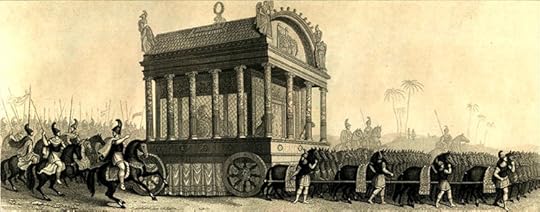
Alexander's funeral procession, as described by Diodorus
Profile Image for Nicolas Stagliano.
21 reviews5 followers
Read
November 28, 2025
excellent book. I love how Plutarch switches between myth/legend and history/biography. To people in Rome the existence of magic/prophecy/the gods was just a fact of life so from his point of view it seemed perfectly reasonable and realistic.

For example:

“The night before the consummation of their marriage, she dreamed that a thunderbolt fell upon her body, which kindled a great fire, whose divided flames dispersed themselves all about, and then were extinguished. And Philip some time after he was married, dreamt that he sealed up his wife’s body with a seal, whose impression, as he fancied, was the figure of a lion.”

It goes without saying that this doesn't align with the modern academic approach to biography writing, wherein belief in prophecy would be discussed from a purely academic, analytical, dispassionate perspective, because prophecy was just accepted as fact to Plutarch, and Plutarch himself was relying on primary sources that probably explored the element of prophecy more in-depth.

Here is another example:

“(Philip) was told (by the oracle that) he should one day lose that eye with which he presumed to peep through the chink of the door, when he saw the god, under the form of a serpent, in the company of his wife. (...) Olympia (...) told him (Alexander) the secret of his birth, and bade him behave himself with courage suitable to his divine extraction.”

I loved it. I loved this because it's so interesting and it provides insight into the Roman perspective. I wish I could unread this so I could read it again for the first time.
Profile Image for Fionnán.
20 reviews
April 22, 2024
alexander character essay coming up on leaving cert trust
Profile Image for Sabareesh.
85 reviews24 followers
February 14, 2022
Plutarch declares in the first few lines of this work: "It must be borne in mind that my design is not to write histories, but lives." He stays true to it and furnishes us with a chronicling of the life of Alexander, expatiating on the kind of man he was, his virtues and vices, what drove him and broke him, the character traits that led to his victories and accomplishments, and the flaws even great men such as he possessed. It helps contextualize the life of such a mythical figure whose name is known by children world over even 2350 years after his passing. Plutarch keeps him real and paints a full portrait of Alexander rather than attempting to write a story of stunning glory and tragic early downfall. This is not a tale to give you goosebumps or shake you with chills, it's an insightful character sketch and biography of the philosopher-general who conquered half the world.

3 stars for delivering well on what he promised, but no more because it's rather prosaic and factual, often alternating between too concise and too verbose.
103 reviews12 followers
September 29, 2019
Artaxerxes II - wasn't especially interesting to me. Artaxerxes was apparently not super amazing but he was pretty generous. His brother Cyrus II is the one who rebelled and employed 'The Ten Thousand' Greek mercenaries, including Xenophon. There was one kind of interesting scene where Plutarch describes 'the death of the troughs', where the victim is put between two troughs, which have holes for his legs/arms/head to stick out. The victim is then forced to consume milk and honey, which is also poured over his face. This attracts swarms of flies both to his face and to the inside of the trough, where his excrement collects. So he will eventually be eaten alive by worms and maggots. Pretty disgusting.

Pelopidas - I was impressed by two things especially - his daring and his harmonious collaboration with Epaminondas. He led a tiny group of exiles back to Thebes and was able to overthrow the Spartan garrison against long odds. He then led the Theban army against the Spartan and won unprecedented victory against them, in party by organizing the Sacred Band (a group of 300 elite warriors and lovers) into its own unit (it had previously been dispersed across the front ranks of the army). I think at both the battles of Tegyra and Leuctra he led the Sacred Band into headlong charges against the Spartan, absolutely destroying their ranks. He ended up being too bold for his own good though - at one point he got himself captured by Alexander of Pherae (a tyrant in Thessaly), and in a later battle against Alexander he allowed himself to be provoked into a suicidal attack on Alexander in which he challenged Alexander to battle amidst Alexander's troops - Alexander retreated and his troops filled Pelopidas with javelins.

Dion - this life illustrates the vicissitudes of fortune. Dion was one of the most trusted advisors of Dionysius I, the tyrant of Syracuse. After Dionysius I died, his son Dionysius II became the tyrant. Dion tried to 'reform' Dionysius II's character by introducing him to Plato, but in the end Dion fell out with Dionysius and was sent into exile. Dion eventually organized a small mercenary army and returned to Syracuse to overthrow Dionysius - in the process of the siege, he was at first welcomed as a savior by the Syracusans, then told he wasn't welcome, then when Dionysius's mercenaries set fire to the city, they begged him again to come back. So Dion took the city and became its tyrant for a while. And then he was assassinated. So yeah, I basically learned you should hold to your principles - if they are good they will guide you to success, and maybe assassination.

Timoleon - Timoleon is interesting 1) because he spent 20 years in self-enforced exile and 2) because of his extremely good fortune during his expedition to Sicily. When he was younger, he killed his brother because he had made himself tyrant of Corinth. His mother disowned him, and he felt so guilty and depressed that he left Corinth and apparently wandered around the countryside for 20 years. But he was finally recalled to lead an expedition to free Syracuse from the tyrant Dionysius II. This expedition was interesting because Timoleon overcame such huge odds over and over again. He set out with about 1,000 troops and 10 ships but was blocked by Carthaginians in Rhegium. When I was reading this I thought, "How's he gonna overcome this?" But then he does! Via trickery - he worked with the Rhegians to distract the Carthaginians in an assembly and slipped away with his cre to Sicily. When in Sicily he defeated a superior Syracusan force by taking them by surprise. This enabled him to win over a bunch of smaller towns. Then Dionysius II surrendered Ortygia (Syracuse's acropolis) to him (at this point the city had been taken over by Hicetas and the Carthaginians). But THEN the Carthaginians abandoned Syracuse (apparently because they were concerned by Timoleon's luck?). So Timoleon took Syracuse and, in counterpoint to Dion, demolished the acropolis (a redoubt for tyrants) and replaced it with courts of law. THEN Timoleon took on a vastly superior Carthaginian army and managed to rout it, ensuring the Greek Sicilians' freedom from Carthaginian domination. His combination of good thinking and good luck was pretty amazing.

Demosthenes - I think that the inscription carved at the base of a statue commemorating Demosthenes sums up his life pretty well: "If only your strength had been equal, Demosthenes, to your wisdom, / Never would Greece have been ruled by a Macedonian Ares." Demosthenes is interesting because he definitely was not marked out for greatness and earned his fame entirely through his own hard work. As Plutarch records: "He was a skinny and sickly child from the beginning and it is said that it was to make fun of his puny physique that the other boys called him Batalus. According to one account, Batalus was an effeminate flute-player." "His voice was weak and his utterance indistinct and [...] he suffered from a shortness of breath, which had the effect of breaking up his sentences and making his meaning difficult to follow."
He completely devoted himself to the study of rhetoric: "he built an underground study [...]. Every day, without fail, he would go down to work at his delivery and to train his voice, and he would often remain there for two or three months on end, and would shave only one side of his face, to prevent himself out of shame from going out even if he wanted to." "He corrected his lisp and his indistinct articulation by holding pebbles in his mouth while he recited long speeches, and he strengthened his voice by running or walking uphill, discoursing as he went, and by reciting speeches or verses in a single breath. Besides this, he kept a large mirror in his house and would stand in front of it while he went through his exercises in declamation." He was pretty much the Rocky Balboa of Athenian orators.
Unfortunately, as the inscription alludes, although Demosthenes was a great orator and he steered Athens on what was probably the correct path in resistance against Philip II of Macedon, when it came to applying his principles in real life he fell short. At the disastrous Battle of Chaeronea (in which Philip crushed Athens and Thebes), Demosthenes "left his place in the ranks and took to his heels in the most shameful fashion, throwing away his arms in order to run faster" - in the 9 lives covered in this book, Demosthenes is the only coward. Later on, he probably accepted a bribe from Harpalus (Alexander's corrupt treasurer who fled to Athens with a lot of money). In the end, however, he committed suicide rather than allow himself to be taken prisoner by the Macedonians, which kind of redeemed his reputation.

Phocion - I don't have much to say about Phocion. He was just a really great and honorable leader. He lived a very humble life and was incorruptible; he was elected general more times than any other Athenian (over 40 times I think); he always hewed to virtuous, responsible, and principled opinions and policies, even when that antagonized the mob; etc etc. He also lived for forever (to be 84) and was instrumental in arranging compromises between Athens and Macedon. Unfortunately, after various twists and turns in fortune he was condemned to death by the mob (as was Socrates) and died by hemlock. There was one humorous anecdote in this life: Phocion's wife "remarked, when an Ionian woman who was staying with her showed off her gold ornaments and her collars and necklaces glittering with jewels, ‘My ornament is Phocion, who is just now serving his twentieth year as a general of Athens.’" I'm sure Phocion and his wife were amazing people but this comment is so obnoxious it made me laugh.

Alexander - Since I recently read Arrian's description of Alexander's campaigns, this life was very interesting to me. Arrian did not relate many of the anecdotes that Plutarch does, and he did not describe the others as vividly. Even if Alexander had not been born the son of a king and placed at the head of a world-beating army, it's clear that he would have been an exceptional person. "He cared nothing for pleasure or wealth but only for deeds of valor and glory," and he was surprisingly disciplined in most aspects of his life probably due to his pursuit of glory. He was surprisingly controlled around women (especially compared to his father who was very polygamous) - he never touched Darius's wife and daughters after he captured them (which is impressive by ancient standards) and only had one illegitimate child (once again impressive by ancient standards) - and in fact only one legitimate child. He was also "exceptionally temperate in what he ate." "When he was at leisure, his first act after rising was to sacrifice to the gods, after which he took his breakfast sitting down. The rest of the day would be spent in hunting, administering justice, planning military affairs or reading." He trained extremely diligently and was always at the forefront of the action in his battles. "Alexander made a point of risking his life in this way both to exercise himself and to inspire others to acts of courage, but his friends, because of the wealth and pomp with which they were surrounded, desired only to lead a life of luxury and idleness." "He continued to expose himself unsparingly to danger: for example, he crossed the River Orexartes, which he believed to be the Tanaïs, routed the Scythians and pursued them for 11 miles, even though all this while he was suffering from an attack of dysentery."
Alexander was a complicated character and Plutarch goes over his executions of many of his friends and associates. He vividly narrates the confrontation between Alexander and Cleitus the Black. Cleitus had saved Alexander's life at the Battle of the Granicus 6 years earlier. Based off of Plutarch's retelling of their confrontation, I don't really blame Alexander for killing Cleitus, because Cleitus kept on hurling insults at Alexander. And the problem with the insults was that they were really true - especially regarding Alexander's annoying insinuations that he was the son of Zeus Ammon and not Philip, and his adoption of Persian customs.
One interesting anecdote: "He regarded the Iliad as a handbook on the art of war and took with him on his campaigns a text annotated by Aristotle, which became known as ‘the casket copy’, and which he always kept under his pillow together with his dagger."

Eumenes - I read a lot about Eumenes in James Romm's book "Ghost on the Throne," which is basically an extended version of Plutarch's Life of Eumenes. One thing that annoys me about Ghost on the Throne, though, is that Romm always calls Eumenes "little Eumenes," and the "former secretary." That is pretty misleading. Philip II first took note of Eumenes because of his skill as a wrestler, and I doubt that Eumenes was little. Plutarch says "his whole body, with its astonishingly well-proportioned limbs, resembled a carefully composed work of art." He was a tough guy and when he started to make his appearance on the battlefield he killed people (in particular Neoptolemus, his arch-nemesis for a time whom he slew in hand-to-hand combat). I had this impression of Eumenes from Romm's book as a slight but clever former secretary, but from this Life it's clear that he was a tough and cunning general. Even under Alexander he was like that - once Alexander asked him to give him 300 talents since the royal coffers were empty, and Eumenes gave him 100 talents, saying that even that money was hard to find. So Alexander had his tent burned down to see how much gold Eumenes would have to carry out. Unfortunately the tent burned down too fast, but apparently there were 1,000 talents of gold and silver in the tent. (Also, maybe don't take management tips from Alexander). Eumenes also often quarreled with Hephaestion, Alexander's favorite. So even when he was a secretary, Eumenes was a sly guy who was not afraid of a fight.
As a general, Eumenes was extremely skilled both on the battlefield and in manipulating his soldiers in camp. I won't recount his battlefield victories, but his management of his soldiers was pretty amazing I think. Once while he was fleeing he came upon the enemy's baggage train. He realized that if he allowed his soldiers to plunder the baggage train they would be too burdened to flee. So he sent a secret message to the head of the baggage train warning him to head for high ground, thwarting his own soldiers. At other times, however, he allowed his soldiers to plunder the countryside freely to keep them happy. In order to convince the leaders of the Silver Shields to meet with him, he invented the "Alexander tent", a tent with a throne dedicated to Alexander where Alexander's ghost could preside over their meetings. When Eumenes was leading the eastern satraps, he perceived that they hated him, so he got them to lend him money - so if they ever wanted their money back, they would have to keep him safe.

Demetrius - There were a few interesting aspects of this life. One was that Demetrius was a hedonist and a womanizer. Two is that Demetrius went through a lot of very severe swings in fortune - so many that it's hard to keep track of where he was in power - at first he and Antigonus controlled most of Alexander's Asian conquests; Demetrius lost to Ptolemy, losing Syria, but later won against Ptolemy, regaining Syria. Then Seleucus took Babylon and most of the east for himself. Then Demetrius took Athens and most of Greece but then had to come back to help his father fend off an alliance of the other Successors. They were crushed in this battle and Antigonus was killed, but Demetrius was able to escape to Greece (and maybe Cyprus? Can't remember). He was able to make himself king of Macedon, and raised an immense army to invade Asia. But most of his army went over to Pyrrhus, and Demetrius fled to Asia where he fought a pitiful campaign and was ultimately captured by Seleucus, who kept him under house arrest basically. Demetrius then drank himself to death.
The third interesting aspect of the Life is that this is pretty much the point in history at which Athens loses its soul (permanently). It became a competition among the politicians of the city to see who could heap the most honors on Demetrius (while he was alive and in charge of Athens).
"They were the first people in the world to confer upon Antigonus and Demetrius the title of king." "The Athenians changed the name of the month Munychion to Demetrion, gave the name of Demetrias to the last day of the month and renamed the festival of the Dionysia the Demetria." Etc. It was sad to see Athens reduced to this state of servility.

Pyrrhus - Pyrrhus seems to have been defined by his boldness and his restlessness - he was always chasing dreams that led him to be briefly a king of Sicily and later a king of Macedon. He died in Argos after an old lady threw a tile at him and knocked him out.
Profile Image for Alyssa Bohon.
559 reviews5 followers
Read
April 11, 2025
Not rating this one because I don't think I'm qualified to rate it - I mean, it's a classic. Anyway, I feel like having 5 stars for getting all the way through the whole grim, grisly, enlightening, thought-provoking, classic thing!

The lives really do give a perspective on how human personality affects history, and how certain decisions and character traits often lead to certain results. Many times, men who had a virtuous character and sought to do good ended up being hated and killed, and other times, vicious characters were hated and killed. Power is such a lodestone for haters. As I listened to part of this over the Advent season, I especially saw these histories in the light of a Greek and Roman world ripe for the coming of Christ.

Since many of these lives overlapped Bible times, Plutarch enriched my understanding of the Bible also.
Profile Image for Matthew Bloomquist.
61 reviews3 followers
October 6, 2025
Reading the lives of Plutarch is akin to reading a mini Homeric epic. In many ways, Alexander images the glory of a king. Alexander was a forerunner to Aurelius in military conquest as the undefeated king. Yet he was a man of the people who was both mighty and meek. He was a merciful king who made his enemies his friends. As Lewis says in his description of the ideal king, Alexander was the first in every desperate attack and last in every desperate retreat.
Profile Image for Josh Markowski.
33 reviews
June 26, 2024
His father shedding tears, it is said, for joy, kissed him as he came down from his horse, and in his transport said, “O my son, look thee out a kingdom equal to and worthy of thyself, for Macedonia is too little for thee.”
20 reviews
June 11, 2017
Many thanks to Plutarch for such great job he has done. It is a fact that He was not a father of biography genre, but he undoubtedly enriched this genre. To quote more than 150 historians in his Live's and spending more than 20 years and that's I guess a massive job to do. -
-Plutarch's ostensible intent was to remind Greeks in their third century of relatively humane Roman rule, that even if their once-populated countryside was now deserted and their cities were often in ruins, their own more spirited ancestors of centuries past had matched and indeed often surpassed the achievements of the Roman ruling class.

" It is a lovely thing to live with courage, and to die and to leave behind everlasting renown, " this short quote of his tells a lot about his true essence.
In my perception, he was more idealistic than the pragmatic king. The first westerner who marched against minor Asia and beyond ( how we call it now the middle east ). Ironically, only 2000 years after, westerners managed to step up a second time. His courage almost killed him and his Macedonian army at Hydaspes when he was marching against huge elephants. Injured many times in the battle, which I never read before.
He always tried to pursue his glory by entering directly in to the fight, and as a leader urged his army to do the same. With a considerably small army appr. 50,000 men, he won the battle against Darius king of Persia with more than 200,000 men.
Along with being a great strategist, he did a good job in diplomacy too.

From hence he marched into Parthia where not having much to do, he first put on the barbaric dress, perhaps with the view of making the work of civilizing them easier, as nothing gains more upon men than conformity to their fashions and customs. Or another account -

-He followed not the Median fashion, which was altogether foreign and uncouth. He had adopted neither the trousers nor the sleeved vest, nor the tiara for the head, but taking a middle way between the Persian mode and the Macedonian, so contrived his habit that it was not so flaunting as the one, and yet more pump us and magnificent than the other.

Or showing mercy to the royal family in Persia, and taking as a wife of fallen King Darius's daughter.
Meanwhile, Plutarch described him also as the noblest king, in respect toward to the fallen nations and also to his friends and his regular soldiers.

~ One of the common soldiers was driving a mule laden with some of the king's treasure , the beast grew tired, and the soldier took it upon his own back, and began to march with it, till Alexander seeing the man so overcharged asked what was the matter; and when he was informed, just as he was ready to lay down his burden for weariness, "Do not faint now," said he to him ,"but finish the journey, and carry what you have there to your tent for yourself."
He was always more displeased with those who would not accept of what he gave than with those who begged of him. And therefore he wrote to Phocion, that he would not own him for this friend any longer if he refused his presents.

His highest idealism shows this quote: "Telling them, he wondered that they who had been engaged in so many single battles did not know by experience. That those who labour sleep more sweetly and soundly than those who are labored for, and could fail to see by comparing the Persians manner of living with their own that it was the most abject and slavish condition to be voluptuous , but the most noble and royal to undergo pain and labour. "
"Are you still to learn," said he, "that the end and perfection of our victories are to avoid the vices and infirmities of those whom we subdue ?"
Profile Image for Scriptor Ignotus.
594 reviews269 followers
September 12, 2014
Plutarch's biography of Alexander is, of course, the main event of this collection of Greek lives. And what a fascinating biography it is. Nietzsche once said of Alexander that he was a Dionysus incarnate, and although it may be true that Alexander thought himself cursed by the god for his ransacking of Thebes, his life and character can be said to have embodied what Nietzsche understood to be the Dionysian mode of life. He was an utterly otherworldly being, breathtakingly indifferent to risk and adversity, and possessed of a self-assuredness and singularity of purpose more commonly found among prophets than among kings.

The myths Plutarch relates about him are fascinating, and further illuminate the meaning of the man himself. As a youth, he tamed a wild horse, Bucephalus, which may have taken him as an adult from Macedon to Pakistan. When he was preparing to invade Asia, a statue of Orpheus was said to glisten with sweat; a sign, they told him, that the bards and poets would exhaust themselves in relating the glory of his deeds. He never once flinched in the face of danger; making a harrowing crossing of the river Granicus under fire, demonstrating an almost inhuman tenacity in his long siege of Tyre, smashing Darius's army at Issus and Gaugamela, pressing on to make war on the Indians. The man was ambition personified.

Little wonder that the generals of the ancient world so often consciously sought to emulate him. Even Pompei Magnus styled himself after Alexander; Lord of Asia, ruler of land and sea.
Profile Image for Smiley .
776 reviews18 followers
June 27, 2014
I wonder if these Ten Greek Lives are similar to those in the two-volume paperbacks published by Vintage (?). I think their translated versions could be lexically different if another team of translators had to tackle such a monumental historical writing by Plutarch, however, I need time to find the paperbacks first so that I can compare each Life, one by one.

In "Life of Demetrius", a word in this sentence has surprised me: "Besides this Philippides enjoyed a good reputation, since he was no busybody and had none of the self-important habits of a courtier." (p. 413) I mean the word 'busybody'. The reason is that I first heard my Australian friend say this word during our chat in a bookstore and it seems to denote disapproving. So it is a surprise to find it in one of Plutarch's Lives. Moreover, this extract related to Plato is a good point I've found and scribbled:

In short, Seleucus was a conspicuous example of the wisdom that Plato showed when he argued that the man who wishes to be really rich should seek not to increase his possessions but to decrease his desires. For he who can never restrain his avarice will never be free from the sense of poverty and want. (p. 432)
Displaying 1 - 30 of 143 reviews

Join the discussion

Can't find what you're looking for?

Get help and learn more about the design.