Jump to ratings and reviews
Rate this book

Working Bullocks

Rate this book
Writing for British publication The Bookman in 1928, John Sleeman declared Working Bullocks to be ‘the high-water mark of Australian literary achievement in the novel so far’.

‘It’s the story of the people of the timber country in the South-West of WA and follows a young man named Red Burke who has a way with horses and bullocks but not people, as he is torn between two women and struggles to make his way in that world.’ So writes Nathan Hobby, Prichard’s biographer on his website. He goes on to lament, ‘Sadly, Working Bullocks is out of print despite being one of Katharine’s finest novels.’

First published in 1926, the Untapped edition brings this fine novel back into circulation. Hobby’s biography of Prichard, The Red Witch, will be released in May, 2022, by Melbourne University Press.

Katharine Susannah Prichard’s novels include The Pioneers (1915) which won the Hodder and Stoughton All Empire Literature Prize for Australasia, Coonardoo (1928), joint winner of The Bulletin Novel Competition, Intimate Strangers (1943) also in the Untapped Collection, and Haxby’s Circus (1930).

251 pages, Paperback

First published January 1, 1926

1 person is currently reading
38 people want to read

About the author

Katharine Susannah Prichard

39 books15 followers
Katharine Susannah Prichard was born in Levuka, Fiji in 1883, and spent her childhood in Launceston, Tasmania, before moving to Melbourne, where she won a scholarship to South Melbourne College. Her father, Tom Prichard, was editor of the Melbourne Sun newspaper. She worked as a governess and journalist in Victoria then travelled to England in 1908. Her first novel, The Pioneers (1915), won the Hodder & Stoughton All Empire Literature Prize. After her return to Australia, the romance Windlestraws and her first novel of a mining community, Black Opal were published.

Prichard moved with her husband, war hero Hugo "Jim" Throssell, VC, to Greenmount, Western Australia, in 1920 and lived at 11 Old York Road for much of the rest of her life. She wrote most of her novels and stories in a self-contained weatherboard workroom near the house. In her personal life she always referred to herself as Mrs Hugo Throssell. She had one son, Ric Throssell, later a diplomat and writer.

Ratings & Reviews

What do you think?
Rate this book

Friends & Following

Create a free account to discover what your friends think of this book!

Community Reviews

5 stars
3 (17%)
4 stars
9 (52%)
3 stars
4 (23%)
2 stars
1 (5%)
1 star
0 (0%)
Displaying 1 - 3 of 3 reviews
Profile Image for Calzean.
2,770 reviews1 follower
December 21, 2017
Written just after WWI, the book tells of the lives of wood cutters and bullock drivers trying to eke out a living in SW Western Australia. Men are men. They work hard, drink hard, fight and chop wood. Women live a tougher life and are either desired or avoided. Why marry a woman says one man, "feedin' another man's daughter - it's no good to you".
Red deals with his experiences of WWI, the loss of his bullock team, the death of his friend in a logging accident and his feelings for Deb. Deb is a little too stoic, accepting her fate is in the hands of whatever Red wants to do.
Not a great book but certainly one that captures life at that time.
Profile Image for Lisa.
3,788 reviews493 followers
January 1, 2024
I like to start my reading year with a book I really liked, so I choose carefully from the TBR, selecting a tried and true author guaranteed not to let me down.  This year I chose Katharine Susannah Prichard's fourth novel Working Bullocks, from 1926.  It was unputdownable...

My 1991 Imprint Classics edition includes an introduction by Ivor Indyk (now of Giramondo Publishing, founded in 1995), but its cover image from a panel of 'Riverbend' painted by Sidney Nolan, alludes only to the majesty of the forests.  It doesn't even hint at the power of Prichard's story.  Working Bullocks does feature superb evocations of the natural environment which would win any nature-writing prize today, but KSP wrote social realism with political intent, and this novel exposes the hardships of the working poor who laboured far from cities and towns, in the timber industry.

Chapter 21 'The Karri Forest' in Nathan Hobby's award-winning biography, The Red Witch (2022) tells me that the catalyst for this novel was KSP's motorbike trip to Pemberton with her husband Hugo in 1919.
They stayed for a fortnight in the boarding house, living 'among the karri forests...going out every day to watch the timber men at work, and absorbing the spirit of the place'; Katharine said she even drove a bullock team.  She recorded snatches of conversation between timber workers, word sketches of characters she met or heard about, details of logging, handling bullocks, and the sawmill operations, stories about capturing brumbies, descriptions of the plants and animals in the area, as well as the experience of being among the trees; she was interested 'above all in the generative power and wild beauty of the land itself.' (The Red Witch, p182, details below.)
Perhaps by the 1990s marketing departments sought to capitalise on the prevailing interest in environmental issues with a cover depicting trees, but these earlier covers are more true to KSP's social concerns.  They show the teamsters at work...

[gallery ids="125958,125957,125956"]

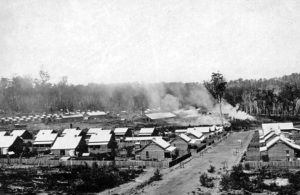
[caption id="attachment_125973" align="alignright" width="300"] Pemberton 1919[/caption]

Set in the early 1920s in the Karri forests southwest of Perth, Working Bullocks is a story of powerful men crushed by a system of body-breaking work, poverty and little prospect of advancement. When we read this story, almost a century later, it is to recognise how brutal working conditions were for the timber workers of that era.  Single men in the forests mostly camped out in the bush. They lived on meagre campfire meals with the basics brought from town. They  supplemented this diet with what they could catch, rabbits and 'tammas' (Tammar Wallabies). When they could, they came into town for a bath and a decent meal at a boarding house and what passed for a social life at the pub.

Married men lived in crude company housing, so pitiless that KSP's story tells of women and children who died while requests for decent housing were 'being considered'.
A fettler's wife died, after having given birth to a baby in one of the wretched huts of bagging and defective timber, far out near the end of the bush line.  Everything in the hut was wet, Jim Anderson, her husband said; neither the roof nor the walls kept out the rain, and everybody who had seen those poor lean-to's of bagging and rough timber which were the fettlers' homes could believe it.  When the woman was raving, her husband had brought her into the township.  There was neither nurse nor doctor in Karri Creek then; he had tried to take her into Jarranup on the rake, but she had died on the way. (P.222)

(A rake is a form of rail transport: rolling stock coupled together.)

The size of the families reminds us that this was an era without effective birth control.  The indefatigable Mary Ann Colburn has 18 children, and a useless husband.  She makes ends meet by decades of incessant work, not just the labour of cooking and cleaning for her own brood, but by doing washing, ironing and mending in town.  When the story opens, her daughter Deb — barely into her teens  — is about to start work in Mrs Pennyfather's boarding house, and like her brother Chris working with Red Burke's bullock team, she will give her wages to her mother.  Mrs Pennyfather provides board and lodging and three meals a day for up to 40 men, and it will be Deb's job to make the beds and do the laundry and lay the tables and do the kitchen prep.  These scenes are vivid, almost certainly drawn from KSP's observations of women labouring seven days a week in this way.

To read the rest of my review please visit https://anzlitlovers.com/2024/01/01/w...
Displaying 1 - 3 of 3 reviews

Can't find what you're looking for?

Get help and learn more about the design.