Bold, hilarious artwork captures the innocent charm of affable George, a dog who is trying to be good — with disastrous results.
George is a dog with all the best intentions. And his owner, Harry, has all the best hopes that George will be a well-behaved dog when he leaves him alone for the day. But when George spies a delicious cake sitting on the kitchen table, his resolve starts to waver. You see, George loves cake. . . . Uh-oh. What to do now? It’s so hard to be a good dog when there are cats to chase and flowers to dig up! What ever will Harry say when he gets back? Chris Haughton’s fetchingly funny story and vibrant, retro illustrations are sure to lure dog lovers of all ages — and anyone who has ever met a temptation too good to resist.
Chris Haughton is an Irish illustrator and author living in London. He was listed in Time magazine's 'DESIGN 100' for the work he has been doing for fair trade clothing company People Tree. His debut book 'A Bit Lost' was first published in English in September 2010. It has been translated into 15 languages and won 9 awards in 7 countries including the Dutch Picturebook of the Year. 'Oh No George' came out in March 2012 and has been nominated for 6 awards in 4 countries including the Roald Dahl Funny award.
فک کنم منم یه جورج درون دارم چون همیشه اسیر وسوسه میشم و سست عنصرم جورج و من این نقل قول اسکار وایلد رو سرلوحه زندگی قرار دادیم که میگه: تنها راه خلاصی از وسوسه ها اینه که تسلیم شون بشی.
تا حالا شده بخواید یه کاری بکنید و خیلی دلتون بخواد ولی نباید انجامش بدید؟ ما چه کار میکنیم؟ معمولا انجامش نمیدیم یا اگه انجامش بدیم جوری انجامش میدیم که کسی نفهمه و بوش در نیاد :) ولی بچهها یه سری چیزا رو واقعا نباید انجامش بدن و یاد بگیرن که گاهی باید از خواستههاشون چشم بپوشن. این کتاب داره همینو یاد بچهها میده و نقاشیهاش بینهایت بامزه و قشنگه. خوندنی و جذاب و بسیار پیشنهادی.
Richie’s Picks: OH NO, GEORGE! by Chris Haughton, Candlewick, March 2012, 32p., ISBN: 978-0-7636-5546-4
“’You know, Toad,’ said Frog, with his mouth full, ‘I think we should stop eating. We will soon be sick.’ “’You are right,’ said Toad. ‘Let us eat one last cookie, and then we will stop.’ “Frog and Toad ate one last cookie. There were many cookies left in the bowl. “’Frog,’ said Toad, ‘let us eat one very last cookie, and then we will stop.’ “Frog and Toad ate one very last cookie. “’We must stop eating!’ cried Toad as he ate another. “’Yes,’ said Frog, reaching for a cookie, ‘we need will power.’” --Arnold Lobel, from (the Newbery Honor book) FROG AND TOAD TOGETHER (1972)
“Freedom is secured not by the fulfilling of one’s desires but by the removal of desire…No man is free who is not master of himself.” --Epictetus (the epigraph on the copyright page of OH NO, GEORGE!)
George is a lovable dog. When his owner Harry goes out, he asks George to be good. And that is George’s intention.
“I hope I’ll be good. George thinks.”
But then George gives in to his desires. He eats the cake, “plays with” the cat, and digs in the flower pot. (The two-page spread of George with his mouth open like some sort of gaping steam shovel, having just bitten off a third of the cake, is roll-on-the-floor hilarious.)
When Harry returns home, he is justifiably dismayed by the manner in which George has trashed the house. And George is contrite. When they subsequently go out for a walk, George stops himself from chomping on the cake (that is part of someone’s picnic), stops himself from chasing a cat (who is surprised), and stops himself from digging.
But then he sees an overflowing garbage receptacle. And George loves sorting through garbage. What will he do?
We are left with a cliff-hanger.
I am utterly in love with the illustrations here. George’s big, sweet eyes, long muzzle, and long ears are something else.
And, of course, this is a very funny book whose humor is based on the concept of self-regulation. One of a child’s most important developmental tasks is moving from external regulation to self-regulation. The degree to which a particular child succeeds in this transition correlates closely with this child’s readiness for the rule-following and socialization that are central to being a participant in school. Its importance is why we encounter this topic time and again children’s literature. (Think Joey Pigza.)
I like how in each "What will George do?" page, George looks just a little bit sketchier and a little bit more beleaguered. George's big-nosed person--and really the whole color palette & the style of the shapes of the objects on the page--make me think of the Pink Panther cartoons. This is really nicely paced for storytime, true-to-life about wrestling with temptation. LOVE the cliffhanger ending. Wish I still did a preschool storytime so we could talk about it together!
This was a great opener to my toddler storytime on the 31st. George strives to be a good dog, but he can't help but give in to his desires! Chris Haughton is one of my favorite picture book authors because of his colorful, unique illustrations and his ability to interact with his readers through storytelling. WHAT WILL GEORGE DO?! The kids had fun trying to guess what would happen next.
This work speaks to the same moral questions as Lobel's classic treatment of the interplay of desire and self-mastery, "Cookies" in Frog and Toad Together.
My only critique would be that I wish George talked a bit more in the last half of the book, since I enjoy doing a George voice.
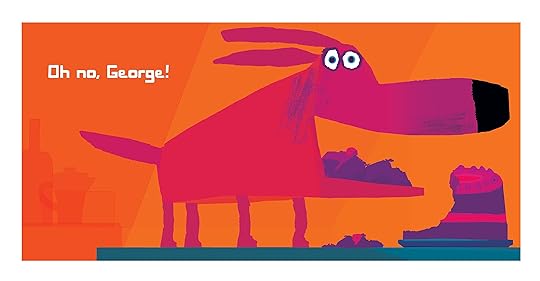
We can all relate to the temptation of cake! This book follows the moral dilemma's of George the dog who 'hopes' he'll be good whilst his owner is out. George is confronted by many things that he loves doing but knows he shouldn't, especially if he is to keep his word that he'll be good. For example the vibrant orange and purple illustrations show George looking at a cake, "I said I'd be good, George thinks, but I LOVE cake.' The book then asks us, 'What will George do?' which is a brilliant opportunity to stop and discuss what George should do, why he should be good etc. However for George the cake looks just too delicious to resist and we are shown him having gobbled it all up. The text reads, 'Oh no George!'
After being faced with more temptation, 'a cat' and 'dirt' amongst them, George's owner returns to find his house is a mess. George, suffering a pang of guilt at not 'being good,' says sorry. He then shows he has learned his lesson by abstaining from all of the temptation he meets on his daily walk, namely a cat and dirt and many of the same temptations he met previously. After so far proving his changed moral stamina he is confronted upon returning home by a new challenge 'rubbish' which George 'Loves.' The book ends asking the question 'What will George do?'
The repetitive format of the book, i.e dog meets temptation, asks moral question, reader is asked what they think will happen and then George gives in to the temptation. As well as then abstaining from the same temptation later as he has learned his lesson allows discussion with the child about moral choices and why it is important to be good, especially when you have said you would be. As George learns his lesson so too can the child/children understand what he should have done. All with the help of the distinctive and zany illustrations of the author.
This book is ideal for children 3-6. However, as it is quite charming in its humor it would could also be enjoyed by those older with lower reading capabilities. Perfect for aiding the teaching of behavioral lessons as well as encouraging interaction with the text as it asks its reader direct questions as well as appealing to their analytical skills. If read to a class would encourage interesting discussions, what should George do? Why has he apologized? and the final question will he resist the temptation of the rubbish?
Overall a fantastic book the images are full of emotive humor and George is an affable scamp even when perhaps not doing as he should.
This book at first appears to be a simple story of a dog being left at home, but it is so much more than that as the reader gets pulled into George’s emotions of excitement, deliberation, naughtiness, and remorse. A great way to teach kids about temptation but also forgiveness. Harry forgives George when he makes a mess at home, which I thought was very sweet; a lesson I need to be reminded of from time to time.
There are three temptations in the book a cake, cat, and flowers which each appear twice in the book. In the first half of the book when a temptation is shown the reader is asked “What will George do?” followed by a full-page illustration of George making a bad choice and the words “Oh no, George!” He then feels remorse for making a mess and upsetting Harry, this is the turning point as you see George’s character grow. Once again George is presented with the same three temptations but this time he makes good choices. My favorite is the ending of George next to a trashcan, leaving the decision up to the reader of what George will do next.
This is also a wonderful,Read Together book. There is a lot of repetition and predictability in the book. The short, simple repetitive sentences my 4-year old “reads”, while I do read the rest. I also blend in the good choice/bad choice teaching method that is used in my daughter’s preschool classroom. My daughter will give me a thumbs up or down for each of George’s decisions. The illustrations are simple with clean lines and bold colors, they are eye-catching.
Click here for the original review and activity ideas at Flowering Minds.
An otherwise good dog is challenged by temptations when his friend, Harry, goes out for a bit. But who can resist cake, dirt, or the cat?
I like the understated illustrations in this one that give the book a I WANT MY HAT BACK meets PETE THE CAT meets No, DAVID! that is rendered like one really, really talented with the old paint programs we used to use when bored with the computer (before the internet, kids).
I ran this one by Maddie (9) who chuckled at the voices we used, but she also liked some of the little surprises in the pictures. The one where George leaves the cat alone is a perfect example of the marriage between words and images in a picture book (check out the cat's eyes).
I think younger readers will enjoy the "What will George do?" approach that keeps the pages turning. And in the end, what would you do if you were presented with some perfectly tempting garbage? A cliff-hanger ending for the ages (the younger ages)(wink)
This is the story of George, a greedy and accidentally mischievous dog. But it isn't really just about George. It's really about all dogs who just can't help themselves but eat everything in sight, chase the odd cat or dig around in the soil in your perfectly manicured garden. Whilst you want to be annoyed at George, and probably ought to be, George perfectly captures every dog lovers dilemma - how can you be mad at George when he's so damn cute?
I love how relatable this book is, I think the illustrations are different and genuinely funny and I adore George. The narrative is funny, George's inner monologue about wanting to be a good boy but just not being able to resist the urge to dig up the plants and eat all the cakes he's forbidden to it just did it for me.
An easy five stars from me, and probably from my pets too!
ARC provided free from the publishers in exchange for an honest review.
Um dos dois primeiros livros que comprei para o meu filho de 20 meses. Apenas tinha três critérios: - Ter muitas imagens; - Ter pouco texto; - Ter algo do interesse dele.
Neste momento, ele é muito ativo e não fica muito tempo concentrado nos livros. Gosta de ver imagens, mas não tem paciência para ouvir uma história longa. O elemento principal da história é o animal preferido dele: o cão. Então, folheia rapidamente as páginas, sempre a repetir: "Cão, cão, cão!" Com o mesmo entusiasmo até à última página. Acho que está aprovado.
It's hard for a dog to be good when there are so many smelly temptations all around. Probably no one knows this better than George. I love Haughton's bold, unusual artwork. A fun, shout-out-loud book.
I think this would be a great read to ks1. It is about a dog called George who has been told to be good whilst his owner is out. George is faced with situtations which are tempting with his conscience reminding him that it would be bad to go through with it. When his own gets home he is dissapointed to find out George has ruined the place. However, George's behaviour turns for the better when he goes out for a walk and behaves well without any temptation to do things that might upset his owner. This book offers questions about what George might do and on the next page direct answers aren't given. The pitcure shows the action George took with the caption 'Oh no, George!' which is repeated everythime George does something bad. The end of the story has a question asking what George will do as he looks tempted this time to go into the rubbish bin. This could be a great starting point for a discussion with the class to find out what they think he might do. Therefore, this could stimulate children's creativeness and imagination.
I love this book! I really wish that it had been around when my son was a bit younger. He is a typical boy, who gets into lots of mischief, but deep down really wants to behave and this would have been the perfect book to introduce a discussion into those contrasting feelings to him.
The pictures should really appeal to young ones. Very simple and based around bight oranges and reds they are eye catching and give you lots to talk about without being too distracting or too detailed for young minds. I can really see why this book made the shortlist.
But for me it is the story line that really makes this book. All young children misbehave, they all do silly things. The scrapes that George gets into in the book are something that most young children would consider doing. When George gets ‘found out’ he feels very guilty, in the same way a young child would and then he gets the chance to make things better. This is all done on a level that a child would understand, giving them a chance to explore their own feelings on wanting to do things that they aren’t allowed to do. That George also gets the chance to do it all again the right way shows children that they can do it too and that we all learn eventually.
Verdict: A lovely, engaging picture book. A fantastic starting point for discussions about behaviour with small children.
Categories/Genres for this class fulfilled by this book: Picture Books
Copyright Date: 2012
Estimate of age level of interest: Preschool-Grade 2
Estimate of reading level: Grade 2
Brief description: George the dog struggles to avoid temptation when left home alone.
Identify at least 2 characteristics of this genre and subgenre and discuss how they appear in your book: "Colors can evoke strong emotional connections in readers." In "Oh No, George!" the bright primary colors help to convey a sense of excitement and focus, as non-essential details are often white with only a small outline. "The message is conveyed equally in pictures and words." The very simple text of this book will delight young readers who can focus on the pictures to make meaning. The text is simple, predictable and repetitive to help emergent readers follow the plot and make predictions as they read.
In what ways and how well does the book as a whole serve its intended audience?: "Oh No, George!" would make an excellent read aloud as it invites readers to answer the question "what will George do?" several times. Readers will also be able to follow the plot by studying George's expressive face as he feels many different emotions.
Awards if any:
Reviews: Booklist 3/12 Horn Book Magazine 11/12 Kirkus Reviews 2/12 Publishers Weekly 1/12 School Library Journal 3/12
We read Oh No George by Chris Haughton in a PGCE English lesson and we all loved the rhythmic writing and the repetition used in the story. It was a really fun read that I hope I can enjoy reading to my own KS1 class.
The book tells the story of a dog named George who continually disobeys his owner Harris who asked him to be good before he left him on his own for the day. Seeing cake in the kitchen, ‘George thinks, but I LOVE cake. What will George do?’ Inevitably George consumes the entire cake and the book continues with the scenarios of George seeing a cat and lovely soil. The repetition of ‘what will George do?’ at the end of each situation could be read and enjoyed by the children as they famililarise themselves with the story, making it a good inclusive class book.
Harris is home, ‘George what have you done?’ You’ve RUINED the place …’ With poor George in tears, Harris suggests a walk and George is soon faced once again with tempting situations; seeing a cake, lovely soil and a cat. It appears Harris’s words of upset at George's unruly behaviour have influenced George’s decisions, that is until George smells a bin!
Overall this is a nice paced story with beautifully vibrant illustrations that can be enjoyed by teachers, parents and children alike.
This vibrant book tells the lovely story of George and his love for everything that is bad. No matter how hard he tries to be good, he just can't help himself when it comes to his favourite things. This is a book that is easy to relate to no matter what your age. Should you have another slice of cake?
The illustrations are bold and vibrant using manly orangey reds and pinks. The subject to which George is about to approach is illustrated in full block colour whilst the scenery around it is thin and linear. This depicts the items importance and also illustrates its appeal helping the reader to slightly empathise with George. Another feature of the illustrations is that whenever George has spotted or is considering to do something naughty, we see only his profile view showing his purpose 'towards' something. When he is considering his options "what will George do?", we perceive him straight on allowing us to see his big puppy dog eyes and droopy ears as he knows what he is about to do is wrong. A lovely read.
We recently read Little Owl Lost by this author and saw that he had a new book out. We loved the dog on the cover and just had to borrow it from our local library.
This tale is funny, repetitive and in the case of many dogs, all-too true. We really enjoyed reading this book together and we liked it even more than Little Owl Lost. The illustrations are very orange-y, but they are very fun and expressive. Our girls joined in on the refrain of "Oh no, George!" with a lot of enthusiasm. I think this book would work very well with a group, as well as for one on one reading.
George loves to eat cake, chase cats, dig in the garbage and all sorts of other things that dogs love to do. But can he resist when his boy leaves him in the house alone? OF COURSE NOT! But that doesn't stop this from being a terrifficly adorable book on human nature and how and why we should behave and the results of giving in to what we want to do, when we shouldn't. This illustrations are simple but "funny as all get out", and I fell I love with the expressions on George's face! A dog is a dig, but George is one adorable dog... Just not very bright! Can he eventually overcome his animal instincts? Read the book and talk amongst yourselves.
Normally I demand that books have an ending. It's kind of fundamental: beginning; middle; end. If a story is missing one of those I get upset. Yet Oh No, George! has no ending, in fact it kind of depends on the fact it has no ending, and I commend it to you without reservation. It is delightful for the tinies and delightful for the grown-ups, and its charm does not diminish on repeated readings which is vital in a kids' book.
Along with 'I Want My Hat Back', this is the book we'll be giving as birthday presents this year.
LOVE the illustrations and the story is wonderful. I feel like the author got inside a dog's head - George WANTS to be good, HOPES to be good, but in the end, doing the thing he loves wins out. Or does it? I like that the story has a completely open ending. The teachers for the class I read it to thought it would be a great story extension - the kids can write/draw their own endings! DID George get into the trash? Or was he good?
This book has been a hit for all grade level story times (k-2). We used this in conjunction with making predictions and it was a resounding success. I also created a passive programming writing activity that lets students write if George digs in the trash or not. Some of the students are firm believers that George will keep his promise and not dig in the trash! What a great use of the library writing center!
Merveilleux petit album cartonné sur les désirs, la tentation et le vraie liberté. Bérénice adore la drôle de dégaine de ce chien qui n'a, comme elle, pas beaucoup de contrôle sur ses pulsions. J'aime aussi les habiletés de pré-lecture qu'elle développe en feuilletant le livre elle-même et en étant en mesure de relater l'action dans ses mots: "Oh non, George il mange le gâteau!!".
It's hard to resist impulses to do things you shouldn't. George, the dog learns how to apologize for what he's done and resist impulses in the future. Simple and fun. Enjoyable art. This is one of my littlest's new faves.