With predation and carnivory as catalysts, the first known eye appeared in a trilobite during the Cambrian explosion approximately 543 million years ago. This period was a crucible of evolution and teemed with anatomic creativity although the journey to formed vision actually began billions of years before that. The Cambrian period, however, spawned nearly all morphologic forms of the eye, followed by descent over hundreds of millions of years providing an unimaginable variety of eyes with at least ten different designs. Some eyes display spectacular creativity with mirror, scanning or telephoto optics. Some of these ocular designs are merely curiosities, while others offer the finest visual potential packed into a small space, limited only by the laws of diffraction or physiological optics. For example, some spiders developed tiny, well-formed eyes with scanning optics and three visual pigments; scallops have 40-100 eyes circling their mantle, each of which has mirror optics and contains two separate retinae per eye; deep ocean fish have eyes shaped like tubes containing yellow lenses to break camouflage; and some birds have vision five times better than ours; but this is only part of the story. Each animal alive today has an eye that fits is niche perfectly demonstrating the intimacy of the evolutionary process as no other organ could. The evolution of the eye is one of the best examples of Darwinian principles. Although few eyes fossilize in any significant manner, many details of this evolution are known and understood. From initial photoreception 3.75 billion years ago to early spatial recognition in the first cupped eyespot in Euglena to fully formed camera style eyes the size of beach balls in ichthyosaurs, animals have processed light to compete and survive in their respective niches. It is evolution's greatest gift and its greatest triumph. This is the story of the evolution of the eye.
Ivan Schwab was interviewed on Wisconsin Public Radio's To the Best of Our Knowledge. I promptly looked up the book and requested it by interlibrary loan.
I admit that I did not read every word of this fascinating book because the details are more technical than I have context for. But I did read a lot of it, and I certainly looked at the pictures. I hadn't thought about the evolution of eyes and eyesight -- from single-celled creatures to modern-day animals (insects, reptiles, birds, mammals). I hadn't considered the scientific specialty of veterinary ophthamology (which Schwab is). My knowledge is much increased and I am better-informed.
One of the books published in honor of the 150th anniversary of Darwin's Origin of Species. A tour de force -- heavy reading but worth the trouble, by an ophthalmologist and master teacher. Based on Darwin's famous observation on the difficulty of imagining how evolution could explain the development of the eye. Prof. Schwab proceeds to attempt such an explanation, from the earliest single-celled celled organisms through hundreds of millions of years. The eye began as a pigmented spot in unicellular organisms; its early history involves much guesswork since soft tissues rarely fossilize.
Some aspects of the eye, such as the opsin group of photoreceptor proteins and the Pax6 gene, appeared early in evolutionary history and remain in related forms in all the Metazoa; others, such as the crystalline lens, appear to have evolved multiple times in diverse forms. At least 12 general types of eyes are found, as animals have evolved to fill various niches in land, air, and water.
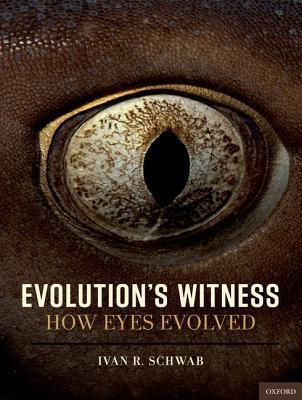
Well-organized and exceptionally beautiful illustrations of the large variety of eyes found in different creatures. Prof. Schwab has collected images from creatures both living and extinct from colleagues around the world. As might be expected in such an ambitious project by a single author, one spots occasional typos, unevenness, and lack of clarity, but overall, a masterly performance, beginning with the visually arresting photo of a shark's eye on the book's cover.
Wonderful book that goes through different time periods of eye evolution and how eyes adapted to the environment in order for species to thrive and flourish. Nice illustrations with plenty of species pictures of eyes. Color coded with different time periods makes it a easy to follow book. Highly recommended for any one curious about life's origins.