With imaginative lushness and narrative elan, Mehta provides a novel that combines Indian storytelling with thoroughly modern perceptions into the nature of love--love both carnal and sublime, treacherous and redeeming. "Conveys a world that is spiritual, foreign, and entirely accessible."--Vanity Fair. Reading tour.
Gita Mehta (born in 1943) is an Indian writer and was born in Delhi in a well-known Odia family. She is the daughter of Biju Patnaik, an Indian independence activist and a Chief Minister in post-independence Odisha, then known as Orissa. Her younger brother Naveen Patnaik has been the Chief Minister of Odisha since 2000. She completed her education in India and at the University of Cambridge, United Kingdom.
She has produced and/or directed 14 television documentaries for UK, European and US networks. During the years 1970-1971 she was a television war correspondent for the US television network NBC. Her film compilation of the Bangladesh revolution, Dateline Bangladesh, was shown in cinema theatres both in India and abroad.
[...]
Her books have been translated into 21 languages and been on the bestseller lists in Europe, the US and India. The subject of both her fiction and non-fiction is exclusively focused on India: its culture and history, and the Western perception of it. Her works reflect the insight gained through her journalistic and political background.
Gita Mehta divides her time between New York, London and New Delhi.
How to describe this novel? What it is about? I would say that is about life itself, about life, love and suffering.
“In his attempt to frighten me, my father had made me realize that to prevent suffering a man must be capable of suffering, that a man who cannot suffer is not alive.” ― Gita Mehta, A River Sutra
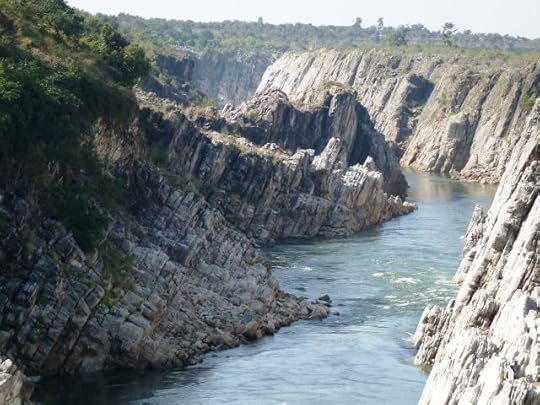
The majestic river serves as a connector to all these stories. This is a novel about India, the modern and the old country of mystery. The author connects the ancient Indian mythologies, religions and teachings with the present beautifully. What a beautiful novel this is. It could also be described as a collection of stories for it features many different stories. The central characters is a man who has left his important job and in some sense retired. He is without a family and wants to renounce the world. However, he keeps meeting different people who tell him his life stories and this makes him realize that leaving the world may not be as easy at it seems. What it means to denounce the world? As he hears the stories of a mystic, a monk, a music teacher, a courtesans and a government official, our protagonists learns a lot but is left with perhaps even more questions than ever.
I set to read this book during a ferry ride and despite being distracted by a horrid group of drunken tourists I managed to finish it in two hours. It really says something about how wonderful this book is for that group of young men was insufferable. When one watches TV, you see this type of men, the loud MTV style jackass idiots, but I always assumed that those kind of people are not real. Tourism made me realize that such specimens of humans not only exists but seem to be prevalent among young in Western societies. I escaped the saloon in an effort to get from that pathetic sight, but some of them went out as well and continued being obnoxiously loud. Unfortunately despite their drunken state, not one of them fell overboard, so I really had to concentrate hard to be able to read during my trip. However, this novel was so engaging and well written that it made it easier for me to ignore the outside noise. This was my first novel by Gita Mehta, but I doubt it will be the least. This is a gem of a book. I do recommend it to everyone but especially to lovers of mythology and India.
I simply adore this book. It was required reading for my freshman core class and so I first read it the summer before college, then again twice in college, and once after. And I will probably go on reading it forever. My copy is all battered and torn up and highlighted and that is exactly the way I enjoy it. I still am not sure what it is about this book that touches me so, and I end up in tears for no reason every time I finish. This is a novel about India and the sacred Narmada River which flows through the country. India is a melting pot of several religions, races, languages, and peoples and this novel serves to unite the country through this sacred river. In doing so, I believe Gita Mehta has united the entire human race in the process.
The novel is held together by a thread of stories heard by an old caretaker who lives on the Narmada's banks. He has come to escape from the world because he believes the world has nothing left for him, and he, in turn, has nothing left for the world. It is said that the Narmada River contains 400 billion sacred places, and people from all over come to its shores for redemption, hope, enlightenment, divine interception, but most of all because they need to believe in something. Each story is laced with emotions, deep and moving, and are characterized by Mehta's intoxicating writing style. I believe that Gita Mehta's writing is the most beautiful prose I've ever read. Her sentences have the cadence and flow of poetry and her words can be so powerful that they seem to speak to you. She writes a lot of the last part of the novel in song, and you can almost hear the music playing as you read.
Each story brings new emotions to the table, and each serves the purpose of uniting human beings. Just as India is a melting pot of different cultures, so is the world. No matter a person's religion, economic standing, social status, culture, upbringing, age, gender, sexual orientation, or ethnicity, we are all human beings and are affected by the same emotions. We all feel pain and loss, happiness and prosperity, sadness and anger, at some point in our lives. Our narrator comes to realize that the river, though some believe it is not divine in any way, serves the purpose of a beacon of hope--A River Sutra which connects the human race to the earth and to each other (Sutra in Hindi means a thread or a string).
I had begun this review by thinking I would describe each story as it connects to the whole, but I think that would be unnecessary, as the plot of the stories are only vessels to guide the reader through the novel and to arrive at its universal conclusion. It is, above all, a novel and not a collection. I continue to treasure this and will keep it on my shelf and open it every so often throughout my lifetime to rekindle my love of its pages. I can not recommend this book enough to everyone out there who reads. I hope that it will change and move you as it has done me over these past 10 years.
I hate reading Hindi/Sanskrit poetry in translation!
Now that it is out of my system, I have mixed feelings about this one. Stories are interesting, some more than others but there is no novel here. There is the common theme of Narmada and love but no central narrative to bind all the stories.
Also, the book is targeted at the western audience which becomes painfully clear when 2 Indian talking to each other about Indian music, feel the need to say that, "I was not even permitted to sing the seven notes of the scale: the sa, re, ga, ma, pa, dha, ni that are the do, re, mi, fa, so, la, ti of western music." On reading that sentence, I suddenly felt like when somebody seems to be talking to you and you look back and realize that they are talking to the person behind you.
I seem to be running into this thing again and again with Indian English writing. Perhaps this is what has changed with the current crop of writers. That they are telling stories of Indians for Indians.
A Government official in India is in charge of a Government Rest House--a sort of inn. He is told stories about various individuals: a Jain monk previously from a wealthy family; a music teacher; a courtesan searching for her lost daughter; an insane playboy; a River Minstrel and an anchorite who worships Shiva. All this takes place near the river Narmada, a place of spiritual pilgrimage to Hindus. Gorgeous, lush writing that taught me something of Indian culture.
Six disjoint stories woven together with a loose thread to present as a beautiful garland that is fragrant with Indian music and culture. Here in along with the retired bureaucrat who doubles as a narrator, in the stories we encounter different people whose lives are way different from each other - a renunciative monk, an honest musician and his gifted blind protégé, a possessed bureaucrat, a kidnapped daughter of a courtesan, a genius musician and his unlucky daughter, an ascetic minstrel. I found all the stories beautiful, and of all, the story of the blind musical genius stands out.
Gita Mehta is the daughter of the former chief minister of Odisha Biju Patnaik and the sister of the current chief minister Naveen Patnaik. I came to know about her when she recently declined to receive the Padma award, because of its political overture. I am glad that I read her work, as I found her writings charming and evocative, and I intend to read more from her, even knowing very well her writings were quite obviously catering to the palate of an western audience.
Of the many stories and themes that flow through A River Sutra, one stands out above all: passion. The individual stories that are told alongside this river are both awe-inspiring and heartbreaking. Altogether, these stories of passion, the story of A River Sutra, function to demonstrate the functions of mythology as set by Joseph Campbell. Here, I will focus on the first and fourth function of mythology. The pain that is seen throughout A River Sutra points to the metaphysical function of mythology: “The impact of this horror on a sensitive consciousness is terrific – this monster which is life. Life is a horrendous presence, and you wouldn’t be here if it weren’t for that. The first function of a mythological order has been to reconcile consciousness to this fact,” (Campbell, Companion 3). Life’s “horrendous presence” is most clearly demonstrated in A River Sutra through “The Teacher’s Story” and “The Musician’s Story.” It is worth noting that both of these stories are about musicians. Among its many themes, the novel also points to the importance of music as the sound of life – though that is a topic for another paper. The story of the teacher, Master Mohan, broke my heart. It started so beautifully as Mohan found his young protégé and worked so desperately to provide him opportunities and, ultimately, happiness and safety. This is a story of passion between teacher and student. As much as Master Mohan was helping the boy, the boy was also helping him. With Mohan’s unappreciated status in his family, the boy was a shining light. When the boy was murdered in front of Mohan, I cried. I had to put down my text and mourn this child and the loss of beauty and hope. I hesitated in picking up the text again. The following stories of the executive and courtesan lifted my spirits. Each not only overcame a negative situation, but seemed to be the better for having suffered through it. I started to connect to the novel and felt hope returning. In “The Musician’s Story,” however, I was again faced with life’s “horrendous presence.” Though it was clear at the beginning of “The Musician’s Story” that there was not going to be a happy ended, I did not think it would be quite so grim. When the ugly woman was betrothed, I saw a glimmer of hope. Her passion for music began to soar. As she spent more time with the bridegroom, her father’s student, I believed I saw love in the making. Knowing the story would end sadly, I feared her bridegroom was going to be killed. The fact that he freely chose not to marry her was actually far sadder. Though this was not as heartbreaking as the murder of the young boy in “The Teacher’s Story,” I was again left wondering… Why do we have to face this pain? How are we supposed to reconcile it? The novel answered these questions for me as it approached the fourth function of mythology: “All societies are evil, sorrowful, inequitable; and so they will always be. So if you want to help this world, what you will have to teach is how to live in it. And that no one can do who has not himself learned how to live in it in the joyful sorrow and sorrowful joy of the knowledge of life as it is” (Campbell, Myths to Live By 104). “The Minstrel’s Story” reveals to readers that one cannot hide from life, but must face it head on in order to actually be alive. Naga Baba first appears to us as a peaceful ascetic. It is rather shocking when we later discover that he has become the unspiritual archaeologist. And, while this may be a rather dramatic example, it acutely demonstrates how we must “reenter the world” (Mehta 281). We cannot dwell in our sorrows nor hide from the world in a cave. We must be in the world to experience it and to live. Life eats on life. Campbell has told us this. A River Sutra has demonstrated it. Life can be horrific. However, it does not end there. It is horrific because we care, because we have both passion and compassion. Passion fuels us. Without desire, pain, and struggle, the glory of the world would mean nothing. The pain that we feel in our life of passion is a sign that we are alive. If we moved through safely, unharmed, untouched, unmoved, what would be the point?
Indian stories, woven together, but not fantastic. Only one story stood out, that of an old music teacher taking a young, blind exceptional singer under his wing. Absolutely moving, very sad story. Love reading it again and again.
This book has stayed with me for years. The poetry touched my heart when I was very impressionable. I love how all the stories were woven together so seamlessly. It made me realize (at a very young age) how connected we all are. A beautiful work that I highly recommend.
O Beloved, can You not see Only Love disfigures me? - Rumi on staring at the sun
You can’t live without desire. After 84 deaths you return to the world of man.
After Shiva destroyed the world, Narmada was at its creation.
(My sister recommended to me. First two tales were my favorite, last few were on desire. Reminiscent of siddhartha: enlightenment is not just about getting rid of desire and emotion but understanding ‘the secrets of the human heart’)
A nicely written, peek into a somewhat different world. Smooth and easy to digest. I found myself trying to actually see the bungalow, the jungle and more importantly the river, in my mind. The chapter about the poor, little singing child really threw me at the end.
All in all, makes me want to read more Indian literature.
This book depicts the adventures of a retired bureaucrat who now lives outside city. People he meets, stories he hears and experiences are the elements. I've got this book from my university library and I must admit the cover attracted me much. And then when I learned it's about Narmada river, it held my interest. Gita Sutra illustrates Narmada river in such a way that it just sticks to your mind. I've never seen the river, I live in another country, probably I will never see it in this lifetime, still due to the writer's excellency, this river is appealing to me.
When I think about Narmada, I see that jain monk, with a muslin mask covering his mouth so that he does not kill a single fly that tries to enter into his mouth. That monk who was once a prince and how he renounced all worldly affairs; wealth, family and luxury. Gita Mehta uses musical notes in a metaphorical way. A dedicated musician teaches his daughter how you can hear perfect musical notes in the chirping of birds, and in nature. The way he intertwines musical instrument with Shiva, is so interesting.
Another story I would like to mention is the one with the blind prodigy singer. Oh how wonderfully the writer has created that last scene! How can you not wonder! All the stories were perfectlly woven into this saga. I loved the dimension of Naga baba. Most of the time when writers try to provide a twist, it backfires as it seems desperate. But here it was beautifully placed, under the moonlight, at the end.
Oh and "Do not reveal the truth in a world where blasphemy prevails", this is going to be one of my favorite quotes. There are very few novels that appealed to me with a perfect ending. I think it is one of those books. Thank you for reading my 'feelings'. Give this book a try 🤎
A lovely setting for some peaceful spiritual tales.
My Take This was absolutely lovely to read. A very peaceful and calming flow of words, descriptions, life that allows the reader to sink into Indian culture. It is so very different from the type of novels I usually read---big surprise---and it sank into me that what many Americans generally read is quite possibly how A River Sutra is viewed by an Indian reader. And I could very well be wrong in that!
There is an insight into life related by the main character which feels as though we are experiencing the real life of this culture, this man.
The tales that travelers tell provide quick insights into different aspects of Indian life and its various religions. I love how important art is in the culture Mehta relates. The day-to-day tasks, the interest in sugarcane for its juices in drink and as sugar.
Cute, Sir's curiosity uses the "guilt" of requiring enlightenment from the Jain monk as to why he gave up so much for his new life of absolute poverty. It's the monk's response that is even more humbling. In part of his story, Ashok questions his father's true adherence to his faith, how he can justify the devastating conditions of his workers with his supposed religious beliefs, his ahimsa.
Master Mohan's life is a torrent of wonder and horror that will make you weep while Nitin Bose's tale is something of a throwback to the days of the sahib and running an estate. The sad tale of reincarnation and Rahul Singh's woman. The story of the ugly woman whose father is a master veena player is so beautiful as she explains to Sir how the seven notes of the scale are simply the sounds of nature. The turns that life takes as Naga Baba continues his journey of enlightenment.
Oh, I do like Tariq Mia's "observation that they [the people Sir has encountered] were like water flowing through lives to teach us something".
The Characters The Narmada River is one of India's "holiest pilgrimage sites, worshipped as the daughter of the god Shiva".
We never do find a name for the man who desires to be the manager of the Narmada rest house, one of many "sanctuaries built by the Moghul emperors across India to shelter the traveler and the pilgrim". Instead, Mehta refers to him as "sahib" or "sir" throughout the story. His identity is not important, instead, it is his meditations on life and his encounters which are important in this story.
Mr. Chagla is Sir's clerk for the rest house. Constable Shashi is with the Rudra police station. Dr. Mitra is a medical doctor with many degrees who prefers his six-bed hospital near the Narmada River where he can collect the stories about the river. Tariq Mia is a mullah in a nearby village and a friend of Sir's.
Of the short tales scattered throughout the story: Ashok is a Jain monk whose wealthy family regrets his choice. Master Mohan is a music teacher blessed with the most marvelous student, Imrat, and the most horrible wife. Nitin Bose, the manager of a tea estate, is the nephew of an old colleague of Sir's who is badly in need of exorcism from the lustful Rima. Rahul Singh kidnapped the exquisite and beautifully trained daughter of an old woman. Naga Baba is an ascetic Naga who rescues Uma on the night of Shiva (think Halloween with a Naga twist). Professor V.V. Shankar is the archeological authority on the Narmada who comes to stay at the rest house. Sheela and Asha are his assistants; Murli his guide.
Shiva is the Creator and Destroyer of Worlds. Kama is the God of Love with his sugarcane bow, the honeybees, and the arrows of desire. Parvati is Shiva's consort.
The Cover The cover is a metaphor for the Narmada River in a tightly twisted length of red silk, a sari twisted yet again on itself.
I think the title is a metaphor for those people to whom Tariq Mia referred, a thread of life, a River Sutra, and how we live that life.
I loved this story of a civil servant, a widower, who has come to manage the government owned guest house on the banks of the Narmada river. He has entered the vanaprashti phase of his life, a concept I am particularly taken with. In the Hindu tradition we all go through phases in our lives-infancy, student, householder, and finally vanaprashti where we turn our energies and thoughts to Enlightenment. As a vanaprashti this manager has decided that a guest house near the sacred river is the perfect place to retire from the world and learn to shut off desires, but with each visitor and the tales they bring he comes to learn that completely shutting down desire might not be as noble a goal as he thought. In the Buddhist tradition we are taught that the best way is the Middle Way and we pray and strive to be 'free from attachment and aversion." I felt that this was the lessons we were meant to learn in this book. I loved the jungle setting, the stories, and the wisdom.
Loved the “old” Indian narrative voice, like a song in the background, that carries the main stories of the many people encountered near the Narmada river. Despite the editing typos which are the publisher’s issue, Mehta’s prose is near prose poetry and easily apprehensible and subtley deeper than consciously acceptable.
I am surprised at the beauty of this book which I’m not sure if Mehta knows gives the reader a certain peacefulness that being with or at the Narmada river is supposed to give!
And, I am paranoid by what strange imps have been spying into my next wishlist of things to read - since it happens to be Kalidasa’s poems and plays which are set often near or on the Narmada river. :)
This book is nominally about an Indian clerk who has retired to the Narmada River, but it reads as a collection of stories more than a single cohesive book. This isn't too much of a flaw, though, since each of the stories is lovely and could stand up on its own. Each story is about someone the clerk meets or is told about, and each of these people has some connection to the holy river. A few of the tales are happy, and several of them end in tragedy, but they all have some sort of moral (without being preachy) and they're all somehow comforting. A very nice read.
Beautifully written. This book is the perfect example of why a good book club can challenge you to read outside of your usual comfort zone. In all honesty, I never would have chosen this book for myself and yet I thoroughly enjoyed its parable-style narrative.
Gita Mehta’s “A River Sutra” is a very good novel for the summer days that stretch like toffee, for evenings on a balcony of a mountain cabin or afternoons on a hammock in an apple orchard. I read it in my parents’ garden in Berlin, listening to squirrels throwing walnuts and acorns and woodpeckers making characteristic noises high up in the Scots pines.
The main protagonist, about whose life we learn very little, is a bureaucrat who after his retirement runs a small guest-house in a forest overlooking the Narmada river in Madhya Pradesh. Here he meets various people - from a local ascetic and music teacher to a musician, minstrel and a Jain monk - and it is their stories which constitute the novel. These charming tales are deeply rooted in Indian mythology and traditions, local beliefs, poetry and songs. The Narmada, one of the holiest rivers in India, is actually the main character here as it binds people together and is a pilgrimage place in which they seek salvation or help, believing its water to be the cure for their troubled mind, heart or body.
“O Messenger of Passing Time, O Sanctuary and Salvation, You dissolve the fear of time, O holy Narmada. You remove the stains of evil, You release the wheel if suffering. You lift the burdens of the world. O holy Narmada”.
The novel reminded me of “Chowringhee” by the Bengali author Sankar, in which the Kolkata’s hotel’s guests’ and employees’ stories were interwoven and told similar tales of human passion, desire, misery, love and hate, albeit with less spiritual and mystical undertones. After all, an old colonial hotel, while surely enchanting, cannot have the same power as a holy river.
“A River Sutra” isn’t a great novel but it’s still worth reading if you’re looking for something light and uncomplicated, written with a certain charm and in an elegant, slightly old-fashioned language.
The cover’s picture of fine linen wrung red—for the bunching and twisting of the crimson cloth. A tale of tales in a way. The story is based on a nameless government official who retires and heads to the hills in India to live near a river and run an outpost with a guest house. He relates the individual stories of people he encounters while living there.
Gentle and rolling with amazing descriptions. Profound pages of this linguistic treasure, one will discover as I had, a collection of truths about the very nature of love and desire; of how the nimble fingers of Eros conduct the symphony of our lives, plucking at the strings of our hearts in harmony with his own design.
All stories are abstract, and yet have so much meaning and details in themselves. Tales are woven and spun and then are beautifully linked to the other - I was engaged with each separate story so much that I didn't want to let the characters go at the end of each chapter. The flow of this book is itself as a river journey. Absolutely loved it. For me, the book was an absolute page-turner.
This book has some pleasant qualities but ultimately didn't hold my interest. There is a kind of lack of sophistication in its language and construction that didn't appeal to me, and made me feel like it was written for a young adult audience.
I am a fan! Definitely for a western audience (I am western audience, so it reached me; its audience), but the storytelling was unique and very engaging. I am a sucker for little stories, and I enjoyed the thematic connections but also the inherent connection throughout of the setting. Would reread !! :0
I freely admit that I more or less bought "A River Sutra" because it was the recommended book with the prettiest cover (Note: The Vintage paperback, not the other editions!).
The back blurb tells us that this book "tells the story of a retired bureaucrat who has escaped the world to spend his twilight years running a guest-house on the banks of the country's holiest river, the Narmada".
To be honest, there is not much guest-house running involved. There are people arriving and leaving, and servants working, and sometimes the protagonist sits in office avoiding some work while he is deeply in thought. There is also not much about him being a bureaucrat; in fact, there is very little about him, as he spends his time listening to other people's stories, and thinking about them. This makes for a lovely structure, as if you were reading short stories connected by a larger story arch, which is something I really enjoy. Fortunately for the reader, none of these stories is desperately trying to get a point across, the stories are just there. Our protagonist thinks about them, but since he arrives at no conclusion for himself either, the reader can make up his or her own mind about the importance of everything that is being told.
Gita Mehta paints a picture with words to let the reader enter the unique place that is the Narmada river. She has a lot of stories to tell about the mysteries that surround the river, which serve as teachings for our protagonist. The river also provides a place where he can think in peace, and his thoughts seem to be reflected in the water. This is most true for one of the last sentences in the novel: "Don't you know the soul must travel through eighty-four thousand births in order to become a man [...] Only then can it re-enter the world."
The ending is as open as the interpretations to the stories. But, like life, it is a journey that has come to rest for the night, only to start afresh on the next morning.
Gita Mehta has proven with this piece that being the wife of the publishing house is not the reason why she deserves respect. Mehta's writing is fantastic and should be read by anyone who would like to explore South Asian literature. I feel that this is another top-shelf book foreigners outside of India can use to peer into that land and experience a taste of their rich culture. A River Sutra, especially, is an accessible read for those interested learning about Indian society as it has been reviewed on multiple accounts as a true depiction of various visions of Indian life, and yet it is also accessible to a Western audience.
I loved the fact that Mehta did not assume that English-readers wouldn't understand the characters or their actions, but I also liked that she included a glossary in the back to explain some of the terms that couldn't properly be explained by the characters without jerking us out of the story. The characters would know what they mean when they say words such as "paanwallah" or "yaar" and that is exactly what they would say at that time, but it's nice to know that readers who wouldn't know those words could remind themselves in the back that they mean "paan (type of bread) vendor" or slang for "friend" without the author forcing the characters to remind us of those meanings.
The structure of the novel in itself is also telling of Indian history as the chapters sometimes refer to different characters' tales that are reminiscent of The Canterbury Tales, perhaps nodding to the fact that Britain's relatively short rule of the Indian empire compared to its lengthy history cannot be forgotten, but the story itself is truly Indian.
This is definitely a book that can be read by many different audiences as the prose is not difficult, but the powerful visions she evokes are far from flat. Everyone grows a little after each story in this book, whether it's the character, the narrator who's listening, or the reader. It's a book for the soul without preaching a religion, and it's a book for the mind without forcing education.
Take me away to India for a few days.... with Gita Mehta's novel A River Sutra, recommended to me some years ago by dear friend David... "sutra", according to the glossary, is literally a tread or string, but also a term for literary forms. My favorite waiter Ishwouri told me it meant "form or pattern"... anyway, the river of the title is the Narmada, a very powerful river in India which indeed forms the backbone of the entire book. The narrator (who is never named) "retired from the world" after his wife passed away and thus ended a long government career to go off to manage a guest house on the banks of this river, which is not exactly retiring from the world, just shrugging off a former lifestyle. He certainly hasn't withdrawn into solitude. The book recounts his moments of meditation on the terrace and during his morning walks, but mostly is fleshed out by the tales he learns from people he encounters (once, or sometimes more than once, as with his Muslimdelder friend in a nearby village) each of whom tells him a tale of a different sort, challenging his feelings about the holiest of rivers and the various ways people choose to escape their pasts/presents/lives... all revolving around an intersection with the river: "..a place where... a millionaire mendicant {a Jain} comes to lay down the burden of his wealth; a sybaritic playboy wanders in a trance of erotic possession; and an aging courtesan seeks her kidnapped daughter. Populated by bandits, naked ascetics, and ecstatic singers...", the river is rich with suggestion and history. I found the wisdom of the millionaire turned Jain intriguing, as he says about his family, wealthy and very generous to the poor: "although we did not perpetrate physical cruelty ourselves, our wealth was sustained by violence." Many more captivating tidbits about what is means to be human, placing music and love in the realm of the sublime (after all, Shiva, the god of Death, created the river Narmada out of love of a woman....so are all those drawn to her banks seeking love? in what form? does it matter?)
This is a very clever, fascinating book which uses the device of a frame story, allowing the author to relate several different short tales through the expedient of their discovery by the protagonist. In this case, a government bureaucrat takes a position as manager of a vacation bungalow nestled on the banks of the river Narmada in rural India. He has been many years in the big city, is childless and a widower; he thinks it high time he went into semi-retirement to contemplate the world.
As part of his contemplation he encounters many different people and listens to their stories. He also is given stories to read from diaries and is told them second-hand by others he encounters. All of these are prompted in some way by the river itself, which is a holy shrine, able to wash away all sins. Much like The Tiger's Wife, many of the tales seem to be ancient stories of great import to the culture in which they arise.
I enjoyed all of the tales told here and was sufficiently interested in the protagonist that I felt quite affectionate toward him. It was necessary to the telling of the story that he be something of a skeptic and not very well-informed, but he is no bumpkin or bumbler and is humble enough to listen to what these storytellers have to say. All in all, an enjoyable, easy read.
The blurb: ‘Written with hypnotic lyricism, this is seductive prose of a high order.’ After the first couple of chapters, I thought not. Then I noticed a different rhythm in my writing. Mehta’s style seemed to seep in beneath my consciousness and it was delightful to find it there on the page in front of me. (Don’t look for it here – it has been some weeks since I finished the book!) It is a book you could say is simply written. The vocabulary does not soar into polysyllabic confusion; the overarching plot is simple – a man retires from a hectic life to quiet seclusion and meets people who intrigue him; the individual stories are short, with sharp arcs; in the background is always the river. Simple. But told with an abiding intensity. The characters have a quality I admire in Dickens’ writing: they are individual and memorable: the Jain priest, the jilted musician, the old mullah, the music teacher, the abducted daughter … And while the overall structure seems simple, the plots of the individual stories are anything but. There is humour here, and irony and tragedy. Much, to this gullible reader anyway, comes unexpected, and I am confronted by what I was expecting. And why. I have been to India, as a young man, and have never fully recovered from the culture shock of returning to Australia. I delighted in this book, even as it tore at my heart.
Mehta’s descriptions were so so gorgeous. Sometimes I would just zone out in class trying to picture myself sitting on the banks of the Narmada, teetering between reason and folklore, listening to the bustle of different walks of life converging. The incorporation of traditional songs, mythology, and religious beliefs was so cool, especially since a lot of the time, the literature we read in English classes is very much about white people problems. I’ve definitely learned new things about belief systems in India as a result of reading this, which I appreciate. But I think that in prioritizing a cohesive message on love, life, and Indian culture, while also weaving together disconnected storylines, the characters themselves were pushed aside. If viewed independently, the stories would fall flat. Especially in the teacher's story, every line was seemingly just there to reinforce that the main character is a good person who does the right thing while everyone else around him is the opposite. The monk and executive’s stories were more nuanced, but still cliche: young rich people who have all their material needs met but are emotionally unsatisfied. I guess I just didn’t like how one-dimensional the characters felt and I wish the characters could stand on their own (but maybe that’s a symptom of short stories?)