I like it when travel writers show me a country that I'll probably never see in my lifetime. Burma, also known as Myanmar, has been under military control since a coup in 1962, and it has a reputation of being one of the worst dictatorships on the planet. In 2005, President George W. Bush called Burma one of six "outposts of tyranny," along with North Korea, Cuba, Iran, Zimbabwe and Belarus.
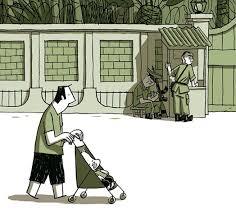
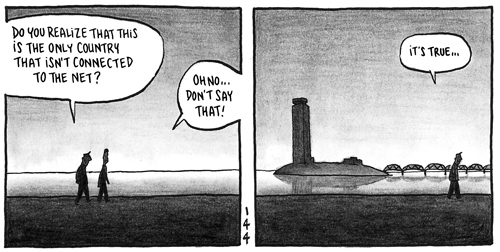
Guy Delisle and his family spent a year living in Burma while his wife worked for Doctors Without Borders. This graphic novel is similar to his other travelogues I've read, Pyongyang and Jerusalem, in that he draws his day-to-day life and his experiences in the region. As a Westerner who doesn't speak the native language, his main source of social contact comes from other expatriates, mostly people who work for nonprofit agencies.
Since Guy receives limited outside information -- government censors strictly control the news -- there's an amusing section when he first hears a World Health Organization employee talking about bird flu and he spends a month panicking about a potential epidemic. His biggest fear is if he and his family were to be quarantined in Burma and wouldn't be allowed to return home to France. Guy obsesses about getting enough doses of Tamiflu, until another worker points out that it probably wouldn't work anyway because it was prescribed to treat the seasonal flu, which is a different strain of the virus. One of the charms of Delisle's comics are the frames where it's just him looking puzzled and not saying anything. (Fortunately, there was no outbreak during their visit.)
Since Guy is an animator, he seeks out other graphic artists whenever he visits a new country. In this book and the other two I've read, there are nice stories of him meeting cartoonists and sharing their work. A particularly moving scene is when he travels to meet an elderly Burmese artist and reverently looks at the original pages of his comic published in 1970, which had inspired a generation of illustrators.
Sadly, the political situation changes and the government makes it more difficult for foreign nonprofit agencies to work there. There is an interesting section where a Doctors Without Borders administrator explains to Guy why they are deciding to leave Burma: Because the government won't allow them access to the remote Burmese citizens who need the most medical attention, and if they only operate in the capital city, then they're essentially propping up the regime.
Toward the end of their stay in Burma, Guy attends a meditation retreat at a temple and tries to focus his awareness: "After 42 hours of meditation in 3 days, I feel more peaceful than ever before, but also very alert. How long can this state of grace last? It could be a hard landing."