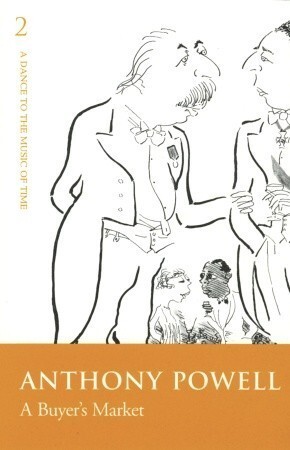
Jump to ratings and reviews
Rate this book
Rate this book
A Dance to the Music of Time – his brilliant 12-novel sequence, which chronicles the lives of over three hundred characters, is a unique evocation of life in twentieth-century England.The novels follow Nicholas Jenkins, Kenneth Widmerpool and others, as they negotiate the intellectual, cultural and social hurdles that stand between them and the “Acceptance World.”

286 pages, Paperback

First published January 1, 1952

114 people are currently reading
790 people want to read

About the author

Anthony Powell

107 books334 followers
People best know British writer Anthony Dymoke Powell for A Dance to the Music of Time , a cycle of 12 satirical novels from 1951 to 1975.

This Englishman published his volumes of work. Television and radio dramatizations subjected major work of Powell in print continuously. In 2008, The Times newspaper named Powell among their list of "the fifty greatest British writers since 1945."

https://en.wikipedia.org/wiki/Anthony...

Ratings & Reviews

What do you think?
Rate this book

Friends & Following

Create a free account to discover what your friends think of this book!

Community Reviews

5 stars
390 (24%)
4 stars
678 (42%)
3 stars
428 (26%)
2 stars
81 (5%)
1 star
16 (1%)
Displaying 1 - 30 of 219 reviews
Profile Image for Kalliope.
738 reviews22 followers
February 14, 2016


2. -- A BUYER'S MARKET


And so the Dance continues in its beginnings. The second period interval is still part of the dawn of times. The main contribution with this term is that the dancers begin to acquire shape. They also become much more numerous, and I now begin to fear a multitude, given how poor my memory for names is, when the do not have a face. Luckily I am accompanying my read with an audio version, which appropriately adds the musicality of the human voice to the dance. The brilliant reader endows each name with a different voice, and so, if not their physical features, it is their accent, intonation, and timbre that helps me distinguish them all from each other.

As the title indicates, at stake here are the professions that the young male characters have to start paving for themselves. When there are Buyers, there are also Sellers. The steps of the dancers in this volume involve finding their place in society: writing & painting and/or Money for the men, dancing & coming out (and/or Money) for the ladies.

For what comes to the fore in the second act is that we are witnessing a choreography in which, as the various dancers chose their places, two sets will interplay with each other, possibly alternating between a harmonic and mellifluous pas de deus and a jarring, dissonant and antagonistic confrontation. Power and the Arts cavorting and frolicking in a dazed prance.

But the dance continues and is beckoning me… I ought to go back.
Profile Image for Vit Babenco.
1,783 reviews5,781 followers
April 19, 2018
Bohemians and freeloaders, socialites and beautiful people are all in a hurry to partake in the agitated stirrings at the bottom of high society…
The roaring twenties preside over the ball…
Although these relatively exotic embellishments to the scene occurred within a framework on the whole commonplace enough, the shifting groups of the party created, as a spectacle, illusion of moving within the actual confines of a picture or tapestry, into the depths of which the personality of each new arrival had to be automatically amalgamated.
Vicissitudes and contrasts of living and loving reign over the characters while the raconteur stays in a stance of an ironic observer.
The world is calling… The future is waiting…
Profile Image for Violet wells.
433 reviews4,481 followers
July 13, 2020
Snobbery is often Powell's filter for arranging experience. Now, in this second part of his magnum opus, the snobbery is joined by unpleasant undertones of gratuitous racism and sexism. Often racism is excused in writers because of the ages in which they lived. But none of my favourite writers, whatever age they lived in, showed any inclination to put forward racist views, not even in a casual or unconscious fashion. When Powell casually introduced first a racist note and then a sexist note I got irritated and my irritation with him wouldn't then go away. Once a novel has irritated you it's hard to carry on reading with a generous mindset.

The comparisons to Proust are becoming more and more farfetched. He has little of the ironic finesse or wisdom of Proust. It's like comparing Anais Nin to Virginia Woolf. In both cases there's a case of a second rate writer deploying a first rate writer for his/her inspiration. I'd probably compare Powell much more with Evelyn Waugh, except he's not as funny as Waugh nor does he write so well.

It's interesting how throughout the 20th century British male writers were consistently overrated in the UK while I can't think of a single female writer who wasn't consistently underrated. Virago had to resurrect dozens of female writers from the scrapheap. I can't imagine it would be possible to do the same with male writers. They've never gone out of print. Not even Virginia Woolf was given the credit she deserves. Often when there was any kind of list of best British novels the novel of hers included was Mrs Dalloway - which though the most accessible of her 'experimental' novels is no more her best novel than A Midsummer's Night Dream is Shakespeare's best play. It's included, you feel, as a token gesture.

Anthony Powell is coming across to me as the author white male Tory MPs are most likely to love. It's not a novel that's aging well. I'd probably abandon it at this point except I've already bought volume three.
Profile Image for Susan.
3,018 reviews570 followers
January 8, 2024
This is the second novel in the Dance to the Music of Time series, following on from A Question of Upbringing. It is set in 1928, when our narrator, Nick Jenkins, is twenty one or two. However, it begins with a flashback to Paris just after WWI, when Nick has a chance meeting with an artist, Mr Deacon, an acquaintance of his parents. This introduction serves the reader to understand the various relationships in Nick’s life, as he meets up with Mr Deacon again after a dinner party at the Walpole-Wilsons.

We are very aware of the time period in which this is written. This is very much the London of the Bright Young Things, when Nick – now working in publishing – seems to spend most of his time at dinner parties, ‘low’ parties and house parties. During this constant gaiety – at one point, people are veering between two parties held in the same square – you sense a certain desperate sense of looking to be entertained and entertaining.

The book is full of chance encounters. Through Mr Deacon, Nick is introduced to Barnby and Gypsy Jones. Other characters, from A Question of Upbringing, also appear – including Charles Stringham, Sillery, Uncle Giles and Widmerpool. Although a figure of fun at school, Widmerpool is certainly becoming a man of ambition and, throughout this book, we are aware that Nick has a slight dissatisfaction with his career, his romantic life and the way his lifestyle compares unfavourably with his contemporaries. These novels are very much a series and, although they do work as stand-alone books, it is much better – and makes more sense – to read them in the order they are intended to be read in.
Profile Image for Nigeyb.
1,475 reviews404 followers
January 20, 2024
A Buyer's Market is the second book in Anthony Powell's twelve novel sequence A Dance To The Music of Time and it picks up the narrative in 1928, via a flashback to Paris where narrator Nick Jenkins introduces us to an artist called Mr Deacon.

Nick is now in his early twenties and whilst more grown up, still uncertain of his place in the world. I assume this explains the book's title. Nick and his contemporaries are searching for money, jobs, sex, social status etc. and their search takes them to a succession of social events that Nick recounts in the same first hand manner of A Question of Upbringing. Also, in common with A Question of Upbringing, it's full of day-to-day detail and Nick's perception of those he encounters.

How reliable is Nick as a narrator? He frequently revises his opinions about those he meets not least Widmerpool whose personal journey continues apace. The narrative technique adds to the sense of surprise and gives the book a few memorable twists. For me Widmerpool is very much the star of the shown and I love the way he kept turning up in ever more incongruous and unexpected places - constantly surprising and confounding Nick Jenkins.

There are also, and again in common with the first book, some moments of humour, and much of the writing has a pleasing and playful tone.

I enjoyed this book every bit as much as A Question of Upbringing, and now look forward to rereading the third instalment, The Acceptance World.

4/5


The twelve books of "A Dance to the Music of Time" are available individually or as four volumes.

Spring
A Question of Upbringing – (1951)
A Buyer's Market – (1952)
The Acceptance World – (1955)

Summer
At Lady Molly's – (1957)
Casanova's Chinese Restaurant – (1960)
The Kindly Ones – (1962)

Autumn
The Valley of Bones – (1964)
The Soldier's Art – (1966)
The Military Philosophers – (1968)

Winter
Books Do Furnish a Room – (1971)
Temporary Kings – (1973)
Hearing Secret Harmonies – (1975)

(dates are first UK publication dates)


Profile Image for Georgia Scott.
Author 3 books324 followers
November 22, 2025
Read this with a good hangover cure in the house. Took me two days to feel human again. It is one endless round of house parties, one after the other. Now, that could be fun. And there is a moment or two which I won't spoil by telling you now. You'll need the relief when those moments come because these parties are the talky kind. Forget food. This is England. Dancing. Only so you can talk. Anything else? Not much. It is talk and talk and talk. There's my head aching again. That's what I mean by hangover. The pounding is the voices. Plummy, ruling class voices. Saying nothing unless it is clever or offensive. Trivial. Spiteful. Or cautious and defensive. Bullies and bullied. All in their finery sipping champagne.

Memories! Not the twenties. The noughties. My London not Powell's. The club scene was private, exclusive, expensive, and oh so very like scenes out of A Buyer's Market. The only difference is the voices talking away in Buckingham Palace accents turned out to be not English at all but German, Korean, and other extractions. Yet, all looked so smart. (There was a dress code.) And drank champagne like water.

I like some of the reflections in Powell's novel. I like the big mirrors in clubs, too. They're good for checking your outfit. You see it's all about looks. Surfaces not depth. Characters appear and disappear. This isn't Tolstoy. You won't care enough to cry. Your head will simply spin with all the names. (Many double barrelled.) The point is no one really knows anyone.

Another writer would have made Powell's gay painter the focus, or the cockney girl who needs an abortion, the young Jewish girl, or the black guest who laughs. As it is, Powell's brush is small. Dots of color serve to fill his canvas.

It works just as a spy works by gathering bits of information. On their own, they seem inconsequential. Together, in the right hands, they paint a picture.

Four stars for capturing the voices so perfectly. Had I known those rooms were bugged . . . .
Profile Image for Algernon.
1,839 reviews1,163 followers
February 24, 2016

The second part of the twelve-step dance around time and memory from Anthony Powell picks up the story of his alter-ego, Nicholas Jenkins, a few years after he finishes school and moves to London, probably around 1925. I am grateful to the group read of the Dance for motivating me to keep to the schedule of one book per month, thus keeping things fresh in my mind and offering bonus material in the discussion pages.

Being familiar with the style of presentation and with some of the characters helped me enjoy this month's offer a little more than the debut. I can spot now the way each chapter begins with a catalyst for memory and with a short key for interpreting the events, and how each chapter has a sort of moral and lesson learned from experience. Jenkins remains a little bland and amorphous, a perfect witness of the times rather than an active participant, but his growing up is evident by the end of the book, even if it comes at a slow and introspective pace. I have grown quite fond of Nick and of his reserved demeanour, mostly for the way he keeps his curiosity alive and for how he tries to understand people without judging them. Jenkins reminds me strongly of one of my favorite quotes from Sir Terry Pratchett:

“The presence of those seeking the truth is infinitely to be preferred to the presence of those who think they've found it.”
- Terry Pratchett]

If the catalyst of the first volume (the Proustian 'madeleine') was watching some workers dig a road in winter, this time memory is triggered by a set of canvases painted by an old family friend. Jenkins remembers mr. Deacon as an unconventional figure, out of synch with both the classical and the modern styles in painting, trying to find his own artistic path yet being either ridiculed or ignored by the establishemnt.

The canvases were none of them familiar, but they recalled especially, with all kind of other things, dinner at the Walpole-Wilsons', reviving with a jerk that phase of early life. They made me think of long-forgotten conflicts and compromises between the imagination and the will, reason and feeling, power and sensuality; together with many more specifically personal sensations, experienced in the past, of pleasure and pain.

The opening scene elegantly sets up what appears to be the main dychotomy of the epic : the relationship between the world of power (materialism) and the world of art (spirituality). Jumping to a later point of the present novel, this aspect is spelled out even more clearly when the closing scene brings in focus another painter friend of Jenkins, this time an exponent of the younger generation named Barnby:

His life's unusual variety of form provided a link between what I came, in due course, to recognise as the world of Power, as represented, for example, by the ambitions of Widmerpool and Truscott, and the imaginative life in which a painter's time is of necessity largely spent: the imagination, in such cases, being primarily of a visual kind.

I referred to the first novel in the series in musical terms, as a symphony of many voices. The second one develops more as a tapestry, weaving together lives and images into a more coherent panoramic view of its period. The narrative is more insightful and more elaborate, as a normal consequence of Jenkins passing from childhood to maturity, expanding his horizons and his areas of interest while maintaining a thematic continuity and a goal of extracting the universal truths from particular incidents.

Mr Deacon's reappearance at that season seemed not only to indicate divorce of maturity from childhood, but also to emphasise the dependence of those two states one upon the other.

The particular incidents of great significance in this second episode are as follows :
- a formal dinner and debutante ball Jenkins attends at the Walpole-Wilsons' London mansion, including an infamous sugar incident
- an after party of the high society given by a Mrs. Andriadis in London, on the same night, in the company of mr. Deacon, Gypsy Jones, Stringham, a prince from the Balkans and many others
- a visit to the country residence of Sir Magnus Donner, at the castle Stourwater
- a dinner at the Widmerpool home, coupled with a birthday party for Mr. Deacon, the painter.

I have identified two common factors in all four scenes : the active participation of Widmerpool in all four, and the personal quest of Jenkins to unravel the eternal mystery of feminity (... or to get laid, if I were to use the coarser third millenium verbalisation, an expression that our friend Nick probably would find repulsive, given his coy and oblique mentions of the subject throughout the novel)

I must have been about twenty-one or twenty-two at the time, and held then many rather wild ideas on the subject of women: conceptions largely the result of having read a good deal without simultaneous opportunity to modify by personal experience the recorded judgment of others upon that matter: estimates often excellent in their conclusions if correctly interpreted, though requiring practical knowledge to be appreciated at their full value.

This shy and elaborate style forms a good part of the charm of Jenkins for me, and I am of the opinion that our modern lives are poorer for the trivialization of our finer sentiments. 'Cringe' comedy is one of the recent fads I would like to bury somewhere deep and out of the beaten track. I mentioned comedy because some of the efforts of Nick Jenkins to woe the young ladies of London are quite funny, in their own stiff-upper-lip way . In a way, Nick reminds me of my own early twenties, when I had the roving eye and used to imagine how it would be to fall in love with every pretty girl I saw at parties... of being in love with the idea of love:

On the way down in the train I had felt that it would be enjoyable to meet some new girl, even at risk of becoming once more victim to the afflictions from which I had only recently emerged.

and,
Mrs. Wentworth was, outwardly, the more remarkable of the pair, on account of the conspicuous force of her personality: a characteristic accentuated by the simplicity of her dress, short curly hair, and look of infinite slyness. Lady Ardglass was more like a caryatid, or ships figurehead, though for that reason no less superb.

As an older man looking back at the folly of his youth, Nick is able to take a less sanguine atitude towards these ladies and towards his romantic feelings:

This affair with Barbara, although taking up less than a year, seemed already to have occupied a substantial proportion of my life; because nothing establishes the timelessness of Time like those episodes of early experience seen, on re-examination at a later period, to have been crowded together with such unbelievable closeness in the course of a few years; yet equally giving the illusion of being so infinitely extended during the months when actually taking place.

A list of all these love interests of young Jenkins could get quite long, but somewhere along the line I got to thinking about the significance of the title for this second novel in the series, which I suspect is a double entendre, referring both to the lack of suitable young men in the aftermath of the World War II and to the world of Power, where some are called forward based less on their intrinsic abilities and more on the strength of their connections.

Widmerpool's presence was 'proof of the insurmountable difficulties experienced by hostesses in their untiring search for young men at almost any price.

The last quote brings me around finally to what appears to be the central figure of the dance, at least according to Jenkins who 'accidentally' runs into his old school mate in the most unlikely places.

I did not, however, as yet see him as one of those symbolic figures, of whom most people possess at least one example, if not more, round whom the past and the future have a way of assembling.

I was confounded in the opening volume by the importance accorded to this oddball personage in the economy of the story, and the bafflement continues in the second book, although Widmerpool's character slowly begins to make sense, like an image gradually coming in focus on photographic paper after being exposed to light. Likewise, the reader understands more about what Widmerpool stands for after each new encounter between him and Jenkins. The final picture is still probably a few volumes away. The same technique is deployed by Powell for all the recurring characters in his saga, with other school friends and acquaintances making a comeback under fresh circumstances : Stringham, Sillery, Templer and his sister, Truscott, Mark Members and Quiggin. Newly introduced characters, like Archie Gilbert - the dandy who lives is invited to all society balls ("he danced his life away through the ball-rooms of London in the unshakable conviction that the whole thing was a sham.) - or the painter Barnby, may play a greater role in later books, yet it is Widmerpool who seems to stay the longest in the limelight for now:

True to old form, there was still something indefinably odd about the cut of his white waistcoat; while he retained that curiously piscine cast of countenance, projecting the impression that he swam, rather than walked, though the rooms he haunted.

Powell is at his best when he makes his observations of human nature, both explaining and holding back his judgement while he tries to remain truthfull to the perspective and current experience of his narrator Jenkins. The author also enchants with his use of the English language, approaching P G Wodehouse in his search for the most evocative and beautiful turn of phrase. I love diving to the dictionary in order to make sense of 'minatory quiescence' even as I know I will have scant chance to use the expression in everyday conversations.

Widmerpool still represented to my mind a kind of embodiment of thankless labour and unsatisfied ambition, [...] forever floundering towards the tape in races never won.

and,
The illusion that egoists will be pleased, or flattered, by interest taken in their habits persists throughout life; whereas, in fact, persons like Widmerpool, in complete subjection to the ego, are, by nature of that infirmity, prevented from supposing that the minds of others could possibly be occupied by any subject far distant from the egotist's own affairs.

Implied here is the fact that such impressions and judgements are liable to evolve over time, to change into something else as Jenkins will grow older. Nick will probably be drifting towards the artistic side of the equation of life, what he calls Bohemianism. He is already working for a small publishing house putting out art albums, and he is writing in his spare time essays and studies 'in the manner of Montaigne' , but I have a feeling the world of Power will also still intrude upon Jenkins and his circle of friends.

Whatever the imperfections of the situation from which I had just emerged, matters could be considered with justice only in relation to a much larger configuration, the vast composition of which was at present - that at least was clear - by no means even nearly completed.

With this elegant conclusion that we never stop learning as long as we live, I am ready to dive into the third book of the dance. Before that, I have a few more bookmarks that I would like to remember from the present novel:

on the subject of finding the universal in the particular, Nick gains ... a belief that existence fans out indefinitely into new areas of experience, and that almost every additional acquaintance offers some supplementary world with its own hazards and enchantments. As time goes on, of course, these supposedly different worlds, in fact, draw closer, if not to each other, then to some pattern common to all.

>><<>><<

on parting from a friend : I certainly felt sad that I should not see Mr. X again. The milestones provided by him had now come to and end. The road stretched forward still.

>><<>><<

on the quest for love, growing up is often associated with heartbreak and disillusionment : ... in so far as I was personally involved in matters of sentiment, the season was, romantically speaking, autumn indeed, and the leaves had undeniably fallen from the trees so far as former views on love were concerned: even though such views had been held by me only so short a time before.

>><<>><<
Profile Image for Rosemary Atwell.
509 reviews41 followers
September 14, 2024
‘Here, therefore, were assembled in a single group - as it were of baroque sculpture come all at once to life - three classes of object all equally abhorrent to Uncle Giles; that is to say, champagne, beards and tiaras: each in its different way representing sides of life for which he could find no good to say:’

A subtle and compelling exploration of class manners from a narrator whose movements remain so ambiguous that they occasionally trip up the unwary reader.
This entire review has been hidden because of spoilers.
Profile Image for Roman Clodia.
2,897 reviews4,650 followers
March 31, 2024
I'm two books in to this twelve book series and I'm still ambivalent about it. It's easy reading, a kind of upper class soap opera but I don't feel any pull-through and so it's hard to feel more than superficially engaged.

The structure is episodic, here featuring a handful of parties, a wedding and a funeral, and the characters feel interchangeable: people flirt, have affairs, fall out, get married, even die and no-one seems to feel anything much. The 'dance' is impersonal and who you marry seems as arbitrary as who you might partner in a ballroom - both sets are essentially closed.

Part of the pattern is the way the same group of 'Establishment' people circulate so that they're always reappearing in gossipy stories or in unexpected places - they (the men - and this is viewed very much from a male perspective) have been at Eton and Oxford together, they meet at the same stifling dinner and weekend parties, marry each other's sisters and cousins, and professional nepotism maintains the boundaries to this social exclusivity. Even a bohemian party takes place in Mayfair and allows the young men to feel a little wild without pushing them out of their comfort zone.

I'm still in the dark as to what the intention is behind this series and given the lack of psychological interest in any of the characters I'd have hoped that something about the prose would offer up a clue but that feels opaque too: Jenkins, our first person narrator, is like a camera - he watches and observes in documentary fashion but doesn't add any tone or colour.

Set in the Bright Young Things 1920s, this volume treads similar ground to Waugh's Vile Bodies or A Handful of Dust but with all the spleen, comedy and satire erased. We watch from a distance as these puppets are moved around the board but there's no reason for what happens that I can see.

Edit March 2024: after yawning my way through the first chapter of the next volume I've bailed on this series. Powell is one of those 'not for me' authors.
Profile Image for Darwin8u.
1,835 reviews9,035 followers
December 14, 2016
"It is no good being a beauty alone on a desert island."
-- Anthony Powell, A Buyer's Market

description

"For reasons not always at the time explicable, there are specific occasions when events begin suddenly to take on a significance previously unsuspected; so that, before we really know where we are, life seems to have begun in earnest at last, and we, ourselves, scarcely aware that any change has taken place, are careering uncontrollably down the slippery avenues of eternity."
-- Anthony Powell, A Buyer's Market

Book One (A Question of Upbringing) of Powell's monster 12-book 'A Dance to the Music of Time' dealt primarily with Nick and his fellow students during their last year in public school and first couple years either "up" at University or "down" in the city working. The four major players in the first book: Nicholas Jenkins (the narrator), Charles Stringham, Peter Templer, and Kenneth Widmerpool. These characters all show up again in Book 2. Along with various other characters (Nick's uncle, Jean Templer, Mark Members, JG Quiggin, Bill Truscott, etc.).

Book Two ('A Buyer's Market') deals with Nick and some new characters, and many of the old, as they maneuver through the social dinners, dances and teas that seem designed to both stratify society AND bring together these young people together to get married; to find adequate husbands for daughters and satisfy the social or monetary need of the men who are just starting to 'make something' of their lives.

Events seem to guide the paths of these people in and out of each others lives. Probably the most painful to watch is Widmerpool, who seems always to exist in a socially difficult place and constantly dealing with sugary embarrassments.

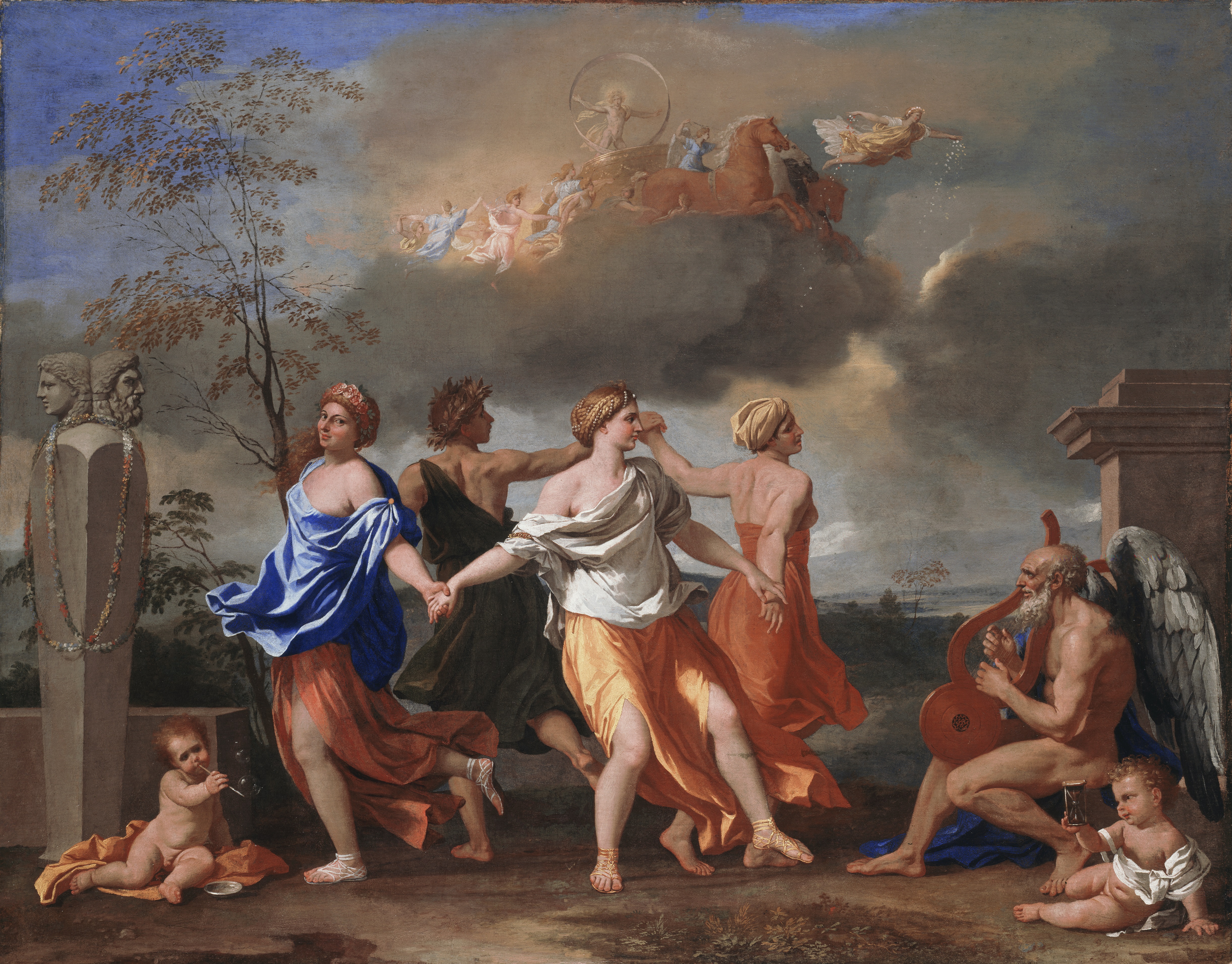
I love how art is taking on a larger presence in his novels. Not a surprising fact given that the book itself is named after a painting with the same name by Nicolas Poussin. But, internal to the book, it makes sense given that Edgar Bosworth Deacon (an artist) plays a part and that Nick is now working in a publishing house devoted to art books.

There are parts of this novel that, obviously, bring to mind Marcel Proust, but a lot of the first two novels, at least, seem substantively more related to both Evelyn Waugh and F. Scott Fitzgerald. I wonder if the either the character of Members/Quiggin is, in fact, E. Waugh. And if so, who the other writer "is".

Anyway, there is enough good writing here, and I'm deep enough into the books, that I think I'm at least marginally hooked. Unless, the final book of the 1st Moment is a complete dud, I think I'm in for a season, in for a year.
Profile Image for Katie Lumsden.
Author 3 books3,767 followers
April 6, 2018
I adore this series so much, the 1920s setting, the characters, the parties, the hints at things to come. Brilliant and hilarious.
Profile Image for Connie  G.
2,143 reviews709 followers
March 23, 2016
"A Buyer's Market" takes the narrator, Nick Jenkins, to London in the late 1920s. Much of the novel is set at either upscale parties, or with a group of bohemians that revolve around the artist Mr Deacon.

The title of the book suggests that the parties are a kind of marketplace. People attend the parties to meet marriage prospects and sexual partners. The parties are also an opportunity to make business contacts, the 1920s version of networking. It was important to climb the social ladder by mingling with people of a high social class.

"A Buyer's Market" introduces the reader to new characters and revisits Jenkins' friends from school. Jenkins is also spending time with artists and writers. Kenneth Winmerpool resurfaces and seems to be especially determined to be successful in business. He tells Jenkins, "No woman who takes my mind off my work is ever to play a part in my life in the future." The book left me wondering what's to come in the third book of the series, "The Acceptance World".
Profile Image for Eleanor.
614 reviews57 followers
January 2, 2015
I am quite mesmerised by Anthony Powell's style now that I have got used to it. The long rolling sentences remind me in a way of the themes in Rachmaninov's symphonies, which roll on and on and sweep the listener with them. The following description of one of the characters gives a flavour of Powell's style:

"She dressed usually in tones of brown and green, colours that gave her for some reason, possibly because her hats almost always conveyed the impression of being peaked, an air of belonging to some dedicated order of female officials, connected possibly with public service in the woods and forests, and bearing a load of responsibility, the extent of which was difficult for a lay person - even impossible if a male - to appreciate, or wholly to understand."

I took a long time reading this book because of other things coming between me and it, not because of a lack of enjoyment. I have now embarked on the third volume.
Profile Image for Laura.
7,132 reviews606 followers
February 19, 2016
From Wiki:
A Buyer's Market is the second novel in Anthony Powell's twelve-novel series, A Dance to the Music of Time. Published in 1952, it continues the story of narrator Nick Jenkins with his introduction into society after boarding school and university.

The book presents new characters, notably the painter Mr. Deacon and his dubious female acquaintance Gypsy Jones, as well as reappearances by Jenkins' school friends Peter Templer, Charles Stringham and Kenneth Widmerpool. The action takes place in London high society in the late 1920s, focusing on a handful of close-knit incidents which illustrate the flowing and weaving nature of the passage of time.
606 reviews16 followers
November 29, 2009
I found this more difficult than Book 1 and it's taken me several weeks to finish. I think I've had, at least, two problems. First, I've had great difficulty caring about Powell's characters. I don't need to like them. After all, sometimes the most compelling characters are unlikeable. But so far, I feel quite indifferent to them. (And there are dozens!) Their dialogue is opaque, their motivations murky and their stories meaningless to me. And perhaps that's because what I'm experiencing is cultural dissonance. This particular class of people, in this place at this time in history, just seem too alien. It's as if the author is speaking a different language.

I know Powell is well-regarded and Dance is considered his masterpiece, so clearly the failing is mine. A failure of imagination, perhaps?

Still, I persevere. Book 3 awaits.
Profile Image for Realini Ionescu.
4,031 reviews19 followers
November 12, 2025
A Buyer’s Market by Anthony Powell


This is the second novel in the twelve-novel series A Dance to the Music of Time. It reminds me of A La Recherche du Temps Perdu. It is magnificent, elaborate and very often hilarious. Like in a Psychology test, to put down feelings, words, adjectives associated with the exquisite experience of reading this book: majestic, British, superb, splendid, wonderful…nec plus ultra, but then there are another 10 volumes and I expect them to be at least as majestic as the first two.


In fact, I love the British, not the ones we met drinking their brains out, but the gentlemen of the Victorian period, the ones from this novel, or from the stories of Somerset Maugham. Sometimes I wish I had lived in The Great British Empire, in the XIXth century, even if I haven’t quite made up my mind if in rainy Britain or in the Indies, or perhaps some other colonies.


I laughed with tears at the beginning of A Buyer’s Market, when sugar is poured on Windmerpool’s head. Then again, when the same odd Windmerpool makes a strange appearance, in the “private dungeons „of a small palace in the country, afterwards managing to produce a car accident and more mischief.


Even if I lose track of some of the very many characters, this is one of the best books I have read, the pleasure it gave me makes me think that I would like to read the 12 volumes again. In the meantime, I take my time, making sure I will not end this exciting read too soon.
Profile Image for Justin Evans.
1,716 reviews1,133 followers
June 11, 2013
Nothing in the first novel of ADMT really prepares you for this. There you get short introductions to characters, traditional plot movements, transparent prose and above all variety. With A Buyer's Market we're suddenly in the realm of Proust volume three, which is pretty much a party described over hundreds of pages. Say what you will about Powell. This is shorter than Le Côté de Guermantes. I wonder if Marias, anglophile that he is, took as much from Powell as from Proust to write Your Face Tomorrow?

Anyway, as in Proust (and Marias), we're pretty much without plot, something of which I often disapprove. Things happen, but they're reported in dialogue rather than narrated, and the things that happen are, unsurprisingly given that the narrator is in his mid twenties, mostly sex and drinking and the results of sex and drinking, until Mr. Deacon dies, probably due to drinking. There's no grit here, just humor. It could easily be Wodehouse, with less plot.

But the form of the novel is breath-taking. We begin, for no obvious reason, with Mr. Deacon, his late-decadent, Alma-Tadema-esque painting, and his antique shop. We conclude with his death, which is followed, uncomfortably, by the narrator fucking Mr. Deacon's young lady friend (who, uncomfortably, has fooled Widmerpool into paying for an abortion, probably by promising him her favors, and then not actually given him any favors) in Deacon's antique shop.

So the narrator's generation takes over from that of their parents: Deacon dies, Uncle Giles is rendered more and more silly, and even the high and mighty end up looking much more down to earth. Characters from 'A Question of Upbringing' have attained some notoriety in their fields. The musical analogy starts to make sense, too, both with the 'return' of Deacon at the end, and with motifs from AQU showing up again (notably the car accident).

In short, ABM is funnier than AQU, but not as entertaining. As an artifact to think about, though, it's much more impressive. Also, Powell's prose becomes more Jamesian here. I can't remember if that keeps up through the other volumes, or not.
Profile Image for Michael.
304 reviews32 followers
April 9, 2018
It's the "Roaring '20s", a time of dances, dinner parties and late night gatherings for the fashionable London crowd that our narrator, Nick Jenkins, hangs with. There are ladies, some young, some not so young, whose charms, at first, infatuate and who eventually go on to disappoint the young Jenkins. Many memorable characters from "A Question of Upbringing" are here as well including schoolmates Widmerpool, Stringham and Peter Templer. All seemed to be gainfully employed and moving up in their various careers, although we not given too many details about careers here. Instead, Mr. Powell chooses, through his characters, to discuss art, literature, social class and relationships. He does so in precise, witty prose that beautifully describes Jenkins' thoughts, observations and reflections on this unique period. There are interesting new characters presented here as well including the enigmatic Mr. Deacon and the mysterious Gypsy Jones among others. At times funny, sad and poignant, "A Buyer's Market" is a worthy sequel and this reader is looking forward to reading the next book in the series.
1,945 reviews15 followers
Read
November 10, 2025
"Indeed, a dedicated reader of A Dance may actually go through it many times and see new interconnections with each fresh reading" (Robert Selig, Time and Anthony Powell 73). Working on reading #72 of the full series, I couldn't agree more.

What’s left to say? Powell has gripped my imagination since 1979, and I’ve read
A Dance to the Music of Time at least once a year (often more frequently) since. Never gets old. London society of the late 1920s is not my world, but I find a lot of character motivation and action quite familiar nonetheless. Of particular interest this time are Jenkins' various musings on sex and love--seen now differently than they were when first read in my early 20s. I find myself noticing more the subtlety of Nick Jenkins' assertions, not that he has no opinions, surely, but that he is too much the gentleman to insist that anyone else must share them.
Profile Image for Diane Barnes.
1,613 reviews446 followers
February 8, 2016
In book 2, Nick and his school friends are in their 20's, and have entered the real world of work and pleasure. The excellent writing continues, with intimations of complications ahead.
247 reviews35 followers
April 2, 2024
Took me ages to complete this.
Profile Image for Paola.
145 reviews40 followers
August 7, 2015
This for me was rather slow going - I got quickly tired of the parties, of Sillery, of some of the hyperboles, and the main character's apparent detachment from most that is going on around him: he is the narrator who does not seem to add much to an omniscient narrator's voice. I am glad I got this as part of the "movement" set of three volumes, as I might have otherwise let the series go.
Profile Image for Tania.
1,040 reviews125 followers
April 29, 2021
Nick has now left Uni and is living in London and trying to make his way in the world. He largely seems to be attending house parties and debutante balls. We meet up with many of the characters from the first book. plus a few extra, quite a dizzying array of characters in fact and at the moment I'm finding them all a bit of a tangle; I have a feeling I might have to go back to the beginning once I've finished the whole series.
Profile Image for Pamela.
1,673 reviews
March 27, 2021
In the second book in A Dance to the Music of Time, Nick Jenkins has entered the world of work. His social life is an active whirl of balls and dinner parties, although he fears that others are having a much better time. He crosses paths with former friends and acquaintances, and contemplates falling in love.

Powell is such a clever writer, he weaves his patterns as the characters move through the ‘dance’ with connections made and missed, and gradually reveals more about his characters as Nick encounters them. Nick is constantly reassessing his views of people and events along with the reader. There are some brilliant characters in this book - Sillery, Widmerpool, and the marvellous Gypsy Jones - and plenty of amusing moments. I’m looking forward to moving on to the next in the series.


Profile Image for Tom Ewing.
710 reviews80 followers
October 8, 2023
EDITED FOR 2023 RE-READ: I bumped it up a star on this reading. The opening chunk is still hard going, but this time I really loved how Powell's (or Jenkins' I guess) prose loosened up as the "night of three parties" progressed, capturing the progression from awkward formality to Nick's plunge into the London demi-monde and his own gradual intoxication. Still one of the most memorable set-piece sections in any novel, even though remarkably little happens. Also more obvious how well the novel works as a unified piece, not just a section of the cycle as a whole. Content Warning: There's one jarring, ugly chunk of racist language which it's as well to be aware of going in. Otherwise, the review below stands.

(original review follows)

Each of the novels of ADTTMOT makes a claim - with varying degrees of conviction - to stand alone, with characters and plots resolved within a single volume. The intricate, lopsided, A Buyer's Market follows two such strands. First, the life of Edgar Deacon, a bad painter and family friend of narrator Nick Jenkins' whose reappearance helps put in motion his escape from the world of balls and debutantes the book opens in. Second, Nick's troubles with women, an overlapping series of largely passive romantic or erotic obsessions, some lasting months, some a hours, which contribute to his sense of the world moving rapidly on past him. A Buyer's Market is the story of his negotiation of these twin frustrations, social and sexual.

(For what it's worth, Powell captures both of these things authentically, from my experience - the pointillist exhaustion of infatuation, and the sense of drift and flux as you move around and between social circles in early adulthood, gradually being pulled into one or two on a more full-time basis. For me, Powell's writing in A Buyer's Market is baggier than in the novels either side of it, but some passages - the squares and parks of nighttime London pulsing with the distant noise of rival dance bands, for instance - caught at something painful and poignant about the uncertain and hectic social life of summers when you're young. Even if you spent them at shit indie discos not coming-out balls.)

As usual, Nick's own progress is the background theme to the formal action, as every other character has a more dynamic time of it, even if we only glimpse their advancing stories in vignettes and snatches of conversation. Compared to the fairly tight cast of A Question Of Upbringing, the second book is a mosaic of names, as Jenkins shifts around four distinct but interlocked social worlds. (It could be called Four Parties and a Funeral). The silly formality of the London Season; the richer and more decadent high society milieu it borders; country house parties and the professional world at play; and the grubbier end of intellectual London. The bulk of the book - a solid two-thirds - takes place at two parties across a single night. It's one of the cycle's best set-pieces, and constantly referred to by characters for several books to come. By dawn, as Jenkins heads exhausted for home, the beginning of the night seems half a lifetime ago - in terms of pagecount, it nearly is.
Profile Image for Christopher.
1,440 reviews222 followers
September 17, 2010
A BUYER'S MARKET, the second volume of Anthony Powell's 12-volume sequence "A Dance to the Music of Times" is a considerably more ambitious work than the first. While A QUESTION OF UPBRINGING was an enjoyable if something lightweight look back at narrator Nicholas Jenkins' days at school and university, now we see him entering the ballrooms of high society while also discovering the London demimonde of the late 1920s.

The novel is impressive in form also. Nearly the entire first half of the novel is dedicated to a single evening, where Jenkins describes the participants of a dinner, a dance and a seedy part in exhaustive detail. Here we see more clearly than the first novel Powell's conception of his social circle over the decades as a dance. Stringham and Widmerpool, among other characters from the first novel, enter Jenkins' life again after a gap of several years, but no sooner do they show up than they are cast away by new fates. With Jenkins' greater maturity comes a recognition of more important societal concerns in 1920s England. One character's awkwardly closeted homosexuality creates complications for Jenkins' circle, as does the need for a young female character to procure an abortion when it was seriously illegal. By the end of the novel, Jenkins has even entered among political radicals, who go on to play a large role in the third volume of the series.

Perhaps Powell isn't for everyone. I've sometimes heard people call it downright unjust that this author sees so much universal importance in what is essentially gossip about a handful of upper-class people, when the masses of early 20th century Britain were still fighting for their rights. Also, the delicacy with which sexual matters are treated in this novel -- a major part of the plot but never overtly presented -- may annoy contemporary readers. Nonetheless, I have to say that I enjoy Powell's world. Its characters are three-dimensional, memorable and always reminscent of people we know in our own lives. As I write this, I look forward to going on and re-reading THE ACCEPTANCE WORLD.

All twelve volumes of "A Dance to the Music of Time" have been reissued by University of Chicago Press in four handsome trade paperbacks. If you think you're going to go the distance, that's a better investment than older editions of the individual volumes.
Profile Image for Patrick.
423 reviews2 followers
July 26, 2022
Two volumes into A Dance to the Music of Time and loving it. If you are not enthralled by close, minute-by-minute analysis of character and behavior, don’t bother though; there will be nothing here for you.

As it happens, I am also two volumes into C.P. Snow’s parallel roman fleuve Strangers and Brothers. I recall that the critic and literary historian Martin Seymour-Smith adores Powell and despises Snow, which frankly I do not get at all, since their appeal is pretty much identical. The two authors were born two months apart in 1905, were working on their novel series at roughly the same time (Snow 1940-70, Powell 1951-75), were personally friendly, and seem to me strikingly similar in their writing styles and the cypher-ish characters of their narrating protagonists, Lewis Eliot and Nicholas Jenkins (the books are decidedly analytic but not SELF-analytic). If you like Dance you will like Strangers, and vice versa; I highly recommend both for the patiently literary sort of reader.
Profile Image for Brooklyn.
261 reviews69 followers
December 23, 2017
Second time round - still wonderful. Nick, Widmerpool, Stringham, Mr Deacon and the gang go round the merry go round of time again in a buyers market: for love, power and art. But don’t blink - the door is open for a moment and then shuts again - with some players off the Field and the stakes higher. Powell has been called the British Proust - and the subject is the passing of time and the life lived within. And Powell is so hilarious and entertaining - with set pieces of four parties in the 1920s. The writing is effervescent and full of witty asides - with passages of pure poetry - describing life and the ambiance of the settings and era and time of life. Read and enjoy!
Displaying 1 - 30 of 219 reviews

Can't find what you're looking for?

Get help and learn more about the design.