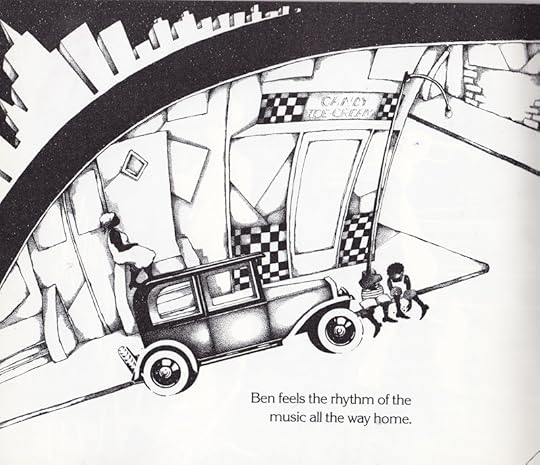
The story of Ben is fiction, but it could be the story of more than one jazz musician who grew up in the twenties. Using the art-deco style of the period, Rachel Isadora not only captures the poignancy and yearning of a youthful talent, but in page after page of striking art seems to convey the very sound of music.
Rachel Isadora is an award-winning children's author and illustrator. She has written children's books on multiple topics including ballet, life in America and Africa, and has illustrated several Brother Grimm tales in an African setting. She is most well-known for her Caldecott Honor Award book "Ben's Trumpet". She was a ballet dancer before she became an illustrator and children's writer.
The artwork in this diverse beginning story is amazing. It captures the mood of a hot city night and the jazz club groovin’ out hits. Each page is its own tone. It conveys the mood of Ben, our character. It is also Escher-like at points. I love it.
Ben lives close to the zig zag jazz club and he loves the music. He has his imaginary trumpet and he is always playing that for his family. He plays sitting everywhere and he is always hanging around the jazz club listening. He loves the trumpet most. The trumpet player sees him and takes a liking to him. I found this to be a fantastic story.
The niece enjoyed the artwork here. She thought the story was good. She gave this 4 stars. The nephew laughed at the naked baby in the story, of course. He thought this story was interesting. He gave this 3 stars.
I wasn’t sure about this one at first. It’s basically a historical fiction very short picture book story. A lot of 20s slang and mood is at the forefront, which I enjoyed, but as I read I wasn’t sure young children would.
The illustrations are terrific. I love when the illustrations bleed out of their area.
However, and I’m embarrassed to admit this, I didn’t read the cues about what was going on re Ben’s trumpet. I wasn’t sufficiently observant about what the pictures were telling me. But, because of that, how this story evolves, I found even more emotionally rich when I finally did understand. What a lovely story! Much is told in relatively few words.
This book is one of the six books (five books and an alternate) chosen by the Pictures Books Club over at the Children's Books group for its March theme of music.
I’d already read two of the books, have three at home to read (including this one), and for the first time cannot get one of the books, in this case the book designated as an alternate book, which is too bad because it looks fabulous.
I was reading this book for the Goodreads Picture Book Club for the theme of music. “Ben’s Trumpet” is a Caldecott Honor Book by Rachel Isadora and it details about a young boy’s interest in playing the trumpet after he sees a popular musician playing his trumpet. “Ben’s Trumpet” may have gorgeous illustrations, but the story might not be enough to attract the attention of younger children.
This story is about a young boy named Ben who sits outside on the fire escape and listen to the music from the Zig Zag Jazz Club and he plays his imaginary trumpet. Ben watches all the musicians practice playing their music, but the musician he is most interested in is the trumpeter!
Oh my goodness, I have never seen such gorgeous illustrations as Rachel Isadora has presented in this book! Rachel Isadora has done an excellent job at making the illustrations extremely dramatic and creative as the illustrations are mainly in black and white colors, which truly brings out the beauty of the story and I also loved the way that all the characters look so realistic as their expressions are truly effective, especially Ben’s sadden face when the other boys made fun of him for playing his imaginary trumpet. What I really loved about the illustrations were the surreal drawings that cross each page, such as how some pages contain sound wave lines to represent the sounds coming from various instruments, as I am a huge fan of surreal art, I mean surreal art is pretty impressive since you would never see anything else like them! I also loved how some of the characters appeared as silhouettes on a couple of pages and I also loved the beautiful effect that the images that have glitter on them bring to the story.
To be honest, the story did not really capture my attention, despite the beautiful drawings, because I wanted so much more out of the book such as knowing what life was like during the 1920s and I also wanted to know more about where his desire to become a great trumpeter stem from. Not only was the ending of this book a bit rushed, but I felt like this book should have been a good opportunity to give the audience the experience of living life during the 1920s and the story did not have enough information to bring that information to the audience.
All in all, “Ben’s Trumpet” does have fabulous illustrations that are both beautiful and surreal at the same time, but since the story was not effective enough, this was an average read for me.
This is a wonderful story about a young boy growing up in the jazz age. He is too poor to have his own trumpet, but the music sings through his heart and he "plays" all day long helping bring joy to his family and himself. But, oh, how he longs to have a real instrument and to play like those cool cats at the Jazz Club. Just when he is mocked by his so-called friends for playing an imaginary trumpet, a new friend steps in and gives Ben a new opportunity to share his song wtih the world.
The audio version of this story is wonderful! I probably would have gotten something from the story just by listening to it but the illustrations are outstanding and I am so glad I bought the book (my library only had the audio, no accompanying picture book) and got to feast my eyes on Isadora's wonderful work here while the story played. I usually don't pay as much attention to the illustrations as I probably could, since I am so eagerly reading the words, so having it on audio really allowed me to focus on the images instead and I noticed so many wonderful details here. It's such a sweet and encouraging story about how having a song in your heart and holding onto a dream is so important and can bring joy to others. I love the kindness shown at the end of the book. The narrator's voice is so rich and honey-warm and just fits the mood and characters perfectly. I understand the music was composed for the audiobook and, while it's no Grammy-winner, it's a very nice introduction to jazz style and I found my toes tapping. It's nice how each instrument is highlighted with a solo at the appropriate moment in the book and then the overall music played at the club is just a great sampling of jazz style. Then, the end is just so darn cute and perfectly fits what happens in the story ;-p The illustrations are fabulous; they really evoke the sense of jazz and the era and the characters' personalities and I agree they are worthy of their Caldecott honor.
Young Ben loves nothing more than sitting on the fire escape, listening to the music wafting up from the neighborhood jazz club. As he listens, he plays along on his trumpet . . . only Ben's trumpet, and the sweet, sweet sounds it makes, exists only in his imagination.
This is a terrific book; the illustrations are AMAZING! Isadora used only black and white, employing both a realistic style, and more abstract panels to create a punchy, staccato style that perfectly imitates Ben's favorite music form.
Rachel Isadora's 1979 picture book Ben's Trumpet celebrates both the power of music and equally the power of imagination. But while Isadora's presented narrative realistically shows Ben's nascent musical talents and how he even without a musical instrument of his own, is able to play a trumpet in and with his imagination for himself and for his family (although I do not really think that Ben's family is all that appreciative of this, as while his mother et al might not laugh at Ben for playing an imaginary trumpet as others often do, they also are not taking all that much of an interest either), it is the brilliant and lively black and white accompanying illustrations (also by Rachel Isadora) that truly "make" Ben's Trumpet, that provide not only a complement and mirror of and for the featured text, but actually much expand on the same, showing emotionality, movement and the simple joy of music (and to tell the truth regarding Ben's Trumpet, yes indeed, I actually even tend to like Rachel Isadora's pictures somewhat more than her printed words, for Isadora's illustrations are rich, nuanced, they rather feel like visual music, like blasts of trumpet strains on paper, while the narrative, while the text Ben's Trumpet Rachel ISadora provides, although definitely more than adequately descriptive, does also remain rather stagnant and emotionless and in particular if compared to the accompanying artwork).
Now thematically speaking for Ben's Trumpet, I certainly do consider it is rather telling (and also quite interesting) how the only person who really and truly seems to understand Ben is the trumpeter from the Zig Zag Jazz Club who as a child also and just like Ben played a trumpet in his imagination (who at the end of Ben's Trumpet gives Ben the sweet hope that he might actually be able to soon play or rather learn to play a real and not just an imaginary, invisible trumpet). And while I definitely feel for Ben and realise that he feels isolated within both his family and amongst his schoolmates and peers (such as the boys in front of the candy shop, for example), I also consider Ben being ridiculed for his "imaginary" trumpeting in Ben's Trumpet, while of course sad, not really an act of truly hateful bullying either (the other boys laugh at Ben, they call him "crazy" but they in no way stalk him or hound Ben, and I guess it is a bit strange or at least it could be a bit strange to perceive, to see, someone walking down the street playing an imaginary, non existent musical instrument).
Four stars for Ben's Trumpet, very much warmly recommended, and that I also and finally must say a huge and frustrated bah humbug to those "puritans" who seem to freak out regarding the illustrations for Ben's Trumpet (and all and only because, oh the absolute horror of it, Ben's infant brother is depicted by Rachel Isadora as being naked and potentially with his penis showing, and also, what the heck is wrong with depictions of men playing cards and/or visiting a jazz club).
With its silver and black cover, angled title, and silhouettes, Ben's Trumpet, a Caldecott Honor Book, announces to readers that they are in for a stylish ride. With simple text and stunning black and white illustrations, Isadora tells the story of Ben, a young boy who lives in the inner city, not far from the Zig Zag Jazz Club. On hot nights, Ben sits on the fire escape and plays his "trumpet" (even the cover communicates that it is an imaginary one) along with the trumpeter, who, as far as Ben is concerned, is "the cat's meow". Ben's family tolerates his "playing", but the candy store kids are less kind, shaming Ben for his imaginative playing. Isadora's tale has a rewarding and uplifting ending that involves one of the musicians from the jazz club taking Ben under his wing. All artistic creation, all achievement, the author seems to stay, begins in the imagination, but dreams require nurturing and mentoring, too.
I'm not sure what medium Isadora has used to create her illustrations. They appear to be pen and ink. Whatever they are, they're stunning: the epitome of "cool". Each of the musicians at the jazz club--the pianist, the trombonist, the drummer, the saxophonist, and the trumpeter--gets his own page, and Isadora manages to communicate through her art the effort and focus each musician brings to the jazz ensemble. The drummer's page is particularly notable--all done in jittery lines to suggest the rattling and percussion.
Ben's Trumpet would be a neat book to use to introduce jazz to kids, but it is an also provides interesting examples of how visual art can suggest movement and sound.
This is an inspirational tale about the magical lure of music, the imagination of a young child and the generosity of a musician who chooses that child, Ben, to mentor. The story is lyrical, but I think it is best appreciated listening to the story on audio. We listened to it as we followed along with the book and the added background music really added a lot of charm to the story.
I discovered this book through the Children's Books group here on Goodreads. This book was selected as one of the March 2011 Music-themed reads and I think it was a very interesting choice. I love this group as it has opened my eyes to so many books, like this one, that I might not have ever discovered before.
This was a book and cassette package that included a hardcover copy of the book with ISBN 0688801943/ISBN 13 9780688801946.
Ben's Trumpet was a fun and visually unusual read. Using black and white art deco style this book is set in the 1920's. Through the first few pages of the book, I wasn't sure how I felt about the art, but as the story went on I began to understand it. I am not sure how a child would feel about these illustrations and may even giggle or be distracted at one of the illustrations.
This story is about a young aspiring jazz musician who lives nearby a Jazz Club. He plays his trumpet daily even though he doesn't physically have one.
A young boy, who is - by the look of it - growing up in the 1920s, Ben loves to listen to the music spilling out of the local jazz joint, the Zig Zag Club, and to imagine that he too can play the trumpet. He watches the musicians, and feels the music. He 'plays' for his family on his invisible trumpet, and even receives a compliment from the club trumpeter, whose own playing is the "cat's meow." But when the neighborhood boys ridicule his imaginary instrument, Ben's trumpeting is at an end. Or is it...?
A Caldecott Honor book from 1980, this brief picture-book was chosen as one of our March selections, over in the Picture-Book Club to which I belong, where our theme this month is music. But although its themes are appealing, and its narrative - despite its brevity - engaging, the best part of Rachel Isadora's Ben's Trumpet is the dramatic black-and-white artwork, with its bold silhouettes, zigzagging lines, and curved figures. The illustrations here really come alive, and were well deserving of the honors they won! Recommended to all young would-be musicians and jazz lovers, as well as to anyone who appreciates a skilled melding of word and image.
I have been on a Rachel Isadora kick lately, she is sooo talented!
Ben visits the Zig Zag Jazz Club every day after school and the music fills his heart and follows him home. One of the musicians at the Club sees Ben's passion for music and shares a trumpet. This inspirational tale features black and white illustrations showcasing great usage of line and deco art.
I love the idea of this book and how Ben is so drawn to music that he air plays the trumpet. I'm just not enthusiastic about how "adult" they went with some of the illustrations since this is a children's book. If some of the images were different, the over all feel of the book would have been better and I would have bumped it up a star or two.
Ages: 4 - 8
Cleanliness: a picture of a naked baby shows his private part. There is a picture with men playing cards, smoking and drinking. A boy is interested in music coming from a Jazz club.
**Like my reviews? I also have hundreds of detailed reports that I offer too. These reports give a complete break-down of everything in the book, so you'll know just how clean it is or isn't. I also have Clean Guides (downloadable PDFs) which enable you to clean up your book before reading it! Visit my website: The Book Radar.
Wow! What a fabulous book. The text & unique illustration style works so well together. This is why we don't just get rid of older books, but we do look at them with a critical eye. This Caldecott Honor winning book may be 40+ years old, but it has not lost any of it's beauty with a contemporary read. Would definitely re-purchase for an elementary library. Celebratory of jazz & childhood dreams, this would pair well with Trombone Shorty (Caldecott Medal 2016) & The Double Bass Blues (Caldecott Honor 2020).
2011: On my first read, I wasn't wowed by this book. But my two year old asked me to read it over and over to her. She really liked it a lot. After a couple of readings, she could correctly name the instruments in the book and she really liked the pictures. The black and white illustrations weren't my favorite, but they did work well for this story... and they hold an important clue to the story as well.
Reread February 2016. I enjoyed the text quite a bit more than I did 5 years ago. The illustrations still aren't my favorite. Particularly the scenes of the city...they overwhelm me. I do really like the illustration of the drummer though..how it shows the vibration of the drums. Not destined to become one of my favorites, I can definitely see the value in this story.
Using black and white illustrations, this Caldecott Honor book tells the story of Ben who longs to learn how to play the trumpet.
Creatively pretending to play a non-existent instrument, Ben lingers outside a jazz club so that he can hear the beauty of the music when played at the hands of a master.
Obsessed with the sound of the trumpet, in public, Ben plays his pretend instrument. Made fun of, Ben is ashamed and walks home slowly.
The following night, Ben still goes to the jazz club and sits outside, longing to enter.
When the trumpet man comes outside and notices Ben, he brings him inside and fulfills Ben's dream.
The illustrations in this book are shining and sleek. The lovely tale is highlighted by the magnificent art work.
1980 Caldecott Honor - Favorite Illustration: Ben leaning against the door of the Jazz Club and the outline of the musicians. A great story about the power of imagination and the love of music. I wouldn't be a fan of this illustration style for every book, but it fits perfectly the setting and plot of this story. Being married to a jazz playing saxophonist (as his hobby, not profession), I have come to appreciate the beauty and uniqueness of this type of music, and I feel that this story is a perfect accompaniment to that musical style.
I love everything about this book: the black and white illustrations, the cool jazz musicians at the Zig Zag Club, and Ben: who loves music so much that he plays pretends to play music with an imaginary trumpet, until he runs into some kids at school who make fun of him and now he doesn't want to play anymore. Will Ben find a way to resurrect his love of music?
Should have remembered to recommend this to Anina on Tuesday when she did a jazz program! Good for a a pre-K storytime about music. Beautifully illustrated in black and white.
Ben's Trumpet is a visually captivating story about a boy who dreams of becoming a trumpeter. The book uses a bit of higher language such as metaphors, so I would recommend it for 2nd or 3rd grade and up. The book portrays the members of the jazz band as cool and interesting people whom Ben looks up to heavily. The book also shows the family life of Ben and shows the financial situation of Ben's family, which further amplifies Ben's dream to play the trumpet. This book does accurately portray the jazz culture of this time and shows how influential this style of music was. The book teaches students about all the different instruments in a jazz band and allows the students to feel as if they are there with Ben. This book displays many windows, mirrors, and sliding glass doors as it allows children to feel represented in maybe not being able to afford something that would help them achieve their dreams, as well as allowing other children to see into what it would be like to have a dream that requires something you do not already have. It allows children to connect on a level that allows them to realize that not everyone's family has the funds to get them everything they want. Sometimes you have to work really hard to get to your dream. I would use this book in a lesson at the beginning of the year. I would have the students read this book and then write down what their dreams are for the school year ahead and how I can help them accomplish them, just like the trumpeter in the book helped Ben. I would then have the students each draw a picture of them completing their dream to hang up in the room for motivation throughout the year.
Ben's Trumpet is a book that could be read to older elementary students as way to learn about a poor young boy that is growing up in the jazz age that is laughed at by other kids because he doesn't actually own a trumpet. Most days, Ben sits on the fire escape and listens to the music from the Zig Zag Jazz Club and joins in by playing his trumpet that he imagines to play. Ben especially looks up to the trumpeter in the Zig Zag Jazz Club. Ben loves to feel the rhythm of the music being played. Ben even plays for his mama, grandmother, baby brother, for his papa and papa's friends. One day while he is sitting on the stairway someone says, "I like your horn" which so happened to be the trumpeter from the Zig Zag Jazz Club! Ben was in awe. That was until the next day as Ben was playing his trumpet that some kids ask what he was doing and said "you have no trumpet" as they laughed at him. Ben felt upset until the trumpeter walks over to Ben and asked where his horn was. Ben replied with, "I don't have one". The trumpeter has Ben follow him back to the club where the trumpeter then allows him to play his trumpet.
This book is a great way to let students know to never give up on their dreams. Ben dreamed about playing his little heart out with his trumpet that he imagined. Even though other students laughed at him for not actually having a trumpet Ben was able to have a mentor to look up to. This story is also a great book to use to teach about mentors and finding a mentor to look up to. The images presented in the book show great illustrations that portray what some families looked liked in this era. Although, a younger student might need a book with color which why I rated this book a 4 out of 5 stars. This book might be better for higher elementary students due to that fact. Furthermore, I would recommend a teacher to read this book at the beginning of the school year to get students thinking about someone they could look up to. An activity that could be used with this is a writing piece. A teacher could encourage his or her students to think about someone they look up to. The students could write about why they look up to that person and eventually the teacher or student could give that person the writing to show how much they look up to them. This book could also be used as a mirror for any students that might not have a lot of money but still have a passion for something that might be out of their reach at that point in time.
A splendid picture book relating a boys' yearning to play the trumpet. The marvelous B&W illustrations evoke the spirit of the Jazz Age. Wholly deserving of the Caldecott Honor, if not the Medal itself.
"The story of Ben is fiction, but it could be the story of more than one jazz musician who grew up in the twenties. Using the art-deco style of the period, Rachel Isadora not only captures the poignancy and yearning of a youthful talent, but in page after page of striking art seems to convey the very sound of music."
This is not my favorite Rachel Isadora book, but it’s got a lot of interesting illustrations. The various black-and-white patterns manage to visually portray the sounds and rhythm of jazz music, and the story itself gives hope to kids who dream of playing a musical instrument, or of reaching any other dream. I think my favorite page in this one is the two-page spread showing the silhouettes of men playing the trumpet.
It's books like these, that made me want to make my own books. This is a gorgeous black and white book published by Greenwillow. One of my favorite books by Rachel Isadora. Ava Weiss probably did the art direction. She gave Greenwillow a wonderful "look." This book carries her talent also.
These are wonderful illustrations that capture the feel of the jazz age. These black and white sketches, drawings, silhouettes, and patterns are very effective and make a perfect backdrop to the story.
When I first read through the book, I was surprised by how accurately the story conveyed the feelings and mood of 1920’s American jazz culture. Through Rachel Isadora’s detailed illustrations and descriptions of the Zig Zag Jazz club, I could almost hear the jazz music coming from the book, and it drew me in to Ben’s story from the very first page. According to the Scholastic Books website, this book, which won the Caldecott Honor in 1980, is intended for children from preschool age through second or third grade. I definitely believe that this appropriate for that age group, as it contains accurate historical slang and depicts what life might have really been like for a young boy of color living in the cities of the 1920’s. Although this is a picture book, children can learn much about the history of art and music of this period through reading _Ben’s Trumpet_. The illustrations are an imperative element of this book, and the story is only fully understood by closely examining the pictures of Ben, his “trumpet,” and other details. For example, the implied main point of this book is that Ben does not, in fact, have a real trumpet. It is implied from the details of the other characters, such as his mother, little brother, and grandma, who appear worn and somewhat sad or impoverished, that he cannot afford a real trumpet, so he plays a fake one. However, this crucial detail is not revealed explicitly in the text until the middle of the story, so readers must pick up on this detail early on from looking at how Ben holds his hands with an invisible or imaginary trumpet between them. In the illustrations, Isadora stays true to the unique artdeco style of the time period and illustrates the book entirely in black and white by using what appears by the shading to most likely be charcoal, emphasizing features of the streets and the jazz players through her use of shadows, shading, and jagged or curved lines to capture the energy and sharpness of the music. Specifically, one of the notable physical design elements that she incorporates into her illustrations is her use of two page spreads to emphasize what is happening in the story. For example, when Ben is ridiculed by the kids in front of the candy store for playing his “trumpet,” the readers see a two-page spread with Ben playing his trumpet in the far left-hand corner, separated by a large black expansion that crosses the gutter, and the boys on the other side in the far right-hand corner, pointing and laughing. This black space and distance between the children illustrates the polarity of the children’s characters and their feelings, and makes Ben seem isolated and attacked, backed in the corner figuratively, but also literally in the corner of the page of the book. This book would be a great book to use with children and help teach them about history in a way they can see, not just read about. I think children would really connect with the fragmented illustrations and it would help them understand the mood and emotions of this time period, and also the energy that jazz music can bring to a community.
This book is about a boy named Ben, in the twenties, who loves playing his trumpet. He lives across the street from a jazz club and sits out on the balcony to listen in the evenings and stops by as he walks home to watch the musicians rehearse. One day as Ben is playing his trumpet on the stoop, the trumpeter, Ben’s favorite musician from the club, tells him “I like your horn.” The next day some school boys poke fun at Ben as he was playing his trumpet walking home from school, because he was never playing a real trumpet. Embarrassed by this, Ben stops pretend playing. When the musician comes by again, he asks, “Where’s your horn?” Ben replies, “I don’t have one.” The trumpeter then invites Ben over to the club to give him lessons on a real trumpet.
I think the big theme of this story is to not give up on your dreams, no matter what some people say.
I chose to read this book because I have played trumpet for a third of my life and loved it. Being able to do something that not many people can, gave me enormous pride as well as being able to make music that people would enjoy listening to.
I would recommend this book to middle school aged children. I think around that time they might be beginning to deal with bullies and finding out what they like and don’t like. I think this lesson of not giving up your dreams and passions, once you find them, no matter what others says is a good lesson to take away, especially for children who are trying new things out. Learning that what you enjoy doing isn’t necessarily what others enjoy or think is “cool”.
After completing my goal of reading all of the Caldecott award winners, I decided that I wanted to read all the Honor winners as well. Why? Well, in reading a number of Caldecott books with elementary kids, I observed that the Honor books were often better liked than the gold medal winners. The kids thought this, and sometimes I did too. Which just speaks to the fact that the Caldecott committee *might* not always be thinking about what kind of story is interesting to children (One of the crieria reads: "Excellence of presentation in recognition of a child audience.") Now, as an adult reader, my opinion is also skewed, biased to certain kinds of stories and art styles, and paying more attention to the quality of the writing. And I may also not know what is going to appeal to children, and certainly not children in 1979, when Ben's Trumpet was written. But after reading this book, having judged it by its cover and then being pleasantly surprised at the art and the sweetness of the story, I remembered why I wanted to read all the Honor winners. The 1980 winner, Ox-Cart Man, has lovely color illustrations, but no real story to speak of, but this Honor book has heart and a story and illustrations that jump off the page. Ben gives the Ox-Cart man a run for his money.
Ben’s Trumpet is a book set in the 1920s about a boy who, inspired by the jazz band at the nearby club, plays his own imaginary trumpet everywhere he goes. He gets lost in the music in his head and thinks that everyone else admires his imaginary music as well until a group of kids makes fun of him. At that point he feels lost and lonely. Eventually he is approached by the trumpet player of the jazz band who encourages him to play his own music.
In the intermediate grades, I would use this book to teach about how all the parts of a picture book go together to create a bigger concept. I would have students identify how symbolic the illustrations are and how they represent the feeling and mood of the book. I’d have students examine how each of the pictures is created using a different style and have them work in teams to compare and contrast two different illustrations/pages to identify the illustrator’s purpose for using that artistic style and what message or mood is the illustrator trying to create with the style.
Ben is a young boy who loves the sounds of Jazz. His favorite artist is the trumpet player and he longs to have a trumpet all his own.
Evaluation:
This book is unique with art deco inspired illustrations and a heartwarming story of a young boy with hopes of becoming an artist. Isadora also uses language that is reflective of the 1920s time period, such as "cat's meow." Overall, the book is artfully done with words and images.
Teaching Tips:
I believe this would be a good book to use for a unit about the Harlem Renaissance. Students could write about what instrument they would want to play if they were in a Jazz band. Students could also listen to Jazz music in the classroom and try to identify all the different instruments.