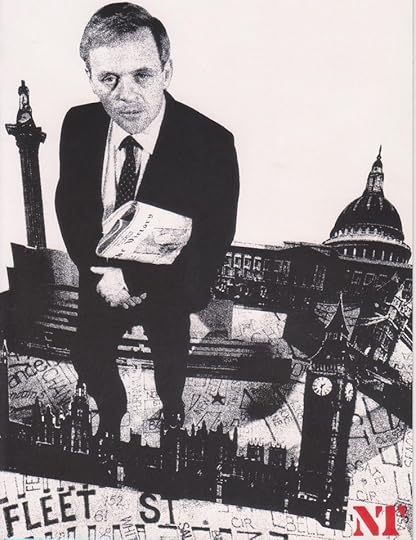
Pravda (which means "truth") is a comedy of excess which, for the first time puts modern Fleet Street on the stage. "Pravda is an epic comedy - part The Front Page, part Arturo Ui - in which a press baron resembling Rupert Murdoch…does battle with over 30 characters as he conquers Fleet Street journalism and by implication, liberal England's soul." (Frank Rich, New York Times) This is Howard Brenton's and David Hare's first collaboration since Brassneck in 1973. It was premiered at The National Theatre in spring 1985 and awarded the London Standard Best Play Award, the City Limits Best Play Award and the Plays and Players Best Play Award.
Pravda is a collaborative play by the English playrights Howard Brenton and David Hare, based on an initial idea of Howard Brenton, to write a black comedy about Fleet Street. What resulted is a bitter satire, based on the real events happening within the newspaper industry during the mid-1980s. The main character in the play is a white South African media mogul, named Lambert Le Roux, who is based on Rupert Murdoch.
Each author had previously penned award-winning plays, and had co-written a satirical play, "Brassneck", for Nottingham Playhouse in 1973. Individually they had each already had two of their plays produced by the National Theatre.
The first production of Pravda: a Fleet Street Comedy was by the National Theatre in 1985, and it was directed by one of the authors David Hare. Anthony Hopkins played the media baron Lambert le Roux, using an incredibly loud, hectoring, strained, South African diction and a bullish manner. The play has over thirty characters for him to take on. The audience marvelled at such a feat; it must have been draining to the point of exhaustion. It personally gave me a headache!
The play's title, Pravda means "the truth", and refers to the Russian Communist party newspaper "Pravda". It is deeply cynical, as is the entire play, exploring the role of journalism within society. David Hare said in an interview,
"Why are the papers so willing to get into bed with government? Or with this particular government? It's usually the proprietors who are blamed. We're not so sure. In Fleet Street, it's convenient for journalists to blame everything on proprietors."
He also commented,
"as the play went along it became less and less about Fleet Street directly. Fleet Street's only a metaphor."
"Journalism is now conducted like any other business. It is conducted as quietly, as sensibly as the office of any moderately fraudulent financier." - G.K. Chesterton
"Journalists say a thing that they know isn't true, in the hope that if they keep on saying it long enough it will be true." - Arnold Bennett
"News is what somebody somewhere wants to suppress. Everything else is advertising." - Lord Northcliffe
"I give my instructions to my editors all round the world, why shouldn't I in London" - Rupert Murdoch
"'Now we've gotter write news,' said William. 'But there isn't any news,' objected Henry. 'Newspapers don' only say news,' contributed Ginger, with an air of deep wisdom, 'they - they sort of say what they sort of - think of things. They sort of write about things they don't like, an' about people doin' things they don't like.' William brightened. 'We could easy do that,' he said." - Richmal Crompton
"Howard read all the papers every day for six months ... That's why we call the play 'a reader's revenge'." - David Hare
On the day that Jim Acosta has been granted access to the White House briefing room courtesy of a federal court, it is a good time to revise Howard Brenton's and David Hare's take on the foibles of the British press, in which a Rupert Murdoch-like titan (in the play, from South Africa not Australia) acquires and guts a newspaper. This is tragedy dressed up as farce, in which no one, especially not the ostensibly principled journalists does well--exception granted to the love interest of one of the editors. The reality, at least in the United States, is both more and less dire. "Pravda", copyrighted in 1985, no doubt predicts the devaluation of journalism (even before rise of the trolls). But it understates the development by Murdoch and Roger Ailes of a "news" network completely devoted to airing one side of the issues. At the same time, there remains hope: the circulation of the New York Times is increasing, and the ownership of the Washington Post by the richest man in the world has not muzzled it. The play itself has no heroes, which is the way farce operates. And perhaps that it is the saddest thing of all: that journalism and the culture have reached the point where we of necessity find heroes in those who are simply doing what we used to expect of them--to report the news, not focussing on the warts, but not airbrushing them either.
Vlijmscherpe satire, met vinnige, sarcastische dialogen, op de machtsgreep van Rupert Murdoch op de pers in Groot-Brittannië. Hij wordt neergezet als een machtsbelust, immoreel maar meedogenloos sluw monster, in dit BBC-radiodrama ongeremd uitvergroot gespeeld door Anthony Hopkins, in een sublieme cast naast Bill Nighy. De Britten laten zich als slapjanussen inpakken, waardoor het conflict voorspelbaar afloopt, maar zo is de realiteit vaak, helaas.
Very good, and still very funny. It is essentially a vehicle for the actors, though, and you'd have to have an audience that cared about the press for it to work, and if the past thirty years have affected one element of this play, it is the loss of that audience. We are so used to the Internet as our news source, and the consequent leveling of the playing field --- everybody with a blog qualifies as an expert --- that newspapers have become largely irrelevant. Hare was on the money with his disquisition about the influence of tabloids, and creepily prescient about Rupert Murdoch. But the battle is lost.
THIS IS GREAT MELODRAMA. The fact that it's a comedy only accentuates its melodramatic powers (and vice-versa). This is what season five of The Wire was supposed to be, if the other four seasons weren't trying to butt in.
This was a big success when it premiered at the National Theatre in London in 1985. The right play at the right time, it was topical and had a dynamic and charismatic central performance by Anthony Hopkins. Howard Brenton and David Hare came out of the radical Leftist theatre of the 1960s and early ’70s – I don’t know much of their work, only Brenton’s early Christie in Love which is powerful and provocative, but very self-consciously provocative; and Hare’s film Wetherby, which I saw over 30 years ago and remember as very serious in intention but maybe not complex in treatment, and his recent TV series Collateral, which had a solid police procedural centre and a number of sub-plots which diluted rather than enrich the central concerns – the result seemed obvious in purpose while also vague. I like the idea of a politically radical theatre, but am a bit uncertain of the reality. Pravda is the story of a foreign entrepreneur who already owns a British tabloid newspaper and then extends his business empire by purchasing the standard bearer of the British establishment. Pravda’s central character, Lambert Le Roux, has the same relationship to Rupert Murdoch as Citizen Kane had to William Randolph Hearst: he is both based on Murdoch and isn’t based on Murdoch – Le Roux is inspired by Murdoch and his recent purchase of the Times, while having his own independent existence. The first half of the play is the more successful: Le Roux takes over a regional paper and then moves on The Daily Victory, the establishment’s mouthpiece. The fun – and it is a comedy – is in the way Le Roux out manoeuvres and bullies figures of the establishment: some snobbishly disdain him, but they either grovel or are wiped away. Le Roux may be monstrous but those he quashes are no more likeable. And this seemed an accurate – although satirically exaggerated – portrayal of the British establishment in the1980s: in the 1970s Brenton and Hare might have dreamed about overthrowing the British establishment, but in the 1980s it reformed itself, out went old fashioned ideas around status and social responsibility, in came the dominance of money...although, in reality, there might have been a shift in ideology, but not in personnel. I don’t think Pravda has any profound insights, but it has fun with the humiliation of the old Tory establishment. The second half of Pravda is less successful. Two things happen: Le Roux establishes editorial control over his flagship paper and uses it to support the Government, suppressing politically incorrect news, and members of the old establishment plot against him. The latter is a continuation of the themes of the first Act, but it never happened to Murdoch, therefore the satirical play between Le Roux and Murdoch is lost. The status of the former is more debatable. I have read a newspaper article dismissing Pravda as ‘wrong’ because Murdoch did not impose a similar editorial control on the Times – true, but, as far as I remember, none of the big stories that have impacted in the United Kingdom in recent years (parliamentary expenses fiddles, illegal phone tapping by newspapers, etc) have been broken by the Times – in fact, their main contribution was trying to suppress the phone tapping stories that implicated Murdoch’s Sunday tabloid News of the World. The second act of Pravda still has a certain satirical impact, but it’s a little vague and is much weaker than the first.
fun! "revenge!" --i think of that line in Fish Called Wanda.. but this really is smashing, smashing entertainment & reads like a glib & snarky The Front Page. -WISH more new plays were like this; WHERE is the Canon these days?; 'sides Yasmina Reza & Jacobs-Jenkins.. have-a-go: READ some david hare.. too much fun. nuf sed
The play takes a long time to get started which may put off some readers. Once the plot starts to thicken however, its pace picks up and we become witness to a doomed and frantic quest to defend the journalistic tenets of truth and honesty. A not entirely unforeseen plot twist ending, but amusing nonetheless.
Nechápu, že mě Pravda míjela tak dlouho. Zpětně si uvědomuji, že jsem byla narážkami, odkazy, zmíňkami o ní přímo zasypaná. Pravda je výborná satira, která možná malinko ztrácí na své původní komičnosti, když si rychle uvědomujeme, že dnes je to pro nás v podstatě realita a většina lidí se s tím už smířila. Při čtení jsem se přistihla, že čtu nahlas. Užívám si jednotlivé scény, jejich dynamiku, cynismus. Tohle je hra, kterou bych rozhodně chtěla vidět na jevišti (ideálně v původní sestavě z roku 1985)
Soooooo slooooooowwwwww. I have (temporarily?) given up on this book. Part of me wanted to keep reading to see if anything interesting happened, but I didn't resonate enough with any of the characters to care enough to continue. Maybe I'll pick it up again later. but probably not.