From the New York Times bestselling author of The Book of Air and Shadows , the story of one man's fearless quest for revenge among some of the world's most dangerous criminals. The Return is as exciting and provocative as Gruber's best work.
Michael Gruber is an author living in Seattle, Washington. He attended Columbia University and received his Ph.D. in biology from the University of Miami. He worked as a cook, a marine biologist, a speech writer, a policy advisor for the Jimmy Carter White House, and a bureaucrat for the EPA before becoming a novelist.
He is generally acknowledged to be the ghostwriter of the popular Robert K. Tanenbaum series of Butch Karp novels starting with No Lesser Plea and ending with Resolved. After the partnership with Tanenbaum ended, Gruber began publishing his own novels under William Morrow and HarperCollins.
Gruber's "Jimmy Paz" trilogy, while critically acclaimed, did not sell at the same levels as the Butch Karp series in the United States. The Book of Air and Shadows became a national bestseller shortly after its release in March of 2007, however.
My introduction to the fiction of Michael Gruber is The Return, a very exciting action thriller which even when it errs, does so on the side of literary fiction rather than as a derivative shoot 'em up. Published in 2013, the novel has an intoxicating hook: what if Vietnam combat veterans with counterinsurgency training put those skills to use against the Mexican drug cartels? The main characters are very compelling, the dialogue sharp and the respect paid to Vietnam veterans commendable, with a narrative that skillfully draws on their experiences in that jungle war to amplify their present day dilemma. I guessed I liked it.
The story takes off in present day New York City, where freelance book editor Richard Marder learns he has an inoperable bubble in his brain, which could leak and lead to a stroke, or pop and kill him instantly. A deliberate man, Marder returns to his Tribeca loft, purchased with an insurance payout from his father, a Linotype operator, in the '80s and is now worth $1 million. His investments--purchasing stock in Apple in 1984--have left Marder rich, with no one but his lawyer and accountant aware. His wife Maria Soledad Beatriz de Haro d'Aries y Casals, or Chloe, killed herself on the roof three years ago, while his two adult children have limited contact with their old man.
With part of a very big cash windfall he takes from his accountant, Marder purchases a Ford F-250 equipped with a camper. He phones the real estate agent in Acapulco he cheated on his wife with, but far from rekindling a relationship, allows her to sell him a 277-acre compound in Playa Diamante, the port town in Michoacán where Marder met Chloe thirty years ago. He packs clothes, his wife's ashes, two pistols and a rifle and seeks out Patrick Francis Skelly, who's getting blitzed under the Gowanus Expressway. Skelly is a "security consultant" who Marder is given to dragging out of scrapes as repayment for a debt in Vietnam. Offering no details, Marder bids Skelly farewell and gets as far as Virginia before realizing he has a travel companion.
"Am I going to get a lecture on secondhand smoke? Don't pretend to be more of a pussy than you are, Marder. It's unseemly. Face it--you're going to Mexico and I'm coming with you."
Marder snapped a startled look at the other man. "How did you know I'm going to Mexico?"
"I checked the email on your laptop. I see you're still dealing with the lovely Nina. Are we still getting any in that quarter? No? A pity; it looks like a nice place. So you're traveling to Michoacán with a lot of guns and a shitload of cash and won't say why. That's not characteristic of my pal Marder. So I'm thinking you're in trouble and you need a friend to watch your six."
"I'm not in trouble and I don't need my six watched. My six? Now we're talking army talk. Jesus, the war's been over for forty years and we lost. Get over it."
"You get over it, and if you think you're over it you're more of an asshole than you usually are. How about passing the semi here, unless you want to breathe diesel fart for the next hundred miles."
"There's an airport in Richmond."
"I'm sure, but we're not going there. Look, chief, I saved your life. We're mutually entwined. Why do you think I let you hang out with me all these years and do all the shit I do for you? Believe me, it's not your charm. I'm responsible for you, end of story." Skelly yawned, stretched, and said. "And now I believe it's rack time. Actually, I fell into conversation with a young lady in Mahoney's last night, and with one thing and another I didn't get much sleep. Wake me when we arrive at a point of historical or scenic interest."
Carmel Beatriz Maria Marder y d'Aries is an MIT grad student and competitive swimmer working on a 3D manufacturing project. Nicknamed "Statch" given a resemblance to the Statue of Liberty, she doesn't buy her father's story about a road trip. She learns Marder abandoned his iPhone in Ojinaga and turns to a lover in the Boston PD to hack Marder's email, where she discovers his real estate purchase. After a bump or two, Marder and Skelly arrive in Playa Diamante, where in addition to the terrified housekeeper and her children, they discover one hundred more squatting on the well-maintained property. Marder lets her know they are welcome to stay.
Marder greets three armed men who let themselves in to his house. They advise him that the lead in the environment will be dangerous to his health unless he leaves immediately, but Skelly disarms the men, demonstrating that they're not the typical stupid gringos and intend to stay. They learn that the men belong to Los Templos, an offshoot of a drug cartel called La Familia fighting for control of the region. Led by Servando Gomez, alias El Gordo, their feud against the cult-like remnants of La Familia, headed by Melchor Cuello, known as El Jabali, has engulfed Playa Diamante and both sides covet Marder's property as the building site for a casino they plan on laundering cash through.
After thumbing his nose at Los Templos, Marder makes enemies with La Familia when he rescues a Mexican television journalist named Pepa Espinoza from a kidnapping attempt and he and Skelly kill several of their men. While Marder offers the reporter protection as his guest, he receives another arrival when his daughter Statch arrives. Marder and Skelly forge an alliance with Los Templos, promising El Gordo a shipment of heavy arms and heroin from Skelly's contacts in Laos in exchange for protection. Marder, Skelly and Statch begin to fortify the compound and its residents against the attack they know is inevitable, with Marder keeping his diagnosis a secret.
As he strolled along, he noticed that the people paused in their work when they saw him and took the time to nod or wave or call out a greeting, nothing embarrassingly deferential, but they were happy and knew that it was his doing and they wanted him to know that they knew it. He recalled how similarly the villagers in Laos had responded to Skelly and the other soldiers and felt a pang. Here, too, a simple and reasonably happy life was surrounded by demons who wanted to destroy it--there politics, here greed and the need to dominate and control. Somehow he had acquired the responsibility for preventing that from happening in this domain. In that instant he felt the true weight and a blast of pathetic self-pity: he wanted to be back in his comfortable loft, in his nice leather chair, with a thick galley his only task, a thousand pages about North Korea, so easy to grasp compared with the current tangle, and no lives at stake.
The Return takes place in a universe that will be recognizable to Tom Clancy fans, but the novel is more progressive and skillfully written, with a greater emphasis on character rather than military hardware. The story is in the mode of The Magnificent Seven, paying off its conceit of two Vietnam vets who use their counterinsurgency training in southeast Asia to give two violent drug cartels what's coming to them. Marder and Skelly--an Air Force tech turned book editor who no longer fears death and his friend, ex-Special Forces and a whirlwind of self-destruction--are very compelling, with a friendship as improbable as their meeting in Laos.
After target practice they would play hide-and-seek. The air force men would walk off into the boonies and, after an interval, Sergeant Skelly would find them. When he found them, he would poke them with his stick and comment on their brain power and ancestry in vile language.
On one of these sessions, however, Marder snapped and said something to the effect that if the sergeant ever poked him with that stick again, he, Marder, would shoot him through both knees and laugh about it every day of his sojourn in Leavenworth.
A little staring after that, and then Skelly grinned and said, "Brooklyn, huh?"
Marder said, "Fuckin' A, Sergeant!"
"And you think you're a fucking wise guy. But understand this, Airman: I am a trained solider and am superior to you in every military art, and besides that I am superior to you in every conceivable human activity, mental and physical. So don't you even think about threatening me again, because if you do I will take that weapon from your shaking hand and ram it up your asshole."
"I would beg to differ with you there, Sergeant," Marder replied. "I can outshoot you with a pistol on any target over any range."
After which, as Marder had expected, Sergeant Skelly had to demonstrate his superiority in this matter, and they organized the Moon River Invitational Shoot-Out, which later became legendary among the Special Forces and marked the time and place when his long friendship with Skelly had begun.
Gruber deserves most credit for his tremendous respect for Vietnam vets and the remarkable narrative skill he uses to show how Marder & Skelly's experiences in the war, including a harrowing, remarkable survival, forges their friendship and impacts events in the present. I could've done with an entire novel set in Vietnam, but the only place this one stumbles is how conveniently the confrontations play out, with Marder & Skelly and even Statch disarming or outwitting the cartels or sniffing out an ambush over and over and over again. I didn't buy they would've lived as long as they do, but as an action fantasy, it thrilled me without asking me to turn off my brain.
Michael Gruber is not well known in general reading circles. His fan base is small as compared to other well known writers but it is a fiercely loyal group. I am one of his readers. When I open a book written by Gruber I am confident that the star rating I will give it will be within the 4 or 5 star rating range: in other words, Michael Gruber is very consistent in the quality of books he writes. This does not mean that Gruber writes the same book twice, at least not since abandoning the Tanebaum project and with the possible exception of his Jimmy Paz trilogy (see below comments under "About the Author"). His subject matter is wide ranging: from art forgeries to English literatury treasure hunts; from Pakistani terrorists to Mexican cartels; onto his extraordinary Jimmy Paz detective trilogy Michael Gruber paints a fictional landscape that skirts the tip of the iceberg of what lies hidden in this author's highly intelligent mind.
As one of his loyal fans (until he eviscerates my trust by writing a bad novel) I also know that whatever book I pick up there will be a fundamental question posed, a thematic question that appears in all of his novels. That interrogative is as follows: in objective reality what is the place of theology, the supernatural, mysticism, dogma if not religious fervor and how do we rationalize the apparent contradiction internally with the objective facts we know? And do it so it becomes believable to even the most logical dissenter of esoteric concepts.
In his Jimmy Paz series, Santa Ria is refuted by a detective who to this point has only dealt with objective facts. In The Forger of Venus Gruber places the idea of reincarnation against drug induced hallucinations. Or perhaps we can turn to The Book of Air and Shadows where a man embarks on a voyage of self-discovery, lured by a 400 year old literary mystery.
Another aspect that will be familiar to readers of Gruber's books is the idea of how the past supposes the present with the obvious result that you will likely be juxtaposed with settings taking place historically vs. settings taking place in the present. Everyone of his books accepts this model and unlike many authors who attempt this method to where it tends to distract the reader, with Gruber it is so relevant that the switch-backs are seemless to the point that the reader almost doesn't notice them. Not losing the reader, from an authorial perspective, is very difficult to do.
The Return turns Gruber's focus to the conflict between Catholic theology and the waging of war. What is the place of ethics when engaged in a war? In this case, the historical setting is the Vietnam War: the current setting the Mexican narco cartel wars. Death, as is plainly evident from the book's slip cover is a fundamental theme throughout the book - though in this case it points specifically to the masks worn by Mexican villagers on their "Day of the Dead", a sort of truce and reprieve from the bloody violence as all arms are laid aside to honor the fallen on this day. But even this time tested day is challenged by Gruber when he asks: "What happens if the truce is not honored?"
The theme is concretized through the actions of our three main characters: Richard Marder, the father; Patric Skelly, the secretive army-buddy; and Statch, the daughter conflicted between her loyalty to both men.
For Richard Marder, a quiet editor for a publication conglomerate, a man with nothing left to lose - a man driven by The Thing - the question becomes one of "what will give meaning to my last actions on this earth: is it redemption or is it revenge?" Gruber takes us on a fascinating tour-de-force through the complex maze of cultural heritage, religious ethics, two wars, and Marder's own profound guilt towards the death of his wife.
At the occasion during which that woman had actually become the present ashes, Marder had impressed or dismayed his loved ones by his stoicism - not a sob from Marder at the crowded funeral service, not even when the casket had rolled through the curtain to the flames. Now he felt something collapse within him; his hands trembled around the urn, he found it hard to speak. He wondered if this was it: he would fall into fragments and Mr. Thing would pop and perhaps they could just leave him there at the cemetery with her, perhaps this was yet another of God's happy jests.
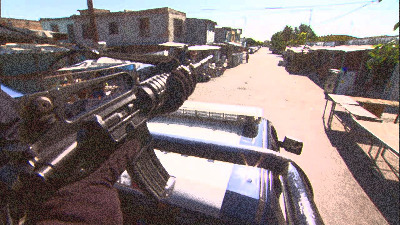
A Narco tank
For Patrick Skelly, the security specialist, Marder's Vietnam war buddy and leader, this book and its dark voyage into the heart of the Mexican cartels is one of redemption. Skelly seeks the meaning of a survival that has no meaning and he thinks Marder can give him that answer. What he finds is something entirely different.
"No, this is the truth. I have a shitty life. Plenty of money, a nice place, all the pleasures, and I feel like shit all the time, scared and looking for oblivion, but I can't look for oblivion, because that would make me less than sharp and that would kill me. And then I think, Oh, fuck, why not just die? But that doesn't feel right either. Marder would say it was because I don't have God, but I can't get my head around all that shit."
And what of Statch the daughter, a brilliant engineer at MIT, a swimmer of almost Olympian status, torn between her mother and father, between a father and the survivor Skelly. Here Gruber uses the theme of water - perhaps an allusion to Catholicism's Holy Water - to cleanse the soul through a great struggle, to cleanse the soul of a torn, courageous, and beautiful young woman.
Statch had never swum long distances in the sea before, but she'd thought it wouldn't matter, water was water, and salt water actually buoyed her up more than fresh, a slight advantage. [...]The water was more than eighty degrees, she estimated, but that was still a lot cooler than the human body. Every minute she spent in the water drained heat from her, which had to be cooked up from food or fat, but she was using too much energy for this to work properly, and in the middle of the tenth eight hundred meters, she felt the first stab of a cramp in her thigh.[...]The chill was starting to steal her mind, her body was resigning the struggle to regulate temperature, the cooking brain was beginning to generate fantasy. She stared at the sky. Polaris was in the wrong place, on her right, not her left.
------------------------------------------------------- About the author
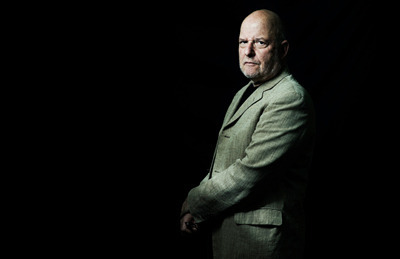
Michael Gruber
Are you a little bored with the conventional thriller but do you still get your entertainment from books, and are you the sort of reader that might read literary fiction but is often frustrated by the lack of a good "yarn" in such novels? Are you totally incensed at having to live in the "Cult of In-between" where your desire for the standards of literature that harbor questions posed in a serious way - questions surrounding the human condition - is in constant conflict with your craving for a good yarn; sadly consigned almost exclusively to thrillers that are formulaic and written in dull prose?
Michael Gruber shares your sensibilities. It's not that he harbors the inability to write popular fiction. He's actually quite good at it. He is generally acknowledged to be the ghostwriter of the popular Robert K. Tanenbaum series of Butch Karp novels starting with No Lesser Plea and ending with Resolve. That partnership ended when Gruber realized that writing the same book over and over was boring. And as Gruber says:
I'm not exactly bitching, had I stayed with that job I might be a Patricia Cornwell or a Clive Cussler by now, with seven-figure advances and the rest of that kind of life. On the subject of cults in fiction he clarifies the issue and defines it "as a writer with a relatively small number of passionately devoted fans, who never quite breaks into mass-market popularity."
And it's true: since then, Michael Gruber has not written the same book twice. Otherness is a word Gruber frequently uses to describe the Cult of In-between. Having discarded popular fiction and with it its millions of followers and since "I don't do cute, and there goes another 70 million readers..." it seems to Gruber that he will never attain the sales of some of his fellow authors (though he once did arrive on the NYT best seller list). Perhaps with a movie this might change as there are cases where a cult readership arrives at popular readership via the exposure of a novel onto the silver screen.
The novel, THE RETURN, (out since early September) would be an ideal vehicle for a couple of older male stars, and there's a nice ingenue role there as well. We shall see. I am pretty content with the cult as is, although I guess I could learn to like being fabulously wealthy too. ; Gruber's life reads like that of a Renaissance man. Born in NYC and a graduate of the public school system he earned a BA in English literature and after working for various small magazines in NY, he went back to City College and obtained a second BA degree in biology. Even that wasn't enough, following this he went to Miami and received a masters in marine biology. During his stint in the U.S. Army he served as a medic. In 1973 he received a Ph.D. in marine sciences, for his study of octopus behavior.
Doing a 180 he worked as a chef in various NY restaurants, then he was a hippie, worked as a roadie for rock bands, was an analyst in Metropolitan Dade county, followed by the title of Director of Planning for HR; worked in D.C. in the Carter White House, Office of Science and Technology Policy; a policy analyst and speech writer for the EPA and was promptly promoted to Senior Executive Service of the U.S., the highest level of civil service.
Only then did he begin writing fiction, mostly writing the novels for Robert K. Tanenbaum after having moved to Seattle. Michael Gruber is a brilliant author whose books not only serve up great prose (and as is so often the case nary a plot to go with it), but delivers on both: a plot that is brilliant, cleverly worked out, and simultaneously delving deeply into the human condition. This, while reading along in "page turning" mode. That is not easy to do :-)
Michael Gruber is unique. I've only met a few that have read him, but he is an island unto his own: a brainy human being's thriller.
Richard Marder, his daughter and oldest friend Patrick Skelly, are those rare characters in fiction that are so totally compelling and unforgettable, they grab you by the heart and soul. The lives of these wonderfully complex characters intersect over 40 years from the Viet Nam war to Manhattan to Michoacon, Mexico in a story so powerfully original, it makes the whole exercise of reading fiction so incredibly rewarding. The initial premise of the book is mild mannered NY book editor Richard Marder's quest for revenge on the Mexican drug cartel that murdered of his in-laws and inadvertently caused his wife's suicide but evolves into a broader epic encompassing the beauty and brutality of modern Mexico, heroism and survival in war, good vs evil, chance vs fate, modernity vs feudalism, love, God and the reality of faith. This is a brilliantly conceived 5 star action novel with enough plot twists and insights into the human condition that I believe to be Michael Gruber's masterpiece. Might also be the best novel I read this year. ......Ed
Anyone who's read Michael Gruber's previous books: Tropic Of Night, Valley Of Bones, Night of the Jaguar, The Book Of Air & Shadows, The Forgery of Venus, or The Good Son, knows by now that he writes extremely realistic police procedurals, or historical novels, or action thrillers that are some of the least cliched of the present day. They all are set in believable worlds. They all have complex, adult, nuanced, interesting characters, who are not the usual thing. Strangely, they all slso have either supernatural or spiritual elements, which aren't hackneyed, corny, embarrassing, or remotely wholesome.
His latest, The Return, can be read, on one level, as a modern thriller about "narco-violencia" in Mexico, which has a big climax on The Day Of The Dead. It's also a somewhat philosophical novel about a man coming to terms with his own death, a complex drama about two men who don't understand why they are friends, an exploration of man-wife, father-daughter issues, and a treatise on spiritual belief and the Vietnam war.
In other words, once again, not the usual thing. The only thing in his books that the reader can rely on is that Gruber is a fine writer. Trust him. Read him. He won't let you down. - BH.
A very successful NYC book editor, Richard Marder, is dying of cancer and wants to put right a wrong that occurred decades ago when his in-laws were killed by a Mexican drug lord. And so he returns to the small Mexican coastal town where the crime occurred and starts down a path to revenge or justice.
The story morphs into a modern day MAGNIFICENT SEVEN or SEVEN SAMURAI story, with the defense of a hacienda, which stands in for the village of those movies. Gruber knows the film background of all this, and even mentions Kurosawa's YOJIMBO at one point.
Marder is aided by a friend, Patrick Skelly, with whom he fought alongside in Vietnam. Skelly is a many of several mysteries, which will be revealed throughout the book. The flashbacks to Vietnam and Laos are particularly well done.
The book is stylized and reminds me of Trevanian's Shibumi and also several of Thomas Perry's thrillers. While that could be interpreted as praise--and I mean it that way--it's also a statement that the story is constructed with some artifice that shows through, and some of the characters are almost archetypes. But then they were that in SEVEN SAMURAI and THE MAGNIFICENT SEVEN also.
Marder is not only aided by his friend Skelly by his daughter, a MIT post grad in engineering and a woman of several other talents. She's a crucial part of the story.
The book is exciting and the excitement builds steadily toward the end, with a successful resolution and then a great reveal following that resolution.
I might mention that Michael Gruber wrote a unique trilogy about a Cuba-American detective in Miami, TROPIC OF NIGHT, VALLEY OF BONES, and NIGHT OF THE JAGUAR. They're all filled with not just solid detective work but also with magic but not the same kind of magic. I enjoyed these novels greatly.
One of the greatest thrillers I've read in many years.
True to a Gruber novel, The Return weaves higher concepts into the fabric of the thriller genre. In past novels, he's tackled racism, the lines between the physical and metaphysical and the frailty of perception, faith and rebirth, greed and ecology. In this one, it's the delicate balance of revenge and justice, it asks questions about when it's right to use violence and when it isn't. His novels always leave you thinking for weeks or months after you've read them!
Disappointed. I'm a big Gruber fan and have read most of the novels under his name. We literary writers and readers often talk about to whom you can turn when you want a good escape read that is... well, GOOD. And I always say, Gruber, Gruber, Gruber. So I couldn't wait for this one, especially as I've been to Michoacan, and my son spent several months there during his gap year, though in the highlands, freaking me out with phone calls home like "Oh, hey mom, I hitchhiked down to such and such, and we got a ride from this dude who drove 5 hours out of his way to take us there, and some people would have been worried about kidnapping I guess, but everyone loves it that we're not afraid."
I don't usually like to review a book hot off the presses because I'm not interested in participating in the general response to a book or in driving sales or in summarizing plots and such. What I like to do is come here to talk about a book with other people who have read it.
So... As far as a review goes, what I'd say is yes, read this book, but not first. If you're new to Gruber, go read the Jimmy Paz books, starting with Tropic of Night (it's a bit of a slow start, but that's okay, savor it). Read The Good Son, which is maybe a not a perfect novel but more than worth your time. I'm afraid if you start with this you might stay away from the others.
The thing Gruber is so great at is, well--the woo-woo. He takes what in some literary (or, let's face it, not very literary) circles might be called the paranormal and normalizes it so plausibly that you think, as spooky as some of this is, I can see how this might be part of life, maybe even my life. Voodoo? Shape-shifting shaman, and I mean real ones? Possession? You might think it's all been done before, but not like this, not anthropologically and psychologically. So that there's a theory of sorcery that starts to make sense. Maybe. Not a theory for Gandalf's sorcery or Dresden's, but one that might account for what happens in a tribe that's been left to itself for all these years, and kept to its ancient traditions. What Castaneda discovered, if he hadn't made it up. So then along came the last novel, The Good Son, in which a Jungian psychologist is kidnapped by Pakistani terrorists and her son, a shape-changer of a different sort, raised both as an American and as a tribal Pakistani, goes after her. That book was so layered, so dense with spirituality and identity and parent/child relationship and the history of Afghanistan and Pakistan and the nature of tribalism.... I didn't even care if it worked as a novel. Every page was a wonder.
I'm sorry to say that The Return does not meet the same standard. Marder, the main character, is not as interesting as any of the other characters Gruber's created before (Jane Doe of the first novel, Tropic of Night, is far and away the best; I have ever been sorry that she was not the star of the next two). He's meant to be a saint. I think the novel probably started out as a meditation on saints/madmen/demons, but for some reason he chickened out, and this element is narrowed down to a page or two--a very interesting conversation in which the the local priest in Playa Diamente seems to be diagnosing Marder as a saint. It's unfortunate that this section is so thin, and even more unfortunate that our dude really does turn out to be a good guy (unlike the woman in The Good Son, who is far more ambiguous). This is the chewy stuff Gruber's fans come looking for; I felt like I was getting the filling for one single-stuff Oreo.
Also, really. You're a 60+ guy. You're this cerebral book editor and not in the best shape. But you're also a Vietnam Vet and you're a great shot with a gun. You just found out you're about to die. Oh, and guess what. You invested a few hundred thousand in Apple at just the right time, so you have millions. What should you do now?
Well?
Bingo! Fix Mexico!
This is Rambo for the bookish set. You can:
<>
a) buy that Hacienda on an island you always wanted. b) stock it with guns, and also, apparently, heroin. c) talk really tough and cool to some really bad and scary guys. d) save a couple of gorgeous damsels e) become a patron to the local peasants, even though of course you don't WANT to be such a feudal lord--you'll only do this if they MAKE you, and the whole idea of an American saving the day is totally patronizing in the first place, oh... never mind f) add in whatever else you can think of; it's probably in here.
For example, the friend you can leave under guard with the bad guys, because he can easily take on 20 armed drug traffickers.
Bullshit.
<>
But. I still read it because there were still lots of great Gruberisms. The wonderful descriptions, the combination of reverence and irreverence--the ability to appreciate culture without surrendering critical thinking--which swings in all directions. Gruber sees strengths in our culture, and flaws. Strengths in Mexican culture, and flaws. He isn't afraid to record what he observes. (This was one of the great elements of The Good Son--the son who was a member of both cultures and could freely comment on both, though Marder does not have as much of a pass in Mexico, IMO).
Sometimes Gruber gets odd, easily Googled things wrong. In the Good Son, the mother had worked in Pueblo, CO, a small town, where she counseled drunken Indians. It would be a stretch to drive, drunkenly or not, to and from any reservation to get therapy in Pueblo, pop 100K (~same as Boulder). Not to go on, but Pueblo in this case actually comes from the Spanish word for town, and not from the Indian settlements which were named from the Spanish word, too. Gruber probably means Cortez, Colorado, if he means Colorado at all, and not, say, Gallup, NM. And that's if we want to let the comment about drunken Indians slide. It's a minor error, but considering he's giving us a lot of information about Pakistan and Afghanistan that I want to believe him about, it made me a little skizzy. Regarding The Return, the local priest is supposed to be one of the "Tarascos," the indigenous los indios of Michoacan, but as I understand it, Tarascan is a term applied by outsiders and not one the Perepucha-speaking people use to characterize themselves. Iréchecua Tzintzuntzáni successfully resisted conquest by the Aztec and so it was not quite correct for the priest to say that his people (the implication being all of Mexico, ie the Azteca) fought a certain way and practiced their religion a certain way. The religious practices of the Tzintzuntzan state are not that well understood. Their pyramids were different from everyone else's. I'm sure they were violent, too. They seem to have had slaves, and to have worked more metal. But we don't know that much, really. Gruber's usually great at dealing with this type of complexity; not sure why he decided to dumb it down it here.
In The Good Son, Gruber made a point of distinguishing between real warriors in warrior cultures and soldiers in the American forces. Here, in The Return, he keeps calling Marder's sidekick Skelly, a buddy from the Vietnam War, a warrior, an egregious lapse in his previous discipline. Skelly might define himself this way, but he doesn't get to, because we do not have a warrior society.
But there are so many good things, even in a watered-down Gruber book like this one. The Vietnam flashbacks are mostly very interesting and vivid--I'm making a point of saying this because there are so many Vietnam books that say the same thing, and you're left with: mud, bugs, steam, trees, chaos, shooting, explosions, limbs, blood, pot. With only one or two exceptions, the descriptions here are different, though, and you should read the book if only for those. How the Ho Chi Minh Trail was really a road, for instance. What those hills look like today, if you were to go back... The transitions to the flashbacks, however, were rather awkward and old-fashioned, like those 70s TVs shows where they would make the screen go all wavy to let you know the character was entering a dream or remembering something. You don't have to do that anymore. I give an example below where he's meditating on smells. In the book, Gruber would then maybe have the character think how a particular smell reminded him of... and then okay, here comes the flashback. Or he will (can you believe it) experience what we're told is a sort of waking dream. You can just have this meditation on the smell of an eviscerated body and go straight to the memory without any of this clunky entry and then, OMG, the exit, where he shakes himself out of it. Just do the line breaks.
Which then--I have to say something about this, because it's a peeve--there are these other line breaks for NO REASON that I can see. So we have these overwritten transitions in some places, and then breaks in the middle of a POV while someone is, say, driving down the road, and then we break, and pick them up a few miles down the road. Why not just do a new paragraph there? I think it's just that we're all using Scrivener now and while writing sometimes we run out of momentum and create a new scene, and when we compile the file it leaves in these line breaks. But a scene break isn't always justified and writers/editors should go back and clean those up.
It's always great to find a thriller that has some concern for character, and if this book doesn't meet Gruber's usual standard, the people in the book are still well drawn. And it's not just that Gruber masters the language well. He even rises to beautiful at times. For example, after Marder's learned that he may die, he calls his daughter, not to give her the news, but to say goodbye without directly saying so:
"He... pushed the button to end the call. For an instant he felt he'd switched himself off, as if he'd already died."
On the way he weaves commentary into the narrative:
"She now decided it was time to use a program her father did not know about, which was not exactly a legal program either, but like most technically adept people of her generation, she had a fairly shriveled idea of what privacy and legality meant."
"She thought he (a date) might be more amenable to a sort of nonkosher favor later on, after a few drinks and some of those orgasms. ALthough she understood that most people got the favors promised before sex, she thought this dishonorable and corrupt."
"They said you couldn't remember smells as you could sounds and sights; the wiring wasn't there, apparently. He'd edited a book about that too, one of many on the mysteries of the brain. But he could recall the fact of experiencing a smell, and supposed everyone who'd had that experience remembered it, although it didn't often show up in accounts of war: what a human body smelled like when it was eviscerated by high explosives."
The problem is, of course, that Mexico apparently needs some white guy from America, however well meaning, to come down and save it. Of course, God does work in mysterious ways. OTOH, Marder heard a voice when he was in LAOS. And while it's true that he was raised Catholic, how are we to know it wasn't Buddha talking to him? Or one of the pre-Buddhism tribal Laotian spirits? There's so much more to be plumbed here and it really bothers me that Gruber so uncharacteristically did not take the opportunity.
One way out of the Great White Hope trap would been simply to have made the hero Latino. First-generation with roots in Michoacan, the state whose biggest export to El Norte is people. Or make him a priest doing liberation theology. Maybe he studied in America. All kinds of potential there.
No comments on the overall plot, because others have done that. It's a silly thriller. Normally it would have been redeemed by all the other cool things Gruber does, but it wasn't.
Dude. Hurry up with the next one. But you know. Okay to go slow if you'll go deep.
*****
I try to add some comments about the ebook version, nothing to do with the author's efforts. I always hope that somehow this will get back to the publisher, as there needs to be more attention paid to the quality of these products. I read on a Kobo, and overall I'd give this 3 of 5 stars. Some typos, some odd font decisions. All of the flashbacks were in a smaller font. Why? They're clearly delineated with line breaks set off by three stars. Most of these sections were too short to bother resizing, but I found them a bit uncomfortable to read. Note to anyone working with digital media: people over 40, and there are a lot of us, HATE small fonts. Quit using them. Just stop it altogether. There was no overall pagination, which I can never understand, just what page you're in in the chapter. Who cares? That's so weird. At least it's formatted like a book, rather than like a blog; ie, there are no line breaks between paras, which I hate.
Graham Greene famously divided his books into "entertainments," (the thrillers) and "novels," (the more serious literary works that dealt with love, death, honor, God, sainthood, and faith.) If he had combined the two and lived until 2013, he might have produced something like this book. The set-up and plot are, frankly, so contrived as to be silly; but it's a tribute to Gruber's ability that you only realize that when you've put the book down. He can write with absolutely convincing authority about Amazonian Indians, Muslim culture in Afghanistan, Vietnamese soldiers, and (here) Mexican narcoviolencia. Richard Marder is the main character, whom I took to be Gruber's version of a Graham Greene flawed saint. I also took his name to be only one letter off "murder"--but one character related it to "martyr" and Marder himself revealed that it's a German word for "weasel." Take your pick, and you won't be entirely wrong. Another main character is his daughter, a beautiful Olympic-quality swimmer, who is also a brilliant engineer at MIT, developing new models of 3-D printing and manufacturing. (I said it was contrived.) She has followed her father to Mexico and found such a different way of looking at life there that she decides to resign from her position at MIT: "...as the letter became longer, as it turned into something close to a Unabomber screed, she found that she was talking not to Dr. Schue, but to herself, whoever she now was. The burden of this was that, all things considered, she no longer thought that the future of manufacturing was the development of self-contained factories that could forage for raw materials and shit appliances. People, she had recently learned, could get by with many fewer appliances, or none at all. She wanted to use engineering in service of modesty, of scarcity, of getting by with less. Did she really believe this? She recalled Dr. Schue exploding the whole small-is-beautiful worldview, what he called hippie-dippie whole-earth crapola. The future belonged to automated factories using solar and nuclear power, making everything anyone could conceive of essentially for free, distributed by automated systems. Physical labor would become an anachronism, like slavery and religion. She believed this as an intellectual proposition, but somehow she'd lost her faith in it, and she couldn't understand why. There appeared in her mind the concept of "conversion experience." She was having one of these, she thought, even though she didn't really believe in them and didn't know what she was converting to." It's this kind of thing that makes reading Gruber so fascinating. Oh, and it's a genuinely thrilling thriller in which secrets are still being revealed in the last couple of pages.
I received an ARC of this book to review through the Goodreads Firstreads program. I was a bit nervous when I received this in the mail. True, something made me sign up for the giveaway - but it looked more violent and adventuresome than I typically like. The cover is absolutely gorgeous but is covered with weapons and ammunition in the shape of a skull. Well, on page 1 I came across this quote I was inspired to write down: "You're dying and I'm not and as much as I care for you I can't treat you like a real person anymore." And on page 2, "Doctors are irritated by those beyond help." I was moved to write down quotes and thoughts for the first 50 pages. After that, I was so engrossed with the story that I couldn't be bothered to take the time to write things down. This is definitely a literary action-suspense novel.
Marder is a vietnam vet who currently works as a book editor in New York City. He has two somewhat estranged children and a wife who has died after some tragedy. When he receives some bad news at the beginning of the book, he sets off to Mexico in an attempt to atone for his perceived responsibility for that tragedy.
At least three times in his life, Marder has voluntarily made a trip to a foreign country in an attempt to find himself. The first time, he enlisted in the Air Force and had a life-altering experience in Vietnam. He came back home still lost but with a life-long war buddy, Skelly. The second time, he flees to Mexico to escape an okay marriage and job. He falls in love with a woman and flees with her back to the United States. She brings Mexican culture with her and he becomes enthralled with Mexico as a natural extension of his love for her. After a tragedy in Mexico ends their immersion in each other and drags her metaphorically back home, Marder is left alone. After a few years, he makes the third trip, a return trip to Mexico. This trip is the present day main focus of the book. He takes his army buddy Skelly with him; his daughter, Carmel Marder, ends up following as well.
The book has three alternate points of view: Marder in the present, Marder in the present telling flashbacks of Vietnam action, and his daughter Carmel. For me the inclusion of his daughter Carmel is important as she is the one I can most relate to. Sometimes, when books have more than one point of view, I grit my teeth and bear the uninteresting characters, waiting to get back to the one I'm most connected to. (Game of Thrones, anyone?) I think as a younger reader, I used to skip the uninteresting stuff - probably why I have fond memories of the Lord of the Rings but find it difficult to reread. Luckily for me, I was interested in all of the characters in this book. I just think that Carmel, or "Statch" as she's called, was the one I could connect to.
I saw this book as a sort of lament for Mexico. The current reality is control by violent drug warlords; the book attempts to explain how the US policy and war on drugs led to this situation. If only the people had a hero, they could reclaim past traditions and make a good, noble life for themselves. Marder is cast as that hero, a role that sits uncomfortably with him as it reminds him of Moon River in Vietnam, where Skelly aspired to the role of hero and was a spectacular failure.
This book is also about the personal search for vocation - what is the right thing to do with my life? Does the answer change if you know your life is likely to be shorter than you'd previously expected? All of the "good" guys in this book struggle with that question.
I originally rated this book four stars because I really enjoyed it but two things added a bit of disquiet or disbelief. After thinking through my reservations, I've decided to bump it up to five stars.
One was the character of Lourdes and Carmel's casual acceptance of sex between an old man and a teenager. Perhaps it's because I identified closely with Carmel, yet we differed strongly on this one point. As a reader, I think I get how Lourdes was used to mirror events from Vietnam and also as a source of conflict between Marder and Skelly to move the story along. She also provides a vocational example - at the beginning of the story, she's drifting because she doesn't know any better and life has let her. Marder inspires her to take a more active role in controlling her future.
The other issue that caused some disbelief was the sheer improbability of the whole thing. But when I started thinking about the novel as a literary, violent modern day version of a fairy tale, I decided it worked for me.
If you have never read Michael Gruber then "The Return" will have you hooked. I was already a fan, and thought "The Book of Air and Shadows", and "The Good Son", couldn't be outdone.... but, "The Return" had me hooked from the first page. Richard Marder touches your heat from page one. His wife, the love of his life, gave up her family and her country to be with the man she loved. She has died 3 years earlier, never having reconciled with her family in Mexico. When he is told by his doctor that he has a inoperable brain tumor and his life could end at any given moment, the book editor makes big changes in his life. There's his estranged son who wants nothing to do with his Dad since his Moms death and his loving loyal daughter who is making her own life in college. Richard makes the decision that he must take his wife's ashes back to the family crypt in Mexico and the adventure begins. He buys a plantation in the town where his wife is from, and along with his longtime friend Skelly, who he's known since Vietnam and who won't let Richard go alone the adventure begins. From the moment they enter Mexico things begin to happen that bring back the man he was in Nam. There are the drug lords who don't want them there, the people who have moved onto the grounds that must be protected and his daughter who comes after her Dad. What does a man do when tomorrow isn't a given and what you love is threatened? This is a fast paced, cannot put it done novel that you will hat to see end. Thank you to Michael Gruber for another great read and to Good Reads.
Spurred by some bad medical news, a man returns to Mexico to right an old wrong. The novel is dense with non-patronizing details about life in Michoacan under the threat of warring drug lords. There's also some accurate (as far as I can tell) flashbacks to the Vietnam War, as the protagonist and his old buddy prepare the villagers for attacks. As a thriller, this is very well-written, although I did guess one of the surprises at the end, the second one caught me, well, by surprise. All of Michael Gruber's mystery/thrillers are better written than 99% of his competitors and I recommend his Jimmy Paz series to everyone. As I would recommend this book. My only problem with The Return: I kept comparing it to The Good Son, which is his previous thriller. The Good Son was about a mother and her son, The Return is based on a father/daughter pair. In The Good Son, the density (I can't think of another word) of the mother's spiritual life was beautifully depicted. In the Return, the father's spiritual life and experiences seem more opaque from everyone, including the reader. So some of his responses toward the end (I can't get more detailed without spoilers) seem unreal and unsupported. I have a sneaking suspicion some editor meddled with the narrative and reined Gruber in, which is a shame. Gruber set the bar very very high with The Good Son. While The Return isn't quite as good, it's still very good. I'll read anything he writes. Due to some sort of shipping snafu, none of my area bookstores had the hardcopy on the day of release, so I purchased it in Kindle and ordered a hardcopy from amazon for good measure. He's that good.
Received an advanced review copy of this book for free through Goodreads First Reads, well before the release date (September 3, 2013).
I had heard of the author before (having considered The Book of Air and Shadows quite some time ago), but had not read any of his previous releases.
I am of two (or more) minds regarding The Return by Michael Gruber. It is well-written, nice grammar, decent vocabulary, but the main character at times comes across as an anti-hero despite having the best of intentions of returning to the town where his deceased wife was born and exact revenge for the murders that took her parent's lives and ultimately led to her own downfall. The plot and storyline are a bit lacking and contrived; everything seems to just fit too neatly into place, if only it were that easy to eliminate narcotraficantes, someone should have already done it. Also, the reader has to wonder if some of the anti-American views opined by the protagonist, Richard Marder, as well as some of the supporting cast of characters, remain solely fictional or if they belong to that of the writer, as well. Not that I disagree wholeheartedly, as it contains certain truths, but they are repeated several times.
It wasn't a bad read, but will not be eager to add Gruber's backlist to my 'Want to Read' pile anytime soon.
This book was terrible. His pacing is awful, firstly, and the book just drags on and on about nothing. If describing in intricate, excruciating detail all the aspects of a character's daily life is supposed to make me connect with them, at the very least make the characters interesting. It felt like I was reading a book where every protagonist was a Mary-Sue. On top of that, Gruber spent so much time setting things up and then went absolutely nowhere with them. The novel is full of cliches and overall was a complete waste of my time. Gruber could have cut about half the book out and told a gripping, tense story about a man returning to face his in-law's killers. This is not that book.
My first novel by Michael Gruber, it will not be the last.
A great fun read and I had a hard time putting this one down. Mr. Gruber filled his characters with life, and I was actually ticked-off at one point in the story reading a plot twist that took one key character in a direction I was unhappy with, and didn't see coming. Mr. Gruber tied it all together in a surprising and satisfying climax.
Not much of a reviewer, maybe the best thing I can say is...
I purchased two more copies to give to friends. That is how much I liked this story.
The Return by Michael Gruber was a fantastic Read! I have to say that action packed novels aren't my normal genre (although I'm not really quite sure what to place my go-to genre to be) but this read was wonderful. I loved the way the flashbacks were woven into the story and how surprises seemed to lurk around every page turn. When it comes out early this fall, RUN don't walk to your nearest book store. I was drawn into the story after the first page.
Unusually refreshing and invigorating book. It's sad and funny at the same time. Very nicely written too. I liked very much this author's literary style. This novel is also inspirational and thought provoking. I will definitely read more Michael Gruber books in the future. Thanks a lot once more for the recommendation, Ed! The book wasn't at all dark or gloomy.
Perhaps I've just gotten to old for White male revenge fantasies at the expense of Brown people. A Vietnam vet finds that his Mexican wife has gone increasingly batty and finally kills herself because Narco-terrorists have killed her parents...soooo, vengeance must be meted out. I suppose because the vet is sympathetic to the lowly camposinos he can the himself indulge in racist and sexist behaviors without consequence...the women cook and clean the men for some unknown reason all swear fidelity to the White Patron from the North to do battle with those same narcos and with a few very fortunate and timely interventions from God and Catholicism the world is righted in a small corner of Mexico. Lots of guns and explosions and daring do...I'd have liked this in high school.
Good thriller. Almost makes me want to go to Mexico. I started listening to it on one of those evil Playaway devices. When that froze up and died as is their habit, I had to finish the story. Maybe I'll write a proper review later but it is after four in the morning and I am tired.
There are preconceptions associated with what makes a thriller. If you took two minutes time to scribble out some of those ideas and conventions, what would populate your list? Short punchy chapters—certainly, it is a physical representation and motivation for you to keep turning pages. A protagonist who has his burdened backstory spooned out in quippy expositional asides by supporting characters—or by an interior monologue. There are supporting characters that serve plot and not much else. There is typically an awkward, transitional sex scenes that indicate the story is heading towards its literary climax—written in a fumbling manner as the author tries to straddle erotica/romance/servicing the plot territory. Women characters flit around the story either as stoic superwomen or flighty bimbettes that only provide surface titillation. Perhaps most obvious of all, thrillers exist as empty caloric reading. They provide a lot of excitement, but simply just do not say anything. The Return—shatters all of those ideas, while making you wonder why more thrillers do not attempt this more often.
Michael Gruber pulls off a seemingly impossible task of crafting a literary thriller that sidesteps esotericism and rather, is accessible, daring, unnerving, and insightful—provided you know where to look. Anytime a thriller takes time to contemplate on issues of identity, memory, nostalgia, redemption, the emotional weight of guilt, and shining a light on the thorny bramble of socio-political-economic status of Mexico, while never forgetting to be entertaining and compelling is a book that demands attention. Gruber takes his time with the story, even while the plot furiously trucks along. The exposition in the novel is deftly handled and no better example exists than in the pages involving a bedroom. The chapters breathe and give the reader time to move around in the space that Gruber describes in tantalizing detail. Further regarding detail—do not read sections of this book in between meals, Gruber’s description of Mexican folk cuisine puts certain food writers to shame. The Return is almost equal parts nail biting and mouthwatering.
Characterization is king in The Return. In a time where serial thrillers doll out information about their protagonists in only a scant few paragraphs stretched over several novels—Gruber gives a reader realized, colored in characters. Even in the details that a reader does not get regarding a character, it is not distracting or aggravating—it comes off as human makes a reader want to dig deeper into the world Gruber shapes. The protagonist is flawed as most protagonist of the genre are, but here it feels like an earned disgruntlement that elevates beyond simple plot mechanics. The supporting characters actually enrich the narrative and enhance both the main character and story in unexpected refreshing ways. The Return could be confused for a standard, rote page turner beach read, but with characters as honed as the ones a reader meets in the novel—you are reminded that it is something more than just a mindless thrill ride.
The Return is a novel that has a wide appeal. It is commercial and it is literary. Its imagery is penetrating and its details haunting. It is a story that English majors can dissect craft and Sociology majors can delve into ramifications of the story could have on the world at large. The book has the hallmarks of a Michael Bay movie and a Terrance Malik film. It is one of those rare blockbuster stories that prove to the other genre writers that you can introduce style and substance of great caliber and the audience will follow. The Return is a must-read for anyone seeking a provocative, quality reading experience.
I obtained my ARC from GoodReads First Reads program. Thank you to the publisher and the website for offering the giveaway.
Page 321 of the first edition hard copy has a misspelled word ("comversation"??? ever heard of spellcheck?), that pretty much sums it up. Yet another case of someone trying to write a fiction story and incorporating things they do not know about personally. The first three paragraphs of chapter 22 are the most inaccurate and terribly written paragraphs I have ever read in a novel. I attended college on a swimming scholarship, so nice try with all of the bullshit about keeping time by counting the number of strokes because Statch swam 800 meters so many times before. Spare me! She was in open water (fighting currents and she didn't have walls to push off of the accurately determine her stroke count), in clothes, with a gun. The overall prose is extremely wordy, almost as if he is trying to show off how much he knows - which just makes it worse. The last two chapters are filled with cliches and quotes from extremely famous works of literature. After writing all of this, I think I need to change the rating to one star.
Michael Gruber provides a novel which was enjoyable to read. Marder desires to do something special with his remaining days after the doctor’s diagnosis and his old pal Skelly tags along. Memories from the past are sprinkled throughout the book which contributes to the adventure. Will this be a dream retirement or will revenge become Marders intent. Who is Skelly anyway and why would you not tell your daughter, Statch, you are heading to Mexico for retirement? All will be answered as the story unfolds. The strong characters come to life as you proceed through the chapters. Thanks to Mr Gruber for a wonderful story, Henry Holt & Co for publishing and Goodreads for introducing me to this author.
Interesting book, with some action, a well constructed plot that is unfolding nice, with interesting characters, dialogues, all placed in a somewhat exotic place in Mexico.
The author is indirectly promoting the Mexican culture and traditions, revealing and the good and the bad that can be encountered once one may dive deeper into it.
It is a relatively entertaining book, but the action pace is kind of slow - at least to my liking - so in my case I had to be patient and to kind of wait for something to happen, for the things to take shape and that's not always easy to me. In my case I expect a book to get my attention from the start and keep me engaged from the first chapters and this was not really the case here.
Book editor Marder learns he has an inoperable brain tumor and decides to spend his remaining days and fortune (he has, we're told, invested wisely and is now secretly wealthy,) by returning to Mexico to kill the cartel that killed his wife's parents, leading to her suicide. He buys a house in her home state which is on a property coveted by 2 different drug gangs (why didn't they just buy it first?) Luckily, his old army buddy tags along and when it looks like war is brewing, uses his not quite above ground connections to get ridiculous amounts of weaponry and even smuggle in some of his old Hmong allies to help. Well reviewed, but meh.
This book was OK. Not any better or worse than others of this genre. The character development was average at best. It was obvious that Marder had some issues, but were never really pulled out, at least not until the end of the book. While the plot was interesting, it was far from believable. I put this in my category of palate cleanser. Something to be read mindlessly and purely when I don't feel like thinking about what I'm reading. Would I read another book by this author? Probably, but again it would be just a filler between something more substantial.
this was so bad, i would give it a zero, but i can’t, so it gets a 1. this entire book reeks of white saviorism, it’s so hard to look past that. 3 things i’m sure of; gruber has never talked to a POC ever, he’s never had sex and he’s never experienced poverty. i hate that i read the whole thing, but man, i would advise you to NOT do that. it will leave your eyes rolling & your mouth running to complain.
What a superb book! What depth! What a plot! What characters! What an ending! Gruber simply has no equal among current writers.
Set mostly in Mexico, with a lot of flashbacks to Vietnam and a few scenes in New York and Boston, this marvelous novel is completely believable even while it reaches far outside ordinary life. Unforgettable!
A male revenge fantasy set in Mexico starring two Vietnam vets. A dense story, with well-developed characters that is more literary than a dime store thriller. I liked the main character a lot and the backstory around him and his family. His crazy, special-ops sidekick with major attitude was too much of a wildcard for my taste.
Interesting premise. Excellent characters. Wonderful acquaintance with Mexico. Poor pacing. Badly edited. Would have profited from a sharp editing knife.