First published in 1983, River celebrates fluvial landscapes, their creatures and their regenerative powers.Inspired by Hughes's love of fishing and by his environmental activism, the poems are a deftly and passionatelyattentive chronicle of change over the course of the seasons. West Country rivers predominate ('The West Dart'and 'Torridge'), but other poems imagine or recall Japanese rivers or Celtic rivers, and 'The Gulkana' exploresan ancient Alaskan watercourse. At its core the sequence rehearses, in various settings, from winter to winter,the life-cycle of the salmon.All this, too, is stitched into the torn richness,The epic poiseThat holds him so steady in his wounds, so loyal to his doom,so patientIn the machinery of heaven.from 'October Salmon'
Edward James Hughes was an English poet, translator, and children's writer. Critics frequently rank him as one of the best poets of his generation and one of the twentieth century's greatest writers. He was appointed Poet Laureate in 1984 and held the office until his death. In 2008, The Times ranked Hughes fourth on its list of "The 50 greatest British writers since 1945". He married fellow poet Sylvia Plath in 1956, and they lived together in the United States and then in England, in a tumultuous relationship. They had two children before separating in 1962 and Plath ended her own life in 1963.
"Imagine what you are writing about. See it and live it."
So said Ted Hughes, in his book from 1967, "Poetry in the Making". And nowhere does he display his talent for this better, than in this collection of poems entitled River from 1983. It is the tenth out of the sixteen collections of original poems he published throughout his lifetime, the first, "Hawk in the Rain" immediately bringing him to the world's attention in 1957, to his final one, "Birthday Letters" in 1998. It is also his second collaboration with a photographer, in this case fellow-angler Peter Keen.
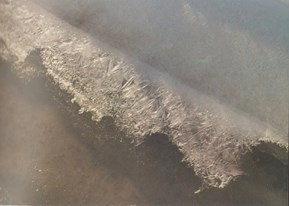
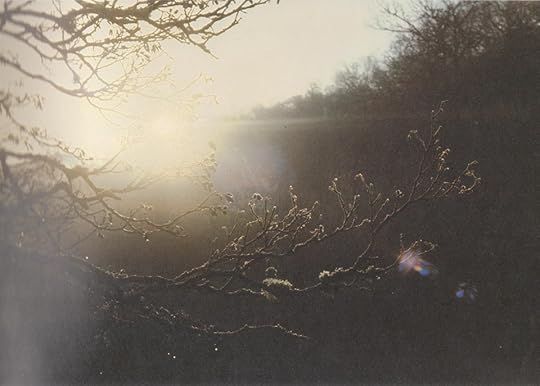
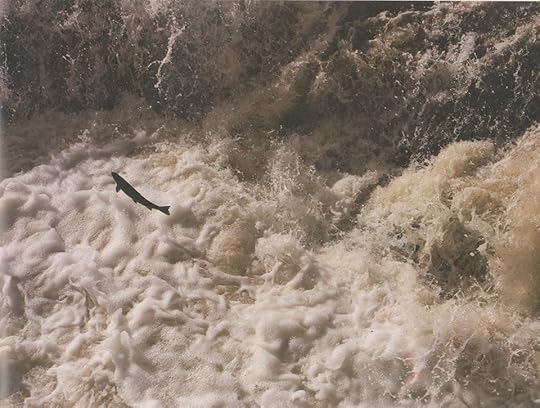
Each poem in this large-format book is placed opposite a photograph, also of elements of the river. Various rivers are shown, from all over the world. It is an odd pairing, however. Photograph and poem do not complement each other, or even seem to have any bearing on the same subject. This was the first edition of the book, and subsequent editions did not include any photographs. This was probably wise, since one's first impression of the book is that it is a "coffee-table book", where pleasant images can be appreciated for a minute or two. But the poetry belies this. It is typically Ted Hughes - dark, primordial - and astonishingly complex.
The photographs are beautiful rather than bleak. Fay Godwin's contrasting sharp images, barren and stark would better complement his poems, as they did earlier. Peter Keen's images are different in character; skilled and attractive, painterly, and imbued with subtle colour. Often they have an abstract feel, and feel impressionistic and blurred, as if the eye is halfclosed and focussing on pattern, which is alien to Ted Hughes's sharp incisive grip.
For that is what I feel when I read Ted Hughes's poetry. It disturbs me. It makes me uneasy. I do not like it ... but it grips me in its talons. It's powerful stuff. Pretty pictures cannot hope to convey Ted Hughes' response to Nature. He is concerned with the flow of the river, the constant change, the power, the voice and music of the river. The imagery is full of energy; full of kinetic, tactile and aural descriptions. He sees the river as the lifeblood; the generator and regenerator of life. His eye sees how everything is interconnected and related to the season and the weather. The whole ecosystem is,
"sewing body And soul together, and sewing soul And sky together and sky and earth Together and sewing the river to the sea"
– "In the Dark Violin of the Valley"
Ted Hughes was a passionate angler and conservationist, and this collection is a continuation of what is often called his "Nature Poetry", such as that in his "Moortown Diary" and "Remains of Elmet" (which is the book he wrote with Fay Godwin's photographs). The focus here however, is more strongly on rivers and other bodies of water, and the animals that live in and around them. But it is not simply descriptive poetry. Edward Lucie Smith said of Ted Hughes’ poetry,
"Each image denotates another, so that the whole poem throbs" – "British Poetry since 1945"
Ted Hughes was a keen fisherman from a young age. He once said that the trout "had a magical meaning for me ... It was an authentic aboriginal … the holiest creature out there in its free unspoiled sacred world." The trout guaranteed the existence of the world which he glimpsed in all the places he was happiest in his childhood, and was the precursor of all the salmon which later came to embody for him the entire great cycle and meaning of life.
He himself viewed writing poems as a continuation of his earlier passion as a fisherman, saying,
"This is hunting and the poem is a new species of creature, a new specimen of the life outside your own" – "Poetry in the Making"
A poem may seem to be about a single creature, but it is defined by its relationships with other creatures, and the environment. The controlling and linking image of River has to be the wheel. In Ted Hughes' 1960's poetry, this would have been connected with karma and reincarnation, but now the wheel is the cycle of the seasons, and of Nature’s annual fading and renewal. He also explores the wheel of water, lifted from the sea as clouds, dropping back to the land as rain, and flowing back to the sea as rivers. But perhaps most of all, threading through the collection, is the wheel as the lifecycle of the salmon as it follows the river to the sea to feed and grow, then returning to its birthplace to spawn, and to die. There is healing, sacrifice, atonement and most of all a strong sense of predestination,
"all things draw to the river" – "Everything is on its Way to the River"
"It is a god, and inviolable. Immortal. And will wash itself of all deaths"
– "River"
In an interview, Ted Hughes once recalled a vivid dream he had had, of walking by a large, swiftly flowing river,
"And coming up this river were these big salmon. As they came past me they were leaping. And as they leapt they shook themselves in the air. As they shook themselves in the air, their milt and spawn were splashed over me."
Reading the poems, the reader feels that this image was everpresent in his mind, as some kind of mystical experience. Indeed the very first poem has a sort of religious reverence, although it takes place in a very down to earth, perhaps distasteful or unpleasant part of the ordinary world. Entitled "The Morning Before Christmas" it describes how he and seven other men waited at a "salmon ladder" (a series of natural steps incorporated into a dam, to allow salmon to pass upstream). Ted Hughes describes how they performed the "precarious obstetrics" of stripping first the hen salmon of their eggs, and then the cock salmon of their sperm, decanting them into plastic bowls. The men then solemnly and lovingly, performed "the lavings, the drainings, the rewashings", in an effort to slightly improve the terrible odds for a few "lucky" salmon,
"Nothing So raggy dead offal as a dead Salmon in its wedding finery. So After their freakish luck in the lottery – Their five thousand to one against survival – Dead within days of marriage"
The imagery in this poem is intense. The words are raw and savage. The feeling is bleak, with the sheer power and energy of the life-force coming through. The brutality does not come from the gentle, respectful devoted men; it comes from Nature itself.
The poems in River are arranged to follow the cycle of the year, from salmon-stripping in late December to the spawning of the following January. In the second poem, “Japanese River Tales”, the river is sinisterly visited by “the snow princess” of winter, and is transformed into “a gutter of death”. And in the third, “Flesh of Light”, Ted Hughes’s view of the river's origin smacks of the divine; it comes from the “boiling light” of “The mill of the galaxy”. There is a vision of Hell in a later poem, with its "furnace boom of the Gulkana". The salmon,
“were possessed By that voice in the river, By the drums and flutes of its volume”
Ted Hughes' view of a river is not mine; it is extraordinary. I approached the poems feeling that he viewed the river as a living entity on its own account, but by the time I had reached this long four-page poem I felt that the poet was describing something even greater and more powerful. In the poem the salmon are engaged in a dance of death which is simultaneously a ritual of being reborn from their own eggs and sperm.
Prior to writing this poem, Ted Hughes and his son Nicholas (who was later sadly to kill himself in 2009, after battling depression for years) had spent some weeks salmon-fishing in "The Gulkana", a very wild river in Alaska. Of this time, Ted Hughes wrote to a friend,
"Alaska was everything I’d hoped. Everything happened I wanted to happen, and a whole lot more. We caught salmon until we were actually sick of catching them. We got ourselves off great lakes (living time, 5 minutes of immersion - so cold) by the skin of our teeth two or 3 times. We fished alongside bears. Lay awake listening to wolves. And generally sleepwalked through that dreamland. Unearthly valleys of flowers between snow mountains. Miles of purple lupins."
It was clearly a primoridal experience, demanding a primordial response,
"In the mercury light My illusion developed. I felt hunted. I tested my fear"
And this Ted Hughes is a different, accepting being from the earlier hard, resistant one. He aims at a selflessness, a oneness with Nature,
"... one inside me, A bodiless twin, some disinherited being And doppelganger other, unloving, Ever-living, a larva from prehistory Whose journey this was, Whose gaze I could feel, who now exulted Recognizing his home."
- "Gulkana"
In earlier collections the wheel, karma, or the "cycles of recurrence", had been images of horror or absurdity, needing to be transcended. Ted Hughes described the pressure to get off the intolerable wheel. But in The River his viewpoint has changed. It seems that Nature is now, for him, not in need of redemption, but is itself the only redeeming power. He refers to "Earth's tidings" and salmon eggs as "blessed issue" . He claims "only birth matters". In this first edition of River, the collection is framed by two poems, beginning with "The Morning Before Christmas" and ending with "Salmon Eggs". The emphasis is on birth, but birth does not discount death, for death is the price to be paid for birth. Ultimately the themes in this collection are death and renewal, or rebirth.
The river has many guises, often invoking the supernatural. In “Gulkana” it is the “deranging cry” of a monster, “A stone voice that dragged at us”, in “Last Night”, it is an “evil” presence, yet in “River”, it is a god,
“uttering spirit brightness Through its broken mouth.”
Sometimes Ted Hughes sees the essence of the river as female; through the seasons, the river is cast in several female roles. In “Fairy Flood”, it is a young girl eloping, while her father, the landscape,
“Claws weakly at her swollen decision”
“Low Water” refers to,
“a beautiful idle woman”
and it is a bride in “Salmon-taking Times”. It is a maternal character with a “Heavy belly” in “River Barrow” and the gruesome victim of a caesarean with no issue in “New Year”.
In “Torridge” the imagery is female throughout, with a direct reference to Eve,
“A novelty from the red side of Adam ... She who has not once tasted death.”
And finally it is both male and female,
“the swollen vent Of the nameless Teeming inside atoms ...
Only birth matters”
- “Salmon Eggs”
There are many animal characters in and about the river, and I particularly enjoyed the poems with these in. There are the land animals such as mink embodying play, gluttony and lust in “The Merry Mink”. In “Salmon-taking Times”, the pigs are described as,
“Tumbling hooligans Piling in the narrows”
A ewe in “Four March Watercolours” takes her nourishment from the river, stepping into it “to replenish her udder”, playing a sort of allegorical character who stands for Spring. There are birds, too. “The Kingfisher” is my favourite poem; a rare beauty. The kingfisher is a dazzling irritant, a chaotic spirit. Similarly, in “Last Act”, the damselfly is a “dainty assassin”. The cormorant has a dual role, as the antagonist who outduels the fisherman narrator in “A Cormorant” and the cold-blooded figure of death itself in “A Rival”.
But outshining all these are the fish, the most significant characters in Ted Hughes' view besides the river itself. The eel is “The nun of water”, a predator whom we find difficult to relate to, because it is so ancient and so single-minded. There are cock minnows, who “have abandoned contemplation” to have “A stag-party, all bridegrooms, all in their panoply” in “Under the Hill of Centurions”. And the sea trout, the first fish eulogised by Ted Hughes, come in, although now they play the part of happy simpletons.
By far the most important characters among the fish, of course, are the salmon. They seem tragic, or even godlike. Their one aim is to procreate, singlemindedly ignoring all obstacles to do so. Probably the best-known poem from the collection is "An October Salmon", which works through to the October salmon’s slow death. The exhausted salmon, worn out with his two thousand mile journey, and the Earth's "insatiable quest", ends as a "shroud in a gutter",
"This chamber of horrors is also home. He was probably hatched in this very pool"
"All this, too, is stitched into the torn richness, The epic poise That holds him so steady in his wounds, so loyal to his doom, so patient In the machinery of heaven."
– "October Salmon"
Yet in this cycle, even the salmon's dead body is needed, as food for scavengers. It also provides essential nutrients for the rainforest, on which depend the rains which will make it possible for the next generation of salmon to reach their upstream spawning grounds. All creatures are part of this great machinery. And the river is the machinery behind its scenes, the “Engine of earth’s renewal” cranking up in the Spring, repairing itself, and in Summer, it becomes a wine which,
“Swells from the press To gladden men.”
Life, in River, is "the bliss of making and unmaking"; unmaking in order to continue the cycle of making. In the two final poems there is a theme of sacrifice and dedication. In the penultimate poem, "Torridge",
"And the fish worship the source, bowed and fervent, But their hearts are water"
And in the final poem, "Salmon Eggs", the mating salmon are "emptying themselves for each other", a selfless form of giving.
All life is connected. The life of the salmon is the life of the living waters, sea and river, the life of earth and sky, our only life. The salmon is part of an unending flow; the river is itself an archetypal image for life, a process which Eliot had described as "the one-way helpless journey towards death". But a river is not merely a process of dying,
"Something else is going on in the river More vital than death – death here seems a superficiality Of small scaly limbs, parasitical. More grave than life Whose reflex jaws and famished crystals Seem incidental To this telling – these toilings of plasm – The melt of mouthing silence, the charge of light Dumb with immensity. The river goes on Sliding through its place, undergoing itself In its wheel."
– "Salmon Eggs"
When this collection was republished in 1993, Ted Hughes chose to end it with one of the earlier poems, "That Morning". This feels like the most religious or mystical poem of all. In it, two awe-struck human beings are allowed to re-enter Paradise, as long exiles being welcomed home. The sheer profusion of salmon is presented as a sign and a blessing, the body as a "spirit beacon lit by the power of the salmon". Ted Hughes' vision is of a "body of light", expressing the divine harmony of matter and spirit,
"Then for a sign that we were where we were Two gold bears came down and swam like men
Beside us. And dived like children. And stood in deep water as on a throne Eating pierced salmon off their talons.
So we found the end of our journey.
So we stood, alive in the river of light Among the creatures of light, creatures of light."
Nature itself seems to be the spiritual light. It is not a celestial light which is described, but wholly earthly light, which is none the less divine.
Ted Hughes lived in Yorkshire all his life. He started to write poetry at fifteen, and won a scholarship to Cambridge University in 1948. Before this, he spent much of his National Service time reading all of Shakespeare, until he could recite it all by heart. At Cambridge, he reportedly spent most of his time reading folklore and Yeats's poems. His own first published poem appeared in 1954, the year he graduated from Cambridge.
Ted Hughes is frequently ranked now as one of the best poets of his generation, and one of the twentieth century's greatest writers. He was the Poet Laureate from 1984 until his death, at only 68. At that time Seamus Heaney described him as "a guardian spirit of the land and language" saying at Hughes’s funeral, “No death outside my immediate family has left me feeling more bereft; no death in my lifetime has hurt poets more”.
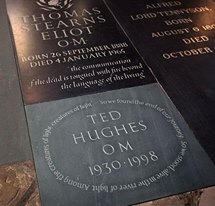
"So we found the end of our journey, So we stood alive in the river of light, Among the creatures of light, creatures of light"
is the inscription on the memorial stone to Ted Hughes, in the South Transept of Westminster Abbey, colloquially known as "Poets' Corner". The practice of honouring the greatest poets of the age with a tomb or a stone is a 600-year tradition, starting with Geoffrey Chaucer, through Dryden, Tennyson, Browning, Hardy, Milton, Wordsworth, Keats, Shelley, Blake, Hopkins and Eliot.
It is an extract from "That Morning", a poem in this collection. Simon Armitage said that poetry was in Ted Hughes’ breath and in his blood. And of these words, he said,
"Those three lines say as much about his work as anything: the immediacy of it, but also the absolute depth. It’s mesmerising and crystal-clear at the same time."
In total Ted Hughes wrote over 90 books, and won numerous prizes and fellowships. I do have difficulties with this particular collection, apart from the complexity of the poems. Ted Hughes' view of a river is not the same as mine. His view of Nature is not the same as mine. His view of Life itself is not the same as mine.
But I can see this poetry's greatness, and think it is a contender for his finest collection, as some critics have suggested. "River", said one, serves to "enliven our awareness of and respect for the source, and strengthen our resolve to ensure, at the very least, that it continues to flow." There are dark depths to Ted Hughes' poetry. Its themes are complex and cerebral, yet the language is approachable and commanding. It is elemental and unpretentious, with a disturbingly organic quality. As Simon Armitage says, it is "almost as if the poems had grown out of the earth".
But there has to be a reason, after all, why a quotation from River was chosen to be carved in stone, as Ted Hughes' lasting memorial. This collection typifies the man. It is brilliant, forceful, primal, and savage.
My idea of reading every Hughes poem is really annoying me now. He would NOT stop talking about salmon, yeah its going to be a metaphor but i do NOT want to think about “what a salmon is representing” so many times. I liked the river and performance.
For my part, there were three poems toward the beginning of the collection that really stood out for me, Japanese River Tales, The Morning Before Christmas and Four March Watercolors. After that the collection just seemed repetitive.
Hughes is a bit of a word-smith and can really craft some interesting lines but there is only so much you can say about salmon before it just becomes too much. Mind you, I like nature poetry but I think that doing a thematic collection like this limits the audience to die-hard Ted Hughes fans.
So not one of my favorite books of poetry but I would still like to read more by Hughes just no more flowing water please.
Highlights ~ "Japanese River Tales" "Flesh of Light" "The Merry Mink" "Ophelia" "The West Dart" "In the Dark Violin of the Valley" "An Eel" and "October Salmon".
Superb, a beautiful collection of poems focusing on the life-cycle of the salmon, from birth to death and rebirth. The collection explores aquatic life and landscapes as the year progresses through the seasons.
Ted Hughes is widely regarded as one of the 5 or so most important British writers of the 20th century. When I decided to begin reading his work, rather than one of the more seminal collections, I began here, simply because the book was called "River," and I'm oddly fascinated with Rivers (strange selection process I know).
I was blown away. I can honestly say, and this is weird for me, that I liked, to some degree, every single poem in this collection. I read poetry widely, and this is one of the best collections I've ever read. There is no redundancy, despite rivers playing the protagonist in most of the poems. The insights are each fresh, and the use of language evocative and observant. A wonderful book that I will revisit many times.
Re-reading after 30 years. I found my way into Hughes via Plath, then a serendipitous find, a copy of “Crow,” which was just the thing for my high school mind. “River” I found more subtle, then. It seems much less subtle now, but his portraits of the river and of the old dying salmon are deeply moving. It’s also strange; I assumed all along he was writing about an English river but the poem “The Gulkana” fixes the setting in Alaska. A weird dislocation of thirty years of understanding.
A book mostly filled with Nature poetry that didn't really stand out to me, although the poetry gets more engaging for me as the book went on. Two poems, one with a gorgeous title that begins an interesting poem 'In the dark violin of the valley' stood out to me, as did another, 'August evening'
Another work of Hughes was suggested by a book tuber so I decided to check him out. I could not get into this collection. Maybe it's because i don't like to fish.
The latter half of this collection impressed me more than the first half, but overall this collection left me rather mystified and uncertain about what Hughes was getting at here. There were impressive moments that make me want to revisit some of these poems - I'm sure there's something happening here, I just haven't quite caught the vision yet. This is not the Hughes collection I would read first, but for those already familiar to Hughes and who like him, you should get to this one eventually.
Not my favorite Hughes, but not a bad collection. The conceit of a book of poems set along a river, some about the nature of rivers, is interesting. Several had wonderful moments and ideas, but no complete poem made a very strong impression.
If you like rivers and fish, very compelling. An inspiration surely for Alice Oswald's fine 'Dart'. I detected too a welcome echo of David Jones in one or two places.