

What do you think?

In Montgomery: And Other Poems
Composed of three sections, this collection features the final poems of the late poet laureate of Illinois. The first section, ""In Montgomery,"" is a verbal description of a visit made by the poet and a highly talented photographer for Ebony Magazine , Moneeta Sleet. This is followed by a section of poetic character sketches. The final section is based upon a well known building located in the Black ghetto of Chicago's south side.
- GenresPoetry
147 pages, Hardcover
First published January 1, 2003
About the author
Gwendolyn Brooks
128 books599 followersGwendolyn Elizabeth Brooks is the Pulitzer Prize-winning author of Annie Allen and one of the most celebrated Black poets. She also served as consultant in poetry to the Library of Congress—the first Black woman to hold that position. She was the poet laureate for the state of Illinois for over thirty years, a National Women’s Hall of Fame inductee, and the recipient of a lifetime achievement award from the National Endowment for the Arts. Her works include We Are Shining, Bronzeville Boys and Girls, A Street in Bronzeville, In the Mecca, The Bean Eaters, and Maud Martha.
Ratings & Reviews
Friends & Following
Create a free account to discover what your friends think of this book!
Community Reviews
Displaying 1 - 18 of 18 reviews
February 1, 2026
I have a little niggle that maybe five other people in the world care about, but here I go: I don’t like books of Collected Poetry. I don’t mean individual poetry collections; I mean Collected Poetry of one poet’s work.
You see, what happens is: poetry goes out-of-print or libraries don’t want to carry every individual collection, so they slap it all together in one book. It makes for a hefty book and often you lose poems, publication dates become vague, etc, etc.
For too many poets, this is their fate, especially the older poets. Unless a poet was hugely successful, like Robert Frost, you are just not going to find too many of the individual entries anymore.
Gwendolyn Brooks, who is one of the most acclaimed poets in the United States and was the first Black poet to take home the Pulitzer Prize for poetry (1950), has been relegated to the same fate.
It is impossible now to find an available, affordable copy of Ms. Brooks’ ANNIE ALLEN (and, for the love of all that is holy, if your Great Aunt Bessie had a random copy of this book and it is, for whatever reason, lying on a bookshelf in your house, this is my WHITE WHALE and I need you to send it to me immediately!!)
Outside of Collected Works, like this one, it’s challenging now to get the individually published collections.
So, here we are, with one of these bigger books of everything shoved together, in one place.
I don’t like reading these types of books, and I don’t like reviewing them either (I mean, let’s be fair, there are FOUR separate, previously published books in this anthology—what are the odds that I would rate them all the same?)
The quick breakdown of this book is:
Part 1 is an epic poem, which appeared originally in “Ebony” magazine, in 1971, titled “In Montgomery:”
At the Dexter Avenue Baptist church
in History City, Martin King
gave the True Bread to his People.
Now Murray Branch,
heartening, handsome,
is the provider, the True Bread.
“Which comes down from heaven, and gives life
to the world” (New Testament), is strengthening still.
It is served quietly
to “The Beautiful People” of Montgomery.
“In Montgomery” is a fascinating snapshot of a particular time in the Civil Rights Movement, here in the States. Ms. Brooks writes of the glories and frustrations of organizing a group to protest in Montgomery, Alabama. Given the dust I had to blow off of this book at the library, and its near obscurity on here, I suspect not too many teachers or readers are using this book as an historical resource any more.
Part 2 of this collection is Ms. Brooks’s 1988 publication, GOTTSCHALK AND THE GRAND TARANTELLE, which, of course, no one has ever heard of. It’s an unusual collection, published when the author was about 70, and it’s mostly a lot of poetic tributes to famous people, like Winnie Mandela, Duke Ellington, Martin Luther King, Jr, and others. This was my favorite one from this section:
Brelve. A Battered Woman.
She began the Marriage
with exhilaration.
She chose, with live care,
saucepans, a blue roaster,
a set of silverplate from Marshall Field,
a lace tablecloth (headed for Heritage!)
He had smiled. He had felt her.
He was bright for the wedding.
Bright for the week, the two weeks. The four. She
could not believe
the arrival of her own loathing:
nausea behind her eyes:
the fear of a memorized footstep:
ice in vein and brain.
The descent of dream.
The dried-out drum-beat of desire.
The slams of doors down Corridors.
Decay of construction, of old construction,
scrupulous and confirmed.
End of love. End of love.
But presently, presently,
the self-wrought hour of self-confrontation
and small steps to a
raw resurrection.
New shapes of hospitality to Self.
New architecture in another morning.
Part 3 is my favorite part, and it’s from a book that, if you’re lucky, you can still find, individually, at your library (not mine, but maybe at yours, if you’re in the States): CHILDREN COMING HOME (1991).
This part’s a little heart breaking and a little breath taking. Ms. Brooks chose to write 20 poems from the perspective of school kids living in the South Side of Chicago. I could read this part, over and over again, but I’ll choose this one to share:
I AM A BLACK
According to my Teachers,
I am now an African-American.
They call me out of my name.
BLACK is an open umbrella.
I am Black and A BLACK forever.
I am one of The Blacks.
We are Here, we There.
We occur in Brazil, in Nigeria, Ghana,
in Botswana, Tanzania, in Kenya,
in Russia, Australia, in Haiti, Soweto,
in Grenada, in Cuba, in Panama, Libya,
in England and Italy, France.
We are graces in any places.
I am Black and A Black
forever.
I am other than Hyphenation.
I say, proudly, MY PEOPLE!
I say, proudly, OUR PEOPLE!
Our People do not disdain to eat yams or melons or grits
or to put peanut butter in stew. . .
Part 4 is another epic poem, IN THE MECCA, which was originally published in 1968. It felt like it was just slapped onto the end of this collection, and its presence made very little sense to me.
Regardless of this somewhat uneven offering, I’m a big fan of Gwendolyn Brooks's. She never knew it, but she became my poetry mentor, at an early age. Whenever I slack off or I give up on my own verse, because I think poetry doesn’t have enough readership, because I think poetry never pays enough money, I always conjure my favorite image of her, and I think of her telling me to brush myself off and get back to work.
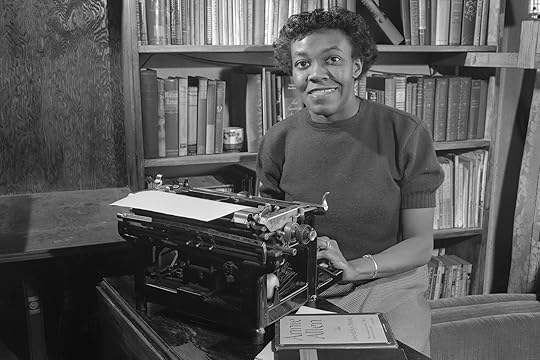
She was a professional poet, and I know it.
You see, what happens is: poetry goes out-of-print or libraries don’t want to carry every individual collection, so they slap it all together in one book. It makes for a hefty book and often you lose poems, publication dates become vague, etc, etc.
For too many poets, this is their fate, especially the older poets. Unless a poet was hugely successful, like Robert Frost, you are just not going to find too many of the individual entries anymore.
Gwendolyn Brooks, who is one of the most acclaimed poets in the United States and was the first Black poet to take home the Pulitzer Prize for poetry (1950), has been relegated to the same fate.
It is impossible now to find an available, affordable copy of Ms. Brooks’ ANNIE ALLEN (and, for the love of all that is holy, if your Great Aunt Bessie had a random copy of this book and it is, for whatever reason, lying on a bookshelf in your house, this is my WHITE WHALE and I need you to send it to me immediately!!)
Outside of Collected Works, like this one, it’s challenging now to get the individually published collections.
So, here we are, with one of these bigger books of everything shoved together, in one place.
I don’t like reading these types of books, and I don’t like reviewing them either (I mean, let’s be fair, there are FOUR separate, previously published books in this anthology—what are the odds that I would rate them all the same?)
The quick breakdown of this book is:
Part 1 is an epic poem, which appeared originally in “Ebony” magazine, in 1971, titled “In Montgomery:”
At the Dexter Avenue Baptist church
in History City, Martin King
gave the True Bread to his People.
Now Murray Branch,
heartening, handsome,
is the provider, the True Bread.
“Which comes down from heaven, and gives life
to the world” (New Testament), is strengthening still.
It is served quietly
to “The Beautiful People” of Montgomery.
“In Montgomery” is a fascinating snapshot of a particular time in the Civil Rights Movement, here in the States. Ms. Brooks writes of the glories and frustrations of organizing a group to protest in Montgomery, Alabama. Given the dust I had to blow off of this book at the library, and its near obscurity on here, I suspect not too many teachers or readers are using this book as an historical resource any more.
Part 2 of this collection is Ms. Brooks’s 1988 publication, GOTTSCHALK AND THE GRAND TARANTELLE, which, of course, no one has ever heard of. It’s an unusual collection, published when the author was about 70, and it’s mostly a lot of poetic tributes to famous people, like Winnie Mandela, Duke Ellington, Martin Luther King, Jr, and others. This was my favorite one from this section:
Brelve. A Battered Woman.
She began the Marriage
with exhilaration.
She chose, with live care,
saucepans, a blue roaster,
a set of silverplate from Marshall Field,
a lace tablecloth (headed for Heritage!)
He had smiled. He had felt her.
He was bright for the wedding.
Bright for the week, the two weeks. The four. She
could not believe
the arrival of her own loathing:
nausea behind her eyes:
the fear of a memorized footstep:
ice in vein and brain.
The descent of dream.
The dried-out drum-beat of desire.
The slams of doors down Corridors.
Decay of construction, of old construction,
scrupulous and confirmed.
End of love. End of love.
But presently, presently,
the self-wrought hour of self-confrontation
and small steps to a
raw resurrection.
New shapes of hospitality to Self.
New architecture in another morning.
Part 3 is my favorite part, and it’s from a book that, if you’re lucky, you can still find, individually, at your library (not mine, but maybe at yours, if you’re in the States): CHILDREN COMING HOME (1991).
This part’s a little heart breaking and a little breath taking. Ms. Brooks chose to write 20 poems from the perspective of school kids living in the South Side of Chicago. I could read this part, over and over again, but I’ll choose this one to share:
I AM A BLACK
According to my Teachers,
I am now an African-American.
They call me out of my name.
BLACK is an open umbrella.
I am Black and A BLACK forever.
I am one of The Blacks.
We are Here, we There.
We occur in Brazil, in Nigeria, Ghana,
in Botswana, Tanzania, in Kenya,
in Russia, Australia, in Haiti, Soweto,
in Grenada, in Cuba, in Panama, Libya,
in England and Italy, France.
We are graces in any places.
I am Black and A Black
forever.
I am other than Hyphenation.
I say, proudly, MY PEOPLE!
I say, proudly, OUR PEOPLE!
Our People do not disdain to eat yams or melons or grits
or to put peanut butter in stew. . .
Part 4 is another epic poem, IN THE MECCA, which was originally published in 1968. It felt like it was just slapped onto the end of this collection, and its presence made very little sense to me.
Regardless of this somewhat uneven offering, I’m a big fan of Gwendolyn Brooks's. She never knew it, but she became my poetry mentor, at an early age. Whenever I slack off or I give up on my own verse, because I think poetry doesn’t have enough readership, because I think poetry never pays enough money, I always conjure my favorite image of her, and I think of her telling me to brush myself off and get back to work.
She was a professional poet, and I know it.

October 23, 2024
lotta long poems and it made me stretch that muscle, but i didn’t feel any knock outs here. there’s a mini collection about students that was fun to think about, but i really can’t say that this did anything new for me.
November 13, 2019
This collection has four different sections. By far my favorite was "Children Coming Home," a series of 21 poems about 21 school children. Wonderful.

January 1, 2019
This is mostly notes on the title poem, "In Montgomery" originally published 1971 in the August Ebony magazine. Ebony's editor sent Brooks on commission to Montgomery, pairing her with noted civil rights photographer Moneta Sleet Jr.
I came to Brooks’ poem because I’m interested in the long history of documentary poetry. What it has been, what it has done. Many folks cite (myself included + Craig Santos Perez) Rukeyser and Nowak and not much else, so I was surprised when in a conversation a poet/academic casually mentioned Brooks’ “In Montgomery.” I was wondering if this was my own ignorance or if large swathes of the poetry community had forgotten or not known this giants’ contribution to the field. I dug out a nine page list a poet had compiled of other poets citing documentary works that influenced them. Sure enough, Brooks wasn’t there. I wanted to see what they were missing.
In her introduction, Brooks lays out her goal as to talk with a wide wide swathe of Montgomery's black community; among them, “Civil Rights stars and starlets [were] chosen for us to find, freeze and frazzle” (ix). In a sense, Brooks is checking in to see how the city fared since the height of the civil rights movement: “My work: to cite in semi-song the / meaning of Confederacy’s Cradle.”
Brooks described her method as verse journalism. This, I think, distinguishes it from a great deal of documentary poetry in that hers was written for a mass outlet and reached a large audience. It also doesn't cut and paste from official documents or do archive diving. Her focus is squarely on folks reflecting on the state of their city and their struggle for equality after the heat of the civil rights movement had died down in a city that had become synonymous with it through the 1955 bus boycott.
There’s a dynamic push and pull between the expectations Brooks brings to the city due to its history of successful struggle, the narrative as it has been told, how the stars understand the city in light of these struggles, and what Brooks sees. Brooks seems particularly interested in the bitterness of the civil rights leaders in what they see as only partial victory whose gains were embattled and youth disinterested in political struggle. Brooks seems to concur on some of these points, clapping shut the twenty-eight page poem w/the rhymed couplet: “Martin Luther King is not free. / Nor is Montgomery.” This ending is not a shocker as the poem begins with an image which communicates how white supremacy is celebrated within the monuments of the state: “White white white is the Capitol. / Inside the beautiful door / a Plaque in right print which cites / sweet white supremacy’s restoration” (1). Though sparks exceptional to this dominate picture flash up. Brooks lamenting a picture Moneta took and lost: "heart-stopping feature of a solitary Black boy atop a tower of golden sand, in wonderful isolation--skinny arms spread in almost violent exultation, in exhilarated love of self and of the world."
Poetics:
Brooks’ “semi-song” is compressed, pairing quick, memorable sketches of individuals with extensive quotations, often indicating the emphasis of her speakers (I think) with bold type. One wonders if she left the job of setting the scene to the photographer. Can’t find a version with Sleet’s photographs.
A spear of a Black girl
in a glass-green skirt, tight, tiny
below her sleeveless white blouse.
She is Real Cool, munches candy,
flicks a comb
“In The Mecca” (pgs 107-140)
-Is this, in its title, a self-conscious companion to “In Montgomery”?
-It would seem to be in its method—a social panorama of a particular place, its poem through portraits of people living in a Chicago tenement. Though fiction.
-It pushes IM’s compression even harder, blending elements.
-A walk, a chorography, a more focused Paterson.
-If not documentary, intensely sociological, a social survey of characters, obsessions, obligations, bitternesses, pleasures.
Her own poetics?
“And steadily / an essential sanity, black and electric,
builds to reportage and redemption”
Brooks pushes on
A hot estrangement.
A material collapse
that is construction”
A Quote:
“Hateful things sometimes befall the hateful
but the hateful are not rendered lovable thereby.”
“She never learned that black is not beloved.” (140)
A statement of purpose:
“I am tired of little tight-faced poets sitting dow to
shape perfect unimportant pieces.
Poems that cough lightly—catch back a sneeze.
This is the time for Big Poems,
Roaring up out of sleaze,
poems from ice, from vomit, and from tainted blood.
This is the time for stiff or viscous poems.
Big, and Big.”
-“Song of Winnie” 48
I came to Brooks’ poem because I’m interested in the long history of documentary poetry. What it has been, what it has done. Many folks cite (myself included + Craig Santos Perez) Rukeyser and Nowak and not much else, so I was surprised when in a conversation a poet/academic casually mentioned Brooks’ “In Montgomery.” I was wondering if this was my own ignorance or if large swathes of the poetry community had forgotten or not known this giants’ contribution to the field. I dug out a nine page list a poet had compiled of other poets citing documentary works that influenced them. Sure enough, Brooks wasn’t there. I wanted to see what they were missing.
In her introduction, Brooks lays out her goal as to talk with a wide wide swathe of Montgomery's black community; among them, “Civil Rights stars and starlets [were] chosen for us to find, freeze and frazzle” (ix). In a sense, Brooks is checking in to see how the city fared since the height of the civil rights movement: “My work: to cite in semi-song the / meaning of Confederacy’s Cradle.”
Brooks described her method as verse journalism. This, I think, distinguishes it from a great deal of documentary poetry in that hers was written for a mass outlet and reached a large audience. It also doesn't cut and paste from official documents or do archive diving. Her focus is squarely on folks reflecting on the state of their city and their struggle for equality after the heat of the civil rights movement had died down in a city that had become synonymous with it through the 1955 bus boycott.
There’s a dynamic push and pull between the expectations Brooks brings to the city due to its history of successful struggle, the narrative as it has been told, how the stars understand the city in light of these struggles, and what Brooks sees. Brooks seems particularly interested in the bitterness of the civil rights leaders in what they see as only partial victory whose gains were embattled and youth disinterested in political struggle. Brooks seems to concur on some of these points, clapping shut the twenty-eight page poem w/the rhymed couplet: “Martin Luther King is not free. / Nor is Montgomery.” This ending is not a shocker as the poem begins with an image which communicates how white supremacy is celebrated within the monuments of the state: “White white white is the Capitol. / Inside the beautiful door / a Plaque in right print which cites / sweet white supremacy’s restoration” (1). Though sparks exceptional to this dominate picture flash up. Brooks lamenting a picture Moneta took and lost: "heart-stopping feature of a solitary Black boy atop a tower of golden sand, in wonderful isolation--skinny arms spread in almost violent exultation, in exhilarated love of self and of the world."
Poetics:
Brooks’ “semi-song” is compressed, pairing quick, memorable sketches of individuals with extensive quotations, often indicating the emphasis of her speakers (I think) with bold type. One wonders if she left the job of setting the scene to the photographer. Can’t find a version with Sleet’s photographs.
A spear of a Black girl
in a glass-green skirt, tight, tiny
below her sleeveless white blouse.
She is Real Cool, munches candy,
flicks a comb
“In The Mecca” (pgs 107-140)
-Is this, in its title, a self-conscious companion to “In Montgomery”?
-It would seem to be in its method—a social panorama of a particular place, its poem through portraits of people living in a Chicago tenement. Though fiction.
-It pushes IM’s compression even harder, blending elements.
-A walk, a chorography, a more focused Paterson.
-If not documentary, intensely sociological, a social survey of characters, obsessions, obligations, bitternesses, pleasures.
Her own poetics?
“And steadily / an essential sanity, black and electric,
builds to reportage and redemption”
Brooks pushes on
A hot estrangement.
A material collapse
that is construction”
A Quote:
“Hateful things sometimes befall the hateful
but the hateful are not rendered lovable thereby.”
“She never learned that black is not beloved.” (140)
A statement of purpose:
“I am tired of little tight-faced poets sitting dow to
shape perfect unimportant pieces.
Poems that cough lightly—catch back a sneeze.
This is the time for Big Poems,
Roaring up out of sleaze,
poems from ice, from vomit, and from tainted blood.
This is the time for stiff or viscous poems.
Big, and Big.”
-“Song of Winnie” 48

January 20, 2022
In Montgomery is divided into four parts: In Montgomery, Gottschalk And The Grande Tarantelle, Children Coming Home, and In The Mecca.
The first part, In Montgomery, is composed entirely of the titular poem. "In Montgomery" is a panoramic portrait of Civil Rights Movement, so named because of the bus boycott that occurred in Montgomery, Alabama, following the arrest of Rosa Parks...
The second part, Gottschalk And The Grande Tarantelle, is perhaps most noteworthy for its numerous tributes. Indeed, the second part contains tributes to Elizabeth Steinberg, Duke Ellington, Martin Luther King Jr... and a poem I mistook for a tribute to Danny Glover turned out to be something else... Something I can't quite describe... Why would I describe it when I could just show you?...
The poems of the third part, Children Coming Home, are written as from the perspective of children, describing in the simple language of a child the corrupting influences that the poet perceives as being introduced to children at younger and younger ages, thereby capturing a snapshot of the hardships of the time, hardships related to race, religion, class, sexuality...
The fourth part is composed entirely of the long poem "In The Mecca"...
The first part, In Montgomery, is composed entirely of the titular poem. "In Montgomery" is a panoramic portrait of Civil Rights Movement, so named because of the bus boycott that occurred in Montgomery, Alabama, following the arrest of Rosa Parks...
The first thing I saw at Court Square corner
was Black, lifting that bale . . .
In Montgomery
when it was 1955,
when it was 1965,
when Martin King was alive and loud -
the civilrightsmen were many.
the civilrightsmen and civilrightswomen
hit it out as hatchets with velvet on.
With sometimes the hatchets hacking through.
White white white is the Capitol.
Inside the beautiful door
a Plaque in rich print which cites
sweet white supremacy's restoration.
[...]
The second part, Gottschalk And The Grande Tarantelle, is perhaps most noteworthy for its numerous tributes. Indeed, the second part contains tributes to Elizabeth Steinberg, Duke Ellington, Martin Luther King Jr... and a poem I mistook for a tribute to Danny Glover turned out to be something else... Something I can't quite describe... Why would I describe it when I could just show you?...
Danny Glover is
a good poem.
This poem tells us what is new and old.
This poem reinforces, clarifies
and dares.
This poem is
an aspect of utility
bold, braced, and brave.
Danny Glover
is a today-poem.
Memorize him joyfully and well.
The poems of the third part, Children Coming Home, are written as from the perspective of children, describing in the simple language of a child the corrupting influences that the poet perceives as being introduced to children at younger and younger ages, thereby capturing a snapshot of the hardships of the time, hardships related to race, religion, class, sexuality...
At home we pray every morning, we
get down on our knees in a circle,
holding hands, holding Love,
and we sing Hallelujah.
Then we go into the World.
Daddy speeds, to break bread with his Girl Friend.
Mommy's a Boss. And a lesbian.
(She too has a nice Girl Friend.)
My brothers and sisters and I come to school.
We bring knives pistols bottles, little boxes, and cans.
We talk to the man who's cool at the playground gate.
Nobody Sees us, nobody stops our sins.
Our teachers feed us geography.
We spit is out in a hurry.
Now we are coming home.
At home, we pray every evening, we
get down on our knees in a circle,
holding hands, holding Love.
And we sing Hallelujah.
The fourth part is composed entirely of the long poem "In The Mecca"...
Sit where the light corrupts your face.
Miës Van der Rohe retires from grace.
And the fair fables fall.
S. Smith is Mrs. Sallie, Mrs. Sallie
hies home to Mecca, hies to marvelous rest;
ascends the sick and influential stair.
The eye unrinsed, the mouth absurd
with the last sourings of the master's Feast.
She plans
to set severity apart,
to unclench the heavy folly of the first.
Infirm booms
and suns that have not spoken die behind this
low-brown butterball. Our prudent partridge.
A fragmentary attar and armed coma.
A fugitive attar and a distinct hymn.
[...]
July 30, 2024
This collection houses some of my favorite poems of Gwendolyn Brooks. I would recommend looking for a scan of the original publication of In Montgomery in Ebony magazine. The text is all the same, but the context of the captured images along with Brook’s writing is breathtaking. Gottschalk and Children Coming Home are equally as powerful in my opinion. However, In The Mecca left me speechless. A true masterpiece of epic proportions.

December 26, 2021
I hadn't read a lot of Gwendolyn Brooks before tackling this book. I like that she does surprising things with language, but in a way that's organic and not ostentatious. The writing is often playful, but she will switch abruptly into a serious mode and get into some very heavy subject matter. There's real magic at work here a lot of the time.
January 27, 2020
How have I not read this compilation before? Loved it. This is the book one reads, then sets aside, picks up, allows it to open at any point, reread, reread, reread, and always find something new. Harrowing and lovely, gritty and sad.

Read
June 13, 2020“For the old tellings taught me / that all of Before was rehearsal, / that the true trends, the splendors, the splurges / were to be lit by the young / (who would give up life, limb and length of a / morrow for the Necessary Dream.”
Read
January 11, 2022Love song of winnie II and the beauty of the forest. Did not follow the last poem well at all
I feel like i cant rate these collections of poetry. Because poetry is hard for me. And all the poems are so different
I feel like i cant rate these collections of poetry. Because poetry is hard for me. And all the poems are so different

May 5, 2021
Brooks' most famous poems are those included in Selected Poems. This collection is selected from the late 1960s to her last poems. This is a handsome volume with some lesser-known gems.

March 19, 2022
Later works by Brooks, reflecting on leaders of the Civil Rights movement, and a particularly touching series telling the stories of elementary school students. A vital and vivid voice.
December 16, 2025
the standout is “In the Mecca”

April 16, 2018
Gwendolyn Brooks is an indisputable global treasure who gifted us with her words, AND I really had trouble getting into this collection of poetry. I lost steam reading and struggled to regain it. The poetry felt languid to me; it meandered sluggishly, and even though there were gems in each poem, the lack of concision distracted from their luster. I was hoping for something otherwise, especially given that he early poems in the collection are rooted in Montgomery.
However, I freely acknowledge that this reaction is total hearsay and more likely attributable to my demerits as a reader than to any lack of skill on Brooks’ part.
However, I freely acknowledge that this reaction is total hearsay and more likely attributable to my demerits as a reader than to any lack of skill on Brooks’ part.
July 29, 2015
These are intense poems. She is a poet in the vain of O'Connor's prophetic writers ... willing to look wide-eyed into the world we inhabit and willing to say things that many would rather not here. I think my favorite poem and the one I would like to re-read was the long one called In The Mecca about an apartment complex in New York (I think New York, it mentions Dearborn Ave).
The poem is about a little girl who goes missing and ultimately was killed by someone in the complex ... but that seems to be symbolic of all the lost children who grow up in places like this. Here is a few lines:
...The Lord was their shepherd.
Yet did they want.
Joyfully would they have lain in jungles or pastures,
walked beside still waters. Their gaunt
souls were not rested, their souls were banished.
In the shadow valley
they feared the evil, whether with or without God.
They were comforted by no Rod,
no Staff, but flayed by, O besieged by, shot a-plenty.
The prepared table was the rot or curd of the day.
Anointings were of lice. ...
The poem is about a little girl who goes missing and ultimately was killed by someone in the complex ... but that seems to be symbolic of all the lost children who grow up in places like this. Here is a few lines:
...The Lord was their shepherd.
Yet did they want.
Joyfully would they have lain in jungles or pastures,
walked beside still waters. Their gaunt
souls were not rested, their souls were banished.
In the shadow valley
they feared the evil, whether with or without God.
They were comforted by no Rod,
no Staff, but flayed by, O besieged by, shot a-plenty.
The prepared table was the rot or curd of the day.
Anointings were of lice. ...

August 2, 2007
Brooks' collection of poems "Children Coming Home" has stuck with me since middle school. Each poem is written from the perspective of an inner-city child, mostly focused on their lives outside of school. One of my favorites is "White Girls are Peculiar People."

March 25, 2009
I couldn't really get into her poetry, although she spoke about some poignant topics
Read
June 24, 2017A beautiful and eloquent book but my mind is mush
Displaying 1 - 18 of 18 reviews