Franklin W. Dixon is the pen name used by a variety of different authors who were part of a team that wrote The Hardy Boys novels for the Stratemeyer Syndicate (now owned by Simon & Schuster). Dixon was also the writer attributed for the Ted Scott Flying Stories series, published by Grosset & Dunlap. Canadian author Leslie McFarlane is believed to have written the first sixteen Hardy Boys books, but worked to a detailed plot and character outline for each story. The outlines are believed to have originated with Edward Stratemeyer, with later books outlined by his daughters Edna C. Squier and Harriet Stratemeyer Adams. Edward and Harriet also edited all books in the series through the mid-1960s. Other writers of the original books include MacFarlane's wife Amy, John Button, Andrew E. Svenson, and Adams herself; most of the outlines were done by Adams and Svenson. A number of other writers and editors were recruited to revise the outlines and update the texts in line with a more modern sensibility, starting in the late 1950s. The principal author for the Ted Scott books was John W. Duffield.
This time Frank and Joe are brought into the middle of a bitter family feud in Georgia at the request of a newspaper editor. The boys brave a hurricane, an alligator and a swamp monster to solve the mystery of Hidden Harbor and resolve the differences! My kid and I loved this Hardys adventure because it had a great storyline (aside from the implausible plot device where a hurricane in the Gulf of Mexico could get to Georgia (crossing the Florida panhandle and moving north - no way this could happen. But, hey, it was exciting nonetheless) and full of hijinks including some humor from Chet and of course clever sleuthing from the Boys. Now on to The Sinister Signpost!
4 Stars. Good but again formulaic. I wonder why I stopped reading The Hardy Boys when I was 10 or 12. I definitely remember the first few, including #2, The House on the Cliff. Fun, exciting. I enjoyed a good mystery then as I do now; Agatha Christie's Hercule Poirot and my teenage years are synonymous. Could it be too much action? I don't think I liked every chapter ending in a terrible, life and death situation for Frank and / or Joe, with inevitable escape just a few pages later. Looking at myself today, it appears I wanted more challenge to my read. What's going on here? Is there a clue back there that would help me understand? I gave this one four stars because there's some of that here. Tempting. The boys are in coastal Georgia trying to find the source of a serious squabble between two cousins, Blackstone and Rand. They are fighting over a swampy area and pond between their properties. What for? The possibility of treasure is hinted. And smuggling years ago, in and around the time of the American Civil War. But there's a third but hidden force involved. The book deserves a 4. And my favourite, Chet, is slowly but surely taking a more important role. (Au2025)
If u see me reading really random kids books, mind ur own business, I got reading challenge items to complete.
This is so bad. I used to read Nancy Drew and Boxcar Children books, I don’t think I ever read a Hardy Boys one when I was a child. And yeah, ok, I’m not the target audience, but I read enough books targeted at younger audiences and I can confidently say that this is so so bad. Anyways, I’m now going to read Boxcar Children instead of another Brady Bunch book for the 20s like I originally planned, so let’s see if it holds up better.
Book read for Dekalb County 100 Books in 100 Years 2025 reading challenge, item 91, A Book Published in the 1930s 89/100
This was the fourteenth volume in the Hardy Boys mystery series. It was produced by the Stratemeyer Syndicate and was published in 1935 by Grosset & Dunlap with 25 chapters and 219 pages. Authorship has been attributed to Leslie McFarlane, who wrote most of the best early books in the series (under the House pseudonym of Franklin W. Dixon, of course), but that seems to me to be unlikely. The writing style is quite different and there are several differences in the way the plot is developed and how the characters act. From 1959-'73, the first 38 books in the series were revised under the direction of Harriet Adams, Stratemeyer's daughter. Some of the books were just lightly edited or somewhat shortened and simplified, and some were completely replaced by new novels. This one falls in the latter category; in 1961, James Buechler wrote an entirely new book which replaced the original in the series, so there are two different novels with the same title and author. The newer book has twenty chapters and is 177 pages long. I read the original and then immediately read the newer one to compare the two. The original book has a strong racist element which I never found in any of the other early books (another reason I believe that the work wasn't McFarlane's), and that element is missing from the 1961 iteration. In the original, the Boys and pal Chet are on a ship that sinks, they're accused of stealing money from a passenger they save, and they get caught up in a generations-long feud that ties in with a plagiarism case their father is investigating. There are several things that seem pretty dated, even for 1935, such as the observation on page 110 that the greatest innovation of the century is the "electric ice-box," or Aunt Gertrude's fear that the Boys will be engaged in "...revelry with squads of gay chorus girls." And if they randomly mailed a letter to the license bureau and asked, would they get a prompt response with the name and address of the car's owner, like on page 53? In the new book, the Boys are hired to help investigate a libel suit brought against a small-town newspaper owner/editor in Georgia, and get involved with the search for a Civil War-era lost fortune, are attacked by (somewhat incompetent and not-too-bright) criminals, have an alligator encounter, etc. It's closer in spirit and feeling to the later traditional books, though it's not among the best of the lot. It's directed to a younger reader, with more action, less characterization, and a simpler plot. I've decided to give both versions three stars, but for different reasons.
This was the fourteenth volume in the Hardy Boys mystery series. It was produced by the Stratemeyer Syndicate and was published in 1935 by Grosset & Dunlap with 25 chapters and 219 pages. Authorship has been attributed to Leslie McFarlane, who wrote most of the best early books in the series (under the House pseudonym of Franklin W. Dixon, of course), but that seems to me to be unlikely. The writing style is quite different and there are several differences in the way the plot is developed and how the characters act. From 1959-'73, the first 38 books in the series were revised under the direction of Harriet Adams, Stratemeyer's daughter. Some of the books were just lightly edited or somewhat shortened and simplified, and some were completely replaced by new novels. This one falls in the latter category; in 1961, James Buechler wrote an entirely new book which replaced the original in the series, so there are two different novels with the same title and author. The newer book has twenty chapters and is 177 pages long. I read the original and then immediately read the newer one to compare the two. The original book has a strong racist element which I never found in any of the other early books (another reason I believe that the work wasn't McFarlane's), and that element is missing from the 1961 iteration. In the original, the Boys and pal Chet are on a ship that sinks, they're accused of stealing money from a passenger they save, and they get caught up in a generations-long feud that ties in with a plagiarism case their father is investigating. There are several things that seem pretty dated, even for 1935, such as the observation on page 110 that the greatest innovation of the century is the "electric ice-box," or Aunt Gertrude's fear that the Boys will be engaged in "...revelry with squads of gay chorus girls." And if they randomly mailed a letter to the license bureau and asked, would they get a prompt response with the name and address of the car's owner, like on page 53? In the new book, the Boys are hired to help investigate a libel suit brought against a small-town newspaper owner/editor in Georgia, and get involved with the search for a Civil War-era lost fortune, are attacked by (somewhat incompetent and not-too-bright) criminals, have an alligator encounter, etc. It's closer in spirit and feeling to the later traditional books, though it's not among the best of the lot. It's directed to a younger reader, with more action, less characterization, and a simpler plot. I've decided to give both versions three stars, but for different reasons.
1935 version: ★★★★✰ (The inclusion of this on my "dead dog warning" shelf applies to this version only.) 1961 version: ★★★✰✰ It deserves two stars, but I want to give it four (explained below) so I'm splitting the difference at three.
Review for the revision, 8/19/18:
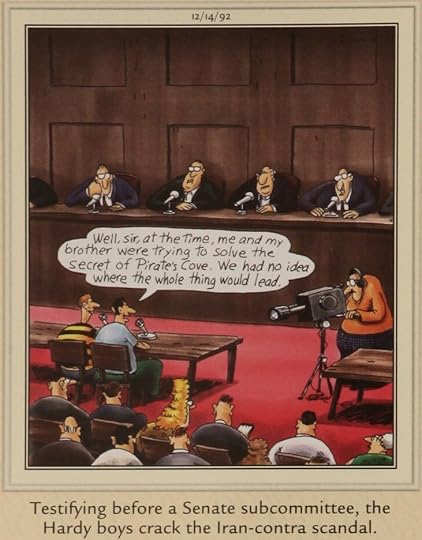
Before I start, here's a Far Side cartoon showing us that you're never too high up the chain to get nailed by those Hardy boys.
And while I'm being silly, let's enjoy this paraphrased Hardly Boys South Park parody.
"Dude, this mystery sounds super hard." "Oh... oooohhh... dude, I think I'm getting a clue." "You are?" "Yeah, I'm definitely getting a raging clue." "Oh... that's giving me a clue too." "Really?" "Oh yeah, I've got a huuuuge clue now." "My clue is totally pointing me this way, what about you?" "Yeah, me too. Let's go over there and check out our clues." "Look. Clue goo!" "Oooohhh."
Thank you for indulging me.
I thought I was done with the Hardy Boys series. The plan was to just read The Tower Treasure and The House on the Cliff since I had two versions of each and do a comparison and to read just the original version of The Mystery of Cabin Island since I happened to have it. However, mama found the original of this in her stash, and my boss had the revision from when he was a kid, and he also has the revision of The Mystery of Cabin Island, so here we go again.
I read the revision first this time, and I want to give it four stars, but it certainly doesn't deserve them. It is so ridiculous that I don't even know where to begin, and trying to list every inanity would fill up this entire review space. So, it really deserves maybe two stars at most, but I was immensely entertained, and "really liked it" (Goodreads' four star rating) sums up my feelings. Therefore I'm splitting the difference at three stars.
I enjoyed reading it. I guess I just happened to be in the right mood for such fiddle-faddle, and the stars aligned just right to provide me with an enjoyable experience. Plus, I recognize that I'm a discerning grown-up and not a naive child. Almost nothing in the revision makes sense to one of my ilk, but most kids wouldn't even notice the things that made me want to employ a facepalm. And had I actually used that maneuver every time I came across something that deserved such a response, I would've beaten my eyebrows off before I was halfway finished with the book and given myself several bloody noses in the bargain.
I suppose I can provide at least one example of the silliness strewn throughout the book, though. This is from chapter one. Business dude approaches the Hardy boys and tells them about some mysterious stuff. Burly dude at a nearby table overhears the conversation. Hardy boys are all like "I don't think we'll take this case, but we'll let you know." Business dude departs a little disappointed. The Hardy boys leave, then are lured into a dark place where they think someone might be hurt. Suddenly burly dude sneaks up behind them, says "I'll teach you to mind your own business," then knocks both of them out, never mind the fact that the Hardy boys had just stated their intention to mind their own business right where burly dude could hear them. You'd think burly dude would say "well, that was easy," and go home, but no. And why burly dude was following business dude in the first place doesn't make sense because... well, like I said, I'll use up all of my allotted 20,000 characters right now if I continue with this, so it's best to step out of the whirlpool now before we get sucked all the way down to the bottom. And the lighthouse... Nope better stop... And the hurricane... Nope, stop it, stop it... And the "monster..." And the geography... And the chemistry... And the laws of physics and optics... STOP IT, I SAID, GOD DAMMIT!... Okay, okay. Read it for yourself if you want a good ride on the suspension of disbelief highway.
Review for the original and comparison with the revision, 8/24/18:
This was a completely different story from the revision which is actually kind of nice since I wasn't reading the same tale twice. The Hardy Boys website lists this one as being "drastically altered," and that's accurate. There are a couple of common characters, a feud between them, and some of the action takes place in the same town, and some of the geography is the same, but that's about it. The plots don't resemble each other in the least.
I understand why some changes were made. One of the main antagonists is a "colored" person, and his actions and manner of speaking perpetuate stereotypes associated with his race. I can see why all that would be changed for kids in the early 60s who were witnessing the onset of the Civil Rights movement. But why they changed the story is beyond me to explain. The story in the revision sucks when pit against the original. So do the characters. I don't know why they felt they needed to inject a healthy dose of stupidity into the thing. Granted, the original is still a kid's book, and it isn't as hardcore as grown-up books, but at least the boys aren't complete ignoramuses. But I bitch about that enough in my other Hardy Boys reviews, so I'll give it a rest in this one.
There's more action, and the situations are more dire, so I actually ended up caring what happened to the characters. (I was just laughing at the ludicrousness of the revised story, and I knew by the way it was written that nothing too bad was going to happen to anyone.) There're even several instances of actual suspense due to misunderstandings. The boys are arrested and constantly finding themselves on the wrong side of the law and other adults. And this was also written long before Miranda Rights, so the cops got to do a lot of stuff that simply wouldn't fly nowadays. This version also had guns and an attempted lynching, although the posse was trying to string them up with the rope around the boys' waists. It's implied that a noose for the neck was eventually going to show up, though.
If you can stomach a little bit of racism, and like child-lit mysteries, then you'd probably like the original. Only grown-ups looking to laugh at silliness would enjoy the revision. Oh, and kids. Kids could get on board with both of them.
It is pouring down rain, and I am in the mood for a light read.
"This is going to be a terrible night on the open sea," said Joe Hardy.
"I wish the captain would speed up," responded Chet Morton, with anxiety. "The ocean is getting rough, and the sooner we reach Bayport the better it will suit me."
"Just the kind of setting for a mystery," returned Frank Hardy."
A shipwreck, stolen money, a feud between two families, and a black gang. The action in this book is non-stop.
When I was about 10 or 11, my mother signed me up for a book of the month club. Every month, I received two Nancy Drew or two Hardy Boys books. Every month, they were both read in a week and I was asking when the next book would be there! I thank my mother for recognizing and encouraging my love of reading.
Een dramatische cover die wel aanspreekt. De plot rammelt en hangt aan mekaar van toevalligheden zonder een logische samenhang. Het leest wel vlot omdat het vol aktie zit. Maar er zijn te veel personages om er een mooi samenhangend geheel van te maken. Pluspunt is dat Chet Morgan zijn vaste stek lijkt te hebben gevonden als de dikke vriend die van eten houdt maar door dik en dun achter zijn vrienden staat. Hij is wel de figuur die staat voor humor maar bij wordt niet langer belachelijk gemaakt. In de jaren 60 is het boek compleet herschreven (dit is nog de vertaling van het origineel) op een woke manier waarbij de zwarte dader verdwijnt uit het verhaal!. Psychologisch rammelt het en ook de besluiten van de jongens kunnen niet goedgekeurd worden. Eerst een gevangene naar de politie brengen terwijl ondertussen mensen kunnen vermoord worden! Een grote vraag: wat gebeurde er met de tunnel die vader en zoon Jones gegraven hebben onder het huis van rand? Een samenraapsel van aktie zonder echte samenhang maar met een rode draad waarin te veel verhaallijnen slecht uitgewerkt worden en te veel personages oppervlakkig de revue passeren.
I rate this book five out of five stars because it is an overall awesome story. The Hidden Harbor Mystery is the 14th book in the Hardy Boy series and I have never been disappointed yet. If you are not familiar with the hardy Boys, it is about a pair of brother who go out and solve fun, awesome mysteries that always end wanting you to read the next book. This story is more of an easy read to pass time. It is not that long with only 177 pages, but is very enjoyable and I highly recommend that you try it out.
This was an entertaining and quick read. The boys see their parents off on a cruise and find a man who wants to hire their father. They offer their services and are off on a new adventure. This one takes place in Georgia and involves two sides of a family arguing over property and there’s libel involved as well. Chet gets to go along and provides some light comedic relief as well as taking care of the food situation. Sounds like he’d make a great chef.
The classic boy detectives by Frank Dixon--I read ALL of them in my younger years, one I ran out of Nancy Drew books. The Hardy Boys are brother amateur detectives, aspiring to follow in their famous father's footsteps. Frank Hardy is the elder of the two and has dark hair. Joe Hardy is the younger brother, and has blond hair and blue eyes. The stories are an unaging series, in which Frank and Joe are always 18 and 17 years of age, respectively. In the original series the brothers were a younger 16 and 15 years of age, but their ages were increased during the revision process that began in 1959. The series utilizes a "floating timeline", in which events always take place in the present day.
The two boys live in the fictional city of Bayport (on Barmet Bay) with their famous father, Fenton Hardy, a private detective formerly with the New York Police Department, their mother Laura Hardy (erroneously called Mildred in The Flying Express), and their Aunt Gertrude, a character often used for comic relief.
The only thing I really worried my lip about was the use of "Negro" to describe people of color, but as the original story was written in the 1930s, maybe this was the best Franklin. W Dixon (or whatever author was using the pseudonym at the time) could do. Tame and bloodless, though there are several attempted murders throughout the book, the non-wrestling Hardy Boys Encyclopedia Brown their way to solving a case. Would you be surprised if I told you that the words "pirate's gold" appear before page 20? The author does a good job of laying out clues and calling attention to little things so that a young reader feels like Sherlock Holmes at the end of the novel. Oh! And travel times are weird. A drive from New York to Georgia and a later flight from Jamaica to the same locale in Georgia happen between page turns. That's it. Good clean fun for your early twentieth century boy child. Meh.
Similar to the other installments of the Hardy Boys series that I have read, Dixon continues to provide readers with an elaborately entertaining plot. Each adventure the boys partake in is complex, where their mission is more enjoying to follow as it is split into different, smaller mysteries and twists that, by the end of the story, add up to a surprising, satisfying, and sensible conclusion. However, this novel tended to repeat numerous aspects of the plot, causing the boys to experience the same misfortunes multiple times. The conclusion also seemed a bit rushed, as many questions were not answered until the very last chapter, seemingly dealing with a larger timeline of events than the rest of the chapters.
Plot: Joe and Frank Hardy are called upon by a frightened stock company employee to help solve a libel case that had something to do with a hidden harbor and a allegedly treasure trove that’s never been found! Join them as they solve a spine tingling mystery battling crocodiles, lake monsters, kidnappings, criminals, disappearing friends, almost drownings, and thunderstorms! Rating: 5 stars Recommend: for all ages of readers, especially teens and preteens Warning: some racial stereotypes and almost being drowned purposefully by some unknown foe. Joe and Frank do sporadically date girls, but they always act appropriate with them. Reading interest level: While most of the Nancy Drew and Hardy Boys books are absorbing, this one really lagged and got boring fir me in several places
A newspaper editor is in trouble after someone sneaks false copy into the paper, defaming the person who controls the small, southern town. It is up to Hardy Boys to find the truth about the big man's ancestor's nefarious origins.
The beatings continue as Frank and Joe get cold-cocked in the first chapter. For good measure each gets blacked out one time in the subsequent chapters.
While trying to help settle a feud between two brothers who own land directly beside each other, Frank and Joe get caught up in dangers like never before when they learn people are attempting to find treasure - no matter the cost! Dixon will have fans cheering the whole way in this entry! Can the boys find a way to end the feud before things spiral out of control?
What a nostalgic read. Bought a beat-up 1935 copy in a 5 for $1 sale. I whipped through it in an hour or so - classic Frank and Joe and Chet. (Love Chet.) I would have rated this 4 or 5 but the depiction of Luke and his friends is so disturbing to a modern reader...
Two feuding cousins, divided, literally and figuratively, by a pond and a libel suit bring the Hardy Boys into action in the 14th installment of this series. Filled with chases, lost villages, mysterious aquatic creatures and a great twist ending, this story is a rollicking good time!
This book is very dated (published in 1935, and it shows). There are a lot of better books/stories for young people to read that are not so obnoxiously racist, among other things.