

What do you think?

The Light in the Piazza
THE BOOK HAS TWO NICKS TO THE HARD COVER NO DUST JACKET THE BOOK HASN'T BEEN READ FIRST EDITION
110 pages, Hardcover
First published January 1, 1960
About the author
Elizabeth Spencer
87 books61 followersElizabeth Spencer was an American writer. Spencer's first novel, Fire in the Morning, was published in 1948. She has written a total of nine novels, seven collections of short stories, a memoir (Landscapes of the Heart, 1998), and a play (For Lease or Sale, 1989). Her novella The Light in the Piazza (1960) was adapted for the screen in 1962 and transformed into a Broadway musical of the same name in 2005. She is a five-time recipient of the O. Henry Award for short fiction.
Ratings & Reviews
Friends & Following
Create a free account to discover what your friends think of this book!
Community Reviews
Displaying 1 - 30 of 90 reviews

December 3, 2014
Like a lot of people, probably, I was unaware of this author until 2005 when this story was chosen for a theatrical adaptation, and now it’s a relatively famous musical. That year I went to see a talk at Lincoln Center in New York with Elizabeth Spencer (the author) and Adam Guettel (who wrote the musical). She was small and elderly and very quiet, and she could hardly believe what was happening to her little book that was no longer even in print.
I knew then, hearing her speak about her story, that it would be a lovely novella and I would enjoy reading it one day. It is still so nearly out of print (though seems to currently be packaged in this academic anthology), and eventually I did get this used copy that came with the world’s finest bookmark.
But it took me until I finally planned a trip to Florence, Italy before I took it down from the shelf and turned the pages. A wisp of a novel, it could be read extremely quickly, but I managed it in little pieces as we traveled. On the sofa in our holiday home near the Accademia where David resides, marking notes where we’d seen the same bridges and churches as we wandered through Firenze. Finally finishing in the dark further on our journey, in bed in Sicily with my phone on my chest to cast light, shivering on the side of a mountain.
I love literature for travel, books that share the street with you, put words to the scene from another moment, conjuring a secret experience in you as you look around as if you lived it in another life. I live with someone who always wants to read books of history for the places we travel, but I always want to read novels.
In mid-December nearly sixty years after it was written, my tourist experience couldn’t quite match that of Clara and her mother Margaret very well. They are lost in a summer haze of heat and sun-baked architecture and money, drifting in an open-ended tour of Italy from which they don’t ever really need to go home. Their life in America, which appears so prettily buttoned up with their fine family and excellent home and respectable friends, is really a series of escapes. Dodges, maybe, around Margaret’s permanent buzz of anxiety about Clara’s relationship to the world.
The affliction that has defined Clara is intentionally vague — a head injury, once, that altered her. How much did it change? Was it ever going to be different for her? We only have her mother’s version of their history and what we can see in front of us, this summer, in Italy. Margaret’s life is devoted to protecting Clara from awkward harm, things that others will be unaware will upset her, and yet to her credit she is also constantly embattled with this reality. Can’t Clara be normal, anyway? Can’t she live well some other way? Their family has vacillated between pretending there are no problems with their life and keeping Clara away from everything that makes life up.
Margaret as much as admits that they came to Italy to avoid a stickiness with a man Clara began to befriend back home. She may call her a child still, but she knows. And here they find themselves now: Margaret blazing Clara through a well-organized route of art, shopping, and cafes; and Clara practically photosynthesizing in the Tuscan sun. Here, Margaret sees, Clara works. She learns Italian to fluency, she fits the fashion to perfection. She brings no negative attention whatsoever. When her mother isn’t directing her around, she is budding and bubbling, and promptly attracts a persistent, darling boy.
What is so good about this story is that it takes very little time for Margaret to notice exactly what is going on. When Fabrizio will not go away — and when Clara will not go away from him — she has a reckoning. If I step back, she wonders, is it possible that this is actually going to turn out fine? Or am I dreaming?
She’s so sad, going through this alone, keeping herself collected (because, where she comes from, that’s just what you do) but privately bearing down on an entire motherhood of built-up grief and tension. Getting to know her, you understand that she can go either way on this one, there’s so much baggage on both sides. But we watch her, and we see which thing she wants more. And we want her to win.
I loved reading this, and I think the author deserves a little renaissance. She won multiple prizes and published many works and now seems to have only a smattering of quiet recognition. Note: she is still alive, at 96! And four years ago published a new story collection! Her writing is clever and wry, insightful and sad and vivid. This book is a perfection of concise storytelling and I’d recommend it to anyone. Most certainly, it’s going to remain on my shelf to share when we visit Florence again one day, a souvenir of another journey, and of ours.
.
Received a used copy of this from a reseller, with a souvenir photo from North Carolina Aquariums showing five teenage girls being dramatically eaten by a green-screen shark, stuck in as a bookmark before Chapter 8.
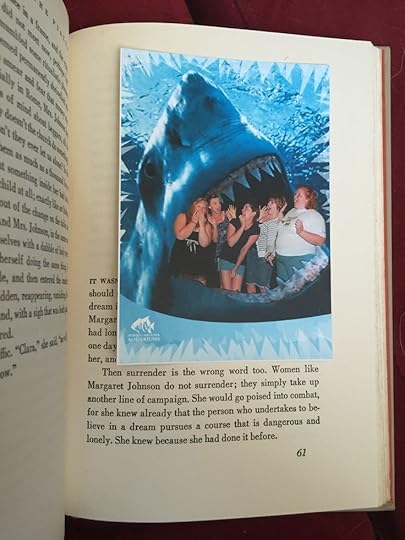
So many reasons to buy used books. <3
I knew then, hearing her speak about her story, that it would be a lovely novella and I would enjoy reading it one day. It is still so nearly out of print (though seems to currently be packaged in this academic anthology), and eventually I did get this used copy that came with the world’s finest bookmark.
But it took me until I finally planned a trip to Florence, Italy before I took it down from the shelf and turned the pages. A wisp of a novel, it could be read extremely quickly, but I managed it in little pieces as we traveled. On the sofa in our holiday home near the Accademia where David resides, marking notes where we’d seen the same bridges and churches as we wandered through Firenze. Finally finishing in the dark further on our journey, in bed in Sicily with my phone on my chest to cast light, shivering on the side of a mountain.
I love literature for travel, books that share the street with you, put words to the scene from another moment, conjuring a secret experience in you as you look around as if you lived it in another life. I live with someone who always wants to read books of history for the places we travel, but I always want to read novels.
In mid-December nearly sixty years after it was written, my tourist experience couldn’t quite match that of Clara and her mother Margaret very well. They are lost in a summer haze of heat and sun-baked architecture and money, drifting in an open-ended tour of Italy from which they don’t ever really need to go home. Their life in America, which appears so prettily buttoned up with their fine family and excellent home and respectable friends, is really a series of escapes. Dodges, maybe, around Margaret’s permanent buzz of anxiety about Clara’s relationship to the world.
The affliction that has defined Clara is intentionally vague — a head injury, once, that altered her. How much did it change? Was it ever going to be different for her? We only have her mother’s version of their history and what we can see in front of us, this summer, in Italy. Margaret’s life is devoted to protecting Clara from awkward harm, things that others will be unaware will upset her, and yet to her credit she is also constantly embattled with this reality. Can’t Clara be normal, anyway? Can’t she live well some other way? Their family has vacillated between pretending there are no problems with their life and keeping Clara away from everything that makes life up.
Margaret as much as admits that they came to Italy to avoid a stickiness with a man Clara began to befriend back home. She may call her a child still, but she knows. And here they find themselves now: Margaret blazing Clara through a well-organized route of art, shopping, and cafes; and Clara practically photosynthesizing in the Tuscan sun. Here, Margaret sees, Clara works. She learns Italian to fluency, she fits the fashion to perfection. She brings no negative attention whatsoever. When her mother isn’t directing her around, she is budding and bubbling, and promptly attracts a persistent, darling boy.
What is so good about this story is that it takes very little time for Margaret to notice exactly what is going on. When Fabrizio will not go away — and when Clara will not go away from him — she has a reckoning. If I step back, she wonders, is it possible that this is actually going to turn out fine? Or am I dreaming?
She’s so sad, going through this alone, keeping herself collected (because, where she comes from, that’s just what you do) but privately bearing down on an entire motherhood of built-up grief and tension. Getting to know her, you understand that she can go either way on this one, there’s so much baggage on both sides. But we watch her, and we see which thing she wants more. And we want her to win.
I loved reading this, and I think the author deserves a little renaissance. She won multiple prizes and published many works and now seems to have only a smattering of quiet recognition. Note: she is still alive, at 96! And four years ago published a new story collection! Her writing is clever and wry, insightful and sad and vivid. This book is a perfection of concise storytelling and I’d recommend it to anyone. Most certainly, it’s going to remain on my shelf to share when we visit Florence again one day, a souvenir of another journey, and of ours.
.
Received a used copy of this from a reseller, with a souvenir photo from North Carolina Aquariums showing five teenage girls being dramatically eaten by a green-screen shark, stuck in as a bookmark before Chapter 8.
So many reasons to buy used books. <3

October 3, 2021
This was a quick, absorbing, and atmospheric novella that made me ache to return to Italy (soon….soon).
Clara is 26 and summering in Florence with her mother Margaret when local lad Fabrizio takes an interest. Clara blooms while Margaret broods, conflicted and indecisive. The story takes place in Margaret’s tense interior world through the hazy, blinding light of the Ponte Vecchio, the crowds, the sounds, the sun, the disorientation of the piazzas and young love.
I was 27 when I went to Italy and it wasn’t summer and I didn’t fall in love with an Italian shop owner. I don’t have a daughter so I’ll never watch her fall in love in Florence (it must be amazing to fall in love in Florence!), and I’ll never make a decision like Margaret did. It was selfless and selfish. She’ll be haunted and she’ll be free.
He would grow quiet at last, and in the quiet, even Margaret Johnson had not yet dared to imagine what sort of life, what degree of delight in it, they might not be able to discover (rediscover?) together. This was uncertain. What was certain was that in that same quiet she would begin to miss her daughter. She would go on missing her forever.
I will return to Florence and I won’t be so young, but I won’t be too old either. It’ll be autumn. Covid will be something that used to happen to us. The Duomo will still be there. Florence suits melancholy and Clara’s wide-eyed life-is-about-to-start joy. Florence suits me and it suits Margaret’s sorrow and loneliness. I want my husband to see Florence. I want to read this again right before I go back. Soon…soon.
Nobody with a dream should come to Italy. No matter how dead and buried the dream is thought to be, in Italy it will rise and walk again.
Clara is 26 and summering in Florence with her mother Margaret when local lad Fabrizio takes an interest. Clara blooms while Margaret broods, conflicted and indecisive. The story takes place in Margaret’s tense interior world through the hazy, blinding light of the Ponte Vecchio, the crowds, the sounds, the sun, the disorientation of the piazzas and young love.
I was 27 when I went to Italy and it wasn’t summer and I didn’t fall in love with an Italian shop owner. I don’t have a daughter so I’ll never watch her fall in love in Florence (it must be amazing to fall in love in Florence!), and I’ll never make a decision like Margaret did. It was selfless and selfish. She’ll be haunted and she’ll be free.
He would grow quiet at last, and in the quiet, even Margaret Johnson had not yet dared to imagine what sort of life, what degree of delight in it, they might not be able to discover (rediscover?) together. This was uncertain. What was certain was that in that same quiet she would begin to miss her daughter. She would go on missing her forever.
I will return to Florence and I won’t be so young, but I won’t be too old either. It’ll be autumn. Covid will be something that used to happen to us. The Duomo will still be there. Florence suits melancholy and Clara’s wide-eyed life-is-about-to-start joy. Florence suits me and it suits Margaret’s sorrow and loneliness. I want my husband to see Florence. I want to read this again right before I go back. Soon…soon.
Nobody with a dream should come to Italy. No matter how dead and buried the dream is thought to be, in Italy it will rise and walk again.

Want to Read
February 26, 2020If you've never listened to Adam Guettel's opera of this story, visit his YouTube channel and rectify this oversight. It's a beautiful piece of music, and the story's an evergreen.
May 1, 2023
✔️Published in 1960.
🖊 My review: an outstanding short story! The main plot solidifies the idea that there is someone for everyone, the “You were made for me, I was made for you” concept. Then there is the decision a wife makes without the blessing of her husband and her liberation (another plot line). It was a sacrifice, without question. Finally, it is a story of two cultures meeting and merging.
The short story is a fast read, and it can be read in one easy sitting. The 1962 movie by the same title, lifts much of the dialogue from the book, and it does follow the plot well. Also, I enjoyed the smattering of Italian throughout; it was a good refresher for me.
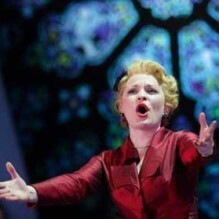 ⭐️ I cannot imagine this story as a musical, but it is that, too, in another incarnation. My cousin, Lucy Schaufer, played and sung the part of Margaret Johnson in the European première, and there is my connection to this— as reviewed here in this article published in The Guardian on 6 May 2009. More insight to the musical version can be found here in this podcast.
The 🔥 dénouement is optimistic and rebellious, and 🖋 the writing style is intelligent. 📌 Would I read this again? Yes, I would.
🤔 My rating 🌟🌟🌟🌟🌟
🔵 Media form: Internet Archive .
✿●▬●✿●✿●▬●✿
🖊 My review: an outstanding short story! The main plot solidifies the idea that there is someone for everyone, the “You were made for me, I was made for you” concept. Then there is the decision a wife makes without the blessing of her husband and her liberation (another plot line). It was a sacrifice, without question. Finally, it is a story of two cultures meeting and merging.
The short story is a fast read, and it can be read in one easy sitting. The 1962 movie by the same title, lifts much of the dialogue from the book, and it does follow the plot well. Also, I enjoyed the smattering of Italian throughout; it was a good refresher for me.
⭐️ I cannot imagine this story as a musical, but it is that, too, in another incarnation. My cousin, Lucy Schaufer, played and sung the part of Margaret Johnson in the European première, and there is my connection to this— as reviewed here in this article published in The Guardian on 6 May 2009. More insight to the musical version can be found here in this podcast.The 🔥 dénouement is optimistic and rebellious, and 🖋 the writing style is intelligent. 📌 Would I read this again? Yes, I would.
🤔 My rating 🌟🌟🌟🌟🌟
🔵 Media form: Internet Archive .
✿●▬●✿●✿●▬●✿

January 11, 2024
Lovely novella that shows off Spencer's talents as she shares views of Italy in the 60s. All characters are Italians or Americans of wealth and privilege. The story explores a romance where the parents have almost full control. There was a movie but this version is a little gem.
January 4, 2014
This short book from 1960(some describe is a novella) is written from the point of view of Margaret Johnson, a well-preserved middle-aged American lady who is making a leisurely visit of Italy, together with her beautiful daughter Clara. When the handsome Fabrizio starts courting Clara, Margaret feels terribly conflicted : should she tell him and his rather inquisitive family that Clara's apparent innocence is really due to a cognitive arrest incurred as a result of a fall of a horse when she was 10 years old? Should she stop this budding romance in its track? But Margaret feels strangely paralyzed, partially because she has fallen under the spell of Italy, and partially because she wants her daughter's happiness - and Clara wants Fabrizio. Her husband, back in North Carolina, isn't much help, since he pretty much washed his hands of his daughter since her deficiencies became apparent. But Margaret, usually such a pliable wife, cannot obey her husband's wish to Clara's marriage to what he believes is a fortune hunting, untrustworthy Italian who - horror- is a Catholic to boot. After much waffling, Margaret decides to let the wedding take place. But during a preliminary visit to the wedding registry, Fabrizio's father takes a look at Clara's passport and abruptly stops the proceedings. He later explains that he cannot countenance a marriage between 26-year old Clara and his 20-year old son. Between Margaret mentioning that Clara will have a substantial dowry and Fabrizio reminding his father that he is actually 23 years old, the wedding does take place. The book ends with Margaret feeling herself shrink into invisibility, feeling that her role is at an end, and murmuring to herself that she did the right thing.
I think that this book is a small gem. The writing is wonderful, impressionistic. As other reviewers have noted, there are some stereotypes in how Italians and Americans are perceived (the former crafty, the latter energetic). But ultimately the main theme of the story is that of a mother who wants her daughter to experience all the possible joys of life, including that of love. Margaret is a mother first and foremost, and she has defied her lord and master on a number of occasions when it comes to Clara. One of the book's last musings is that Margaret hopes that the fact that Clara is no longer her responsibility will bring her (Margaret) and her husband closer together.
One of the attractions of the book to me was the veil of ambiguity that covered everything. Did Fabrizio's father really forget his son's age, or was the scene in the wedding office a ruse to extract a larger financial settlement? Was Clara's father really unable to travel to Italy because of pressing business concerns (the crooner who was to be the face of his cigarette company had been called before the Committee on Un-American Activities!) or was he just not that interested in the daughter he considered "damaged goods"?
This book can easily be read in a single setting, but it is a great little dose of good writing about a theme that is still as relevant today as in 1960.
I think that this book is a small gem. The writing is wonderful, impressionistic. As other reviewers have noted, there are some stereotypes in how Italians and Americans are perceived (the former crafty, the latter energetic). But ultimately the main theme of the story is that of a mother who wants her daughter to experience all the possible joys of life, including that of love. Margaret is a mother first and foremost, and she has defied her lord and master on a number of occasions when it comes to Clara. One of the book's last musings is that Margaret hopes that the fact that Clara is no longer her responsibility will bring her (Margaret) and her husband closer together.
One of the attractions of the book to me was the veil of ambiguity that covered everything. Did Fabrizio's father really forget his son's age, or was the scene in the wedding office a ruse to extract a larger financial settlement? Was Clara's father really unable to travel to Italy because of pressing business concerns (the crooner who was to be the face of his cigarette company had been called before the Committee on Un-American Activities!) or was he just not that interested in the daughter he considered "damaged goods"?
This book can easily be read in a single setting, but it is a great little dose of good writing about a theme that is still as relevant today as in 1960.
This entire review has been hidden because of spoilers.

August 18, 2021
When I found out the local theater was going to put on this production I looked into the book so I could read the story first. I listened to an audiobook version and have to admit that the story made me a little uncomfortable.
I can totally relate to Mrs. Johnson wanting the best for her daughter and wanting her to live her life to the fullest.
I can totally relate to Mrs. Johnson wanting the best for her daughter and wanting her to live her life to the fullest.

October 1, 2014
I found this small treasure of a book at a farmer's market (!) where the local library had a "free books" display. Here was the story behind the Tony award-winning play that I have long-hoped to see. Amazingly, this small, 54 year old volume is a first-edition with an almost pristine dust jacket. It is also a book that I read quickly (less than 24 hours)and put down only for the obligatory meals and such. Still, the story lingers in the mind and calls you back at the first moment of opportunity. If you have had the pleasure of visiting Florence, Italy and are able to envision the Arno and Ponte Vecchio, the crowded streets, the Duomo, and piazzas of this timeless city, the story takes on an amplified dimension. As I recalled all of this, The Light in the Piazza became a vacation of the heart, while Margaret and Clara became my companions on the short journey. The quality of the prose is exacting and delightful, painting an atmospheric picture not only of the city, but of the interior worlds encompassed by the minds and hearts of mother and daughter.

March 12, 2011
I am about half way through The Light in the Piazza and it has proven to be a very quick read. I have to share this passage to show the wit in Elizabeth Spencer's writing: "Tea at the Naccarelli household revealed that the family lived in a spacious apartment with marble floors and had more bad pictures than good furniture." My only critique at the moment is that there is some conversation in Italian and I wish I would have brushed up in basic conversation Italian before picking up the book. Granted the copy I am reading is the first edition published in 1960, so I am not sure what current editions look like. Don't get me wrong, I love the hint of Italian language in the book. I just wish I knew the translation without picking up my Italian dictionary.
Tonight I finished reading the book and I thoroughly enjoyed it.
Tonight I finished reading the book and I thoroughly enjoyed it.

June 8, 2017
I saw this movie on TCM, one of the 1960s movies. It was on Hoopla and a short read, so I added it as a light book to read while on the recent trip to Asia.

May 30, 2022
It was good. I do think the story should’ve focused more on Clara and Fabrizio though, and less on Margaret.

May 16, 2024
Honest admission: I read this in The Light in the Piazza and Other Italian Tales, which I abandoned!
The story is about an American woman and her child with a traumatic brain injury summering in Italy, and It suffers from the usual plight of short stories and novellas -- length. Somehow short stories and novellas either run too long or run too short.
This one ran a bit too long, and the writing was a challenge for me. At times the writing was beautiful, but too often it was laborious! Sentences ran on too long -- with numerous commas -- requiring me to re-read a second or third time to comprehend.
As I have said before, working as a technical writer and a marketing hack has made me a tad impatient and intolerant of meandering text.
The story is about an American woman and her child with a traumatic brain injury summering in Italy, and It suffers from the usual plight of short stories and novellas -- length. Somehow short stories and novellas either run too long or run too short.
This one ran a bit too long, and the writing was a challenge for me. At times the writing was beautiful, but too often it was laborious! Sentences ran on too long -- with numerous commas -- requiring me to re-read a second or third time to comprehend.
As I have said before, working as a technical writer and a marketing hack has made me a tad impatient and intolerant of meandering text.

July 28, 2020
If you can leave the stereotypes alone, and imagine that Clara is developed more completely, you will enjoy this story. But it is distressingly easy to poke holes through it, little though I wanted to.
I have only heard selections from the musical (beautiful, BTW) , but I can’t help thinking that any librettist would fix the story, making it more conventional, but also more real. I wonder if that’s true.
I have only heard selections from the musical (beautiful, BTW) , but I can’t help thinking that any librettist would fix the story, making it more conventional, but also more real. I wonder if that’s true.

June 3, 2024
Wow! I enjoyed that quick read. It’s s especially interesting to read the night before the Welty book club discussion of A Room with a View, about Florentine romance. And of course, ending with the vision of Perseus and Medusa, I’m thinking of Welty’s stories, too.
(Which Spencer do I read next?)
(Which Spencer do I read next?)

Read
February 16, 2024Read for role prep! I like the musical adaptation of the story better than the novella itself, though that could be because I was familiar with the former first.

June 8, 2024
4.5🌟 A surprising small gem of a book!
I found this vintage edition at a local library book sale for only a few dollars. I primarily bought it because of the lovely dust jacket. It looked so intriguing! After posting a photo of The Light in the Piazza on my Bookstagram account, I realized that some of my book friends had really liked this book and also loved the movie adaptation.
The story begins in Florence, Italy with a mother (Mrs. Margaret Johnson) and her daughter, Clara entering a piazza on a June evening. After that, you follow their story through small, everyday encounters and conversations—mostly through the eyes (and mind) of the mother.
Elizabeth Spencer's writing style is simple and spare, but in the most exquisite and interesting way. I couldn't help but become completely immersed in their experiences and I was spellbound until the end.
I don't want to say more and ruin the story, but it's truly a novel worth reading. The story is still stuck in my mind and I'm very much looking forward to watching the 1962 movie starring Olivia de Havilland, Rossano Brazzi, Yvette Mimieux, George Hamilton and Barry Sullivan.
Very glad that this book found its way into my life!
I found this vintage edition at a local library book sale for only a few dollars. I primarily bought it because of the lovely dust jacket. It looked so intriguing! After posting a photo of The Light in the Piazza on my Bookstagram account, I realized that some of my book friends had really liked this book and also loved the movie adaptation.
The story begins in Florence, Italy with a mother (Mrs. Margaret Johnson) and her daughter, Clara entering a piazza on a June evening. After that, you follow their story through small, everyday encounters and conversations—mostly through the eyes (and mind) of the mother.
Elizabeth Spencer's writing style is simple and spare, but in the most exquisite and interesting way. I couldn't help but become completely immersed in their experiences and I was spellbound until the end.
I don't want to say more and ruin the story, but it's truly a novel worth reading. The story is still stuck in my mind and I'm very much looking forward to watching the 1962 movie starring Olivia de Havilland, Rossano Brazzi, Yvette Mimieux, George Hamilton and Barry Sullivan.
Very glad that this book found its way into my life!

September 14, 2026
There are some stories that I love despite their flaws, and then there are stories whose flaws become impossible to separate from the reasons I love them. Elizabeth Spencer’s The Light in the Piazza is very much the latter for me. I have always had a particular fondness for the 1962 film adaptation, starring Olivia de Havilland, Yvette Mimieux, George Hamilton, and Rossano Brazzi. It is one of my personal favorites, and revisiting the novella made me realize just how much of what I cherish about this story comes from the film rather than the book.
At its heart, The Light in the Piazza follows Margaret Johnson and her adult daughter Clara during their trip through Italy. Clara, who is twenty-six, has the intellectual development of a child following a childhood accident, and when she meets the young Florentine Fabrizio Naccarelli, the two immediately become enamored with one another. What follows is both a romance and a moral dilemma for Margaret, who has spent years worrying about whether her daughter can ever have an ordinary adult life. The novella is ultimately less interested in the romance itself than in Margaret’s internal conflict: whether she should protect Clara from the world or allow her the possibility of happiness, even if that happiness comes with risks.
I found the premise fascinating, but I also found the book considerably more problematic than I remembered. The biggest difficulty for me is the way Clara’s disability is handled. Spencer creates Clara as an adult woman who is simultaneously treated as a child, but the novella never really digs deeply enough into the complicated reality of that contradiction. Clara is essentially presented as a child in a woman’s body, and that framing becomes increasingly uncomfortable when the story asks us to accept her romantic and sexual awakening.
There is something deeply troubling about the simplicity with which the book approaches this. Clara has desires, emotions, and a capacity for attachment, but the narrative rarely gives us enough interiority to understand her as a fully realized person. So much of our understanding of Clara comes through Margaret’s perception of her. Margaret loves her fiercely, but she also manages her, interprets her, protects her, and makes decisions on her behalf. That creates an interesting maternal conflict, but it also means Clara herself can disappear inside the story.
And yet, strangely enough, the film works for me in a way the novella sometimes does not.
The chemistry between Yvette Mimieux and George Hamilton is the heart of the adaptation. Their relationship feels tender, sincere, and almost startlingly wholesome. Fabrizio’s fascination with Clara never feels cynical to me; there is a sweetness in the way they discover one another despite the language barrier and the enormous complications surrounding them. Mimieux plays Clara with a delicate, almost otherworldly innocence, while Hamilton gives Fabrizio an earnestness that makes their connection believable. Their scenes together have a warmth that transforms the potentially uncomfortable premise into something much more emotionally affecting.
Olivia de Havilland is equally magnificent as Margaret. Her performance gives the character layers that are sometimes harder to find on the page. Margaret isn't simply an overprotective mother. She is frightened, conflicted, lonely, loving, and painfully aware of the limited choices available to her daughter. De Havilland makes all of those emotions visible. The supporting cast is wonderful as well, particularly Rossano Brazzi as Fabrizio’s father.
The film also benefits enormously from Florence itself. The Italian setting gives the story a dreamlike quality, almost as though Clara and Fabrizio have wandered into a world where the usual rules temporarily don't apply. The beautiful locations, the romantic atmosphere, and Mario Nascimbene’s score all contribute to that feeling. The adaptation also expands certain elements of the story, including Margaret’s interactions with her husband and the addition of a tutor for Clara, giving the filmmakers opportunities to externalize conflicts that are largely internal in the novella.
Of course, viewed through a modern lens, The Light in the Piazza is inevitably controversial. The language surrounding Clara’s disability is dated, and the fundamental question of whether an intellectually disabled woman can meaningfully consent to marriage and romance is much more complicated than either Spencer or the film is equipped to explore. Modern audiences are understandably going to have questions that the story doesn't adequately answer.
For me, that doesn't erase the beauty of the film, but it does change how I experience it.
The novella is an intriguing, beautifully written, occasionally frustrating exploration of maternal love, fear, and the desire to give another person a life of their own. The film, however, takes that foundation and somehow makes the romance feel tangible. The love between Clara and Fabrizio is the reason I return to this story. It feels innocent without being entirely empty, tender without being saccharine, and hopeful despite everything surrounding it.
Ultimately, I think The Light in the Piazza is a fascinating example of an adaptation that improves upon some of the emotional limitations of its source material. The book asks difficult questions but doesn't always have the vocabulary to explore them fully. The film cannot solve those problems either, but the performances—especially those of Mimieux, Hamilton, and de Havilland—give the story a humanity that makes it linger.
It is a deeply imperfect story. But there is something about that light in the piazza, about Clara and Fabrizio finding one another in the middle of all that beauty and uncertainty, that I still find incredibly moving.
At its heart, The Light in the Piazza follows Margaret Johnson and her adult daughter Clara during their trip through Italy. Clara, who is twenty-six, has the intellectual development of a child following a childhood accident, and when she meets the young Florentine Fabrizio Naccarelli, the two immediately become enamored with one another. What follows is both a romance and a moral dilemma for Margaret, who has spent years worrying about whether her daughter can ever have an ordinary adult life. The novella is ultimately less interested in the romance itself than in Margaret’s internal conflict: whether she should protect Clara from the world or allow her the possibility of happiness, even if that happiness comes with risks.
I found the premise fascinating, but I also found the book considerably more problematic than I remembered. The biggest difficulty for me is the way Clara’s disability is handled. Spencer creates Clara as an adult woman who is simultaneously treated as a child, but the novella never really digs deeply enough into the complicated reality of that contradiction. Clara is essentially presented as a child in a woman’s body, and that framing becomes increasingly uncomfortable when the story asks us to accept her romantic and sexual awakening.
There is something deeply troubling about the simplicity with which the book approaches this. Clara has desires, emotions, and a capacity for attachment, but the narrative rarely gives us enough interiority to understand her as a fully realized person. So much of our understanding of Clara comes through Margaret’s perception of her. Margaret loves her fiercely, but she also manages her, interprets her, protects her, and makes decisions on her behalf. That creates an interesting maternal conflict, but it also means Clara herself can disappear inside the story.
And yet, strangely enough, the film works for me in a way the novella sometimes does not.
The chemistry between Yvette Mimieux and George Hamilton is the heart of the adaptation. Their relationship feels tender, sincere, and almost startlingly wholesome. Fabrizio’s fascination with Clara never feels cynical to me; there is a sweetness in the way they discover one another despite the language barrier and the enormous complications surrounding them. Mimieux plays Clara with a delicate, almost otherworldly innocence, while Hamilton gives Fabrizio an earnestness that makes their connection believable. Their scenes together have a warmth that transforms the potentially uncomfortable premise into something much more emotionally affecting.
Olivia de Havilland is equally magnificent as Margaret. Her performance gives the character layers that are sometimes harder to find on the page. Margaret isn't simply an overprotective mother. She is frightened, conflicted, lonely, loving, and painfully aware of the limited choices available to her daughter. De Havilland makes all of those emotions visible. The supporting cast is wonderful as well, particularly Rossano Brazzi as Fabrizio’s father.
The film also benefits enormously from Florence itself. The Italian setting gives the story a dreamlike quality, almost as though Clara and Fabrizio have wandered into a world where the usual rules temporarily don't apply. The beautiful locations, the romantic atmosphere, and Mario Nascimbene’s score all contribute to that feeling. The adaptation also expands certain elements of the story, including Margaret’s interactions with her husband and the addition of a tutor for Clara, giving the filmmakers opportunities to externalize conflicts that are largely internal in the novella.
Of course, viewed through a modern lens, The Light in the Piazza is inevitably controversial. The language surrounding Clara’s disability is dated, and the fundamental question of whether an intellectually disabled woman can meaningfully consent to marriage and romance is much more complicated than either Spencer or the film is equipped to explore. Modern audiences are understandably going to have questions that the story doesn't adequately answer.
For me, that doesn't erase the beauty of the film, but it does change how I experience it.
The novella is an intriguing, beautifully written, occasionally frustrating exploration of maternal love, fear, and the desire to give another person a life of their own. The film, however, takes that foundation and somehow makes the romance feel tangible. The love between Clara and Fabrizio is the reason I return to this story. It feels innocent without being entirely empty, tender without being saccharine, and hopeful despite everything surrounding it.
Ultimately, I think The Light in the Piazza is a fascinating example of an adaptation that improves upon some of the emotional limitations of its source material. The book asks difficult questions but doesn't always have the vocabulary to explore them fully. The film cannot solve those problems either, but the performances—especially those of Mimieux, Hamilton, and de Havilland—give the story a humanity that makes it linger.
It is a deeply imperfect story. But there is something about that light in the piazza, about Clara and Fabrizio finding one another in the middle of all that beauty and uncertainty, that I still find incredibly moving.

July 14, 2009
I'm not exactly sure why I avoided Elizabeth Spencer as long as I did. (Also I'm not sure why it took me so long to read this 100-page book. I blame that small person I live with.) It turns out that she is kind of good in a quiet way. Lots of unexpected turns of phrase settled among comfortable 50s prose. Does that make any sense? Not really. Sorry.
December 18, 2007
A delightful read and basis for one of my favorite musicals of all time. I highly recommend this!

March 4, 2013
Short and interesting character study -- watching a mother rationalize her way into something unexpected -- but way too short to show any real consequences. I wanted the rest of the story.

February 17, 2016
The writing is beautiful but I found the story disturbing.

March 17, 2021
“Nobody with a dream should come to Italy. No matter how dead and buried the dream is thought to be, in Italy it will rise and walk again.”
Florence is my favorite place in the world, and I am quite seriously on a quest to read every book about it in existence. Every day I dream of the cobblestone streets, the beautiful piazzas full of tourists, the gelato shops and the Medici sculptural legacy in the Loggia dei Lanzi. I had vaguely heard of this story / its musical adaptation before, but I’m so glad I finally read it. Spencer’s story is simple, and really sort of inconsequential, but the descriptions of my beautiful favorite city made up for a lot of it — I could perfectly follow where the characters went throughout the story through my mind-map of Florence :’) A lot of the story falls into that E. M. Forster-esque trap of “Italy” being an independent force to Anglo-American tourists, and the idea that it is a place where these traditionally reticent people can let their passions loose (see also: the quote at the beginning of the review; also, my review of Forster’s own WHERE ANGELS FEAR TO TREAD.) Luckily, I love reading about Anglo-American impressions of Florence, because otherwise I would have been really pissed off with these frankly incorrect assumptions about a country, a city, and a people who are so much more complex and beautiful than these writers would wish you to believe. (For the reality of Florence and it’s people as well as it’s tourists, please read Penelope Fitzgerald’s INNOCENCE, it’s excellent!)
Otherwise, this was a quick read and I enjoyed it. I think that Clara’s mental difficulties in the novel were not dealt with as sensitively as they could have been, but also this was written in 1960, so I guess I can’t expect too much. I don’t think this book is anything especially earth-shattering, except for Spencer’s descriptions of Florence, which soothed my soul a bit and really connected with me. Recommended as a quick read or if you’re in the mood to travel via novel in these pandemic times!!
Florence is my favorite place in the world, and I am quite seriously on a quest to read every book about it in existence. Every day I dream of the cobblestone streets, the beautiful piazzas full of tourists, the gelato shops and the Medici sculptural legacy in the Loggia dei Lanzi. I had vaguely heard of this story / its musical adaptation before, but I’m so glad I finally read it. Spencer’s story is simple, and really sort of inconsequential, but the descriptions of my beautiful favorite city made up for a lot of it — I could perfectly follow where the characters went throughout the story through my mind-map of Florence :’) A lot of the story falls into that E. M. Forster-esque trap of “Italy” being an independent force to Anglo-American tourists, and the idea that it is a place where these traditionally reticent people can let their passions loose (see also: the quote at the beginning of the review; also, my review of Forster’s own WHERE ANGELS FEAR TO TREAD.) Luckily, I love reading about Anglo-American impressions of Florence, because otherwise I would have been really pissed off with these frankly incorrect assumptions about a country, a city, and a people who are so much more complex and beautiful than these writers would wish you to believe. (For the reality of Florence and it’s people as well as it’s tourists, please read Penelope Fitzgerald’s INNOCENCE, it’s excellent!)
Otherwise, this was a quick read and I enjoyed it. I think that Clara’s mental difficulties in the novel were not dealt with as sensitively as they could have been, but also this was written in 1960, so I guess I can’t expect too much. I don’t think this book is anything especially earth-shattering, except for Spencer’s descriptions of Florence, which soothed my soul a bit and really connected with me. Recommended as a quick read or if you’re in the mood to travel via novel in these pandemic times!!
November 21, 2024
November 21, 2024
This book does an excellent job of immersing us in the setting of Florence, Italy. I'll give it that. I was reading this book during my lunch period and I was so hungry and I was really craving spaghetti. Kudos for the setting.
I enjoyed this read overall, but once I finished the book, I thought a little more deeply and realized that hardly anything of substance happened. I initially picked up this book because the synopsis promised troubles with Clara's mental capacities, and yet that is hardly a problem at all in the novel. (Also, the synopsis said that she was mentally a twelve-year-old, yet in the text, it says ten-year-old. Odd.) We hardly get any details on the "freakish accident" that Clara suffered, and it certainly isn't a main plot point other than the fact that Mrs. Johnson has to always be around Clara.
I got to the end of the book and felt kinda stupid. It was like the book was trying to say something profound, yet it completely missed the mark for me. I mean, consider this line, right after Mrs. Johnson has gotten Clara Johnson and Fabrizio Naccarelli married (without the consent of her husband and with the disapproval of Fabrizio's father):
I felt like this book needed to be longer and have a bit more to do with Clara's mental issues. I liked Clara and Fabrizio together, yet I didn't really see much of it since the story was told from the point of view of Clara's mother. But as a short novel, it was okay. Just nothing all that profound.
This book does an excellent job of immersing us in the setting of Florence, Italy. I'll give it that. I was reading this book during my lunch period and I was so hungry and I was really craving spaghetti. Kudos for the setting.
I enjoyed this read overall, but once I finished the book, I thought a little more deeply and realized that hardly anything of substance happened. I initially picked up this book because the synopsis promised troubles with Clara's mental capacities, and yet that is hardly a problem at all in the novel. (Also, the synopsis said that she was mentally a twelve-year-old, yet in the text, it says ten-year-old. Odd.) We hardly get any details on the "freakish accident" that Clara suffered, and it certainly isn't a main plot point other than the fact that Mrs. Johnson has to always be around Clara.
I got to the end of the book and felt kinda stupid. It was like the book was trying to say something profound, yet it completely missed the mark for me. I mean, consider this line, right after Mrs. Johnson has gotten Clara Johnson and Fabrizio Naccarelli married (without the consent of her husband and with the disapproval of Fabrizio's father):
"I did the right thing," she said. "I know I did."That screams in your face, "LOOK AT ME! I'M PROFOUND!!!" Yet I just didn't get it. Wasn't it the right thing to do to get Clara and Fabrizio married before Clara's father arrives from America and puts an end to Clara's chance at happiness? And I couldn't tell if Mrs. Johnson and Signor Naccarelli were maybe in love or not. It felt really unclear.
Signor Naccarelli made no reply. "The right thing": what was it?
I felt like this book needed to be longer and have a bit more to do with Clara's mental issues. I liked Clara and Fabrizio together, yet I didn't really see much of it since the story was told from the point of view of Clara's mother. But as a short novel, it was okay. Just nothing all that profound.

August 2, 2026
I saw the musical based on this. It was okay, but like musicals, felt superficial. I left after the end of the first act. It wasn't bad, I was just disinterested, but I did want to read Spencer's story, and just finished it. Her writing is very controlled, and not unlike a modern Henry James, and the theme of Italians and Americans interacting is very familiar. Margaret Johnson and Clara, her exuberant if very childish daughter (at 26) come to Florence and are taken in by it. Margaret has been here before, Clara is new, so Clara's world is very sensual and exciting; her hat flies off, rolling across the square, and picked up by young, eager, Fabrizio...and love! It seems so cliched, and I found the story from Margaret's POV rewarding. Her coming to terms with change, a parent's concerns and status, all of this overtaken by Florence is the heart of the story. While she came to study the statues and art, Clara BECOMES the art in a study of the mature and sensual. Signor Naccarelli, Fabrizio's father, is courtly and offers perspectives on the young couple Margaret begins to accommodate to. Noel, her husband, has a more stern way of dealing with relationships; not from anger, but from a parental love that seeks to overcome an accident Clara had in childhood that defines how he has been treated by her parents. Fabrizio and Florence offer a different perspective on dealing with such misfortune. It doesn't feel like great literature to me, but well-told, and I admire Spencer's structure. There was a 1962 film made of this, and it is very enjoyable, watchable, and follows the book, bringing out the inner troubling of Margaret very well. Spencer's Florentine location shows the real love she had for Italy, a place she adopted as home, and she makes it a very good supporting player in this story.

June 25, 2022
Straightforward writing, easy to read in one day, paints a picture of being a tourist in Florence that scratches a little beneath the surface and allows for satisfying armchair travel.
I'd argue that it doesn't transfer well to the present day, and think that nowadays one would handle disability representation a lot differently and better. I also imagine that marriages nowadays are much less coordinated by family and also often considerably less impulsive.
Still it is a good pastiche, I suppose, of 1950s/60s gender roles and of American materialism as incarnated in the distant figure of Mrs. Johnson's husband. What I wasn't able to decide by the end of reading the book was whether the girlish and innocent affect of Clara is also presented to us by the author directly as a way to question 1950s/60s ideals of what a young woman was supposed to be, and her role in a marriage. ('The nurse and the maid will do everything for Clara; she doesn't need skill to be a housewife,' to paraphrase loosely, was a striking observation.)
I'd argue that it doesn't transfer well to the present day, and think that nowadays one would handle disability representation a lot differently and better. I also imagine that marriages nowadays are much less coordinated by family and also often considerably less impulsive.
Still it is a good pastiche, I suppose, of 1950s/60s gender roles and of American materialism as incarnated in the distant figure of Mrs. Johnson's husband. What I wasn't able to decide by the end of reading the book was whether the girlish and innocent affect of Clara is also presented to us by the author directly as a way to question 1950s/60s ideals of what a young woman was supposed to be, and her role in a marriage. ('The nurse and the maid will do everything for Clara; she doesn't need skill to be a housewife,' to paraphrase loosely, was a striking observation.)
This entire review has been hidden because of spoilers.

June 25, 2025
While on vacation in Italy, a mother and her adult daughter meet a young man who flirts with Clara. Her mother is uncomfortable with the relationship in spite of his persistence because her daughter had a head injury that makes her behave like a child. The language barrier and difference in customs makes her begin to wonder if married life is possible for her daughter after all.
"They were rather remarkable flowers, Mrs. Johnson thought-- a species of lily apparently highly regarded here, though with their enormous naked stamens, based in a back-curling waxen petal, they had always struck her as being rather blatantly phallic... it had come to her to wonder then if Italians took sex so much for granted that they hardly thought about it at all, as separate, that is, from anything else in life."
This novelette was turned into a remarkable movie starring Olivia de Havilland, Yvette Mimieux, and George Hamilton.
"They were rather remarkable flowers, Mrs. Johnson thought-- a species of lily apparently highly regarded here, though with their enormous naked stamens, based in a back-curling waxen petal, they had always struck her as being rather blatantly phallic... it had come to her to wonder then if Italians took sex so much for granted that they hardly thought about it at all, as separate, that is, from anything else in life."
This novelette was turned into a remarkable movie starring Olivia de Havilland, Yvette Mimieux, and George Hamilton.

October 4, 2020
The situation and setting bring to mind memories of reading Jane Austen and E.M. Forster's Room with a View and Henry James's Italian novels but the story has a much tighter focus than any of those writings and the prose is straightforward American English. The main character is a woman from Winston-Salem, North Carolina, whose intellectually-challenged but delightful adult daughter is courted by a young Italian man during the mother and daughter's visit to Florence. How the mother resolves this "impossible" romance carries the story along through a series of gentle trials and upsets; the characters are vivid and realistic, the dialog brisk and amusing. Oddly, I feel a sense of loyalty to the characters that is strong enough that I do not want to read other of Elizabeth Spencer's stories right away; I want to savor the lives of these good people a little longer.

August 2, 2017
I knew the story from having seen the musical years ago. Still the writing made this a worthwhile reading experience. There was a rather shocking surprise towards the end which I felt was handled brilliantly by the author - she didn't mislead us in any way, and in fact there were some clues along the way [time wasn't making sense to me] - it wasn't a loud "OMG", but rather a quiet "Oh, I see, yes that makes perfect sense." I am drawn to Florence and Venice (dream destinations) so the setting was an attraction, and the author's description of the city betrays her affection for Florence. This isn't on the same level as A Room with a View, but it's an engaging story well told.

October 29, 2019
🌟3.5 stars🌟
Early this year, I was lucky enough to happen upon a signed copy of this book at Powell’s. I’d been looking for a copy for years, as this novella inspired one of favorite musicals, but it’s largely out of print, so I really feel fortunate to have a copy even if the book isn’t an all time favorite.
Overall, it’s not quite as good as masterful broadway adaptation, but still a nice, thoughtful little read.
Early this year, I was lucky enough to happen upon a signed copy of this book at Powell’s. I’d been looking for a copy for years, as this novella inspired one of favorite musicals, but it’s largely out of print, so I really feel fortunate to have a copy even if the book isn’t an all time favorite.
Overall, it’s not quite as good as masterful broadway adaptation, but still a nice, thoughtful little read.

June 21, 2020
Interesting because of the Florentine setting — experience helps — but pretty inconsequential. More like a short story.
Only one character really developed— Mrs. Johnson. Atmosphere well done but perhaps that’s because I know what she was saying.
Ah — reading Goodreads reviews I see this has been turned into a successful musical, which is perhaps the only reason most people are reading and reviewing this!
Only one character really developed— Mrs. Johnson. Atmosphere well done but perhaps that’s because I know what she was saying.
Ah — reading Goodreads reviews I see this has been turned into a successful musical, which is perhaps the only reason most people are reading and reviewing this!
Displaying 1 - 30 of 90 reviews