Artamène ou le Grand Cyrus Madeleine de Scudéry, femme de lettres française (1607–1701)
Ce livre numérique présente «Artamène ou le Grand Cyrus», de Madeleine de Scudéry, édité en texte intégral. Une table des matières dynamique permet d'accéder directement aux différentes sections.
Table des matières - Présentation - Première Partie. Artamène Ou Le Grand Cyrus - Seconde Partie. Artamène Ou Le Grand Cyrus - Craignant Donc De Mourir En Laissant Le Roy Dans L'opinion Où Il Estoit Il L'envoya Suplier Qu'il Luy Peust Parler : Et Ce Fut Justement Comme Je Revenois D'amathuse. Je Me Trouvay Donc Aupres De Ce Prince, Lors Qu'il Reçeut Ce Message : Et À L'instant Mesme Il Partit, Pour Aller Chez Philoxipe : Mais Avec Tant De Chagrin Qu'il M'en Faisoit Piti. Il S'estoit Repenti Plus D'une Sois, De Ce Qu'il Avoit Dit À Aretaphile : Et Ne Sçachant Si Effectivement Cette Princesse N'auroit Point Dit Quelque Parole Obligeante À Philoxipe, Apres Qu'il Les Eut Laissez Ensemble ; Il Retournoit Chez Luy Avec Une Inquietude Extréme. Comme Nous Y Fusmes, Il S'informa Si La Princesse Aretaphile Y Avoit Encore Esté Long Temps Apres Luy ? Et Ayant Sçeu Que Non, Il Entra Dans La Chambre De Philoxipe : Qui Me Voyant Avec Le Roy En Fut Fort Aise. Seigneur, Luy Dit Il, Je Voy Bien Qu'il Est Temps De Vous Adjoüer Ma Foiblesse, Et De Vous Desabuser : Le Roy Qui Ne Pouvoit Concilier Ces Deux Choses, Ne Luy Respondit Qu'en Soupirant : Et S'estant Assis Aupres De Son Lict, Philoxipe Reprenant La Parole, Luy Demanda Pardon De La Peine Qu'il Luy Avoit Donnée : Et Me Pria De Raconter Au Roy Ce Que Je Sçavois De Son Avanture : Le Suppliant De Ne Trouver Pas Mauvais Que Je Ne Luy Eusse Point Dit La Verité, Puis Qu'à Moins Que D'attirer Sur Moy Le Courroux Du Ciel Et D'estre Parjure, Je N'eusse Pû Reveler Son Secret, Apres Les Sermens Qu'il M'avoit Fait Faire. Je Commençay Donc De Dire Au Roy, Tout Ce Que Je Sçavois De L'amour De Philoxipe : Mais Seigneur, Tout Ce Que Je Luy Disois, Luy Paroissoit Tellement Incroyable, Et Parce Qu'en Effet La Chose N'estoit Pas Trop Dans La Vray-semblance ; Et Parce Qu'il Craignoit Qu'elle Ne Fust Pas Vraye ; Qu'il Fut Un Assez Long Temps À Ne Pouvoir Mesme Concevoir Qu'elle Fust Possible. Enfin Il Dit À Philoxipe, Qu'à Moins Que De Voir Policrite, Il N'adjousteroit Point De Soy À Mes Paroles. Philoxipe Voyant Donc L'obstination De Ce Prince, Luy Dit Qu'encore Qu'il Se Trouvast Fort Mal, Il Ne Laisseroit Pas De Se Faire Porter À Clarie, Pour Peu Qu'il Se Trouvast Mieux Le Lendemain : S'imaginant Qu'il Recouvreroit Plustost La Santé, En S'aprochant De Policrite, Qu'en Demeurant À Paphos. Cependant Quoy Que Le Roy Ne Creust Pas Encore Ce Que Je Luy Disois, Il Y Avoit Des Momens, Où L'on Ne Laissoit Pas De Voir Des Sentimens De Joye Dans Son Cœur. Ha Mon Cher Philoxipe, Luy Disoit Il, Seroit Il Bien Possible Que Vous Ne Fussiez Point Mon Rival, Et Que Je Me Fusse Trompé ? Si Cela Est, Adjoustoit Il Encore, Je Pense Que J'adoreray Cette Policrite Dont Vous Me Parlez, Au Lieu De Condamner L'amour Que Vous Dittes Avoir Pour Elle : Puis Que Par Là Je Ne Seray Plus Contraint De Ceder, Ce Que J'aime Plus Que Ma Vie, Et Que Mon Confident Ne Sera Point Mon Rival. Mais Admirez Seigneur, Les Effets Extraordinaires De L'amour ! Philoxipe Estoit Encore Assez Malade, Lors Qu'il Avoit Envoyé Prier Le Roy De Le Venir Revoir : Mais Des Qu'il Eut Formé La Resolution De Retourner À Clarie, Il Luy Amanda ; Il Dormit Toute La Nuit Suivante, Avec Assez De Tranquilité ; Et Le Lendemain Il Se Fit Porter En Litiere À Clarie, Où Le Roy Alla Coucher. Le Jour D'apres, Philoxipe Quitta Le Lict : Et Celuy Qui Suivit Malgré Sa Foiblesse, Il Monta À Cheval Avecque Le Roy, Accompagné De Peu De Monde : Et Fut Jusques Au Pied Des Rochers Où Il Faloit Descendre. - Troisième Partie. Artamène Ou Le Grand Cyrus - Quatrième Partie. Artamène Ou Le Grand Cyrus - Cinquième Partie. Artamène Ou Le Grand Cyrus
Madeleine de Scudéry, often known simply as Mademoiselle de Scudéry, was a French writer. She was the younger sister of author Georges de Scudéry, but is generally regarded as his superior in skill.
Madeleine de Scudéry, sœur cadette de Georges de Scudéry, morte à Paris le 2 juin 1701, était une femme de lettres française.
Preamble: After spending four and a half months with this book, I’d love to give it more than three stars, but necessity rears its ugly head. Keep in mind that three stars for me means that the book is good. Overall, I enjoyed it. Now for the review…
Artamenes, or Cyrus the Great
Certainly I am no stranger to long books, but Artamenes, or Cyrus the Great takes the first-place spot in terms of length by a mile, outdistancing Proust’s magnum opus by around 600,000 words. (Though I freely admit Artamenes is far inferior to Remembrance of Things Past--there’s truly no contest.) The English translation I read was approximately 1.8 million words. Suffice it to say that the remainder of 2019 will be spent with novels of brevity.
For those with thousands of dollars to spend and a thorough grasp of the French language, here’s a picture of the complete work (and what a set!):
Artamenes is a complex piece of writing in some ways and utilizes a ponderous structure. While the novel is approximately 7,400 pages, it is comprised of ten parts, each of which contains three different books (for a total of thirty books). The typical structure of each book is as follows: 1) Cyrus’s narrative continues to unfold and 2) new characters and various subplots are introduced. Much more time is spent on 2) than 1) in most of the thirty books. At times, the subplots make Artamenes feel more like a collection of novelettes rather than one cohesive book, but many of the numerous characters intertwine and reappear throughout, providing a sense of continuity.
“Numerous characters” is an understatement, as there must be hundreds and hundreds in this book. In every one of the ten parts, new characters are introduced, all of whom seem to possess names that begin with the letter A. This particular aspect of Artamenes is aggravating and often proved to be a source of confusion. For dedicated readers, creating some sort of character chart may prove an invaluable companion piece to the reading experience. If I ever reread this book—not likely but not impossible—I’ll be following my own advice. Some of the characters introduced in the subplots remain vital throughout Artamenes (e.g., Cleander, Anaxaris, Hidaspes, Meliantes), while others seem to vaporize into thin air. Knowing which characters are essential and which are disposable is, unfortunately, impossible to glean in advance. Best err on the side of caution and pay attention to all of them.
While there are myriad characters within Artamenes, many of them prove to be very similar, playing off early character archetypes. For instance, the men are often: valiant, respectful, handsome, brave—and all have the predilection to wax whiny when their maidens resist their advances. The women, on the other hand, are: modest, fair, pale with slender arms and small mouths, and virtuous to an extreme degree. For a woman to admit that she has any sort of romantic leaning toward a man within the pages of Artamenes would be considered indiscreet. “Cyrus gloried in his love of Mandana, and she, in return, permitted him to know that he was not hated by her” (such is the turn of phrase most often employed by Madam de Scudery).
Though I’ve spent the last couple paragraphs noting some of the foibles of Artamenes, I don’t want to give the impression that this is a book without merit. The characters, as noted above, are models of virtue, preserving values that have lessened in prevalence since the release of the work in the 1650s. There are examples of mercy and forbearance (as when Cyrus lets pass the opportunity to kill the hated Thomyris), and many enemies are converted to friends through kindness and forgiveness. More often than otherwise, rival kings fall under the kindly rule of Cyrus when they witness his magnanimity. Though Cyrus is something one-dimensional in his overwhelming goodness, he remains an endearing character throughout the book. Not all characters must be true-to-life in order to be amenable to the tastes of readers.
Unlike many long-winded novels, the pacing of Artamenes, or Cyrus the Great is surprisingly rapid. Admittedly, there are sections of the book that crawl, particularly when characters opine of their romantic woes; however, for being a 7,400-page affair, Artamenes moves at a steady clip. This is a book that at least partially justifies its length: the scope of the story requires a broad playing field.
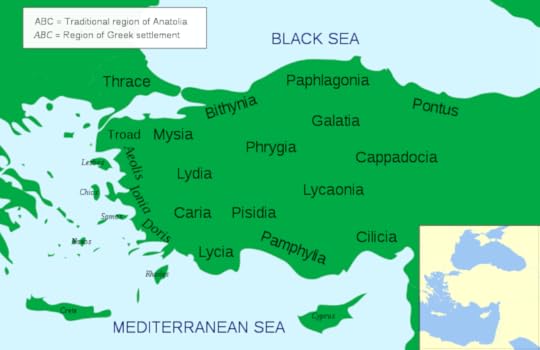
The physical playing field of the novel is less broad, primarily occurring in the ancient Mediterranean with an emphasis on Anatolia. Finding some simple maps through a Google search can help establish a sense of place and distance for those readers (like myself) who make no claims to geographical prowess. The below is a very straightforward map that I often referenced in my reading:
Artamenes, or Cyrus the Great is an imperfect novel, but one that is not without its charms. The story is complex and intertwining; virtue and morality feature prominently; and the characters, if underdeveloped, manage to remain likeable. Mme. de Scudery has created a major epic with Artamenes, and I do not regret the four and a half months I spent poring over its thousands of pages.
*For those readers interested in tackling this, see the following free digitization provided by the University of Michigan: Artamenes, or the Grand Cyrus
I must say, the only thing about this book that actually impressed me was how devoted the Author was to smashing in every pointless detail into every pointless subplot, which was also wedged inside multiple pointless attempts to try and make the book even worse than it is by making it a damn romance. If I had known this was a romance before I was halfway through, I would've given it up a long time ago. But now that I'm finished, I might as well tell you how bad it was. I'm pretty sure half of the people even bothering to read this review can tell I'm annoyed because of the constant run-on sentences that I'm typing in. The beginning was boring, well half of it. Then someone's about to get executed and you get hooked into it. But that interest is crushed by more random details. And in the end, the guy doesn't get executed. I hate that because I have a sort of blood-lust meter for novels that needs to be filled or I'll keep hating on the book until they do. Besides from these facts, the book never recovered after it's downfall in the beginning. After the beginning it just surrounds you with trash here and there about Cyrus and his woman. It's like the Author let someone take over and finish the story halfway through. I guess you could say some goals were met, like the 1600's Award for The Most Dull Novel in History. Concluding this review, well, there's a reason why this book got such a bad Goodreads rating before I came in and rated it myself.
I recommend this to cheap fans of ancient French romance novels.