

What do you think?

A Winter's Tale: The Wreck of the Florizel
Before becoming Newfoundland's famous author of sea tragedies, Cassie Brown wrote hundreds of shortstories as a professional journalist. Twelve stories are presented Tales of shipwrecks, captains, sealers and sailors, and heroic women, all described by one of Newfoundland's most respected authors. Headlining this collection is an account of the sinking of the S.S. Caribou, torpedoed by German submarine U-69 in the Gulf of St. Lawrence, killing 137 men, women and children, including Caption Ben Tavenor and his two sons. Also included is Cassie Brown's short story "DeathMarch," which she later developed into the best-selling book Death on the Ice. Another tale briefly describes the tragic S.S. Florizel disaster on Newfoundland's Southern Shore.
- GenresNonfictionHistoryCanada
276 pages, Paperback
First published January 1, 1976
About the author
Cassie Brown
13 books3 followersCassie Eileen Brown (1919–1986) was a Newfoundland and Labrador journalist, author, publisher and editor. Brown is most distinguished for her books Death on the Ice which was featured in Reader's Digest and the Wreck of the Florizel.
Ratings & Reviews
Friends & Following
Create a free account to discover what your friends think of this book!
Community Reviews
Displaying 1 - 8 of 8 reviews
May 5, 2021
A Winter's Tale: The Wreck of the Florizel by Cassie Brown follows Death on the Ice: The Great Newfoundland Sealing Disaster of 1914 in the reporting of another devastating sea disaster in Newfoundland in the early twentieth century. The Florizel was a passenger liner that was also used in the seal hunt as described in Death on the Ice. Fate took her four years later as she was run aground on the Renews Rocks, off the southeast Avalon Peninsula. A map of her final trip was an invaluable resource and I referred to it constantly as I travelled along on her final journey.
As in Death on the Ice, Brown has the capacity to write a gripping story which centres the reader in the midst of disaster. You can feel the panic of the passengers as they scramble for survival amidst torrents of freezing water rushing into their cabins. From the beginning the reader is presented with a mystery--it is stated on the back cover--about the slow speed of the Florizel and how it might have related to her foundering. This mystery hung over the entire read. Captain William Martin wondered why the ship wasn't travelling as fast as she should especially since he had issued a full speed order. Only during the enquiry did we learn of the relationship between the captain and the chief engineer, John Reader, and how they often didn't communicate even though they each played vital roles in navigation. Brown saved the reason for the ship's slow speed--a personal, selfish one which ended up costing 94 lives--until the very end.
Of the 138 passengers, only 44 survived. I can only wonder if more might have survived if the rescue effort wasn't hindered by red tape and wasteful poking around on shore for people to act. Brown was able to write about the fury of the sea however her survivor testimonies seemed repetitive. This book was published in 1976 and in her research and interviews with survivors I can imagine that she wanted to include everyone's eyewitness accounts. She incorporated all of these personal memories within the story yet they often told the same horrific story of the struggle to survive. Everyone needed to stay alert amidst the whining and scraping of the ship as she tore apart. The strength of waves crashing over the ship and carrying people overboard, while tragic, seemed monotonous until the rescue ships were sighted and something new happened.
Three-year-old Betty Munn perished in the wreck and this statue of Peter Pan was erected in her memory in Bowring Park in St. John's. I visited this park with my mother and Mark in 2012: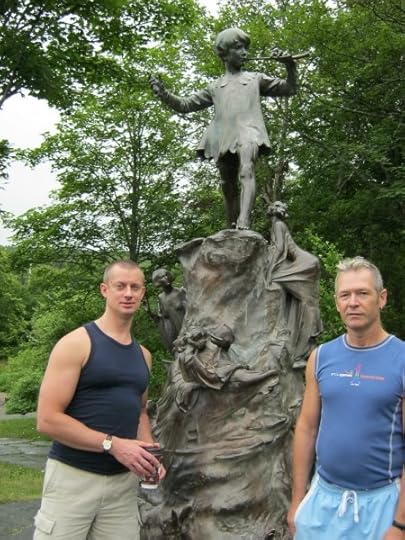

March 26, 2018
Cassie Brown writes like the story is a history book. She is amazing at gathering details and meticulously puts it all together in order to create the story. This book is very graphic, and sad. The author tells us who is boarding the boat and then what happens to each of them. Sometimes it is hard to keep them all straight. I wish she had included the dimensions of the Marconi room, so that we could picture clearly how crowded it was with 32 people inside. Basically the story is about a ship that was used for taking men to WWI, for going out sealing, and for taking people to different places- like New York. The destination this time was New York. There were cabins and nice restaurants, and a bar. The accommodations were comfortable. The ship had been through many rough seas and no expected to crash into the rocks.
In the end we find out the mystery. The engineer wanted to spend a night at his home in Halifax, and if they got there late- he would be able to do so. If they got there quickly they would only spend a couple of hours. So- he cut the speed a knot or two. So the captain figured where they would be by the speed he had ordered, and because they were in very rough seas, and because the engine wasn’t going as fast as it was supposed to go- they weren’t that far. So- they turned the corner too soon. They were supposed to be around the peninsula and instead they ran into some rocks in a bay that was before the peninsula even started. They crashed near Renews.
This story tells about how the ship broke up and how people survived. It shows people being strong- and it also shows people being washed overboard by waves. 138 people were on board, and 44 survived. The rescue operation was not sent as soon as it could have been. Many mistakes were made. The seas were very rough and two men died in capsized dories trying to rescue people. Tragic story. Worth the read. Part of Newfoundland history- another book I read told of a 12 year old boy who remembers picking up the bodies from the wreck that washed up on the shore.
In the end we find out the mystery. The engineer wanted to spend a night at his home in Halifax, and if they got there late- he would be able to do so. If they got there quickly they would only spend a couple of hours. So- he cut the speed a knot or two. So the captain figured where they would be by the speed he had ordered, and because they were in very rough seas, and because the engine wasn’t going as fast as it was supposed to go- they weren’t that far. So- they turned the corner too soon. They were supposed to be around the peninsula and instead they ran into some rocks in a bay that was before the peninsula even started. They crashed near Renews.
This story tells about how the ship broke up and how people survived. It shows people being strong- and it also shows people being washed overboard by waves. 138 people were on board, and 44 survived. The rescue operation was not sent as soon as it could have been. Many mistakes were made. The seas were very rough and two men died in capsized dories trying to rescue people. Tragic story. Worth the read. Part of Newfoundland history- another book I read told of a 12 year old boy who remembers picking up the bodies from the wreck that washed up on the shore.

December 21, 2018
Between this and Death on the Ice Cassie Brown has kind of temporarily ruined other books for me. After such intense reads it's hard to settle into another book.

March 11, 2025
A sad tale that probably could have been prevented. Cassie Brown tells the fate of the Florizel in her usual wonderful fashion. These are timeless stories that should never be forgotten.

February 26, 2026
Cassie Brown is NL’s greatest journalist. Read during the 108th anniversary of the wreck of the Florizel. A tale of tragedy and courage.

February 16, 2012
"Cassie Brown has the instincts of a true raconteur and the rare ability to allow a good story to unfold without stridently intruding her own views into it." -- The Globe and Mail
"A Winter's Tale will go down in history as one of the great contributions to Newfoundland literature...captures the tragedy and despair of the ordeal..." -- The Telegram
". . . all the elements of a thriller; suspense, disaster, mystery, and death…Cassie Brown unravels this yarn with the vividness of a folklorist recreating local history." -- Books in Canada
"A tale of shipwreck to rival that of the Titanic in excitement and suspense." -- Quill and Quire
"A Winter's Tale will go down in history as one of the great contributions to Newfoundland literature...captures the tragedy and despair of the ordeal..." -- The Telegram
". . . all the elements of a thriller; suspense, disaster, mystery, and death…Cassie Brown unravels this yarn with the vividness of a folklorist recreating local history." -- Books in Canada
"A tale of shipwreck to rival that of the Titanic in excitement and suspense." -- Quill and Quire

September 30, 2013
I was first introduced to Cassie Brown in high school and have been a fan ever since. In this novel, Cassie tells the story of the Florizel, a legendary steamer that's not only been to the ice of the sealing industry and back countless times, but has also shipped troops to the front lines, troops such as The Blue Puttees. This book tells the story of that brave ship's final voyage and foundering. Anyone interested in history and in their cultural past (if you area a Newfoundlander) this is a book for you!

January 30, 2022
A fascinating retelling of that harrowing night in 1918. Human error and a winter storm resulted in the loss of many lives, including one of my own ancestors. I recommend this book to those who are interested in Newfoundland and nautical history.
Displaying 1 - 8 of 8 reviews