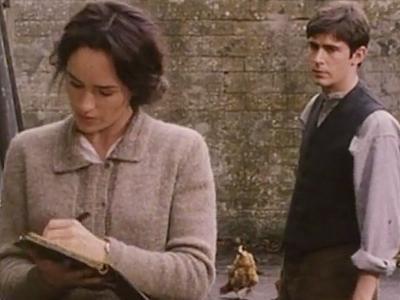
As World War I approaches, Foreshaw Park, the rundown estate of the once-wealthy Thorman family, becomes the setting for the burgeoning romance between the Thorman's elder daughter, Agnes, and Robert Bradley, a hired hand
Catherine Cookson was born in Tyne Dock, the illegitimate daughter of a poverty-stricken woman, Kate, who Catherine believed was her older sister. Catherine began work in service but eventually moved south to Hastings, where she met and married Tom Cookson, a local grammar-school master.
Although she was originally acclaimed as a regional writer - her novel The Round Tower won the Winifred Holtby Award for the best regional novel of 1968 - her readership quickly spread throughout the world, and her many best-selling novels established her as one of the most popular contemporary woman novelist. She received an OBE in 1985, was created a Dame of the British Empire in 1993, and was appointed an Honorary Fellow of St Hilda's College, Oxford, in 1997.
For many years she lived near Newcastle upon Tyne.
This is my third Cookson novel, & I don't think I'll be reading any others.
My first Cookson was 'The Whip', & it contained what I thought to be an inordinate amount of Life Suffering(tm)...however, I liked the MCs & assumed the onslaught was in homage to Victorian fiction where the poor heroine barely survives to reach her HEA. I still like 'The Whip' & remember it fondly. But I've since discovered that Cookson's copious Life Suffering style isn't making a statement about the genre -- no, it's her authorly kink. The endless pile-on of gloom, doom, & shitty life events NEVER ENDS, & I can't deal with such a thundercloud.
Now, y'all know I'm the first to criticize an author who chickens out rather than putting their characters through legit plotting quandaries. Hardship makes stuff happen -- I don't read solely to experience happy emotions. But Cookson's continual landslide is just too much, & it ruins my ability to care. She's the cheesy romantic equivalent of depressing post-modern lit-fic.
Example: reading The Lord of the Rings is a visceral, gut-wrenching thing for yours truly. There are chapters where JRRT rips my heart from my chest cavity, jumping up & down on my feels like a sadistic mofo. Yet such woebegone sadness is NOT A CONSTANT. There are brief periods of hope, contentment, & (most important) an overall aura of "Yes, it hurts, but I KNOW these people will make it to something better." Even old-skool rippers like This Other Eden or Stormfire, while epic in their suffering, embrace that oh-so-important glimmer, that pride in an as-yet unrealized period of "this too shall pass."
Cookson, on the other hand, lacks that spark. Her characters continually mope, moan, & wallow in suffering even while they're (supposedly?) fighting to reach that future contentment. Yet even when (or if) it manages to arrive before the final page (literally), they ARE STILL UNHAPPY. Yeah, I get it -- life is a veil of tears, blah blah blah. But there's a line, y'know?
In particular re: my distaste for The Moth, the final straw (spoiler beware) was when a formerly loyal family retainer goes insane & sets fire to the house, then runs inside to his death after realizing his beloved Unbalanced Daughter of the House was still in the bedroom with her dog. Why did he do this? Because he couldn't face the Older Daughter of the House marrying a commoner who used to work for him in the stables & would therefore become higher than him on the servants' social ladder.
Set in 1913 Northumbria, England, the story is about Robert Bradley, a strong-willed young worker at a Jarrow shipyard, who arrives home one day to find that his father has died. At the funeral he meets his father's estranged brother, his uncle John Bradley, and his wife Alice who offer Robert a new home and a place in his uncle's carpentry workshop. Robert accepts and after a few weeks at his new home, he is out walking late one night on the grounds of a rundown estate when he meets an ethereal young girl, Millie Thorman, whom the locals call the Moth, and befriends her. All seems to be going well for Robert until his cousin, Carrie, is revealed to be pregnant. Robert is immediately the suspected father, which he adamantly denies, but no one believes him. Even worse Carrie will not say who the real father is because she has always had a crush on Robert, and would rather marry him. Robert refuses to take the responsibility, shocking the townspeople, and leaves his relative's house, finding a place to work on the estate of Millie Thorman's once wealthy, now debt-ridden family. It is there that a mutual attraction develops between Robert and Sarah Thorman, Millie's older sister, but their social differences and Robert's reputation stand in their way.
A movie was made based on this book and it's available at YouTube.
4* Feathers in the Fire 5* Katie Mulholland 5* The Black Velvet Gown 5* The Rag Nymph 4* The Black Candle 3* Colour Blind 4* The Dwelling Place 4* The Glass Virgin 4* The Gambling Man 3* The Girl 4* The Maltese Angel 5* The Round Tower 3* The Cinder Path 4* The Fifteen Streets CR The Moth
The Mallen Trilogy: 4* The Mallen Streak 2* The Mallen Girl 3* The Mallen Litter
This is one of those stories where a man and a woman from different classes fall in love. However, there is so much more to the story than that.
Agnes Thorman has a younger sister, Millicent, who has some unusual qualities. Today she would likely have been determined to have some sort of disability. In her time, her quirks made her the object of scorn, ridicule, and other peoples' ignorant jokes. Members of her own family want to lock her away, not only so that they won't have to deal with her, but so that her existence won't cast dispersion on the sanity (and therefore suitability) of their pedigree. (Agnes is her sole advocate and spends her days saving her from being institutionalized or wandering off somewhere.) The family was once wealthy, and that is not the case now. Agnes' and Millie's three older brothers are looking for ways to continue living the lives their titles indicate, even at times if it is only a facade. They overlook the repayment for recurring debts and continue scheming in order to keep up appearances. They care little for the welfare of their younger sisters. Their mother is sickly and detached. Their father is selfish and lacking in many qualities - among them integrity and maturity.
At the same time, Robert Bradley is a working man, mostly skilled as a carpenter. His father has died, and his long-lost uncle offers him a job in his wood-working shop and habitation to patch up a past family squabble. At one time, Robert finds out, his uncle was engaged to Robert's mother, but she fell in love with his younger brother and married him instead. A grudge was held even after his own marriage and birth of a daughter. Now the uncle wants to make amends, and Robert takes the job.
A misunderstanding occurs which sends Robert looking for employment again, and he becomes entangled with the Thorman family when he accepts work at their estate.
Agnes treats him with the mild contempt that has been modeled by her peers and family toward men of Robert's class. There have also been scandalous rumors spread about Robert before he arrived, and the staff treat him with skepticism in response to these rumors.
Robert comes to the rescue on several occasions, proving his character. However, class keeps the recipients of mercy from showing the amount of gratitude that was appropriate for Robert's compassion. One reason is that Robert is proud, and does not allow those of higher or even equal stature to talk to him as though he is worth less. He reads a lot and speaks as an educated man, which puts off those in his class and above it. He dresses as fine as he can afford to do, but not to prove anything. He takes pride in himself and tries to be the best that he can be, disregarding the heckling from others he often receives.
The book becomes a story of two people who are very different, reacting to life through the eyes of what they have learned within their respective classes, finding themselves questioning it. What if all men in Robert's class are not ignorant? How is it that he treats me better than my own family does? Robert find Agnes a woman that he can talk to about serious subjects (such as in books), absent the games he has been subjected to by a number of women of his acquaintance. In short, he finds a woman who actually interests him.
Both are aware of the result if they step over the line. There are plenty of others around them to remind them. People talk, even about situations that are not actual but imagined. This book is about how the two of them navigate some very choppy waters toward mutual understanding.
"The Moth" nicknames a flighty young lady, eccentric to the point of madness in the eyes of the men of her family, but well loved by longtime servants and her repressed 26 year old sister, Agnes. After he first glimpses the girls by moonlight, charismatic carpenter Robert, confident (upstart, say some) in his well-read, clear-speaking intelligence, escaping concupiscent nymphomaniacs, joins the minimal unpaid staff of the decaying estate. Catherine Cookson, experienced from impoverished birth in 1906 NE England, deservedly a most popular UK author, envelopes us in old-fashioned romance crossing rural class divisions, as WWI breaks. She conveys deep passion in a glance, a style I heartily endorse.
Loved this book! (and if you get the chance to see the BFS film version (Jack Davenport and Juliet Aubrey 1997 its well worth a viewing and is faithful to the book). There is some cussing of the British variety (calling into question one's parentage mainly) but no sex. It's a classic "two people who arent social equals fall in love...". Great story And by the way, if a hero doesn't end up half dead, blind, scarred and crippled by the end of a CC novel someone hyjacked it!
As in most of Cookson's books she writes with strong female characters overcoming some miserable circumstance or misfortune. I also love the English accents given her characters. If you like books set in old England and well developed characters, you will enjoy books by Catherine Cookson!
I chose this book because I recently became aware of the 90s adaptation starring jack davenport (I haven’t watch it yet but I expect to love it). Give me a forbidden love story between an underestimated lady and a misjudged workman any day.
Het heeft me even tijd gekost om volledig in het verhaal te komen, maar eens ik erin zat, kwam ik er niet meer uit. Mijn oren (het is een audiobook) hingen aan het verhaal als een mot die naar het licht wordt getrokken.
Het is een zeer mooi verhaal over twee mensen van verschillende klasse, die hun weg naar elkaar vinden en dat niet zonder hinder of obstakels.
Ik voeg Heer Robert Bradely met genoegen toe aan mijn fav fictional men's list.
This is the first book I've read by Catherine Cookson. Her writing reminds me of authors D.E. Stevenson and Grace Livingston. I stumbled upon a review by another reader of this book and decided to try this one. So glad I did as I had trouble putting it down after starting it. If ever there was a book designed to illustrate the definition of a "double standard", then this is the one. The story takes place between 1912 and 1914 in Northern England.
The main female character is Agnes Thorman. She is considered "gentry" yet lives on a run down estate in the country. She has three brothers (Arnold, Roland and Stanley), a younger sister named Millicent but called Millie, and a father who drinks away any income derived from what few holdings of his remain. Her brothers are spoiled and narcissistic snobs. Millie is vibrant and almost always happy but is also considered dim by her family and their servants. She is called "the moth" by other citizens of the community due to her affinity to wander the estate grounds at night.
The main male character is Robert Bradley, a working class man who decides to leave his ship building job in Jarrow after his father dies. He goes to work for his Uncle John Bradley who lives in a hamlet near the village of Lamesley as a skilled carpenter. He's very good at his craft. Since there was complicated history between Robert's late father and his uncle, they don't always see eye to eye on religion and social customs. But Robert works hard for his uncle while residing above the workshop and the business is successful. During downtimes, he becomes acquainted with the Taggarts who run The Bull Tavern. Over the next several months during Robert's visits to The Bull, he learns of Foreshaw Park and its residents - the Thorman family.
One night after leaving the tavern, Robert decides to take a different route home and he meets Millie. Even after four pints, Robert thinks she does resemble a moth under the moonlit sky. She also does not strike him as being dim or "insane." Quite the opposite actually. Before departing, Robert encounters servant foreman Dave Waters and Agnes Thorman. After introductions, Robert finds he's accidentally trespassed and is strongly encouraged by Mr. Waters to leave.
Over the course of the story, the reader learns about the adverse and hostile circumstances which drive Robert to leave his uncle's carpentry business. He is blamed for something that he is not responsible for regarding his cousin Carrie and refuses to acquiesce to his Aunt Alice's solution. Robert leaves and ends up working at Foreshaw Park for very little pay. During his time there, the reader becomes well acquainted with servants Dave, Peggy, Ruthie, and Maggie Waters, Greg Hubbard, Arthur Bloom, and Betty Trollop. A few of these workers are key supporting characters to the story and its offences. But my favorite is Maggie.
The book is rife with class prejudice and transgressions:
Robert to Agnes after picking her up from the Crockford estate: "I've often wondered why one person can be born rich and another poor. And why some people are given dominion over others when, to my mind, they haven't the qualities to hold such power, so to speak."
Robert's response to Agnes after she inquires about his intentions toward Maggie: "You lot amaze me. You know that? You with your codes, your codes for other people, for the underlings, you simply amaze me. You can have your mistresses, your lovers, you can do any damn thing you like in that way, but when it comes to one of what you term the lower class, you begin to moralise".
Over time, Agnes develops feelings for Robert Bradley and he for her. She believes he is a good man. But she remains cautious because she knows it's not accepted for a gentry woman to become involved with a man considered below her status. What frustrates her though is that it is deemed okay for an upper class man to take on a mistress or a wife of lower stature but not the same for a woman known as a "lady". So much hypocrisy.
When 1914 arrives, the reader is aware that war is on the horizon. Robert knows a lot of men enlist after the war begins, but he doesn't believe wars solve anything:
"What caused wars? Greed, the greed for expansion, for land, greed for power, for domination. Why should men die or be maimed to satisfy the muddled thinking of elderly statesmen, men who no longer had the strength to fight or to reason calmly, only the power to sacrifice youth to gain their ends... "
Robert tells Agnes that he will eventually be recruited by the military, but until then he sees no reason to enlist. And soon enough, he begins to receive white feathers from anonymous senders. It saddened me that people Robert helped in the story were some who participated in the white feather propaganda.
This is truly a good historical fiction book. A lot happens that this reader would love to divulge but can't because I don't want to spoil it for future readers. But trust me, there's action in the form of an attempted murder, an accidental murder, and arson. There's emotional upheaval in crimes of passion and a broken engagement. There's some forgiveness and love. Lastly, there's the part where the "upper class" finally get their comeuppance!☺️
The reason I gave it four stars instead of five is because I felt it warranted an epilogue. This reader was left wondering what ultimately happened to Millie the "moth", Aggie's brothers, and a few other characters. If there's a sequel, I hope to find it. But this book was listed as a stand-a-lone. It's highly likely I will read another of Ms. Cookson's books.
I can almost cut and paste the review for "The Glass Virgin" and put it here. The main difference is that Agnes must choose between being a poor spinster within the gentry class or being a tradesman's wife without title or upper crust ties. For those of us who haven't lived in turn of the century England, the choice seems like a no brainer, but at that time, the conflict was great. Once again the reader is left wondering if love can overpower disinheritance and social isolation. What also makes "The Moth" unique is the WWI setting and the theme of mental illness.
Had this book on my shelf unread since 1991. I assumed it was about a ghost, like the girl in white who appears to driver's on some road or a story in that genre. After 22 years of thinking this way, I had a real hard time at the beginning getting it through my skull it wasn't that type of story. Once my brain accepted it, it was a good book.
Beautifully written, positively spellbinding! Catherine Cookson had such a talent for bringing her characters and the localities to life. Many authors have a talent for it, but hers was more than outstanding!!!
This writer is unique and disturbing enough to make the reader jolt out of their comfort zone. She shows different class perspectives that are honest and believable. An exquisite read. Lovely.
There's some line in Anne of Green Gables where Anne describes the ocean as something that blows out the cobwebs of her soul. This is what Catherine Cookson books (at her best) do for me. I'm always sort of driven up and outward when reading my favourites by her, particularly The Moth and Fifteen Streets, and she expresses in me a wonderful sort of restlessness. Maybe its that she's able to pen words to abstract feelings. I dunno. I just know I'm grateful to have read her books. The critics are justified, but at the end of the day, sometimes you gotta accept the formula, roll with it, and see it for the web of feelings it is.
The Moth is the usual Cookson prototype of a woman burdened with thankless responsibilities and a-hole relatives. Agnes is tethered to the place and her situation due to the precarious situation of her developmentally-delayed sister, Millie. All she wants is marriage to her long-engaged partner James, not simply to free her from the place, but so that she could feel like an actual woman. But even then, marriage to James is a murky future. Once while trying to provoke a passionate kiss from him, he made a joke so rude she later tried to wash off the dirt it provoked from off of her. She fears spinsterhood, and sees it as something to be endured. "What a waste of life." Cookson often alludes to this fear of spinsterdom in her books, and I can understand it from two angles. There's the realistic one, in that women of a certain era (i.e. anytime pre-1960s) were **nothing** if not married. They were meant to be both invisible and laboriously useful. Secondly, I sense in Cookson's portrayal of spinsterhood a fear of life without passion, without love. It is one thing to be invisible to society, and a whole other thing to be invisible to love. I often wonder why it is people often lump Cookson books as the 'U.K's Danielle Steele', i.e. romantic trash, when I never see the romance in CC's books. It's never really a love story, but more of an elemental attachment that needs to bridge, whether you like it or not. I'm not articulate enough to explain why, but I sense that Cookson's books are in a way subversive to Romance.
Speaking of subversive, I adore Robert Bradley. CC often writes men as either brash or gentle, Robert is neither of these things. A middle-man who doesn't want to walk the line or play the field. He is just incredibly interesting to read. He lives life for himself, not selfishly as some of the townspeople think, but thoughtfully. Why waste his life in mediocre marriage, or in subservience? Why be a soldier, when war is a construct made by powers that don't serve him? He's not an activist in these opinions, but simply and quietly reflected his understandings onto his life goals and is happy to go along his way living life for him. Just sucks for him that he goes ahead and falls in love with someone absolutely cloistered in the same classist structure that he happily dismisses. Anyhow, his pain is our pleasure.
I'll stop rambling but quickly add that I hope there's a book out there where CC really unravels what she means by "how dirty people could make life. How they could stain a beautiful thing, and once stained by slander it was indelible, it was there for always". YASSS. I want to explore this more.
I'm pretty stingy with my 5 star reviews, but holy smoke, what a great story this was!!!! The title is poor and in no way gives the reader any sort of a hint about this book. We follow an upper class English family in 1913-14, and all the events that go on in their lives - the family as well as the servants. This book covers the social taboo (of the time) of crossing social standings and class barriers. I was interested from page one to the end, and I'll continue to read every Catherine Cookson book I can find! They're not all this good, but they all tell really interesting stories of bygone days in England.
This is an interesting one about class divisions and crossing the line. The role of women vs men in the upper class. How people were viewed who crossed those lines or spoke out. Also touched on how society dealt with odd or irritating persons - by removing them to asylums.
This was a book that I read in high school and I kinda forgot about it until I saw someone reading it on the plane. So I re-read it and it still holds it's own. I also did watch the BBC movie of the book too and it wasn't bad.