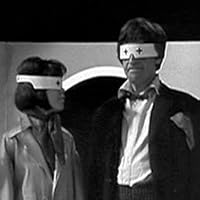
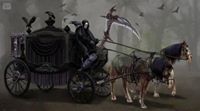
A shrieking, killing nightmare erupts from an overgrown well, hidden in the grounds of an old house, Tranchard’s Folly – and Mary Shelley, the Doctor’s latest travelling companion, rescues teenage twins Finicia and Lucern from the clutches of the monster.
But a TARDIS trip in search of the origin of the horror goes terribly wrong when the Doctor, Mary and their two new friends find themselves stuck in the middle of a seventeenth ncentury witch scare.
While the Doctor investigates the strange lights at Vetter’s Tor, and the twins go in search of an artefact from the Hecatrix Dimension, Mary confronts the secrets of her past… and her future. The truth will out: Master Kincaid, the terrible Witch-Pricker himself, commands it!
2022 52 Book Challenge - November Mini Challenge - 3) Related To The Word "Gift"
This is a hit and miss audiobook. For the most part, the Doctor and Mary are kept apart in two different eras, and so what was so good about the last audio, the interactions between the two, was missing in this one.
The bits with Mary and the dude with the library were enjoyable, and I kinda wish that they'd been longer, because it was far more enjoyable than the Doctor's time with the twins and the witch hunters and everything that was going on there.
I had decidedly mixed feelings about this one. Some of the pluses: Mary Shelley continues to be just about the perfect Doctor Who companion, demonstrating an ideal blend of curiosity, resourcefulness, and fearlessness in the face of the unknown. I wish she could be a companion on the TV series. I enjoyed the two time-zone nature of the story. I know that lots of listeners have complained that it deprives us of Doctor/Mary interaction, but on the flip side, it gives Mary a chance to shine. I also quite enjoyed the characters of Beatrice and Agnes, who could both have easily been stock characters straight out of central casting, but who, thanks to some combination of the acting and the writing, really come alive.
Some of the minuses: The plot is only sustained by our heroes being idiots at key moments. It starts with the Doctor's willfully ignoring the signs that anything odd is going on with the twins. Not only is this rather at odds with his usual attitude towards new people, but you'd think that the Doctor would at least pick up on the hint that he's crossed his own timeline. When you write an 8th Doctor audio, you really don't get to pretend that he's unfamiliar with how time travel works. And then there's the long stretch of time during which the Doctor and Mary are separated in two different time zones, during which the listener is wondering when it will finally occur to her to use the fast-return switch which was carefully explained in episode 1.
On the whole, the pluses just outweigh the minuses for me, making this a reasonably entertaining if imperfect story.
Sorry to say that I thought this was a rare misfire from the Big Finish main sequence of stories. I love the chemistry between Paul McGann's Doctor and Julie Cox's Mary Shelley, but this story keeps them apart in return for a tale of moral, psychological and time-paradoxical complexity which the script didn't really do justice to. Some elements of the plot were similar to the Who book I was reading at the same time, Justin Richards' novel The Death Riders, which confused me a bit, though this is not anyone else's fault.
I'm going to state up front that I strongly dislike Doctor Who witch stories (Yes even The Daemons). That being said I do have practical reasons for disliking this one. Witch stories are often about blind prejudice, a topic that can be interesting, but when most of the cast is ignorant your heroes just end up talking to unrepentant brick walls. In this story there are at minimum four of these type of characters. None of them have terribly interesting back stories and all of their reasons for their prejudices are dumb. Especially the two main villains who are villains because every said they were so why the heck not? Ugh.
The Eighth Doctor and Mary, on their second outing together, are kept apart nearly the entire time. Given that a highlight of The Silver Turk was their interaction. Thus there are a few good lines, but mostly they bounce off the stupidity of other characters. The story is split into two timelines: the 17th century and the present-ish (they have the internet and cell phones). The past story follows the Doctor takes up the most time, is the most convoluted, and has the most prejudiced characters. The present follows Mary and, while the min plot isn't interesting, there are slices of Mary being tempted to learn about her future. These scenes along with the interaction with her Byron-loving pseudo-companion are the best stuff this story has to offer.
Honestly, I'd skip this one. It isn't scary, it isn't funny, it doesn't give you any insight and it isn't that interesting.
Sadly, the second story in the trilogy of stories with 8 and Mary Shelley is a weak story which gave me mixed feelings, sometimes getting me engrossed into parts of its plot, then moments later, I'd be losing interest and patience with it. The Witch From the Well definitely has potential, but the plot is slow and dreary and limits its ability to keep the listener engaged.
Aside from the weak plot, the acting is fairly strong by the guests, and the main stars absolutely dazzle. Paul McGann and Julie Cox are stunning as the Doctor/Companion duo, carrying on their strong chemistry from the previous story. Mary is allowed a chance to take control in this story, which is one of the positives to this story.
The sound and music is one of the story's strongest elements, but sadly, this story is the weakest (as of the moment, I still have to listen to Army of Death) story in the Shelley trilogy, and it's not a story I'd bother re-listening to unless I was marathoning 8's timeline.
I did enjoy this one a bit more than the last one, The Silver Turk, but this one still feels more reminiscent of classic Who than new Who. That’s not necessarily a bad thing, but it does mean the emphasis is on the monsters and the events and not so much on the characters.
Every time I finish an 8th Doctor audio I'm tempted to give it 5 stars because hearing the 8th Doctor do anything is 5 stars. Then I realise this is unreasonable and usually give it 4. Unless it's actually a 5 star. Or unless it's Doctor Who: The Creed of the Kromon, not even the 8th Doctor (and Charley) can save that one.
That being said, this is a good story, and I love the duo of Eight and Mary Shelley Godwin (she's still Godwin at this point in her life!). I think their first adventure in Vienna is better, more atmospheric and the monster is more effective. Although it's a little unfair to compare the two as that one was a well established Doctor Who foe. Still, the explanation of the alien stuff is not the strongest part of the story, little too much fake alien science and not conveyed in the most believable or interesting way.
While I praised the Doctor & Companion team, they're actually separated for a good chunk of the plot. This gave Mary things to do and show she can more than stand her ground on her own, surrounded by alien and (to her) futuristic tech as she's stuck in the present, while The Doctor is in the past. I appreciated how unphased she is by things she never heard of, when she's asked if she has a mobile phone, she just says no and moves on. Mary encountering a Byron biographer was a nice touch too and I also loved the moment towards the end, when Mary
Meanwhile, Eight is faced with witch trials as he's investigating the so called witch from the well. in the same village but in the 17th century. As The Witchfinders tv episode proves, witch trials work well in Doctor Who, putting the Doctor against the prejudice and closed mindedness of real atrocities people committed against each other. The Doctor is equally exasperated with the perpetrators and sympathetic to the accused. He also picks up "semi companions," villager Beatrice and Agnes, the woman accused of witchcraft. The latter is a great one off character, she's witty and caring even facing what seems to be certain death. Her story is what we know about so many women condemned for being witches, an unmarried woman who helped her community with knowledge of herbs and such , making her a target of the same people she helped. DW highlighting how much which trials were a sham and used to persecute people (women) who were different is nice.
I also liked the dual timeline storytelling, a little different from most audios but not timey-wimey (which is not a bad thing, just not everything needs to be that). The aspect of the twins They were also a nice contrast to Mary, who isn't much older, but being a teenager in the 19th century vs the 21st affects one's maturity and Mary has been thought some stuff. I think she was mature in comparison probably, she wrote something so philosophical and layered as Franknstein at a young age.
#langolobigfinish L'ANGOLO BIG FINISH: “THE WITCH FROM THE WELL” (Main Range 154)
Scritto da RICK BRIGGS. Con PAUL McGANN, JULIE COX, SIMON ROUSE, ANDREW HAVILL, SERENA EVANS, LISA KAY, ALIX WILTON REGAN e KEVIN TRAINOR.
Un incubo urlante e letale erutta da un pozzo coperto, nascosto nei giardini di una vecchia casa, Tranchard’s Folly - e Mary Shelley, l'ultima compagna di viaggio del Dottore, salva i gemelli adolescenti Finicia e Lucern dalle grinfie del mostro. Ma un viaggio in TARDIS alla ricerca dell'origine dell'orrore va terribilmente storto quando il Dottore, Mary e i loro due nuovi amici si ritrovano bloccati nel mezzo di una caccia alle streghe del XVII secolo. Mentre il Dottore indaga sulle strane luci a Vetter's Tor, e i gemelli vanno alla ricerca di un artefatto della Dimensione di Hecatrix, Mary affronta i segreti del suo passato... e del suo futuro. La verità verrà fuori: il Maestro Kincaid, il terribile cacciatore di streghe in persona, lo comanda!
-------------------
Questa storia è molto meno horror rispetto alle precedenti con Mary, anche se non per questo meno bella. La narrazione parte ai giorni nostri, quando da un pozzo su cui si stavano facendo dei lavori viene scoperchiato e da esso esce un'arpia. Mary, che era andata in esplorazione, salva i due gemelli e li conduce al TARDIS, per poi tornare indietro nel tempo per indagare quel mistero. Nonostante il tentativo della sinossi di far apparire i due nuovi arrivati quasi come dei companion extra, è chiaro fin da subito che qualcosa non va in loro, sia dal fatto che non sono per niente stupiti dal TARDIS, sia perché vengono introdotti frettolosamente senza un minimo di backstory. Di conseguenza la rivelazione che in realtà non sono affatto quello che sembrano non è per nulla scioccante. Tuttavia, ci sono molti altri misteri da svelare, intrecciati in una trama intrigante e dalle continue sorprese. Ad un certo punto, lo stesso mistero viene indagato da due punti di vista differenti: da un lato il Dottore nel Seicento che ne studia l'origine, dall'altro Mary, ai giorni nostri, che ne affronta le conseguenze. Sta di fatto, quindi, che i due rimangono separati per gran parte del tempo e, se da una parte questo permette a Mary di essere più indipendente e di avere molto spazio per brillare, significa anche che ci sono pochissime interazioni tra lei e il Dottore. Il che è un peccato, perché non è che abbiano così tante storie insieme. Mi è piaciuta molto la caratterizzazione dei personaggi e l'ambientazione storica incentrata sulla caccia alle streghe, che dona un senso di minaccia per il fatto che chiunque può essere accusato di stregoneria, e di frustrazione in quanto qualunque spiegazione scientifica che il Dottore può dare sarà sempre vista come tale. La parte sci-fi è quella che regge un po' di meno, in quanto le motivazioni e la tecnologia di questa specie aliena non sono del tutto convincenti. Ma nel complesso la storia funziona molto bene.
Mary Shelley is one of the finest companions the Doctor has travelled with.
Sadly they spend so much of this story apart :(
Still The Doctor and his companion in two diffrent time periods in the same place and The Doctor without the TARDIS is a very fun concept, espically since we're dealing with a witch here.
Also the theme song here... It's so incredibly good.
God I love Mary's narroration in this story.
The Doctor staying with this little alien creature to make sure it doesn't die alone. It's the most Doctor thing in the world.
Now the longer this story goes on the more dissapointed I am. Not due to the fact that it's bad. Quite the contary it's really a fine witch prosecuting story but man....
There is no reason for The Doctor and Mary Shelley to be seperated. Like non at all, her story is just so not needed for thist story. Like yes the temptationg of her learning about her future is really interesting but like.... she doesn't need to be seperated an entire story for that to happen.
Having Mary be present during the entire twins story in the past would have been so much better because the story is so bloody good.
Man did this story come together well in the end. It is not perfect at all but it is really one of the more saddest Doctor Who stories.
This entire review has been hidden because of spoilers.
I like Paul McGann's Doctor and the idea of traveling with Mary Shelley (picking up from a previous stories) is fun. This even had a good starting point, with lots of incidents to turn up in her novel Frankenstein, or the Modern Prometheus. However, the story quickly becomes muddled with too many ideas and too many characters. Mary and the Doctor are very rarely together, which defeats the purpose of this new pairing. In the post-story interviews, Rick Briggs notes that the original version of the story was too complicated and had to have significant edits. I'm guessing Big Finish should have either stuck with his draft or opted out of its production.
The 8th Doctor continues his adventures with Mary Shelley as his companion.
They visit Lincolnshire in 2011 and in the 1650s, where they encounter some Varaxils who are looking for a human who could channel Odic energy. Mary also meets Aleister Portillon who is obsessed with Lord Byron and has a biography of Mary herself.
The story manages to keep Mary Shelley and the Doctor apart for most of it, which was unfortunate, but it did give Mary a chance to shine as found ways to help the Doctor regardless. However, the story also made the Doctor appear to be a bit foolish - he got almost everything wrong. He doesn't have to be infallable, but this one really needed the Doctor to be completely off his game to work.
I am just happy to have Mary as his companion - and I really really really dislike that Chris Chibnall basically erased all this with his 13th Doctor story (it would have taken but a line to canonize this part of the Doctor's history).
This one was fine. I was really intrigued in the beginning, and the paranoia of the witch trials was really well done, but by the end I was just lost and a little bored.
The beginning was strong enough to knock this one up to three stars, and I’m sure there’s people out there who consider this one a favorite. It just wasn’t for me!
The music was less memorable than what was played in The Silver Turk but it was still well done and fit the vibe of the story. The voice acting situation was as good as ever. Paul McGann especially has one or two scenes that are really well done and oozing empathy.
As ever, Big Finish have gone beresk with their screeching creature effects. Notwithstanding such overindulgence, this pseudohistorical take on the seventeenth-century witch trials offers uncommon nuance and character depth. A particularly good story for Paul McGann and Julie Cox (as Mary Shelley).
This audiodrama had some really good moments (mostly in Mary's scenes), but it was annoying that the Doctor seemed to be either useless or actively making everything worse.
In the second part of the "Mary Shelley trilogy", the 8th Doctor takes the novelist to modern day England, where she almost immediately encounters a monster. He then travels back to the 1650s to try and save the crew of the crashed spaceship that apparently brought the monster to Earth at that time. At which point he becomes embroiled in the witch-hunting scares of the day.
For most of the story, the Doctor and his companion are separated, with the latter to a large extent dealing with the consequences of the former's actions back in the 17th century. It's a nice plot idea, and works without much in the way of timey-wimeyness, although it does have the downside of not allowing them much time to interact with one another, which is a pity when the companion is so newly introduced.
On the other hand, I have to confess to a bias here, which is that I'm never terribly keen on Doctor Who stories that deal primarily with magic. In this case, what the aliens are doing is described as if it were some form of technology, but it clearly isn't, and the explanation for it doesn't really make any sense. (The energy that's said to power it would also, logically, have cropped up many times before, which, of course, it hasn't). Which left me rather cold.
If I try to put that to one side, then the plot is quite good, if nothing remarkable. The atmosphere of rural 17th century England is well-evoked, with many of the characters turning out to have more depth than initially appears. There is some degree of sanitation of the real-world brutality of the witch finders, but that's probably a good thing, all considered - it's not that kind of story.
In the modern-day sections, at least Mary gets to be the lead character, and remains consistent with her portrayal in the first part of the trilogy. There are also some good sections where she faces the temptation to find out about her own future through interaction with a man fascinated by the life of Lord Byron.
So, in the end, I'd probably give this a 3.5, rounded down to 3.
Mary Shelley works very well as a companion to the 8th Dr as she's not afraid to speak her mind or ask the questions that need to be asked. I love the way she's portrayed and she comes across as very much of her time period in her speech etc.
This story was an interesting one with a few twists, which foreshadow nicely Mary's eventual writing of Frankenstein. I'm enjoying this series of her and 8 very much.
Second episode with Mary Shelley as the companion and still really liking her. Great balance and story writing. The ending actually caught me off guard!