

What do you think?

Cooper's Creek
The first fully documented story of the strange drama - familiar to every Australian child - that took place in the remote interior of Australia 150 years ago. More than any other incident in Australia's history the story of Burke, the dashing but inexperienced expedition leader and Wills, his heroic second-in-command, evokes the memory of the early settlers and the seemingly insurmountable odds they sought to overcome. From the days the expedition set off from the rich, gold-rush town of Melbourne through the triumphant crossing of the continent to the heartbreaking return to base camp at Cooper's Creek, this is an epic adventure in the grand manner told by a master.
232 pages, Paperback
First published January 1, 1963
About the author
Alan Moorehead
94 books98 followersAlan Moorehead was lionised as the literary man of action: the most celebrated war correspondent of World War II; author of award winning books; star travel writer of The New Yorker; pioneer publicist of wildlife conservation. At the height of his success, his writing suddenly stopped and when, 17 years later, his death was announced, he seemed a heroic figure from the past. His fame as a writer gave him the friendship of Ernest Hemingway, George Bernard Shaw and Field Marshall Montgomery and the courtship and marriage of his beautiful wife Lucy Milner.
After 1945, he turned to writing books, including Eclipse, Gallipoli (for which he won the Duff Cooper Prize), The White Nile, The Blue Nile, and finally, A Late Education. He was awarded an OBE in 1946, and died in 1983.
After 1945, he turned to writing books, including Eclipse, Gallipoli (for which he won the Duff Cooper Prize), The White Nile, The Blue Nile, and finally, A Late Education. He was awarded an OBE in 1946, and died in 1983.
Ratings & Reviews
Friends & Following
Create a free account to discover what your friends think of this book!
Community Reviews
Displaying 1 - 30 of 64 reviews

December 22, 2012

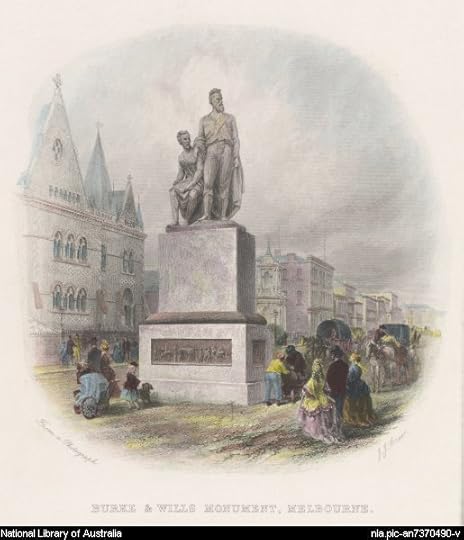 The Burke and Wills monument in Melbourne in the eighteen-sixties
Hand written inscription:
Best wishes from
Eileen & Keith
July 1966
Opening: Here, perhaps more than anywhere, humanity had a chance to make a fresh start.
Peppered with glossy photographs and sketches.
From the authors note: Mr Sidney Nolan first suggested that I should write this book, and for this, as well as for his permission to reproduce here some of his splendid paintings, I most warmly thank him.
5* The White Nile
4* The Blue Nile
4* Cooper's Creek

September 13, 2020
This is a very well written book on the Burke and Wills exploration party in mid Victorian Australia. Outside of Australia the story is probably less famous than the adventures of Stanley and Livingstone, Lewis and Clark and even the Donner party. For that reason reading it helps round out the stories of 19th century exploration. Because of some ignorance of the territory, poor administrative support and just plain bad luck, it didn’t go well for the leaders. There was plenty of finger pointing afterwards. Moorehead explains all of this in a very readable way.

January 23, 2012
This book was not as good as I was hoping it would be. The story was inspiring and then at times very depressing, but I was disappointed at how it was told. The author made an extremely racist remark in the second sentence of the book and I had a hard time ever getting past that. He also spent the last third of the book giving the word for word details of the trial, and about his own journey to the Cooper. Not nearly as interesting as the actual expedition.
The story deserves telling, but this book left many things to be desired.
The story deserves telling, but this book left many things to be desired.

November 22, 2016
This is a wonderfully gripping account of the true story of Burke and Wills and their ill-fated journey into the heart of Australia. I was as gripped as by any thriller - by turns thrilled at their adventure and daring, horrified at the Committee that turned what should have been a journey of research and discovery into a race, and also ravished by the gorgeous descriptions of the Australian desert. Other books have been written since I think, about Burke and Wills, but surely none as personal and idiosyncratic and well written as this one. Admittedly some of Moorhead’s opinions are dated - but that doesn’t lessen the power of this account. Highly recommended.
October 24, 2019
This book tells the tragic story of the 1st expedition across Australia from south to north by Burke and Willis in 1860 and 1861. Moorehead tells the story very well and it is a fascinating story to read. As an American, one is often reminded of the Lewis and Clark Expedition that did something similar some 60 years earlier with only one death during that long voyage. I found the story to be a very interesting one and Moorehead really allows one to understand all that went into the Burke and Wills Expedition and the rescue parties that went out later.

October 15, 2013
Highly recommended account of Burke and Wills expedition through the centre of Australia in the 1860s, even if some of the decisions of members of the expedition party remain a little mystifying even after finishing the book.
I am not sure if there are any worse ways to expire than a very slow death as a result of starvation, malnutrition and exposure (not to mention thirst) over many weeks and even months, essentially the fate of the very brave but not entirely competent Burke and Wills and their party of explorers.
Bad communication, bad luck, and personality issues all played a role in their deaths. Yet you can't help but admire the pair's sense of adventure, their willingness to head into the unknown and the fact they still managed to achieve the goal that would cost them their lives.
Also notable was the portrayal of relations between the aboriginals and the explorers, which were more cordial than some might have imagined.
I had long thought Australia had little to offer history buffs but both this and "A Fatal Shore" (a must-read) show that is far from the case. It would be good also if more of Moorehead's books - many of which are not about Australia - were released as e-books as very few are available at this time.
I am not sure if there are any worse ways to expire than a very slow death as a result of starvation, malnutrition and exposure (not to mention thirst) over many weeks and even months, essentially the fate of the very brave but not entirely competent Burke and Wills and their party of explorers.
Bad communication, bad luck, and personality issues all played a role in their deaths. Yet you can't help but admire the pair's sense of adventure, their willingness to head into the unknown and the fact they still managed to achieve the goal that would cost them their lives.
Also notable was the portrayal of relations between the aboriginals and the explorers, which were more cordial than some might have imagined.
I had long thought Australia had little to offer history buffs but both this and "A Fatal Shore" (a must-read) show that is far from the case. It would be good also if more of Moorehead's books - many of which are not about Australia - were released as e-books as very few are available at this time.

May 16, 2018
Having read Fatal Shore awhile back, I had basic knowledge of Australian history. This book is about the beginnings of the exploration into the outback and beyond. Not a huge book but the 200 pages are mostly text and not a lot of pages of preface or notes. It took a little longer to read than I expected which was nice.And now I know what The Dig Tree means(The Dig Tree is another book about Australian exploration that I want to read) I really enjoyed this book. By the three quarter mark I was getting antsy but that is because I was dying to know the outcome. So the book definitely grabbed my emotions about the fate of the Burke party. I purposely avoid prolouges, pictures or introductions because they usually spoil an ending or tell me things I'd rather learn as I go. And like a lot of arctic exploration books I've read I found myself cheering for some while wishing others would get eaten by a crocodile. Great little book and now I think that The Dig Tree just moved up closer to the top of my "to read" list. If you like history or exploration, this is a great little book. Even if your not into history, this may be a good book to start with.

February 1, 2015
Reading accounts of disastrous journeys—so abundant in tales of early exploration—I find it hard to decide which disasters seem the most poignant: the ones caused by human failings or those determined by chance. Both types play a role in Cooper’s Creek, Alan Moorehead’s gripping story of the Burke and Wills expedition into the center of Australia, a vast region of rugged climate and terrain, where summer temperatures can reach 150 degrees, so hot that a match dropped on the ground can ignite.
Moorehead is a wonderful storyteller, and even on rereading, this tale of a disastrous journey doesn’t lose its tension. Indeed, against all intelligence and reason, I found myself hoping that this time, things would turn out differently.
Moorehead is a wonderful storyteller, and even on rereading, this tale of a disastrous journey doesn’t lose its tension. Indeed, against all intelligence and reason, I found myself hoping that this time, things would turn out differently.

June 15, 2023
Normally I like reading past exploration books BUT written in 1963, (Alan Moorehead - 1910-1983) this book is really illustrative of the casual racism and sexism of both times, (1860s and 1960's) which distracts from the whole narrative.
In the second sentence the indigenous peoples are dismissed as, "the most retarded people on earth" and from that point on it just gets worse.
The author doesn't just reserve his racism for the original peoples of Australia, but also applies it to Burke's Irish roots. "He (Burke) knew nothing of exploration, and had no scientific qualifications of any kind. Moreover, he was Irish and it has to be admitted (at the risk of fierce contention) that there is something about the Irish temperament that is not ideal for exploration. It is too quick, too mercurial, too imaginative, too headstrong and, paradoxically too brave".
The author then moves on from casual racism to sexism and misogyny, There is something almost feminine in Dr Wills’ avenging single-mindedness". Then the author says, “Dr Wills was a marvellous indulger in prejudice”, a bit rich coming from the author who does the same throughout the book.
One could forgive the original text and post mortem of the expedition as being "of it's time", however it is impossible to permit the same lee-way for the author writing in the sixties a time that started aspiring to less racism and increased equality.
The imbeded racism is obvious to today's readers, "All at once the dark, threatening atmosphere of the Cooper is lifted, and this is now a place where white men can live in safety". However, and this is perhaps the intriguing bit, the author does manage towards the end of the book to site, "King’s account of how he was cared for during the next two months until Howitt arrived is one of the most moving tributes ever written to the kindness of the primitive people of Australia, and it makes the best epitaph for the now vanished blacks of Cooper’s Creek".
The photographic plates in my original edition does have contemporaneous pictures of four Aborigines from Cooper's Creek but they are not accorded their names and described with a racist epitaph.
Perhaps saddest of all the author waits until page 201/209 to name the area’s tribes, Yuntruwunta and Dieri, of whom, having numbered a thousand, only 5 “blacks” remained by 1902.
As for the expedition itself, poorly organised and "valour" won out over discretion. If the Victorians had valued the skills of the Aboriginal peoples and society the explorers probably wouldn't have died.
In the second sentence the indigenous peoples are dismissed as, "the most retarded people on earth" and from that point on it just gets worse.
The author doesn't just reserve his racism for the original peoples of Australia, but also applies it to Burke's Irish roots. "He (Burke) knew nothing of exploration, and had no scientific qualifications of any kind. Moreover, he was Irish and it has to be admitted (at the risk of fierce contention) that there is something about the Irish temperament that is not ideal for exploration. It is too quick, too mercurial, too imaginative, too headstrong and, paradoxically too brave".
The author then moves on from casual racism to sexism and misogyny, There is something almost feminine in Dr Wills’ avenging single-mindedness". Then the author says, “Dr Wills was a marvellous indulger in prejudice”, a bit rich coming from the author who does the same throughout the book.
One could forgive the original text and post mortem of the expedition as being "of it's time", however it is impossible to permit the same lee-way for the author writing in the sixties a time that started aspiring to less racism and increased equality.
The imbeded racism is obvious to today's readers, "All at once the dark, threatening atmosphere of the Cooper is lifted, and this is now a place where white men can live in safety". However, and this is perhaps the intriguing bit, the author does manage towards the end of the book to site, "King’s account of how he was cared for during the next two months until Howitt arrived is one of the most moving tributes ever written to the kindness of the primitive people of Australia, and it makes the best epitaph for the now vanished blacks of Cooper’s Creek".
The photographic plates in my original edition does have contemporaneous pictures of four Aborigines from Cooper's Creek but they are not accorded their names and described with a racist epitaph.
Perhaps saddest of all the author waits until page 201/209 to name the area’s tribes, Yuntruwunta and Dieri, of whom, having numbered a thousand, only 5 “blacks” remained by 1902.
As for the expedition itself, poorly organised and "valour" won out over discretion. If the Victorians had valued the skills of the Aboriginal peoples and society the explorers probably wouldn't have died.

May 26, 2023
Cooper's Creek is another book about an expedition of exploration that went disastrously wrong. Like all those other books, the adjective "harrowing" tends to spring to mind. The 1840s to the 1860s was a period of exploration of Australia's interior. Among other goals was to find out once and for all whether there was an inland sea in central Australia, which would have made everyone's lives easier. People wanted to know which parts of inner Australia were favorable to farming; another major motivation was to open up overland routes between south and north on which roads, rail lines and telegraph service cold be established, and to see if any gold was left over from the Australian gold rush of a few years before. An expedition was mounted that would travel north from Melbourne along an established route about a third of the distance between the coasts, and then to strike out into what was, for the white man, unexplored country.
The book tells the story of how an expedition that set out well stocked and with great optimism gradually went to pieces over the next year or so, in which all but two or three of the party died of thirst, starvation or the elements. A concatenation of errors and mishaps, multiplied by the fecklessness of some and the irresponsibility of others, doomed the effort to ruin and death. If the territory they traveled through had been less inhospitable, the expedition might have been salvageable; but unforgiving Nature was against them. The tale of tragedy reminds me of Scott's doomed British Antarctic Expedition and of Franklin's futile search for the Northwest Passage. The descriptions of the Australian wilderness are very reminiscent of Francis Parkman's descriptions of the Great Plains in The Oregon Trail.
The main problem I had with the book, even with the map of Australia on the inside cover, was keeping all the various personages straight and keeping track of who went where. Because the party split into several small groups who went north, south, and west, back and forth every which way, blundering all over the countryside, missing each other, and running out of all of their supplies. Coming to the end, I found myself extremely confused about who wound up where and why.
This is history that few Americans ever learn. I read this book because we are planning a trip to Australia and I happened to have a copy - don't ask me how I came by it, I have no idea. It's not for everyone, but it is very well written.
The book tells the story of how an expedition that set out well stocked and with great optimism gradually went to pieces over the next year or so, in which all but two or three of the party died of thirst, starvation or the elements. A concatenation of errors and mishaps, multiplied by the fecklessness of some and the irresponsibility of others, doomed the effort to ruin and death. If the territory they traveled through had been less inhospitable, the expedition might have been salvageable; but unforgiving Nature was against them. The tale of tragedy reminds me of Scott's doomed British Antarctic Expedition and of Franklin's futile search for the Northwest Passage. The descriptions of the Australian wilderness are very reminiscent of Francis Parkman's descriptions of the Great Plains in The Oregon Trail.
The main problem I had with the book, even with the map of Australia on the inside cover, was keeping all the various personages straight and keeping track of who went where. Because the party split into several small groups who went north, south, and west, back and forth every which way, blundering all over the countryside, missing each other, and running out of all of their supplies. Coming to the end, I found myself extremely confused about who wound up where and why.
This is history that few Americans ever learn. I read this book because we are planning a trip to Australia and I happened to have a copy - don't ask me how I came by it, I have no idea. It's not for everyone, but it is very well written.

May 15, 2023
A well written work recounting attempts to traverse Australia south to north in the Nineteenth Century.
Moorehead sets the scene with prior travels in the outback. Early explorers, at best, got half way there amidst the heat and barrenness. Rumours of an inland sea continued to propel explorations until residents of Victoria set up a committee to finance an expedition.
Settling on Burke to lead, assisted by Wills, they provided great stores of equipment. However, scurvy, poor leadership and travelling in summer would be their downfall.
The party split up and a major portion of the stores was to follow on behind to the base camp at Cooper's Creek from which Burke and Wills set off. These stores never arrived due to the indolence of the man left in charge. Illness of the small party at the base camp required them to pull out the very morning that Burke and Wills returned from their successful foray to the north coast.
Although a small cache of food was left behind this was insufficient to sustain Burke and Wills who, by this time, were seriously malnourished and vitamin deficient. Despite help from Aborigines they were unable to cross the desert back to their store camp and they perished a few weeks later.
A rescue expedition from Victoria found only a junior member of the team, King, alive to tell the tale of what happened.
Moorehead had access to the primary documents used in the Royal Commission which followed to determine where fault lay. He knew his country well and followed the track of the explorers, albeit the fauna is now change and aborigines have died out around Cooper's Creek.
A fascinating tale of semi-failure and exploratory disasater.
This completes my reading of Moorehead's ouevre. For those interested I recommend his excellently written, if dated, book on Gallipoli, his masterpieces on the White and Blue Nile, recounting the history of their exploration, and his journalistic work from the Second World War in his African Trilogy.
Moorehead sets the scene with prior travels in the outback. Early explorers, at best, got half way there amidst the heat and barrenness. Rumours of an inland sea continued to propel explorations until residents of Victoria set up a committee to finance an expedition.
Settling on Burke to lead, assisted by Wills, they provided great stores of equipment. However, scurvy, poor leadership and travelling in summer would be their downfall.
The party split up and a major portion of the stores was to follow on behind to the base camp at Cooper's Creek from which Burke and Wills set off. These stores never arrived due to the indolence of the man left in charge. Illness of the small party at the base camp required them to pull out the very morning that Burke and Wills returned from their successful foray to the north coast.
Although a small cache of food was left behind this was insufficient to sustain Burke and Wills who, by this time, were seriously malnourished and vitamin deficient. Despite help from Aborigines they were unable to cross the desert back to their store camp and they perished a few weeks later.
A rescue expedition from Victoria found only a junior member of the team, King, alive to tell the tale of what happened.
Moorehead had access to the primary documents used in the Royal Commission which followed to determine where fault lay. He knew his country well and followed the track of the explorers, albeit the fauna is now change and aborigines have died out around Cooper's Creek.
A fascinating tale of semi-failure and exploratory disasater.
This completes my reading of Moorehead's ouevre. For those interested I recommend his excellently written, if dated, book on Gallipoli, his masterpieces on the White and Blue Nile, recounting the history of their exploration, and his journalistic work from the Second World War in his African Trilogy.
September 4, 2023
Moorhead brings his skill as a war correspondent and an intense observer of reality, to this historical analysis of the Burke and Wills Expedition.
Please don’t judge the book from the, apparently, racist remarks at the beginning. Moorhead is presenting the contemporary context for a reason. As you read on, you realise he is perceptively critical (for his time) of such attitudes, which were largely responsible for the tragedy that unfolded at the end of the expedition – all but one of the explorers ignored and denigrated the available knowledge and care of the aboriginal people at Cooper’s Creek.
As well as investigating all the original archival documents, from diaries, to the records of the official enquiry, Moorhead drove the route of the expedition in a Land Rover. Thereby he experienced both the beauty and harshness of the landscape and, to some extent, the privations of the original expeditioners. He does rather labour the details of the evidence presented at the official enquiry – but this is history, and the evidence speaks for itself.
The book is a beautifully written and deeply critical analysis of one of the most iconic of Australia’s explorations. Rather than spoil the narrative for you, I simply suggest you read this fine and insightful story of an extraordinary and unnecessarily tragic part of Australia’s colonial history.
Please don’t judge the book from the, apparently, racist remarks at the beginning. Moorhead is presenting the contemporary context for a reason. As you read on, you realise he is perceptively critical (for his time) of such attitudes, which were largely responsible for the tragedy that unfolded at the end of the expedition – all but one of the explorers ignored and denigrated the available knowledge and care of the aboriginal people at Cooper’s Creek.
As well as investigating all the original archival documents, from diaries, to the records of the official enquiry, Moorhead drove the route of the expedition in a Land Rover. Thereby he experienced both the beauty and harshness of the landscape and, to some extent, the privations of the original expeditioners. He does rather labour the details of the evidence presented at the official enquiry – but this is history, and the evidence speaks for itself.
The book is a beautifully written and deeply critical analysis of one of the most iconic of Australia’s explorations. Rather than spoil the narrative for you, I simply suggest you read this fine and insightful story of an extraordinary and unnecessarily tragic part of Australia’s colonial history.
November 13, 2020
This account of the Victorian Exploration Expedition is comprehensive, starting with an “unknown” land, descriptions of other earlier explorations in the region, the idea for the VEE, the journey itself and the post-tragedy analysis by a Royal Commission. The book ends with reflections on the region explored, the outback from the Copper to the gulf. I will say that this book was published first in 1963. Some of the comments relating to indigenous people are hard to read; but these are a sign of the times and past attitudes, and we can be happy that we have become more aware and sensitive to indigenous culture and heritage. Aside from this Alan Moorehead is such a great writer and is able to draw a picture of the harshness and beauty of the outback and the personalities and actions of the people involved in this saga with such vividness and warm passion, and with lack of obvious bias on reasons for the expedition failures. Burke has been a victim of many criticisms but he did achieve a tremendous trip in crossing of the continent. Moorehead has a fair commentary on Burke. And as he ends the book it is an epic Australian tale well known because of tragedy.
October 7, 2022
Entertaining to a point
A little dated. I was uncomfortable with his use of pickaninny and other offensive references to aboriginal people. Also disappointed with overly long chapter that appears to be simply a transcript of the hearings on the tragic expedition. One description of nature seems to go on for years. Else, quite satisfying and thrilling account of an important story in Australian history. Full disclosure: my first introduction to anything Australian. I was googling everything like crazy, which means that I was fully engaged. I'm probably going to check out his other books, hopefully looking past the racial cringe.
A little dated. I was uncomfortable with his use of pickaninny and other offensive references to aboriginal people. Also disappointed with overly long chapter that appears to be simply a transcript of the hearings on the tragic expedition. One description of nature seems to go on for years. Else, quite satisfying and thrilling account of an important story in Australian history. Full disclosure: my first introduction to anything Australian. I was googling everything like crazy, which means that I was fully engaged. I'm probably going to check out his other books, hopefully looking past the racial cringe.
May 24, 2026
I read this first as a kid more than 50 years ago, and it made a great impression on me. Such a tragic, epic story, that could so easily have been different, though it would then never have become so famous. The overt racism of the time, and when it was written in the early 1960’s, is very upfront, and the opening up of the interior sadly marked the beginning of the destruction of the way of life of remote indigenous communities. Full of interesting history, such as Darwin’s observation that “it may be long before these animals (emus and kangaroos) are altogether exterminated, but their doom is fixed”.

May 4, 2017
Decent history of the doomed Burke/Wills expedition across Australia. The tale is not as interesting as I anticipated. The expedition was FUBAR from the get-go and I think the only reason it's so memorable is for the utterly horrific final doom which was Burke, Wills and King on the edge of death arriving at their supply depot only to find the rest of the expedition had left only hours previously. Truly shudder inducing but the rest is basically a tale of mismanagement on all levels.

Read
December 8, 2024Every Australian ought to read and learn the lessons that the story of the crossing of the Australian continent teaches us non-indigenous humans...you have to learn to live in Australia whether in thecity or the bush. I have worked in remotecentral Australia well beyond the 'black stump' and experienced the joy and horror of being alone in this often unforgiving land. Moorehead made a good job of digging up original sources but wish he had done an index.
January 7, 2026
Very interesting for me who doesn't know uct about Australia, and nothing at all about this bit of its history: the exploration of the interior. It's told well, by someone who's told many other such stories and knows his craft (see his book on the Nile, for example), and he has a good sense of place and atmosphere, so that we're there, in the sun...And the exploration bit itself is certainly fascinating to read about, with a good glimpse of Australia then (later part of 19th C.)

August 3, 2018
This is a report about the first expedition crossing the Australian continent. Unfortunately, the first half is boring, and you only wonder why such unable idiots were sent to undertake such an expedition. Once the rescue mission and the following inquiry are described it gets a bit more interesting, thus the 2 stars.

August 14, 2018
The way way Outback!
I felt like I was right there with the early explorers, through all the vivid countryside, through all the hardships.. Truly an amazing feat to have had the fearlessness of these men. Mr. Moorhead has done justice by these past travelers and lovers of the truly unknown.
I felt like I was right there with the early explorers, through all the vivid countryside, through all the hardships.. Truly an amazing feat to have had the fearlessness of these men. Mr. Moorhead has done justice by these past travelers and lovers of the truly unknown.

February 1, 2022
I surprised myself, enjoying this unusual bit of history I'd never heard anything about. It chronicles the exploration of the Australia's interior. The history is fascinating. I admit it dragged a little discussing the investigations toward the end. But I guarantee you will get rewarded for making it through to the last section, which contains a wonderful description of the nature in that area.
June 4, 2017
Exploration of Australia Mid -1800s
Great historical account of early exploration of interior of Australia. The bitter hardship undergone through a harsh land with its native people feeling both accommodating as well as threatening greetings. A tragic but epic account.
Great historical account of early exploration of interior of Australia. The bitter hardship undergone through a harsh land with its native people feeling both accommodating as well as threatening greetings. A tragic but epic account.
June 1, 2017
This was an ok read about the exploration of the outback of Australia during the 1860's. It went on and on into the inquest after the disastrous expedition.

July 21, 2017
Interesting book but the way the investigation proceeded was formatted weirdly.
August 15, 2018
Boring
Boring. Could not get into it. Typical British attitude. I will try another Aussie author. I enjoy reading about the outback. Enough words now?
Boring. Could not get into it. Typical British attitude. I will try another Aussie author. I enjoy reading about the outback. Enough words now?
July 5, 2020
This was an interesting read, but the overt racism beginning on the very first page, gave me such a dislike of the author that I ended up disliking the book.

September 24, 2020
Fascinating, intriguing and horrifying. An excellent book about the time, 1860's, and the country.
December 27, 2020
great read
March 15, 2022
Excellent work
Absolutely perfect description of life and events from those lost times.. Thanks for a wonderful trip back in time. vivid!!
Absolutely perfect description of life and events from those lost times.. Thanks for a wonderful trip back in time. vivid!!

November 18, 2022
A sombre and moving account of one of the great Australian expeditions, which opened up the interior of a significant proportion of the continent's eastern land mass.
Displaying 1 - 30 of 64 reviews