"The idea behind Whatever Happened To Alternative Nation? is to look back at an era that’s both incredibly important and yet mysteriously absent from my life as a music fan. I’ve gone back and repurchased a lot of the CDs I sold off—which, thanks to the bargain bin at Half-Price Books, has actually been a fairly inexpensive proposition—and reacquainted myself with groups that I once adored before they died off, broke up, or settled into respectable but uninspired careers. My goal is to rediscover what I saw in these bands when I was a teenager, and figure out why the music went from enlightening to deadening so rapidly, from the bucolic early years of Lollapalooza to the apocalyptic assault of Woodstock ’99. Because as easy as it is now to take potshots at the mumbly, histrionic sounds of the ’90s, this is music that meant a great deal to me and many others at the time. Out of respect for my teenaged self, I’m giving it an honest re-examination.
Each installment of Whatever Happened To Alternative Nation? will be tied to a year, starting with 1990—which I’m packaging with this introduction, since it’s really a prologue year—and proceed chronologically up through 1999. However, this isn’t intended to be a definitive history of grunge; I won’t be writing about every single Seattle band, or even most Seattle bands. A lot of it won’t even be about grunge; I also plan on looking at the feel-good bro tunes of Sublime, and the ironic arena-rock posturing of Urge Overkill, among other groups, and how they fit in with the overall narrative of ’90s alt-rock’s rise and fall. I promise I’ll completely overlook at least one of your favorite bands; please don’t take it personally.
As a general rule, I’m interested in discussing ’90s bands that were played regularly on MTV and on the radio, even in a small city like my hometown of Appleton, Wisconsin, because this was the last time (as of now, anyway) that rock music acted as the engine under the hood of American pop culture. Inevitably, this series will reflect what I liked and cared about back then, which fortunately matches up with what millions of other teenaged residents of Alternative Nation liked and cared about. More than an exercise in nostalgia—or, worse, an excuse to pick on bands that haven’t aged all that well—I hope to give those who deserve it their due, and maybe figure out how something that seemed so promising at the time went so wrong." - excerpt from Whatever Happened To Alternative Nation?
In his opening, Hyden all but admits that this book (or, rather, the column that originated it) was an attempt to cash in on 90's rock nostalgia. His tone is cheeky, brazen, and self-aware. And yet, I found this quite captivating. It took me back to an era when I learned how to love rock music, and it gave me enough background to provide some depth and context to my own experience and reminded me of what I'd loved about some of these bands.
I really enjoyed this book. Nice walk down memory lane about the Grunge era. I liked the fact that each chapter was a year from 1990 to 1999. He talks about the biggest and most influential bands of each year. Nirvana, Pearl Jam, Alice-in-Chains, Soundgarden, Smashing Pumpkins and tons of other bands that were just Awesome acts at the time. If you grew up listening to these bands and others you will definitely enjoy this book. Probably my favorite of the three books that I've read by him.
I feel bad about low-balling this book. It would definitely be a 3-star book on Amazon's rating scale. It was OK, but I didn't really like it.
And here I was, reading Christopher Hitchens on Tom Paine, who says it's simplistic to try and frame every conflict as Cavaliers vs. Roundheads, and I'm wondering, why not? Certainly there are two or three cases of Cavaliers vs. Roundheads in this breezy history of nineties rock:
1. Axl Rose vs. Kurt Cobain 2. Oasis vs. Radiohead 3. Korn vs. everybody.
I'd say the thesis of this book boils down to the contradictory simultaneous assertions that first, Nirvana was amazing, and epoch making because it influenced everything that came after, and second, that all the post-Nirvana groups were kind of lame because of how much they tried to sound like Nirvana.
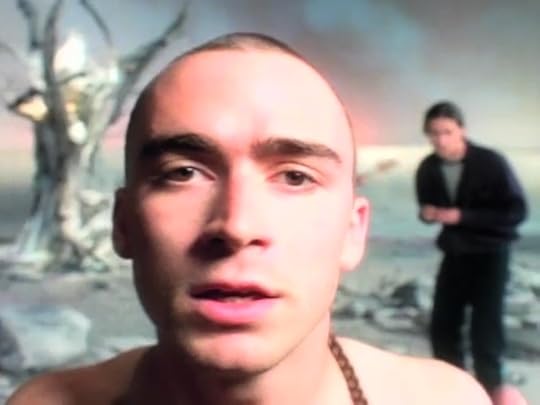
Aside from being totally right about the rat-tail, the ire directed at the "I Alone" video here is baffling to me:
... Now Kowalczyk is shirtless, baring a modestly built torso that positively screams to be covered by several layers of clothing. His spastic mannerisms are reminiscent of a hacky nightclub comedian hoofing it through a lame David Byrne impression. “It’s easier not to be great,” he sings as a long, braided rattail rests over his right shoulder. Suddenly I’m full of rage: Jesus Christ, this is supposed to be a commercial for Throwing Copper, and all I want to do is kick the shit out of my computer screen.
Reminded me about a lot of great (and some not-so-great) bands from the 90s decade that have slowly faded away. The book chronicles each year in a separate chapter. Hyden is fun and interesting to read in a Klosterman way that music fans can certainly relate to. I'm inclined to check out his other books.
Liked this book because of its look back at that era in a honest, personal matter without the rose-tinted glasses of nostalgia. No matter what, the music changed you, was important to you, and it will always be.
This is an older title and I thought it would lack hindsight. I was wrong about that. It’s a series of essays on certain parts of the grunge era of music. As usual, Kurt Cobain is the alpha, Smells Like Teen Spirit, and the omega, suicide. The writer does go into other areas of the decline of the genre. There were watered down versions of the genre, some artists propped up as great that don’t hold up anymore. He is rough on Pearl Jam on that point. Layne Staley’s death is more terrible than I thought. The description of what her ion did to that man is horrific. It ends with the repudiation of the promise of the genre, Woodstock 99 and nu-metal. In the end, he answers the question posed by the title and offers a glimpse into what played on the radio.
The book doesn't answer the question posed in the title and is arguably not even about alternative rock, at least outside suburban Wisconsin. I was willing to forgive, as the author asked, the failure to mention my favorite bands - there are constraints after all. But, in that context, the focus on Throwing Copper and GVB makes no sense and is irrelevant to the question at hand. This is the second book I've read by this author and I'd summarize both as cheap Chuck Klosterman knock-offs except for all the Klosterman quotes.
Catching up on his earlier work finally, Steven Hyden has steadily become the music writer I look forward to reading the most. A fitting replacement to Chuck Klosterman as that author moves further and further from his core music/pop culture focus.
This is a good, not great book. The hypothesis is interesting and the author means well, but I don't find the material to read well, not do I find that it captured me like his other two books.
Love the author. This is a collection of essays that walks us through the 90s a year at a time noting the misconception between what is now the memory of what the 90s left behind in music with what was happening at the time.
As a fan of 1990s grunge, I found this very short book, which is actually a series of articles that appeared on the AV Club website about 1990s music, pretty entertaining. It's written by journalist Steven Hyden who not only shares a similar name with That 70s Show character Hyde but whose writing will attract fans of awesome music and pop culture writer Chuck Klosterman. Sometimes, I disagreed with the author's commentary, but he spouts so many other truths that I often nodded in agreement. He intersperses his own coming of age with the music he most paid attention to during that time.
Past 1997, I stopped following music so heavily because it didn't speak to me anymore. The author puts a summation of my similar thoughts into words. Once grunge ended, I was on my way out, but it also could be that my next stage of life was on the horizon -- marriage, babies, houses. I was content with the music I already loved, and if I heard anything new that I liked like the White Stripes or something else, it probably came from my husband's collection or I delved into jazz or blues.
Now I listen to the same music I've always loved on CD, SiriusXM, or turntable and sometimes hear contemporary, saccharine pop music from my daughter along with Abba or the Ramones or Blondie or hear the covert bleeps and raps of my son's favorite rappers or thankfully the Beatles or Rolling Stones.
A collection of Steven Hyden's 10-part AV Club series, "Whatever Happened to Alternative Nation" (2011). A good, quick read (and excellent deal for the buck on Kindle), a satisfying romp through '90s "alternative" music, from a mostly personal angle ....
As a reassessment of his past as a music listener, Hyde's goal is to see how & why what he loved (or hated) changed in the past 20 years. That's an approach that served Chuck Klosterman well in "Fargo Rock City," but somewhat less effective, not as enlightening and less amusing in its self-reflection.
It serves as an adequate primer for the period, but I drop it from 3 stars to 2 because he seems to stray from his basic premise — "My goal is to rediscover what I saw in these bands when I was a teenager, and figure out why the music went from enlightening to deadening so rapidly" ... but I don't sense he changed his opinion too much about anything either way over the years.
A combination between memoir and music journalism, this did exactly what I wanted it to do, which was fill in some of the gaps in my rock-music knowledge between when I stopped paying attention (Nirvana) and -- well, I have never exactly started paying attention again, but anyway, it filled in some gaps and was funny and interesting to read, and I think my spouse would like it a lot although he would probably have very strong opinions about all the bands in a way I did not.
I grew up and was one year behind the author of this book but I enjoyed the book and the nostalgia that it gave me. I agree with some of what the author said and the breakdown of the eras of the 90's.