As a phrase and idea, "the palm at the end of the mind" serves well in illustrating the distinctive elegance of Wallace Stevens' poetry. He had a way of boosting odd notions into the aesthetic stratosphere; appealing enigmas were his forte. What palm and why at the end of the mind and how did it get there?
Stevens' unhurried, meditative, low-key poetic style is, it seems to me, the real pleasure and essence of his achievements. In a way, he wrote the same poem over and over again, but each time the poem has a distinctive way of asserting itself.
Stevens' core idea was that the poet does more than endow reality with meaning; he makes reality; his focal plane is that verbal space between things and perception; and that is where words give us experience.
As important as recurrent images, certain words are talismanic in Stevens' work. Combined, images and words elicit a kind of emotional frisson that goes beyond the rational into the obscurely gratifying.
In fashioning his longer poems, Stevens often seems to know what he is doing without letting the reader in on the secret. He manages non sequiturs with the persistent grace of his tonality and tosses off impenetrable tropes with insouciant carelessness.
The question does come up, again and again: What does Stevens mean, if anything, by palms at the end of the mind and blue guitars and ordinary evenings in New Haven and Comedians as the Letter C and Supreme Fictions and Ideas of Order at Key West? Each turn of phrase and image comes back to that single point: if there is order or a comedian or a palm anywhere, it is because the poet (or the devout reader) put it there. God having decamped, man must take over.
Certain poets, perhaps many poets, deserve leeway when it comes to explaining themselves. The being of the poem is the meaning of the poem. That which is not exquisitely forged lacks lasting being. Front to back, that's the point and experience of this volume.
Obfuscation. Delicious prevarication. Obtuse, lyrical, lovely. Wallace Stevens confounds me and yet I cannot help but savor each phrase as it were a small sliver of the sweetest orange. Parakeets! Ice Cream! Snow! Oranges and Coffee!
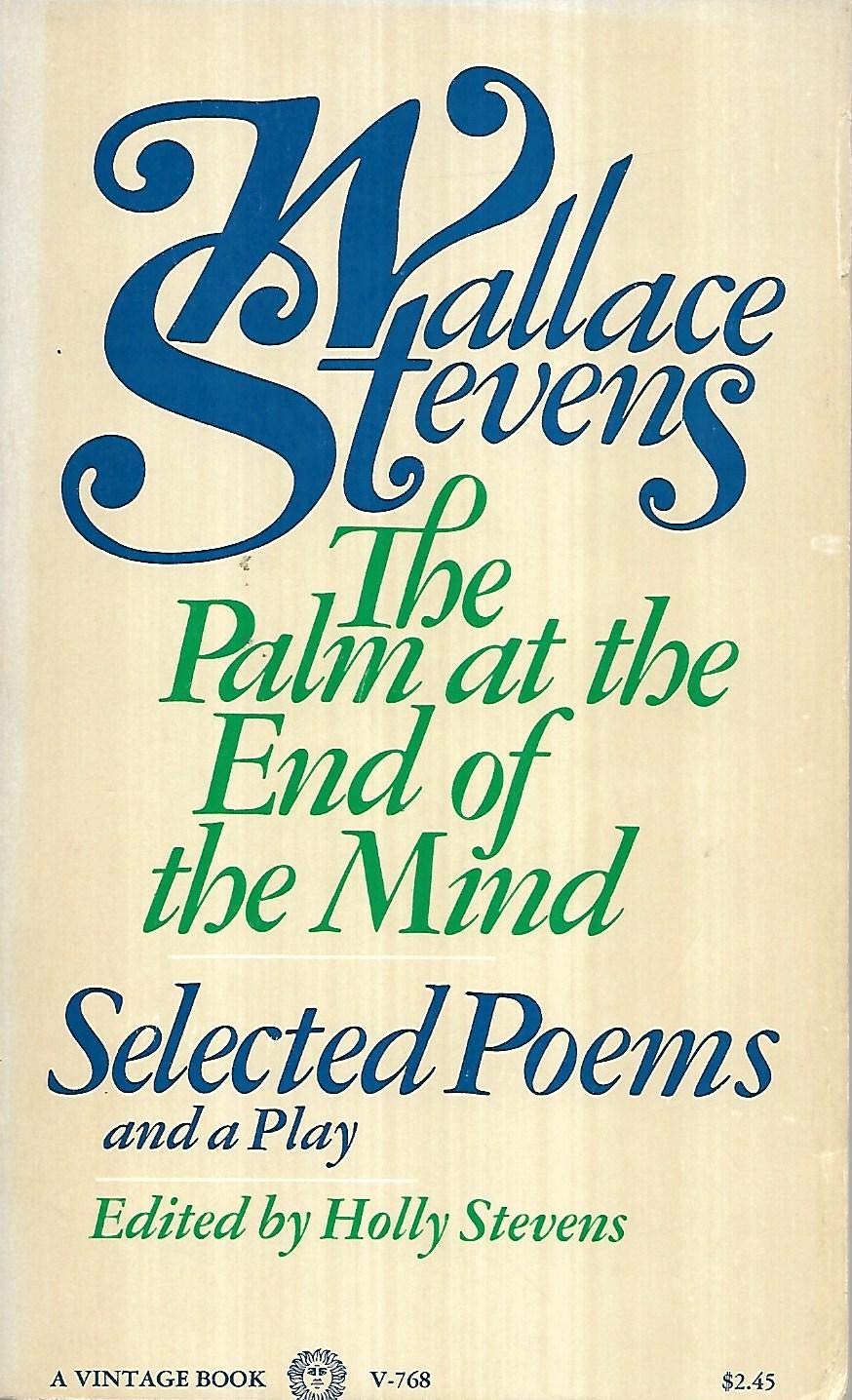
"The Idea of Order at Key West." "A Postcard from the Volcano." "The Well-Dressed Man with a Beard." As a demonstration that poetry can combine lavish beauty with the greatest philosophical depth, arguably making it the greatest of the arts, this book alone. Read "Reality is an Activity of the Most August Imagination," a late poem - you'll feel me. One quibble though: it's well-known that Stevens didn't start publishing until he was in his forties, after his career in the insurance business was established. So why does he look like he's barely out of his teens in the cover photo? Stevens could be playful, rapturous, but this isn't youthful verse.
There are many great poems in this book. My favorite poem "Prologues to What is Possible" begins with the line "There was an ease of mind that was like being alone on a boat at sea." This sentence is a challenge to the reader. What I love about it is that Stevens is essentially choosing his audience with this poem. Take the line for granted and you will not understand the poem. There are other whimsical poems in this book that are great as well.
The eponymous poem of this collection, Of Mere Being, still gives me chills. I find my favorite poetry is often a set of words or images that I can't quite grasp the meaning of until I have memorized them, at which point some mysterious understanding transpires. This is one of those. The surreal imagery of this utter blank vacuous space in the moments immediately after death, with this distant, all to vivid palm rising out of eternity gives me a strange sense of serenity. But I doubt I will ever understand the bronze decor.
This collection, while not as definitive as The Collected Poetry, includes all the major longer poems and many important shorter poems of critical value. Arranged in chronological order by probable date of composition this text provides the reader the possiblility of considering the overall arc of Stevens' career. I find myself dipping into the poems included here time and again and it is difficult to pull myself away. The thoughtful consideration of art and meaning in life is seldom conveyed any better than in the poetry of Wallace Stevens.
Of Mere Being
The palm at the end of the mind, Beyond the last thought, rises In the bronze decor,
A gold-feathered bird Sings in the palm, without human meaning, Without human feeling, a foreign song.
You know then that it is not the reason That makes us happy or unhappy. The bird sings. Its feathers shine.
The palm stands on the edge of space. The wind moves slowly in the branches. The bird's fire-fangled feathers dangle down.
What didn't I learn from this book? There is no end...and I'm still both learning and being joyfully inspired. Stevens' poetry is without peer to me. As a poet, I go to his work continually to nourish my own imagination and give it permission to fly. His work is distinctive, having many of its roots in French symbolism and surrealism. It's been ignored by some, poets and readers alike, because his work is dense, philosophical as well as filled with quirky humor. It does require repeated readings, as much good poetry often does. He himself said that any good poem should need to be read again and again...not for its intellectual "meaning" but for its quiddity.
No, I have not read the whole book. This is a compilation of his poetry. I understand about 5 percent of what is going on. Even if I understood nothing, I would still love the way he uses words. He writes a lot about poetry and imagination; I always enjoy people who write about writing and words...if they are creative.
The Literal Reaction One of Wallace Stevens's Co-Workers Had When The Other Guys In The Insurance Company Told Him That Stevens Was A Big To-Do Over In The Poetry World:
By Jmark2001 If poets aren't interested in being understood, they will have to resign themselves to being read by no one except English Lit drones. There was a time when poetry was so popular in the USA that many daily newspapers had daily poems and the average worker with a grade school education could recite several great American poems by heart. That was also the time when poets wrote about things that people experienced and could relate to. I love Whitman. I have a Masters degree. I can read Spinoza and the Greek dramatists and poets with pleasure. I started this book because Stevens was said to be a great poet. After forcing myself through twenty of these poems I still had no idea what any of them were about. I might as well have been reading Icelandic for all I got out of them. Here's an example of how Stevens unnecessarily obscures his poetry: in one poem, he refers to "the halo-John." This phrase never occurred before Stevens used it. Its appearance stops the reader as abruptly as if he had driven into a brick wall. Who or what is "the halo-John"? The reader searches through the rest of the poem for clues. Ok, it is a religious poem so maybe he means St. John the Evangelist because saints have halos. But why not just say "St. John"? "The halo-John" doesn't add anything to the poem. In fact, it detracts as the reader has to stop reading the poem in order to do the equivalent of a crossword puzzle exercise in order to proceed further. If the reader isn't christian, he may be completely out of luck. Stevens doesn't just do this sort of thing once or twice; his poems are full of this sort of nonsense. If a poem needs a commentary in order to appreciate it, the poem is a failure because this sort of poet is incapable of speaking to the reader without an intermediary, a literary priest to offer sacrifices for the poor, ignorant layman who has insufficient piety and intelligence to approach the divine mysteries of poetry on his own. The reader has his revenge, though. Poetry is unread. Poetry becomes irrelevant. Poets must either scrap with each other for literary prizes that mean the difference between starvation and three steady meals a day or slog away at teaching jobs since no one will buy their work. My copy of this book of poetry will meet its end in the dumpster.
MarkAndrews REPLIES:
MarkAndrews says: It's not the poet's obligation to write down to your level. Stevens is easily the greatest poet in the language in the 20th century, and most of his fellow Americans have never heard of him.
NOTICE HOW Jmark2001 MAKES SOME PERFECTLY GOOD POINTS, AND THEN MarkAndrews ENGAGES IN QUESTION-BEGGING TAUTOLOGY? WHOSE POINTS ARE STRONGER?
Jmark2001 REPLIES TO THIS:
Jmark2001 says: "Stevens is easily the greatest poet in the language in the 20th century, and most of his fellow Americans have never heard of him." Which proves my point. Another "Great" poet who no one has ever heard of. Sort of how Gustav Mahler is the greatest composer in the world even though no one listens to him, right? If there isn't an audience for someone's work, it isn't great. No audience, no talent. I know someone who likes eating yeast and butter sandwiches. He says that this foul tasting, bitter snack is the greatest food in the world. Sure it is. The rest of the world is just too pedestrian to understand, I guess.
THEN Harper Willson CHIMES IN WITH AD HOMINEM ATTACKS, SPECULATION, AND SOME FANCY QUOTE NO DOUBT THAT'S SUPPOSED TO DEVASTATE HIS OPPONENT:
Harper Willson says: What a thoroughly anti-poetry, soullessly over-educated little twerp of a reverse-snob you are! What a straw-bale heart you possess! I bet you spit on other literary "incomprehensibles" like Dickinson, Beckett, and Nabokov, too. So hey, why don't you go hold pompously forth about the inherent moral superiority of popular literary tastes and conventions in a review where somebody might give two happy craps about it--say, the latest NYT Bestsellers' list chart-topper--and leave the poet, the mystic, the seer and the saint to his insolvent, daimon-driven, merry/mad obscurity (and while your at it, leave their fans & admirers to their feasts of xenophiliac bliss; yeast and butter sandwiches, indeed: I'll take two). A poetic definition of philistinism, as conceived by J.D. Salinger in the short story _A Perfect Day For Bananafish,_ strikes me as a fitting closing quote (and caveat): "A person deprived, for life, of any understanding or taste for the main current of poetry that flows through things, all things." What a singularly devastating state of life-long affairs, eh? I wouldn't wish it on my worst enemy. Thus, I sincerely hope that yours is merely a case of envy-addled, intellectually sophomoric piffle, as common as it is remediable, in due course of time. :-P
TO WHICH Jmark2001 ISSUES THIS SHORT, SIMPLE REPLY:
Jmark2001 says: Wallace Stevens sucks
I WOULD ADD MY THOUGHTS: Does Wallace Stevens suck? There are quite a few poems of his that I enjoy, such as "Disillusionment of Ten O'Clock" or his short poems about watching nature. But I must agree with Jmark2001, at least about this volume, which I remember well from college, that it doesn't really seem to make a fuck of a lot of sense. At times, I was totally irritated by this twaddle, and didn't understand why it was assigned, as I'd have to show up in class and pretend I understood something unfathomable. It seemed to me to be a class about bluffing.
So I think my verdict is mixed. Most poems I've read by Wallace Stevens have sucked. Some poems by Wallace Stevens I've liked. And, even though I like some of his poems, I feel he's overrated. Instead of buying a whole book, sample what's available online and enjoy what you can.
Also, just judging by his online "defenders," I'd say they seem to be unreasonable people. I liked Jmark2001's "review" very much, found it readable, pertinent to the book, and entertaining. The others who took issue with him barely discussed the work, engaged in poor rhetorical tricks and just seemed outraged that their golden god had been blasphemed. As if to say, "That can't be right! I paid several thousand dollars to be taught that Wallace Stevens was great!" You know the drill ...
Though I do not know enough to speak confidently, I get the sense you can sum up the arc of Wallace Stevens’ poetic life by contrasting similar images from earlier and late in life. Here, in “Anecdote of a Jar”:
“It took dominion everywhere. The jar was gray and bare. It did not give of bird or bush, Like nothing else in Tennessee.”
to here, in “Looking Across the Fields and Watching the Birds Fly”:
“The mannerism of nature caught in a glass And there become a spirit’s mannerism, A glass aswarm with things going as far as they can.”
Artifice goes from defining nature by contrast to poetic artifice itself being shown its limits by nature. The poet realizes he is trapped inside the jar.
As such, Stevens’ poetic facility is a regular and honest topic of his poetry. As in “Notes Toward a Supreme Fiction”, he practically sums up his stylistic inclinations:
“The poem goes from the poet’s gibberish to The gibberish of the vulgate and back again. Does it move to and fro or is of both”
“Does the poet Evade us, as in a senseless element?” It’s a fair question, and one that grapples with a writer’s limits. A poem nearer the end of life admits:
“This endlessly elaborating poem Displays the theory of poetry, As the life of poetry. A more severe,
More harassing master would extemporize Subtler, more urgent proof that the theory Of poetry is the theory of life,
As it is, in the intricate evasions of as, In things seen and unseen, created from nothingness,”
Stevens has some absolute, all-time gems in his repertoire. Stevens’ sonic skills and affinity for internal rhyme, consonance, and alliteration make for lines and whole poems that are just fun to hear and read, and he also often develops vivid imagery and striking thematic explorations as well.
Unfortunately, part of what makes his best poetry great is what makes the rest of his work impenetrably distancing.
In the case of some poets, the fun of their work is to sit in the mystery of their prose, whether you come to an “understanding” or not, but in Stevens’ case, his language is often so academic, so intentionally convoluted as to purposefully keep the reader at bay. This becomes especially draining when approaching his longer, multi-part poems, in which tracing any discernible theme or pattern is nearly impossible.
This is in keeping with his overall Modernist sensibilities, and certainly is an intentional element of his style. Some of his impenetrable prose in this style is thrillingly dense and confusing, like in “The Man With the Blue Guitar”, which directly speaks to the creation of reality out of nothing that Stevens aspired to as a modern writer. Much of the rest is just not for me.
I finished more poems frustrated that I couldn’t get more out of them than I did poems which were satisfying or made me want to read them again.
This is a review of the sample edition on the Nook. I will eventually download the entire book, but I'm so behind on reading at the moment so I do not want to purchase any books until I finish most of what I already have on my Nook.
This particular Nook sample is very generous, in my opinion. It includes ten poems. Some Nook samples of poetry collections include a half of one poem; some include three or four poems; sometimes you're in for a real treat -- for example, Allen Ginsberg's Collected Poems 1947-1997 IS A 1106 PAGE SAMPLE, and at page 1106 we're only up to Ginsberg's poems from the year 1966. AND, there are also some disappointing samples that only give you the first few pages of the introduction, so how can I really make a purchase decision based on that?
SO, back to my "sample edition" of Wallace Stevens' The Palm at the End of the Mind: Selected Poems and a Play. Here are the poems in my sample: 1) Blanche McCarthy 2) Cy Est Pourtraicte, Madame Ste Ursule, et Les Unze Mille Vierges 3) Tea 4) Sunday Morning 5) Peter Quince at the Clavier 6) The Silver Plough-Boy 7) Disillusionment of Ten O'Clock 8) For an Old Woman in a Wig 9) Domination of Black 10) Six Significant Landscapes
Wallace Stevens is very new to me. In fact, of these poems, the only one I was already familiar with is Disillusionment of Ten O'Clock. But now I want to read every poem ever written by Wallace Stevens, because I absolutely loved every one of the poems in this sample.
I think I've read each poem around four or five times over the past few months, and I am not bored of any of them yet. (Which means I may never get bored of them, although I am aware of the possibility that once I read a lot more of Stevens' work I may find some of these somewhat dull in comparison). Expecting to become bored with poems after reading them a certain amount of times may seem like a strange perception (or expectation) to those of you who are reading this review, but reading poetry on a consistent basis and reading the same poems and poets over and over is very new to me.
I've always been interested in poetry as an art, but my extent of reading poetry would be to pick up a collection of poems by someone I might have been curious about -- Neruda, Baudelaire, Rimbaud, Ginsberg, Plath, Eliot, etc., and I would just flip through the collection and never really end up reading more than half of the poems in a collection. To me, reading poetry from the first to last page in a book was only done when reading Shakespeare, Homer, Ovid, and the Greek tragedians.
Well, all that has changed for me recently. I love reading novels, but around six months ago I just needed a break from novels, but I wasn't in the mood for nonfiction either. I had a few poetry anthologies at home, so I read through them to get an idea of which poets I liked the most. It turned out that I like (and love) a LOT of poets from a variety of time periods, genres, styles, and cultures, but on the Nook it's easiest to find 19th and 20th century British and American poetry.
To be fair, I probably should not be writing a review of Stevens' The Palm at the End of the Mind, because, again, I only have the Sample Edition with only ten of the poems, and the one play in this book was obviously not included in my edition. BUT, I can say this: I ABSOLUTELY LOVE ALL TEN POEMS IN THE SAMPLE EDITION ON MY NOOK. I like to read poetry aloud when I'm alone, and certain poems just FEEL SO GOOD to read. And all of these poems felt that way for me.
Sunday Morning, the longest of these ten poems, is wonderful. I love it. Even though Stevens is still very new to me, I feel that I've really become used to his style over the past few months, and even though Sunday Morning is a long poem it just feels so perfect exactly as it is.
For an Old Woman in a Wig is also somewhat long, but not as long as Sunday Morning. For an Old Woman in a Wig is fantastic. I love some of the questions and statements that Stevens includes in his poems. In this poem he asks "Is death in hell more than death in heaven?"
Peter Quince at the Clavier is a beautiful poem. Domination of Black is also beautiful. Blanche McCarthy is magnificent, and so profound. And the shortest poem, Tea, is also magnificent.
The Silver Plough-Boy is interesting and mysterious, but it makes me feel a bit scared, depending on my mood. There's something "nightmarish" about it.
As for the poems that I did not mention, I loved them also. Maybe because reading poetry the way I'm reading it now is so new to me, I really don't have a lot to say about any specific poem except to say how I feel about it. Poetry is art, and for many people art cannot be described. If someone asks me to describe a painting or a great work of music, I don't want to describe it. It's personal to me. I will do what I did here -- I may say "I think this painting is beautiful" or "I love the way this music makes me feel" but if I get too involved in trying to explain how I feel about specific works of art it just takes away the "personal" part of it for me.
So, briefly sharing how I felt about the poems in my sample edition of The Palm at the End of the Mind is the most I can do right now, and I hope that what I have said about these poems will inspire someone to read them. One thing that I am absolutely sure of is that I WILL eventually get this entire book of poems, and I will read every poem in here (and perhaps the play as well). But for now I have two other Sample Editions of collections of Wallace Stevens' poems, and I am glad that I still have so much more of his work to look forward to.
90% of this went over my head and made me feel rather low IQ, while the other 10% shattered my sense of reality and had me wandering around in a daze for a while.
Astonishing on so many levels, and a real treat to savor aloud for the past ten weeks. In my estimation, Stevens resides alongside Dickinson, Moore, and Whitman as one of the great United States poets.
In sum: 'Death is the mother of beauty' (from 'Sunday Morning'); 'Each matters only in that which is conceives' (from 'A Pastoral Nun'); 'I was the world in which I walked' (from 'Tea at the Palaz of Hoon'); 'It is not the premise that reality / Is a solid. It may be a shade that traverses / A dust, a force that traverses a shade' (from 'An Ordinary Evening in New Haven'); 'It makes so little difference, at so much more / Than seventy, where one looks, one has been there before' (from 'Long and Sluggish Lines'). Or image-wise, Caspar David Friedrich's 'Wanderer Above the Sea of Fog'. Or, just Look! Or, Look again! Or, just go read 'The River of Rivers in Connecticut' already.
I was given this first edition/printing ages ago as a birthday gift, and though it's years later I'm glad I have read this only now. It makes me regret that I didn't take the Stevens lecture at college (opted for the more familiar path of Woolf) but it makes me happy that I 'came to Stevens on "my own"'. I mentioned to N that I generally don't like Collected Poems not organised by the poet's previous books; and yet Stevens's growth as a poet, his evolution of his mind, are amazing to see in this selection, which is organised by chronological order instead. Kudos to Holly S.
At another conversation with N and his poet friend L, I mentioned that reading Stevens in chronological order is watching him find ways of exploring a similar idea over and over again (a la Jane Austen and her marriage-trick pony); L said that yes, it really all comes down to 'Death is the mother of beauty'. She's wrong and not wrong. Somehow it's all about that and yet it feels so much more. She's right. Stevens and Eliot are tackling the similar issues and both are being so intellectual about it - and yet Stevens comes off as more tangible. Less academic, more immersed in our 'today' perhaps. We are the world in which we walk; we make it all. I'm not complaining about either master poet. Yes, to rereading his work with gusto for years to come!
Domination of Black Six Significant Landscapes Thirteen Ways of Looking at a Blackbird The Plot Against the Giant Gray Room Metaphors of a Magnifico Life Is Motion Banal Sojourn The Man Whose Pharynx Was Bad The Snow Man Two Figures in Dense Violet Light Evening Without Angels Lytton Strachey, Also, Enters Heaven A Postcard from the Volcano Ghosts as Cocoons Anything Is Beautiful if You Say It Is Poetry Is a Destructive Force The Poems of Our Climate Study of Two Pears Of Modern Poetry The Well Dressed Man with a Beard So-And-So Reclining on Her Couch The Pure Good of Theory Man Carrying Thing The Prejudice Against the Past The Poem That Took the Place of a Mountain Not Ideas about the Thing but the Thing Itself A Child Asleep in Its Own Life A Clear Day and No Memories Of Mere Being
Wallace Stevens has been an important part of my life since I first read my dad's copy of his Collected Poems when I was sixteen... Twenty years later and I always have The Palm at the End of the Mind on my Reading Shelf and read a poem or two at least once every few months... Thirteen Ways of Looking at a Blackbird is one of my favorite pieces of writing.
Definitely in my Top Ten Poets: Wallace Stevens, Leonard Cohen, ee cummings, Dylan Thomas, Ginsberg, TS Elliot, Rilke, Robert Browning, Joan Keats, Tennyson
Wallace Stevens is beyond brilliant. He may be my favorite poet, and The Palm at the End of the Mind contains such amazing stuff. He is lyrical and musical and makes my soul hurt. Almost everything is amazing. In fact, I should reread this soon.
For the listener, who listens in the snow, And, nothing himself, beholds Nothing that is not there and the nothing that is.
There are many great poems in this book. My favorite poem "Prologues to What is Possible" begins with the line "There was an ease of mind that was like being alone on a boat at sea." This sentence is a challenge to the reader. What I love about it is that Stevens is essentially choosing his audience with this poem. Take the line for granted and you will not understand the poem.
The Collected Poems of Wallace Stevens is one of my favorite books, but it is rather unwieldy and heavy, perfect for a study but not to carry around. This selection of his works, edited by his daughter, includes all of his truly great poems and is the ideal edition for any who want to read Stevens, say outdoors.
love love love love i have no words, soooo abstract (not for the light-hearted) but delightful. whimsical. sonorous. imagery. sights. sounds. alight and alive.
Stevens, of course, is a poet who has produced some of the most widely anthologized poetry in the canon. Most of the plaudits for these poems are justified; there are also other poems that (to my knowledge) are not as widely known that appear in this volume that are definitely worth careful reading (the first two that come to my mind are “Esthetique du Mal” and “Prologues to What Is Possible”, both of which appear in the back half of this collection). In terms of craft, there’s a certain admirable rigor to the forms he uses and how he proceeds to unspool his main “theses”, as it were (the poetry being very philosophical or metaphysical in nature… in fact, the poetry succeeds most when he’s able to successfully blend this with a more emotive tone or affect). Poets who want to minutely study how words, poetic and rhetoric devices, sounds can be marshalled to enhance their own writing would do well to even study many of the minor works.
So, why the middling review? These “Selected Works” contain a lot of writing that I would characterize as inferior or less-interesting variations of the strongest poems (in no particular order and not comprehensive, these include “Sunday Morning”, “The Snow Man”, the aforementioned 2 works, “Credences of Summer”, “The Owl in a Sarcophagus”, “The Poem of Our Climate”, some parts of “Notes Towards a Supreme Fiction” and “An Ordinary Evening in New Haven”). Stevens, probably moreso than most poets (although this is a problem in a lot of collected works), dwelled on the same conceits consistently, plumbing their depths with an obsessiveness that unfortunately relies on the depth of the conceits themselves to work. Sometimes, beneath the language there’s “no there, there” (amusingly, this idiom almost sounds like something that could come from a Stevens poem). However, at what point is an idea such as this conveyed more proficiently than at the end of the relatively simple early poem “The Snow Man” (a poem that is rightly anthologized): “Which is the sound of the land/Full of the same wind/That is blowing in the same bare place/For the listener, who listens in the snow,/And, nothing himself, beholds/Nothing that is not there and the nothing that is.” In fact, this idea is the opposite of the “no there there” type of thought. So much of the rest of the work unspools and circles around the idea that there is a thing, and an idea of the thing; and, then, that the idea of the thing also contains or does not contain the idea of the opposition of thing, or some sort of contrary notion of the thing; and that a whole world (relative to the construction of metaphors) can exist out of these notions, and that there can be meta-structures of metaphors that can be developed that continually reveal new truths about said original thing, but then we must return to the original thing… and, really, 400 pages of poems about that is probably too much for even several sittings. The Palm at the End of the Mind also has the unfortunate effect of making the anomalous poems seem better than they are, most likely (although I’d have to do some sort of controlled experiment by re-reading them in isolation to uncover this effect), while making the canonical work simply seem like better versions of other things that aren’t so good, which in its turn reduces their effect.
In a way, putting together a selected works does Stevens a bit of a disservice due to the lack of evolution in the obsession… the writing, over time, simply becomes a more complicated version of what he was doing in the early work, which was already fairly complicated to begin with. What is a reader to make of something like the first stanzas of “Someone Puts a Pineapple Together”: “O juventes, O filii, he contemplates/A wholly artificial nature, in which/The profusion of metaphor has been increased./It is something on a table that he sees,/The root of a form, as of this fruit, a fund,/The angel at the centre at this rind,/This husk of Cuba, tufted emerald,/Himself, may be, the irreducible X/At the bottom of imagined artifice,/Its inhabitant and elect expositor./It is as if there were three planets: the sun,/The moon and the imagination…”. Yet, much of poetry is like this, exploring the metaphorical possibilities for expression of some sort of fundamental identity, only to circle back and examine more metaphorical impressions. Those who aren’t scholars of poetry, or who don’t write poetry and won’t benefit from studying the craft, are going to struggle to penetrate it. Those who do write it, then, are left to grapple with, in the end, not a question of poetry, but of philosophy and metaphysics. What is the value of these explorations, more than 100 years later? Do we believe that examining elements of craft and expression (such as metaphor, or how a poem comes to exist, or the nature of “how can we contemplate X vs metaphorical representation of X vs the idea of non-X”) holds value, outside of the hermetic world of the text? How one answers these for oneself will likely inform how one feels about reading it in its entirety.
"If sex were all/the slightest touch could make us squeak like dolls/the wished-for words." Wallace Stevens, Pulitzer Prize-winning poet, and successful Hartford insurance executive put into "wish-for words" everything from his thoughts on religion ("Sunday Morning"; he preferred the pagan variety of religion to Christianity) to how language forms our world, not just informs it ("Someone Puts A Pineapple Together"). Read him for philosophy, sensuality, and the magic of new spaces created by the artist, e.g. "The Idea of Order at Key West".




.jpg)