3.5 stars
I bought this book in Honningsvåg in February, after standing in front of Bamse’s statue in heavy snowfall. We couldn’t reach Nordkapp because of the weather, so instead I ended up discovering Bamse — and on that front, the book absolutely delivers.
It’s a warm and engaging account, not just of Bamse himself, but of the people around him. I also learned quite a lot about the war in Northern Norway and the North Atlantic, which was fairly new territory for me. Those historical sections were some of the most interesting parts of the book.
That said, I did feel that many of Bamse’s heroic deeds were repeated a bit too often. There is no doubt he was a very good boy and deeply loved, but hearing the same stories retold from several angles became a little much for me. I also missed a clearer explanation of why it was specifically Bamse who became the mascot of the Free Norwegian Navy.
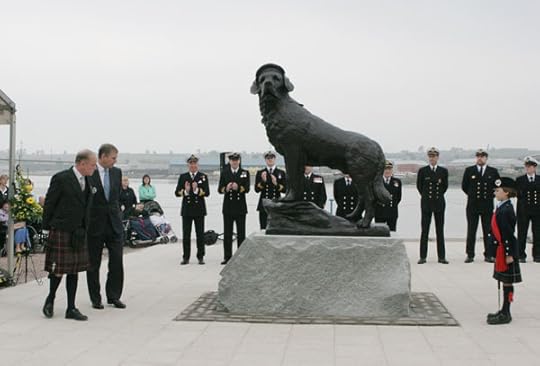
Still, it was genuinely fascinating to read about how his memory was honoured for decades after his death, with statues raised in both Scotland and Norway.
What stayed with me most, though, was how clearly Bamse’s story fits into the larger story of human survival. In a world marked by fear, cold, hunger and uncertainty, he became something warm and steady to hold on to. He wasn’t just a ship’s dog — he was a reminder of home, of kindness, of loyalty, of everything that still made life worth living when the rest of the world was falling apart.
Reading about him made me realise how much people need something living to care for in order to endure hardship. Bamse survived because people loved him — and in many ways, they endured because they had him. His presence created community, comfort and a sense of normality on a small, improvised warship in the North Atlantic. And maybe that is why his story still resonates: he shows that even in the harshest conditions, humanity can survive through the bonds we create with each other, and even with a very good dog.
But the chapters about how his memory was kept alive for decades, and how statues were raised for him in both Scotland and Norway, were genuinely moving.
A cozy and historically interesting read — especially if you’re into maritime history, wartime stories, or simply love tales about very good dogs.