In William's first book A MAN'S GOT TO HAVE A HOBBY he wrote about family life in the 1960s with humour, affection and honesty. WORSE THINGS HAPPEN AT SEA does the same for family life in 2000s; written by William and Sarah in a way that many Australians can relate to and enjoy. This book celebrates the wonderful, messy, haphazard things in life - bringing home babies from hospital, being a friend, a parent, son or daughter, and dog obedience classes. It's about living for twenty years in the family home, raising children there, chasing angry rabbits around the backyard, renovations that never end. It is also about understanding that sometimes you have to say goodbye; that is part of life too. Illustrated throughout with Sarah Watt's photographs of family life and beautiful but everyday objects.
Darryl William McInnes (born 10 September 1963) is one of Australia’s most popular stage and screen actors.
His leading roles in Sea Change and Blue Heelers have made him a household name. The mini-series Shark Net and My Brother Jack earned him widespread critical acclaim. He has been nominated for numerous stage and screen awards, and has won a Variety Club Drama Award in 1997 and two Logie awards for Most Outstanding Actor in 2000 and 2004.
William grew up in Queensland and has travelled extensively throughout Australia. He now lives in Melbourne with his two children. He was married to the late film maker Sarah Watt.
4.5★ “While despair and disappointment may sit quietly in the corner of the house, hope and grace take up more room. And in the parlance of my children, it’s all good.” Sarah Watt (1958-2011)
Tender, funny, rollicking, sad. I loved this. I’d give it five stars for the heart and warmth, but I got a little lost in some of McInnes’s ramblings where he interrupts one story with something from the past and then comes back to the story he’s telling. Just like real life. That IS the way we talk, of course, but occasionally some of his stories didn’t seem quite finished and I wondered what happened to the person or chook or whatever.
Having said that, it is just beautiful. It’s no secret that his wife, Sarah, died a month after this was published, and the quote I included is hers from the end of the book. They’ve each written chapters which include all kinds of episodes from their childhoods, their parents, their past, their meeting, their tragic losses – but not necessarily in chronological order.
It can be random and lovely. Sarah’s sections are more cohesive and William’s are more random, which seems to be exactly how they were together. Argumentative, often in public he says, even on the red carpet, and funny and affectionate. He obviously adored her and may have wondered from time to time how she could tolerate him.
He’s one of Australia’s favourite actors, handsome, tall, intelligent and scrubs up beautifully. Left to his own devices in his beloved Footscray (Melbourne suburb), he’s just a bloke in board shorts and thongs, walking the dog to pick up milk or watching the footy with his mates. Their house was makeshift, renovated, extended, and not the McMansion many actors might live in.
Both recall when their parents died, and are heart-wrenchingly honest about the pain and grief of the baby they lost and miscarriages they suffered before they had Clem and Stella, two smart, funny, gorgeous kids. I know, because Sarah has included family snaps in the book as full page colour spreads. Sarah was an artist and film-maker, and she has chosen extremely candid, un-posed shots that could almost be anyone’s kid – legs sticking up out of the pool, shadow-jumping on the sand. Nothing arty, nothing retouched – at least they certainly don’t seem so. Photo of William McInnes and Sarah Watt, 2009
Here are a couple of William’s stories I liked.
His mother was dying in hospital, and he happened to notice that someone was leaving an orange next to her bed every day. While walking on the beach later, he remembered when she worked at the school tuck shop and she’d serve cut up oranges, shouting out:
“’Oranges,’ she said, ‘have such a happy smell. Happy! Smell!’” . . .
I supposed the doctor had put it there. A happy smell. I swore softly to myself with the realisation of that small kindness, something I hadn’t been able to understand at the time, even though I’d noticed it. A simple kindness.”
On the beach he walked in the rain and watched the gulls.
“And a heron, long and white, waltzed to and fro, treading softly through the flowers and the grass at the sand’s edge.
My mother had always said herons bring luck. And if they didn’t, then at least you’d seen something lovely so it didn’t really matter.
I laughed a little at the logic and then, of all things, I smelt oranges. A giggling little girl walked past with her hand in her mum’s, sucking on an orange and jumping in the puddles.”
I think Clem was only 12 when William and Clem were visiting Sea World in California and stopped to eat at the central markets, a “rough and ready” area, McInnes says. A man nearby remarked that it was pretty good food, and Clem, who was tucking into his meal, agreed.
Then he looked at the man and at his dad and said ”‘But I’m full’ and handed his plate to the man to finish.
McInnes said he hadn’t even noticed the man was hungry, and Clem began talking about how “this place has so much and he has so little . . . it’s funny, I think.’
. . . We walked together, Clem and I, and I put an arm around his shoulder.”
Clem is 17 when the family is visiting Broome, WA, and they’re in a pub to escape torrential downpours (Sarah is famous for breaking droughts wherever she goes), where a bloke has recognized William and started a conversation, which goes from strange to downright peculiar.
McInnes said he talked like someone from a Chips Rafferty film. When they were ready to leave, the guy (who was only about 23) said “F*** that, mate; you can’t squib me on a shout.’ [You can’t miss your turn to buy the drinks.]
So when they’d finally shouted as many shouts as required and left, William asks his son
“’What did you think of him, Clem?’ Clem said nothing for a few paces.
‘He’s just.’ He stopped and I said, ‘He’s just what?’
‘He’s just a man getting drunk. Saying stuff he probably doesn’t talk about much. Stuff that sounds wrong, but stuff he thinks he can talk about. He’s just a man.’
I looked across at Clem. He still looked young, younger than his years, maybe, but I suddenly felt happiness inside. Happiness that what Sarah and I started all those years ago wasn’t just a summer fling.’
And it could well have been just a summer fling. They both reminisce, remembering different versions of their story, which is always fun.
Sarah writes a movie, the 2005 award-winning Look Both Ways. “I showed the first draft to William, my leading – but unfortunately superstitious – man.
’You’ve given me cancer! You can’t give me cancer!’
‘If I give you cancer in the film you won’t get it in real life.’
It’s too late for her to take it back. He’s already read it.
“No wonder people came up with such strict rules in religion – superstition can be exhausting.”
Sarah is well aware of the irony when it’s she who develops an aggressive form of breast cancer, and having been through her father’s cancer and written the movie about a man who suddenly discovers he has testicular cancer which has spread to his lungs, she knows what she’s dealing with.
“I had directed William to play the character as if he were being dumped by a massive wave – tumbled about, swimming frantically towards the surface, only to hit the seabed breathless and panicking – at the same time as being in a state of calm normality.”
These two voices, talking about their lives and family seem to show that no matter how unique and special our own circumstances are, there is no question that there are some feelings and relationships that are universal, and these two wonderful people have touched on a bucketload of them.
Loved it. Recommended for fans, of course, but for anyone who grew up in Australia when they and their kids did. You’ll see yourselves here, I bet. And I recognise plenty from my own American childhood many many years before this.
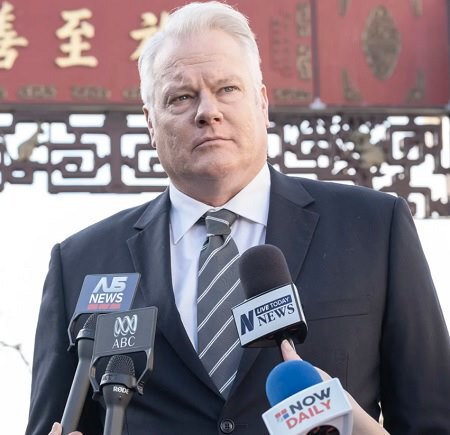
P.S. I'm adding a current photograph of him, still as active and popular as ever. He can present an image of powerful intimidation as well as anyone, not the happy-go-lucky young larrikin we used to see! William McInnes in "Total Control", an excellent Aussie TV series where he plays the federal opposition leader, a sneaky politician (of course).
William McInnes and Sarah Watt’s personal take on the simplicity yet messiness of everyday life is a pure joy to read. Worse Things Happen at Sea is about two famous Australians in the television, film and writing industry; yet two very ordinary people who live through the day-to-day stuff we all do: raising children, renovating homes, coping with the illness of love ones, making mistakes, fixing things and not being able to fix things. The fact that Sarah Watt died after a battle with cancer last November left me devastated that I didn’t get a chance to say goodbye. Don’t get me wrong, I didn’t know her personally, but for a short time she let me into her life through this wonderful memoir. She introduced me to her children and welcomed me into her home. The writing of the chapters is shared between the couple and each is a lesson in living for the moment; not for tomorrow.
One of the ABC’s most popular television series ever was the wondrous ‘Sea Change’ – those similarly addicted will have memories of the little coastal Victorian community of Pearl Bay, with its enduring idiosyncratic array of characters, forever in their hearts. The star of the show’s three series was Sigrid Thornton playing a city-ite whose world comes crashing down around her causing her to ‘escape’. It was the David Wenham role of Diver Dan, the love interest, who became the ‘thinking’ nation’s heart-throb with that lazy, laconic style he has developed and honed down through the years. When he left at the end of the first series, giving up Sigrid for the Galapagos, into the void stepped William McInnes. Although he could never adequately replace his predecessor, he made an admirable fist of it, and the show’s popularity continued. This was my introduction to the now actor/author, and I’ve also admired his role in ‘Curtain’ portraying arguably our most loved Prime Minister – oh for a Curtain these days!
I’ve been aware of McInnes’ rise as a writer for some time without having read any of his oeuvre. That changed, as often is the case, when this book was presented to me as a Chrissy gift by my son’s delightful partner. Co-written with his wife Sarah Watt, a talented film maker, responsible for ‘Look Both Ways’ and ‘My Year Without Sex’, ‘Worse Things Happen At Sea’ is a joy to read.
McInnes, in his many roles, invariably plays a manly man – a notable exception being his cross-dressing character in the second of the aforementioned movies. In his writing here, and in Watts’, he comes across as inept in many manly activities. This makes him easy to relate to for this similarly technology challenged reader. He is also apt to cry embarrassingly in public, another trait that resonates. This book is a homage to family life, in the knockabout Australian context, and his yarns had me ranging from chortling to belly-laughing. His ‘death of a cane toad’ is a classic, as are his chook sagas. Even so, his deep humanity, as well love for his wife and kids, shines off the pages.
The writings of his wife are more sombre and reflective. There is the pain of a stillborn son and the joy of two successful pregnancies, and then, poignantly, her battle with cancer. Sarah Watt passed away before this past year was done, and this book, as well as her films, is a legacy of a fine talent cruelly taken. In the homilies of both writers her struggle is not retreated from, nor overplayed for sympathy. Her ruminations that her death is a possible outcome are as restrained as they are heart-wrenching to the reader.
The fine, gentle photography from Sarah is another asset of this co-authorship. Images of light on water and family life add to what is a beautiful, lovingly put together product. And now, thanks to this thoughtful present, I shall seek out the other writings of McInnes, and hope that, despite his loss, he has plenty more yarns to tell in the future, along with continued film/television work.
I liked Sarah Watt's chapters better than Williams'. He seems like a great Aussie bloke, a genuinely nice guy, but I did find myself hanging out for his chapters to finish so that I could read Sarah's which are interspersed. Perhaps it was her female perspective, perhaps it was because I love her films and I know she battled cancer and I wanted to hear her perspectives. The last few chapters were particularly raw but I appreciated the open and honest tone of the whole book. An unusual format (the book is a non-con-formative size) and with photographs throughout that have no captions or explanation - though I will always encourage pictures - I would have liked to know more about their meanings. A lovely read, the small chunks made it possible to fit in during breastfeeds. (I think if there were half stars I would give it 3.5 but I'll err on the side of generosity)
Tiger mothers, ambitious beyond reason for their children's success, who see compassion and tolerance as weakness, are at one end of the 'mothering' scale - on the other, a very different tiger mother, one who fought with tenacity and courage, for each day she could spend loving her husband and children, and seeing them safely into adulthood. Sarah Watt - I wish I had known you. It's the modesty of the story, the ordinary life spent well lived, but also lived well, that makes this book such a good read. Poignant, at times funny, but mainly a chronicle of a strong and loving marriage, with a strong message of gratitude for every big and small moment of perfection.
A beautiful story about really nice people. I don't know them, but after reading this I feel as though I do. Hauntingly sad at the end, but don't let that put you off reading it. Something to make you stop and take note of the good things you have in life.
Enjoyed this light read. Lots of Brisbane and Melbourne which was nice. Very sad as they seem like such a lovely family. Made me laugh out loud quite a few times.
This month's bookclub selection and what a surprise!
One of the ABC’s best loved TV series was 'Sea Change’ set in Barwon Heads near Geelong – I even went to visit there, stayed 2 days as like many I was addicted to this little coastal Victorian community of Pearl Bay, with its enduring idiosyncratic array of characters, forever in our hearts. The star of the show’s three series was Sigrid Thornton playing a city-ite whose world comes crashing down around her causing her to ‘escape’. It was the David Wenham role of Diver Dan, the love interest, who became the ‘thinking’ nation’s heart-throb with that lazy, laconic style he has developed and honed down through the years. When he left at the end of the first series, giving up Sigrid for the Galapagos, into the void stepped William McInnes. Although he could never adequately replace his predecessor, he made an admirable fist of it, and the show’s popularity continued. This was my introduction to the now actor/author, and I’ve also admired his role in John Curtin portraying arguably our most loved Prime Minister and Auction House.
There is that feel about it -- magazine-glossy paper with a generous number of full-page colour photos. I’ve been aware of McInnes’ rise as a writer for some time without having read any of his oeuvre. That changed, as often is the case, when this book was presented to me as a Chrissy gift by my son’s delightful partner. Co-written with his wife Sarah Watt, a talented film maker, responsible for ‘Look Both Ways’ and ‘My Year Without Sex’, ‘Worse Things Happen At Sea’ is a joy to read.
McInnes, in his many roles, invariably plays a manly man – a notable exception being his cross-dressing character in the second of the aforementioned movies. In his writing here, and in Watts’, he comes across as inept in many manly activities. This makes him easy to relate to for this similarly technology challenged reader. He is also apt to cry embarrassingly in public, another trait that resonates. This book is a homage to family life, in the knockabout Australian context, and his yarns are hilarious. Even so, his deep humanity, as well love for his wife and kids, shines off the pages.
The writings of his wife are more sombre and reflective. There is the pain of a stillborn son and the joy of two successful pregnancies, and then, poignantly, her battle with cancer. Sarah Watt passed away before this past year was done, and this book, as well as her films, is a legacy of a fine talent cruelly taken. In the homilies of both writers her struggle is not retreated from, nor overplayed for sympathy. Her ruminations that her death is a possible outcome are as restrained as they are heart-wrenching to the reader.
The fine, gentle photography from Sarah is another asset of this co-authorship. Images of light on water and family life add to what is a beautiful, lovingly put together product. And now, thanks to this thoughtful present, I shall seek out the other writings of McInnes, and hope that, despite his loss, he has plenty more yarns to tell in the future, along with continued film/television work.
However, William McInnes is as much writer as he is actor. Sarah Watt I knew only as a director -- I had no idea the two were married. I've seen Look Both Ways and My Year Without Sex, but because I spend more time in imaginary worlds than in the real one, I hadn't realised Sarah Watt had died. I still may not have realised that, had I not been told at book club, by the same person who declared this 'a light read'.
This is far, far from a light read. Getting my dates mixed up, I've had to read most of it in a single sitting, and I feel the way I felt after watching Look Both Ways: Utterly affected, looking at life as a big picture of big emotions, mulling over death.
The humour of McInnes and the fact that Sarah Watts is writing in first person, often in present tense, only makes her 2011 death feel sadder.
I'm sad not just for the family, but sad also because there are too few women making films, and even fewer making films *about* women. So to lose someone just as she (probably) was moving into her prime movie-making years is gut-wrenching.
PRESENTATION OF THE BOOK, PHOTOGRAPHY, FIRST PERSON WRITING, HUMOUR AND THE GENUINE HUMAN STORIES ARE POIGNANT AND HEARTFELT. In William's first book A MAN'S GOT TO HAVE A HOBBY he wrote about family life in the 1960s with humour, affection and honesty. WORSE THINGS HAPPEN AT SEA does the same for family life in 2000s; written by William and Sarah in a way that many Australians can relate to and enjoy. This book celebrates the wonderful, messy, haphazard things in life - bringing home babies from hospital, being a friend, a parent, son or daughter, and dog obedience classes. It's about living for twenty years in the family home, raising children there, chasing angry rabbits around the backyard, renovations that never end. It is also about understanding that sometimes you have to say goodbye; that is part of life too. Illustrated throughout with Sarah Watt's photographs of family life and beautiful but everyday objects.
One of my favourite books ever. Such insights, honesty, love, joy, pain, all written with such good humour. There is a page written by Sarah Watt about how people try & figure out why people get cancer. She tells of at first refusing to eat a cake her daughter has baked. Finally, she realises that the disappointment in her daughter's eyes would be far worse that eating packet cake mix. I think I have gifted this book at least 4 times. I hope people love it as much as I do.
This is a book that I have wanted to read for some time, and I found it in a friend's bookshelf so snaffled it! (and returned it when finished!). Illustrated with Sarah Watt's beautiful photographs, it is a sort of memoir/biography of William McInnes and Sarah Watt's family and the story of her cancer. With some of William's wry and funny comments, and many poignant moments, I really enjoyed it.
Entwined memoirs with a cumulative focus on family, mortality, embracing life and coping with death. McInnes reaches his conclusions through rambling associative leaps, Watt by more direct reflection. Fechner’s audiobook reading captures the sometimes humorous, always heartfelt tone (but not female voices).
Like having a chat with a close friend, this book gives intimate details of life in a way that you wouldn't ordinarily see. While not a light hearted read, it is an important one.
This was a book suggested by library book club otherwise I would not have bothered with it. The parts written by William were reminiscences and not very interesting and I felt would be insightful for family members whereas the chapters by his wife Sally were definitely a lot better. Most people I have discussed this with have loved it so I am in the minority.
What an interesting way to capture the lives of two reasonably well know Australians. I really enjoyed the reference to the title of the book. Probably something that only Australians and boat people will fully understand. But oh, so true. Make the most of life. Reference to tragic events are balanced by very backyard tales of the extent families go to support and love each other. I laughed out loud, shed a tear, and gasped. I did find it poignant that given Sarah passed away soon after the book's publication that the book includes photos of family members, but other than author photos on the inside of the book cover, there are no photos of Sarah in the book. I particularly loved the stories of Neil from Altona, and Mister Snowy Stalin. William and Sarah's personal stories about grief were written with very accessible and open hearts. Wow. Thank you.
Part family history, part vignettes of everyday life, this is a confronting book in many ways, as it's meditations on mortality and facing the unpredictability of life ring starkly true. I found this book all the more heartbreaking in the knowledge that Sarah Watt (McInnes' wife and the book's co-author) died in late October, not long after the book's publication, after a long battle with cancer (something she shares honestly and beautifully in her chapters). This book is essentially about courage. Extraordinary courage that ordinary people, like Watt and McInnes, face every day. It's about not taking the little things for granted and being grateful that for every curve ball life throws at you, there are also a million, beautiful little stars.
I thoroughly enjoyed this collection of simple stories and anecdotes from every day family life. I think it was the sheer ordinary nature of the McInnes-Watt household that impressed me most of all. Just because these people are in film and acting, doesn't make their family life extraordinary. I saw a lot of myself in McInnes and found many of his quirks and inefficiences quite affirming! Knowing what became of William and Sarah, the final chapters bring on an ominous feeling as Sarah discusses her cancer diagnosis. A beautifully written book, with terrific pictures - I found it quite a joy to read.
I've always enjoyed McInnes' work and this book did not disappoint. McInnes has an amazing ability to make you laugh and cry in one sentence and I love that all of his reflections and recollections are the stuff of ordinary, mundane, day to day life - the stuff that really matters in the end.
Sarah and William compliment each other beautifully. It is sad that their co-writing cannot be shared in the future. Reading this book made me appreciate the small things in my everyday life. It made me love and appreciate my family and helped me to stand back and enjoy the everyday moments with the light heartedness and affection they deserve.
A wonderfully warm view of Australian family life, even in the amazingly creative life that was the family of William McInnes and Sarah Watt. Written taking turns about chapters, Watts final chapter as she faces death, is a remarkable piece of Australian literature. The lighter moments, always written by McInnes, are deliciously funny. His description of the white rabbit the family adopted had me leaking all over with laughter. Always an serviceable actor, McInnes is a superb writer and his share of this book is no less entertaining and provoking than any which preceded it. It just hurts so much to realise his great love, Sarah Watt, died so soon after it was written.
Although there is great sadness behind this story the overall effect when you have finished reading 'Worse Things Happen at Sea' is one of overwhelming family love and the connections that occur between family and friends. Simple day to day events brings life and happiness, chaotic family life and the closeness of being together make this a warm, inspirational book.This book is one of my favourite possessions, not just because it is a book but because of the love and feelings that emanate from its covers once you know what is concealed inside.
LOVED this book. Felt like I was sitting around having a wine and a yak with my closest friends. Written in such a relaxed manner, even though you know the ending will be incredibly sad, you also know (eventually) these kids will be ok - thanks to their awesome parents. A beautiful, normal, happy, loving, brave family. Thank you for letting us into your lives William & Sarah. Highly recommend.
After finishing this book I was most distressed that we have lost such an amazing writer, artist, film maker, wife and mother with the passing of Sarah Watt. William and Sarah shared moments of their lives with us within the book and I feel very privileged to have read this beautiful story. I highly recommend this book!
A remarkably moving book written by William mcinnes and Sarah watt. Tracks the highs and lows of their life together, including beautiful stories of moments with each other and their children alongside tragedies such as their still born first child and Sarah's cancer. I really connected with this book and particularly Sarah watt.
Just imagine two of the loveliest people in the world writing you letters. They're not pretentious, they're not goody two-shoes, they have lovely self-deprecatory humour...above all they're normal. Gentle, whimsical, laugh out loud funny sometimes and poignant....all wrapped up in love for humanity and our world - suburban though it may be at times.
Beautiful story of a close and caring family. Sweet Sarah has a warm heart in spite of tragic circumstances and William who plays the clown is a father very involved with his children. Sad, funny and very poignant book.
Raw, sad and honest sharing about Sarah's encounter with cancer and how the family reacted. Earlier chapters dealt with family life before the cancer and William is a very funny story teller - i snorted and laughed through his mis-adventures. A wonderfully human book.
Sarah Watts' contributions to this book are well worth reading, about her experience with cancer and losing a baby at birth. William's are just mad and funny.
Enjoyed but was also moved by this very poignant sensitive story. Very much a series of thoughts and memories that form a a story of love loss and family.