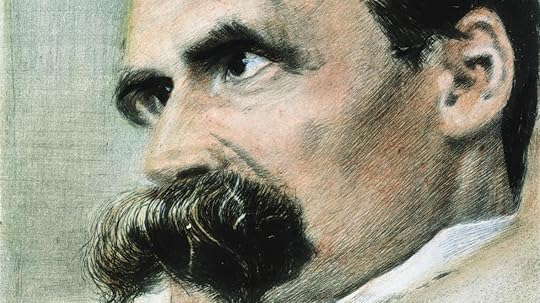
Nietzsche wrote these two books in 1888 as brief asides from a longer book, his ultimate statement, he was trying to write around the time, which was going to be called some variant on "The Re-Evaluation of All Values" and ended up as, I think, "The Will To Power" that we have. He speaks of them as immediate overcharges of energy, inspired by the delight he takes in agon against his favorite foes -- Christianity, other philosophers, conventional foolishness ... to me it seems as though much of what made possible this new vigor is the natural extension of The Genealogy Of Morals, where he had finally been able to put his philosophy into a sort of cyclical coherence (after such attempts as Zarathustra). There he had conceived the follies of man as like blooming plants, quite distinct from their own declared content but rather blindly unfurling, self-unaware processes of generation. That had been two years prior, and by this book he had developed this into a vastly more radical conception of the world, to which he alludes a little in Twilight but which he principally left for the upcoming masterpiece he never saw attained.
The idea of Twilight of the Idols is to philosophize with a hammer, to destroy idols not for any particular end but rather as energizing sport, for the fun of hearing the ringing of their hollow interiors. While his favorite targets are again destroyed here -- Plato and Socrates recast as fools, contemporary social movements reduced to mere neuroses, certain French philosophers revealed as incoherent delusionals -- as they had been in every book since All Too Human, Nietzsche now has in mind a positive philosophy against which to contrast them. The quasi-organic world of conventional thought (likened to plants, or better diseases, in the Genealogy) is contrasted against Nietzsche's new vitalist perspective, where one strives for good health and digestion and frees oneself of the scrupulous distractions of the logical quibbles of the world. He has become so hostile to the constant narcissisms and insecurities riddling all supposedly rational thought that he launches into denunciations against the possibility of objectivity and the existence of casuality as commonly understood; the climax is a frightening, almost Baudelairean (in spite of what accusations Nietzsche might have levelled against many aspects of Baudelaire) reverie in which Nietzsche denounces language as a mere cataloguing of signifiers, a thin web only of interest to those obsessed with the purely symbological / connotative panacaeae, behind which nothing remains.
How to reconcile Nietzsche's own espousal of opinions is a topic he does not treat here, nor do I care to treat it here -- in Pierre Klossowski's study of Nietzsche efforts are made at explaining, but it is a sticky and messy question to ask, not least of all because it is precisely contrary to the attitude espoused here. As an aside, I had delved into some other French attempts at extending the Nietzschean logic into the metaphysical and been impressed by their presentation of these similar denunciations of causality, language, symbology, and was greatly disappointed to find that these francaises' attempts were absolutely eclipsed by hearing Nietzsche's own explanations thereof (I was in the path of the recent solar eclipse, and was reading the great polemic against symbology as the sun faded -- what a moment!); I can only offer that it's probably likely that any attempts to justify these great claims should defer to what Nietzsche himself presumably wrote about it in the Will To Power or elsewhere.
One thing that had bothered me for a long time about Nietzsche was the baffling extent to which his philosophical ideas were appropriated for (admittedly irrelevant) political ideologies; most of the earlier works are so consistently antipolitical that any extrapolations seemed absurd to me. However, it is in this book that Nietzsche begins extending his new health based attitude towards political discussions -- some of the more obvious inferences are made, such as denunciation of the sinewy german scholars of his day and the disgusting (to Nietzsche) habits of the beer drinking normies, as well as some fascinating analyses of liberalism and socialism, denouncing both for the crime of attempting to institutionalize the fulfillment of their desires, which means their ideal utopia is the absolute opposite of the ardent energy for which they spread their cause, an energy in which all their virtues consist & which therefore dissipates immediately upon their success. What might Nietzschean annotations on a John Rawls book have looked like!
The central political passage in this book, however, is the "Improvers of Mankind" section, where Nietzsche pre-empts the criticism Spengler makes of him in Decline of the West -- that the so-called Slave Morals have always been invented by those in relative power, eg, as the Law of the Jews originated & disseminated actually by priests during periods of Israeli strength. By taking the Hindu caste system as a paradigm, Nietzsche laments the relative weakness & dishonesty of western religions in enforcing social orders through more nuanced means, as opposed to the brute heirarchy resulting from the Law of Manu in India; but, in pontificating on these issues, Nietzsche gyrates around to recognizing that the general effect of the abrahamic religions has been to generally maintain social order, concocted by the priests for that functional end, intentional or no ... the result is a rather excited rumination on the idea of 'selective breeding', of the 'taming' of mankind, with vague overtures that Christianity has gone wrong in having lost control of their breeding programme, and that perhaps some new system may be in order. While I think one can try to make a nuanced argument that Nietzsche is not necessarily advocating for a eugenic conspiracy, one can easily see how Hitler & Goering might have received this passage. For reasons as those above, I'm not so sure I'm interested in apologizing for this, or else for analyzing the political ideas of Nietzsche in depth at present, if only because this book is meant as a demonstration than as a genuine prophesy of a new mindset.
If I were to be asked what I really thought of this perspective, though, I think I would answer that Nietzsche at this period was likely beginning to undergo the brain disease that rendered his last ten years totally senile -- the egomania of Zarathustra is returning, but without the subtle considerations in arranging that book and with increasingly incautious zeal. Indeed, Nietzsche declares near the end of Twilight that Zarathustra was the most important book ever written, and it's difficult to find any sort of irony behind the statement. The second book in this collection, fundamentally of the same time & period, seems to show the decline of Nietzsche's brain more clearly than the rather sharp writing in Twilight.
The idea of this book is to show, for similar reasons as in Twilight, the real story of Christianity as a degenerative disease. The basic idea is that the Christ, in the context of the cumbersome logic of Pharisaic Judaism, was a genuine & honest figure, who truly believed in his absolute negation of the world & his singular celebration of divine love; and that the story of Christianity is that of Christ's image, further & further distorted into mere worldly symbolism by Saint Paul and subsequent ecclesiastical writers. The main move is from the complete rejection of the immanent by the Christ into the legislative & salvation-based mentality of the church, which in this book is presented as a drama of two characters, Christ as the ultimate holy fool, indeed the most fundamentally innocent man of all, and Saint Paul as the ultimate world-resenting, inferiority complex decadent, the type whom Nietzsche spent his entire mature period trying to destroy.
Why I say this book is a sign of decay, despite its hypnotic new characterization of the Christ and its absolutely excellent polemic style (indeed, perhaps some of Nietzsche's best writing of all, to my eyes) is that its argument hinges entirely on what seems to me to be an illusory image of Saint Paul; while the idea that Saint Paul re-centered the shift away from concerns that Christ espoused in the Gospel (or that, if you are so inclined, the historical Christ may have preached, as Nietzsche believes the Gospels are tainted by apostolic interference) towards a more rationalized and socially minded perspective, and indeed that his epistles are at the beginning of a causal chain that led to such world-obsessed variants of Christianity as, say, the Catholic church, it really does not seem to me to be a fair characterization of Saint Paul's writings that they contradict this eschatological cathexis of the Christ, or that they recontextualize the 'gnosis' of Christ as immanent attitudes ... indeed, writings like Ephesians and especially Romans seem those most closely aligned with Christ's transcendental messages in contradistinction to worldly concerns, and books like Galatians and Corinthians tend to treat social concerns with due triviality in the exact opposite way that Nietzsche seems to insinuate here. Much could be made of Saint Paul's struggles with the other apostles in favor of Nietzsche's theses, but he does not touch on that; indeed, he writes so abstractly and without reference about Paul that it seems he may as well be inventing a character from scratch.
Now I had read the Anti Christ first, indeed and was absolutely convinced that errors like this were as sure a sign as anything that Nietzsche was starting to get sleepy; but, after reading Twilight, I'm starting to wonder if this can be explained in more charitable terms, such as, for example, that Nietzsche was being honest when he said that reading the New Testament sickened him, and that his characterization of Saint Paul was based off memories from his Lutheran-inculcated youth, which indeed would have given him an image of Saint Paul as the lawman of Luther's more fickle image of God. Moreover, the excitement of his sudden outpouring of new ideas based off his new health-based paradigm would likely inspire in Nietzsche the (perhaps inflated) self-confidence to write with less care and more emphasis on style -- indeed, this whole book tends to rush through the common Nietzschean criticisms of Christianity, expecting that the reader already knows them, and that the ultimate goal here is a more aesthetically perfect realization of these already-presupposed ideas.
In all events, I would probably give the Anti Christ 3 or 4 stars, and the Twilight of the Idols 5, so I will give this entire book a 5, since it is a very fun book to read; both are short, and both are good. It's the sort of book I've had sat around for years and, upon reading it, felt like a fool for not having read sooner.