

What do you think?

Lingua Latina per se Illustrata
Fabulae Syrae: Graecorum Romanorumque fabulae ad usum discipulorum Latine narratae
A basic knowledge of classical mythology is indispensable in understanding and appreciating ancient culture, art history and even modern literature. This delightful assortment of fifty captivating myths of Rome and Athens provides extended readings selected or adapted from the works of ancient authors which not only introduce readers to the essential legends of Roman literature but also cement the grammar and vocabulary taught in an introductory course of Latin. Each selection of Fabulae Syrae corresponds to a chapter in Familia Romana, allowing you to read stories that are perfectly on grade level, and thereby rapidly build comprehension and confidence as you enjoy the adventures of men and mischief of gods.
The collection begins with the adventure of Pygmalion, the Cypriot sculptor who carved a woman out of ivory, and ends with nearly 200 verses of original Latin from books two and three of Ovid’s Metamorphoses. The vignettes are annotated with helpful margin notes and are accompanied by beautiful historic woodcut illustrations. The volume contains two appendices: a list of vocabulary and a glossary of proper names.
Fabulae Syrae can be used concurrently with Familia Romana for further enrichment or as a review text after completing Familia Romana. It is, however, also a stand-alone work and could also be used as a reader in mythology separate from the Lingua Latina per se Illustrata series. New vocabulary is kept to an absolute minimum, so the reader can truly enjoy the readings, while focusing on a mastery of the grammar and essential vocabulary taught in the Familia Romana.
Features include:
- Readings linked to each chapter of Familia Romana from XXVI to XXXIV
- Fifty of the most important tales of ancient mythology
- Every word, cover to cover, is in Latin with vowel lengths marked
- Approximately 18,500 Latin words in length
- Approximately 500 new vocabulary words are taught
- Helpful margin notes Picks up where Colloquia Personarum ends
- Perfect for home-schoolers, as it covers the material of a course in ancient mythology
- Indices of vocabulary and proper names
The collection begins with the adventure of Pygmalion, the Cypriot sculptor who carved a woman out of ivory, and ends with nearly 200 verses of original Latin from books two and three of Ovid’s Metamorphoses. The vignettes are annotated with helpful margin notes and are accompanied by beautiful historic woodcut illustrations. The volume contains two appendices: a list of vocabulary and a glossary of proper names.
Fabulae Syrae can be used concurrently with Familia Romana for further enrichment or as a review text after completing Familia Romana. It is, however, also a stand-alone work and could also be used as a reader in mythology separate from the Lingua Latina per se Illustrata series. New vocabulary is kept to an absolute minimum, so the reader can truly enjoy the readings, while focusing on a mastery of the grammar and essential vocabulary taught in the Familia Romana.
Features include:
- Readings linked to each chapter of Familia Romana from XXVI to XXXIV
- Fifty of the most important tales of ancient mythology
- Every word, cover to cover, is in Latin with vowel lengths marked
- Approximately 18,500 Latin words in length
- Approximately 500 new vocabulary words are taught
- Helpful margin notes Picks up where Colloquia Personarum ends
- Perfect for home-schoolers, as it covers the material of a course in ancient mythology
- Indices of vocabulary and proper names
144 pages, Paperback
First published January 1, 2010
Ratings & Reviews
Friends & Following
Create a free account to discover what your friends think of this book!
Community Reviews
Displaying 1 - 27 of 27 reviews
March 23, 2026
"Fabulae Syrae" is a companion reader to Lingua Latina per se Illustrata: Pars I: Exercitia Latina I aka LLPSI, the book of all books in teaching and especially in self-study of Latin. As stated on the first page, it contains the stories told by Syra, the house servant
from LLPSI, to Iulia, Marcus and Quintus (the children of Iulius and Aemelia). One is supposed to read these stories after lesson 25 in LLPSI, and by that time all these characters from the textbook seem like old acquintances.
In reality though, judging by the amount of metamorphoses, most of the stories are retellings of Ovid's Metamorphoses.
Although one is supposed to read these stories in parallel with the LLPSI lessons, starting from the lesson 24, I began reading in earnest when already on a pen-ultimate lesson 34: the PDF of "Fabulae Syrae" in the Kindle App on my phone became my bomb shelter and bedtime reading book. The stories seemed a bit boring and simplistic at first, which on the other hand was well-suited for reading in short chunks. However, eventually the content became more interesting and complicated, with the last stories heavily sprinkled with anything but simple lines of poetry (a logical progression, considering that lesson 34 in LLPS is called De arte poetica and is stuffed with long quotes from Catullus, Ovid and Martialis).
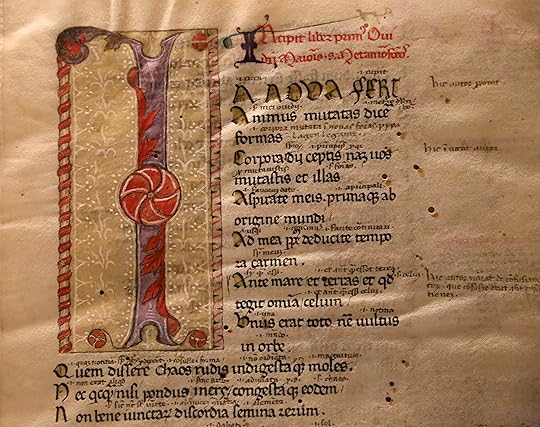
A manuscript of Metamorphoses from Biblioteca Medicea Laurenziana (Image credit:Sailko, CC BY 3.0 , via Wikimedia Commons.)
A personal highlight for me was the myth about Deucalion and Pyrrha, which turned out to be the Greek version of the flood myth. I've heard a lot about the flood in Gilgamesh, but never about Deucalion and Pyrrha's salvation.
Annoyed by our indecent behavior, Jupiter (Zeus) wanted to wipe out all humankind:
But Mercury (Hermes) put a word for Deucalion and his wife Pyrrha:
Upon surviving the flood, Deucalion and Pyrrha recreated the rest of the humankind by... throwing stones from the mountain. Well, why not.
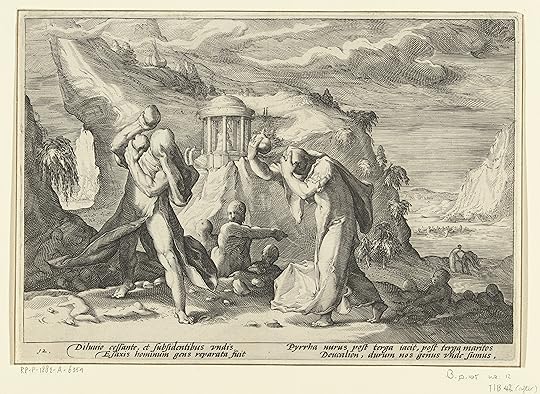
Deucalion and Pyrrha repopulating the Earth. (Image credit:Rijksmuseum, CC0, via Wikimedia Commons.)
To summarize, I've found "Fabulae Syrae" a very useful and moderately entertaining reading material. It felt satisfying to notice new words and constructs being gradually absorbed by my distracted brain. All right, I did read through the same page of Phaeton for about 10 times, each time nodding off at the middle of a poetic stanza, but this was on a long night when I had to stay awake, and is another story.
from LLPSI, to Iulia, Marcus and Quintus (the children of Iulius and Aemelia). One is supposed to read these stories after lesson 25 in LLPSI, and by that time all these characters from the textbook seem like old acquintances.
Hoc libro fabulae continentur, quas Syra liberis Iulii et Aemiliae narrare solet. Iulia, Marcus et Quintus valde his fabulis delectantur. Speramus igitur vos quoque, qui eas lecturi estis, his Graecis Romanisque fabulis delectari posse. Quae certe utiles erunt: nam qui has paginas leget, non modo res utilis ad utendum grammaticas et vocabula Latina, quae in capitulis XXV-XXXIV libri, cui titulus est FAMILIA ROMANA, iam cognovit, certius discet ac memoria retinebit, sed etiam non pauca verba alia facile discere poterit.
In reality though, judging by the amount of metamorphoses, most of the stories are retellings of Ovid's Metamorphoses.
Although one is supposed to read these stories in parallel with the LLPSI lessons, starting from the lesson 24, I began reading in earnest when already on a pen-ultimate lesson 34: the PDF of "Fabulae Syrae" in the Kindle App on my phone became my bomb shelter and bedtime reading book. The stories seemed a bit boring and simplistic at first, which on the other hand was well-suited for reading in short chunks. However, eventually the content became more interesting and complicated, with the last stories heavily sprinkled with anything but simple lines of poetry (a logical progression, considering that lesson 34 in LLPS is called De arte poetica and is stuffed with long quotes from Catullus, Ovid and Martialis).
A manuscript of Metamorphoses from Biblioteca Medicea Laurenziana (Image credit:Sailko, CC BY 3.0 , via Wikimedia Commons.)
A personal highlight for me was the myth about Deucalion and Pyrrha, which turned out to be the Greek version of the flood myth. I've heard a lot about the flood in Gilgamesh, but never about Deucalion and Pyrrha's salvation.
Annoyed by our indecent behavior, Jupiter (Zeus) wanted to wipe out all humankind:
Cum primum vero Iuppiter per Mercurium, deorum nuntium, talia scelera cognovit, tantas hominum inuirias severissime puniendas esse putavit. Tatum igitur humanum genus fluctibus perdere statuit. "Perdendum est" inquit, "mortal genus! Pereant homines, cum tam scelesfisint! Puniantur quam celerrime omnes!
But Mercury (Hermes) put a word for Deucalion and his wife Pyrrha:
Mercurius vero, qui duos homines probos et iustos esse noverat, Iovi suasit ut clemens esset usque parceret. Iuppiter igitur postquam Deucalionem eiusque uxorem, Pyrrham nomine, quos Mercurius praeter ceteros servandos esse censebat, in rate quadam posuit, ventos omnes liberavit, nubibusque atris totum caelum operuit; deinde ingentes imbres de caelo misit, et aquas totius orbis ita auxit, ut omnes terrae mergerentur: omnia mare erant, et litora quoque mari deerant.
Upon surviving the flood, Deucalion and Pyrrha recreated the rest of the humankind by... throwing stones from the mountain. Well, why not.
Deucalion and Pyrrha repopulating the Earth. (Image credit:Rijksmuseum, CC0, via Wikimedia Commons.)
To summarize, I've found "Fabulae Syrae" a very useful and moderately entertaining reading material. It felt satisfying to notice new words and constructs being gradually absorbed by my distracted brain. All right, I did read through the same page of Phaeton for about 10 times, each time nodding off at the middle of a poetic stanza, but this was on a long night when I had to stay awake, and is another story.

April 7, 2016
Hic liber mihi valdē ūtilis erat prō linguā latīnā discendā. Cum quodque capitulum huius librī difficilior sit eōdem capitulō librī cui est titulus 'Lingua Latīna per sē illustrata', mihi necesse erat grammaticam illō librō mōnstrātam bene scīre antequam hunc librum lēgī.
I found Professor Miraglia's writing in this book to be more difficult than Oerberg's, but this is a good thing - you really have to have the subjects introduced in 'Lingua Latina' down before going on to read the corresponding chapters in this book.
I found Professor Miraglia's writing in this book to be more difficult than Oerberg's, but this is a good thing - you really have to have the subjects introduced in 'Lingua Latina' down before going on to read the corresponding chapters in this book.

July 2, 2026
Fabulae Syrae is the perfect companion to Familia Romana as it builds on the level of difficulty of its predecessor and slowly increases it further.
I particularly liked the selection of myths from Roman and Greek mythology; it was a nice mix of well-known ones and some I wasn’t as familiar with.
Overall, ideal for self-learning or paired with school/university courses. (At least my professors highly recommend this series!)
—> 5 stars
I particularly liked the selection of myths from Roman and Greek mythology; it was a nice mix of well-known ones and some I wasn’t as familiar with.
Overall, ideal for self-learning or paired with school/university courses. (At least my professors highly recommend this series!)
—> 5 stars
February 8, 2025
This is great, but significantly more difficult than the corresponding chapters in Familia Romana - same grammar level but more difficult style. With a bit more effort, though, you should be able to read this as you go through FR. Except for the last chapter with poetry - it's brutal and basically impossible for an FR-chapter-34 level reader. (edit: for what it's worth, I have been told by an experienced Latinist that the reason the poetry in the last chapter is so hard to read is that Miraglia is just bad at writing verse)
Also, the myths can be repetitive, but that's the nature of myths, they repeat a lot of story patterns.
Also, the myths can be repetitive, but that's the nature of myths, they repeat a lot of story patterns.

February 17, 2023
This is a great text to read after LLPSI. I only have a single complaint which is during the final chapter they start throwing poetry at you. This isn’t In principle wrong, but the manner in which they do it isn’t great. The book doesn’t introduce you to much new grammar, so reading the text is fairly easy, however whenever poetry is involved they throw multiple new words at you as well as a skyrocket of difficulty with grammar.

April 4, 2025
Et rigtig godt supplement til LLPSI, eller som næste trin efter grundbogen. De græsk-romerske myter bliver fortalt spændende og særligt de originale passager fra Ovid har mange, skønne udtryk. Sproget er rimelig overskuelig latin for fortsættere, men den skal nok genlæses flere gange for maksimalt udbytte.

October 21, 2024
This was great. There were a lot of stories that I've never heard and the Latin was difficult but not impossible. Capitulum 34 was very hard though.
June 17, 2019
Unity: Tu quoque de lingua cultuque Romanorum discere potes, sine lacrimis aut dolore!
3 Prompts:
1. Quomodo LLPSI sequi optimum est? Fabulae Syrae de Fabulis antiquis narrant. Similes in difficultate ultimis capitulis LLPSI sunt, et vocabulum illi extendere et fortior facere. Praeterea, hae fabulae de cultu Romana narrant, et pulchritudo litterarum Romanorum monstrare inicipit.
2. Quibus de fabulis narrare oportet? Aliae fabulae Graeca, alia Romanae sunt. Semper nominibus Romanis uti auctor. Fine libri appropinquante, multae Fabulae de Ovidii “Metamorphosibus” desunt, denique verba ipsi Ovidii ipsa!
3. Quomodo pulchritudo poesiae Latinae demonstrari oportet? Primum multa vocabula (fortasse omnia!) cognoscere necesse est, secundum, ad poemas fluentia legendas, imagines in quibus multa in poema facta demonstrantur, denique magna voce poema legere simiul atque intellegere posse necesse est.
2 Implications:
1. Libertas grammaticae Latinae (maxime, ordinis verborum), poesiam Latinam velut ämnes fluere sinit. Exempli gratia:
1. Cum puero ludebat Apollo prato in aperto:
2. corporibus nudis, agitantes candida membra
3. splendida mittebant trans aera pondera disci.
Sed in quo verbo “splendida” adiit? Mea sententia, “splendida” ad “candida membra,” “trans aera,” et “pondera disci” aeque affingi potest! “Splendida” itaque, totum imaginem pervadit, et membra pueri discum iactantes et discum iactatum et ipsam aeram!
1. Quomodo has fabulas intellegere oportet?
Rating: 5/5
* Valde me delectant hae fabulae, ut libro continuo lecto, rursus ab initio id legere volo. Praeterea, hoc liber utillimum ad vocabula discenda et rursus in memoriam quaedam vocabula vocanda est. Ita vero, Luigi Miraglia velut Cicero alter scribit!
3 Prompts:
1. Quomodo LLPSI sequi optimum est? Fabulae Syrae de Fabulis antiquis narrant. Similes in difficultate ultimis capitulis LLPSI sunt, et vocabulum illi extendere et fortior facere. Praeterea, hae fabulae de cultu Romana narrant, et pulchritudo litterarum Romanorum monstrare inicipit.
2. Quibus de fabulis narrare oportet? Aliae fabulae Graeca, alia Romanae sunt. Semper nominibus Romanis uti auctor. Fine libri appropinquante, multae Fabulae de Ovidii “Metamorphosibus” desunt, denique verba ipsi Ovidii ipsa!
3. Quomodo pulchritudo poesiae Latinae demonstrari oportet? Primum multa vocabula (fortasse omnia!) cognoscere necesse est, secundum, ad poemas fluentia legendas, imagines in quibus multa in poema facta demonstrantur, denique magna voce poema legere simiul atque intellegere posse necesse est.
2 Implications:
1. Libertas grammaticae Latinae (maxime, ordinis verborum), poesiam Latinam velut ämnes fluere sinit. Exempli gratia:
1. Cum puero ludebat Apollo prato in aperto:
2. corporibus nudis, agitantes candida membra
3. splendida mittebant trans aera pondera disci.
Sed in quo verbo “splendida” adiit? Mea sententia, “splendida” ad “candida membra,” “trans aera,” et “pondera disci” aeque affingi potest! “Splendida” itaque, totum imaginem pervadit, et membra pueri discum iactantes et discum iactatum et ipsam aeram!
1. Quomodo has fabulas intellegere oportet?
Rating: 5/5
* Valde me delectant hae fabulae, ut libro continuo lecto, rursus ab initio id legere volo. Praeterea, hoc liber utillimum ad vocabula discenda et rursus in memoriam quaedam vocabula vocanda est. Ita vero, Luigi Miraglia velut Cicero alter scribit!

March 12, 2023
Jupiter knows I'm thankful for an intermediate book of myths in latin. But really they all tend to blur into the same story because all the pith is taken out of them. Beautiful woman/nymph/nereid etc etc loved by blah blah blah tragedy ensues. I was just reading about Polyphemus and Galatea. A simple English summary was more entertaining. Then I took a look at a translation of Ovid's rendition. I found plenty of one-liners that even in simplified vocabulary would have lent it a spark. It does include some of Ovid's points but not the most interesting. For example the bit where Polyphemus after having waxed poetic about her beauty, goes on about what a pain in the rear she is to persue. English translation I found on Perseus :
‘And yet, O Galatea; I must say,
that you are wilder than all untrained bullocks,
harder than seasoned oak, more treacherous
than tumbled waters, tougher than the twigs
of osier and the white vine, harder....and on...
All that the rendition in this book has is "Oh Formosa Galatea caseo candidior, agno suavior, uva matura dulcior’ which is mildly amusing since these are all obviously things he likes to eat but for an intermediate reader it's a bit subtle. And this is one of the more enlivening tales so far. Maybe it gets better but so far it's somewhat maddening - like read a Latin abstract of all the myths.
‘And yet, O Galatea; I must say,
that you are wilder than all untrained bullocks,
harder than seasoned oak, more treacherous
than tumbled waters, tougher than the twigs
of osier and the white vine, harder....and on...
All that the rendition in this book has is "Oh Formosa Galatea caseo candidior, agno suavior, uva matura dulcior’ which is mildly amusing since these are all obviously things he likes to eat but for an intermediate reader it's a bit subtle. And this is one of the more enlivening tales so far. Maybe it gets better but so far it's somewhat maddening - like read a Latin abstract of all the myths.

May 15, 2025
Excellent, enjoyable Latin reading.
My only complaint is that the Ovid passages are good, perhaps, for seasoned readers of Latin poetry, or perhaps under the guidance of a teacher, but don't really serve the purpose of an extensive reader between LLPSI Volume I and II.
----------
Magno mihi gaudio fuit hic liber!
My only complaint is that the Ovid passages are good, perhaps, for seasoned readers of Latin poetry, or perhaps under the guidance of a teacher, but don't really serve the purpose of an extensive reader between LLPSI Volume I and II.
----------
Magno mihi gaudio fuit hic liber!
March 31, 2018
His Latinity is impeccable and often harder than Oerberg himself.

August 11, 2025
Linguam latinam hoc libro disco!
Una scoperta fantastica -- verso la fine diventa difficile quando inizia la poesia però una bella sfida dopo aver fatto la metà di Familia romana. L'ho seguito con l'audio di Luke Ranieri -- un aggiunto perfetto.
Questa era solo la prima lettura, ovviamente tornerò perché non ho capito tante cose. Però sono anche contenta delle cose che sono riuscita a capire dopo solo 20 giorni di immersione.
Una scoperta fantastica -- verso la fine diventa difficile quando inizia la poesia però una bella sfida dopo aver fatto la metà di Familia romana. L'ho seguito con l'audio di Luke Ranieri -- un aggiunto perfetto.
Questa era solo la prima lettura, ovviamente tornerò perché non ho capito tante cose. Però sono anche contenta delle cose che sono riuscita a capire dopo solo 20 giorni di immersione.
February 23, 2026
Fantastic Latin graded reader. No-one seems to note the standout, phenomenal illustrations. It is slightly marred by the thoughtless choice of words defined in Latin in the margins; they are frequently not the most challenging words used at any given level, and are often the ones whose meanings are the most blindingly obvious. It will take you all the way through to stuff that reads like excerpts from Ovid, at which point you definitely will have to break a sweat.

August 24, 2023
Well. That last chapter was sure a jump in difficulty 😂 Definitely a good book to use in your Latin journey, though I sometimes felt the stories were too simplistic. But other times he'd actually drop an Ovid quote in, like the one about Left-handed Mucinex, or whatever his name was. Hostis hostem occīdere voluī, nec ad mortem minus animi est quam fuit ad caedem. That's hardcore.
January 26, 2024
If this is the only book on myths you will read in Latin it is very good, if it is just one of the many, it is not that good. I do like Miraglia's style better than the style from many other writers though.

November 19, 2021
bonus liber est
Read
April 2, 2022nic nie zrozumiałem z ostatniego ad cap. xxxiv ☠️
May 18, 2022
This is an excellent Latin reader to use while completing the final chapters of LLPSI Familia Romana, and after, when you're preparing to move on to more challenging texts.

December 4, 2022
A great Latin reader to read again and again. Works well with Familia Romana.

February 25, 2024
either this guy butchered the stories, or ovid is a dumbass. but you have a cool writing style, sir luigi.

July 8, 2025
Es in muy buen libro solamente en mi opinion mucho más difícil que Familia Romana . Definitivamente hay que poner más atencion y tener in mayor vocabulario

January 25, 2026
Excellent supplement to LLPSI. So much extra reading at just the right level.

December 13, 2025
Beautifully adapted Greek and Roman myths, mainly prose versions of episodes from Ovid's Metamorphoses. Each chapter illustrates grammar concepts and vocabulary from the corresponding chapter of Familia Romana. The style is different from Ørberg's and takes a little getting used to, but I welcomed the challenge of reading a different author, since I think I've gotten a little too used to Ørberg's easy prose!
The book has a larger format, perhaps to accommodate the beautiful antique woodcut illustrations.
I recommend reading each chapter only after reading the corresponding chapter in Familia Romana and studying the grammar concepts. You do need to occasionally look up words not found in Familia Romana.
The last chapter is a doozy both in terms of length and difficulty, with nearly 200 unadapted verses from Ovid's Metamorphoses. The challenge seems appropriate, though, since the corresponding Chapter 34 in Familia Romana also represents a significant step up in complexity, and given that there's no final chapter for Familia Romana's Chapter 35, which covers only grammar.
The book has a larger format, perhaps to accommodate the beautiful antique woodcut illustrations.
I recommend reading each chapter only after reading the corresponding chapter in Familia Romana and studying the grammar concepts. You do need to occasionally look up words not found in Familia Romana.
The last chapter is a doozy both in terms of length and difficulty, with nearly 200 unadapted verses from Ovid's Metamorphoses. The challenge seems appropriate, though, since the corresponding Chapter 34 in Familia Romana also represents a significant step up in complexity, and given that there's no final chapter for Familia Romana's Chapter 35, which covers only grammar.
April 29, 2022
Tam bonus est hoc librum! Multae fabulae in eo continentur.
May 31, 2022
Excellent story length, great vocabulary builder. As others have commented, a harder read than the corresponding chapters in LLPSI: Familia Romana.

July 8, 2015
Lo mejor como complemento para Lingua Latina, Familia Romana de H. Oerberg.

April 29, 2017
Quite enjoyable and easy. Packs in a lot of key myths, which really helped as someone who knows Latin language well but not Roman culture, absent a full classics background.
Displaying 1 - 27 of 27 reviews