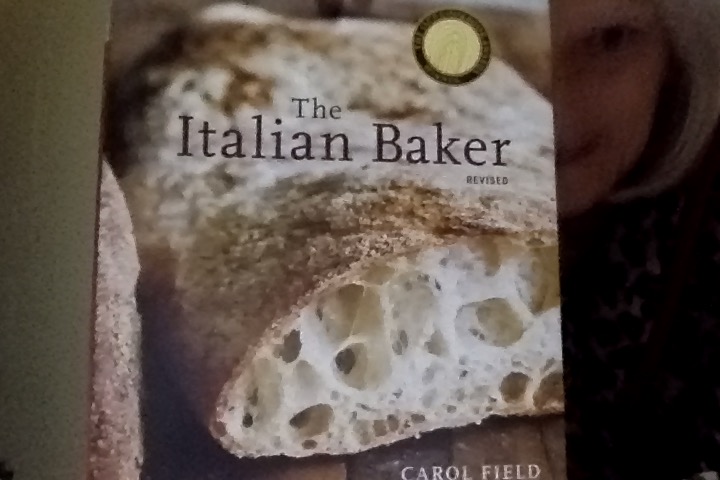
Who can resist bruschetta rubbed with garlic and drizzled with olive oil, almond-studded biscotti dipped in coffee or wine, and, of course, a thin-crusted pizza with fresh, sweet tomatoes and tangy mozzarella? These Italian classics that Americans know and love are just the beginning; there are a wealth of other equally delicious breads and sweets waiting to be discovered.
In this groundbreaking classic—now thoroughly updated for today’s modern kitchen—Carol Field introduces artisanal doughs and techniques used by generations of Italian bakers. Every city and hill town has its own unique baking traditions, and Field spent more than two years traversing Italy to capture the regional and local specialties, adapting them through rigorous testing in her own kitchen.
Field’s authentic recipes are a revelation for anyone seeking the true Italian experience. Here’s a chance to make golden Altamura bread from Puglia, chewy porous loaves from Como, rosemary bread sprinkled with coarse sea salt, dark ryes from the north, simple breads studded with toasted walnuts, succulent fig bread, and Sicilian loaves topped with sesame seeds. The Italian Baker is the only comprehensive book, in English or Italian, to cover the entire range of Italian baking, from breadsticks and cornetti to focaccia, tarts, cakes, and pastries. There is even a chapter on using leftover bread—with recipes ranging from hearty Tuscan bread soup to a cinnamon and lemon-scented bread pudding.
Winner of the International Association of Culinary Professionals Award for best baking book, The Italian Baker was also named to the James Beard Baker’s Dozen list of thirteen indispensable baking books of all time. It has inspired countless professionals and home cooks alike. This latest edition, updated for a new generation of home bakers, has added four-color photography throughout, plus new recipes, ingredients and equipment sections, source guides, and weights. One of the most revered baking books of all time, The Italian Baker is a landmark work that continues to be a must for every serious baker.
Carol Field was an American cookbook author. She wrote about Italy and Italian food since 1972. Her television appearances included being featured with Mario Batali on his series and and baking bread with Julia Child on her series.
This is a book for Italian bread fanatics or for professional bakers, because it is far beyond what the amateur home baker is probably interested in. The supplies alone will set someone back quite a bit of money. But if you are determined to make authentic looking and tasting Italian regional breads in your own home, then this is the book for you.
Just the basic instructions, and an explanation of the equipment and techniques necessary to get the right results, take up one quarter of the book. There is a full index, too, along with a U.S. website that offers sources for the sometimes difficult to find ingredients, and there are even 800 numbers provided in case you need that ingredient pronto!
There is even a long history of Italian bread making, beginning in pre-history and going along to the present day. The author states:
"Bread gives us real glimpses into the complex and fascinating history of all the regions of the country."
The instructions for most breads are provided for bakers working by hand, by mixer, and by food processor.
Special kneading techniques for various types of bread are described, as well as the use of the baking stone, and cast iron pans with rice to add moisture to the bread while baking. I found that not all the instructions were clear, however. Adding more images would help.
All attempts are made to recreate the chewy-porous breads that come from Italy's high-gluten flour and from cooking break in wood-burning stoves.
Regional and rustic breads, modern breads, dishes make with bread leftovers, holiday breads, rolls and breadsticks, pizzas and focaccias are all covered in the book. But while bread is the main focus of the book, it also covers some sweets, such as tarts, cakes, cookies, and sweet breads.
I may try some of the recipes, but the ones that require several days to prepare, and much money to spend on special ingredients and supplies, I'll take a pass on. As I wrote above, this really is a book for an Italian break fanatic, and I'm not one.
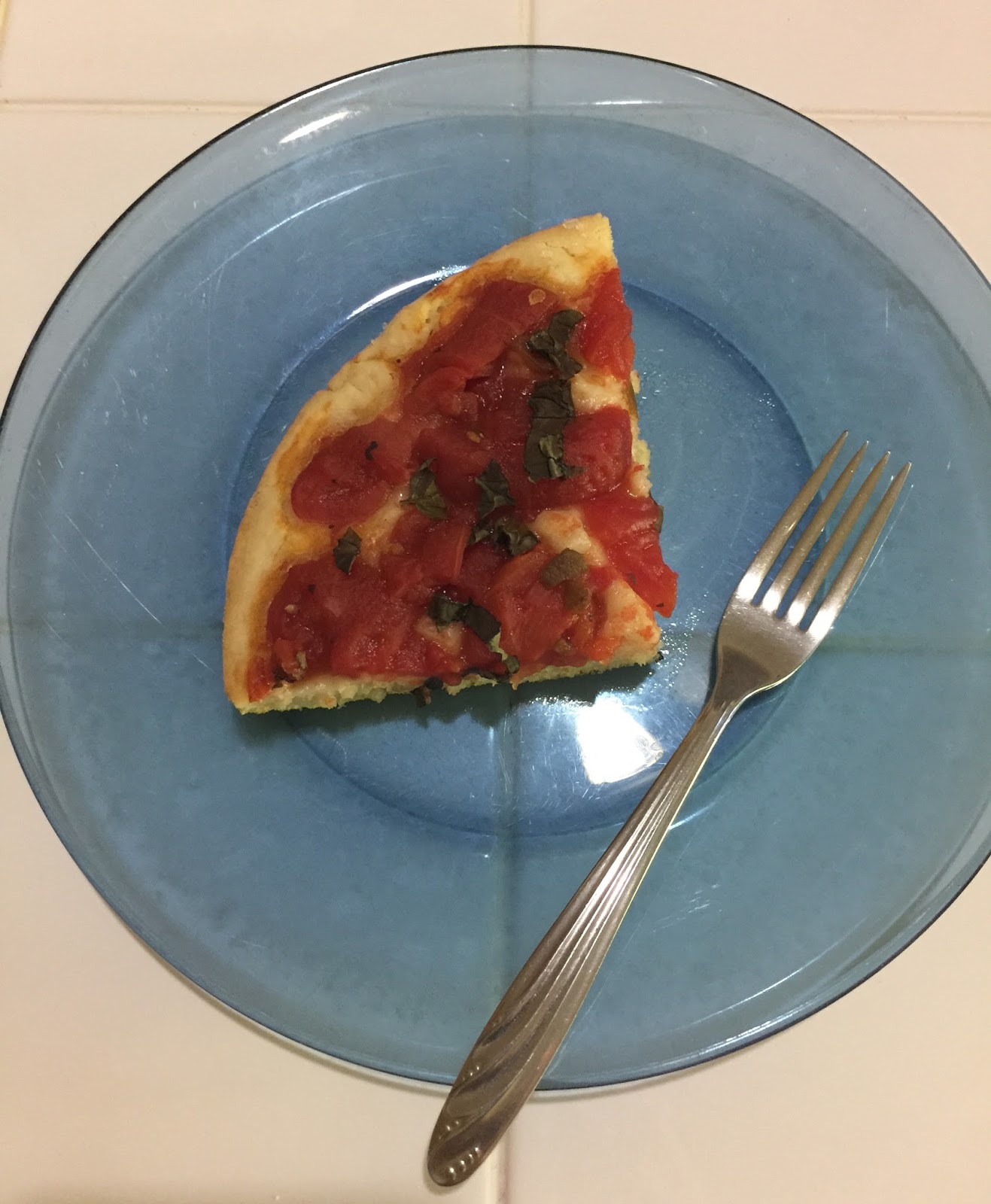
I have slowly, over the last couple of years, been trying out recipes from this book. Last week I made the Pizza all Siciliana (Sicilian Pizza). Field describes this as a "fat pizza" and I think that's a great description. The Sfinciuni tomato sauce is to die for, a rich blend of tomatoes and onions that simmer on the stove for a couple of hours. Delish.
I also posted about this wonderful book a year ago on my blog. I share that post below:
"Bread is merely flour, water, yeast, and salt as the world is merely earth, water, fire, and air."
Carol Field in The Italian Baker
Carol Field offers up recipes of the Italian countryside in this book, including breads, pizza, pastries, cookies, and focaccia. I decided to try focaccia, something that Field suggests has become the national dish.
Field notes that focaccia is "simplicity itself," made from the herbs of the countryside, along with oil from Liguria, and garlic and olives. Sometimes there are variations with tomatoes or oregano, capers or anchovies, basil or sweet onions.
Schiacciata is the word Florentines use for the breads other Italians call focaccia.
Here is the recipe I used:
Schiacciata alla Florentina
2 1/4 teaspoon active dry yeast
1 1/2 cup warm water
2 tablespoons olive oil
2 1/2 tablespoons lard at room temperature
2 1/2 tablespoons of nonfat dry milk
3 1/4 cups flour
1 1/2 teaspoons sea salt
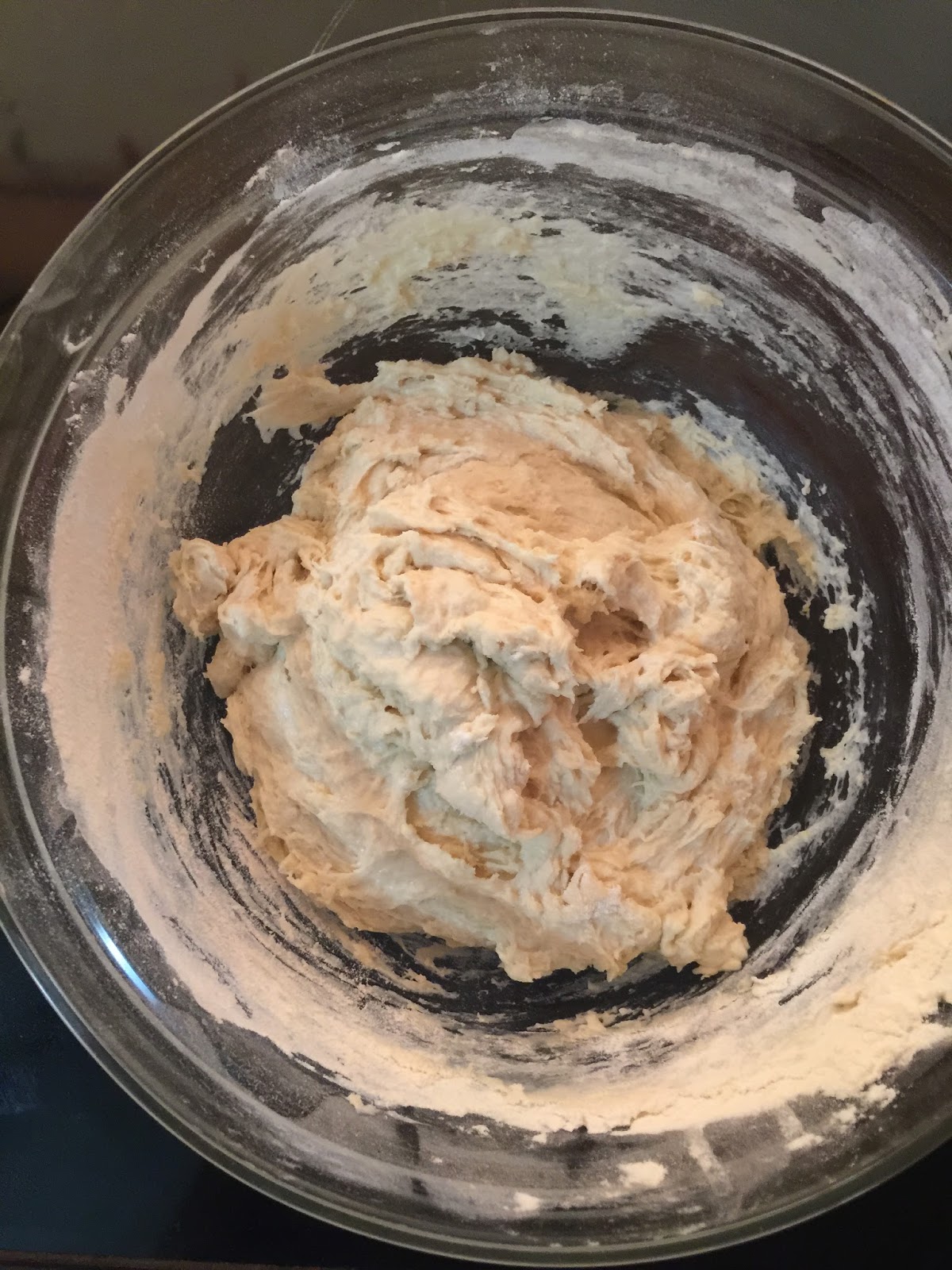
By hand, stir the yeast into the warm water in a large mixing bowl; let stand until creamy, about 10 minutes. Stir in the oil, lard, and dry milk. Mix in the flour and salt and make a well in the center. Pour the yeast mixture into the well and gradually stir the flour into the liquid. Stir until well combined. Knead on a floured surface until velvety and soft, about 8 to 10 minutes. The dough should be soft, so add any extra flour sparingly.
(I didn't have lard, so I substituted butter.)
Place the dough in a lightly oiled bowl, cover tightly with plastic wrap, and let rise until doubled, about 1 1/2 hours.
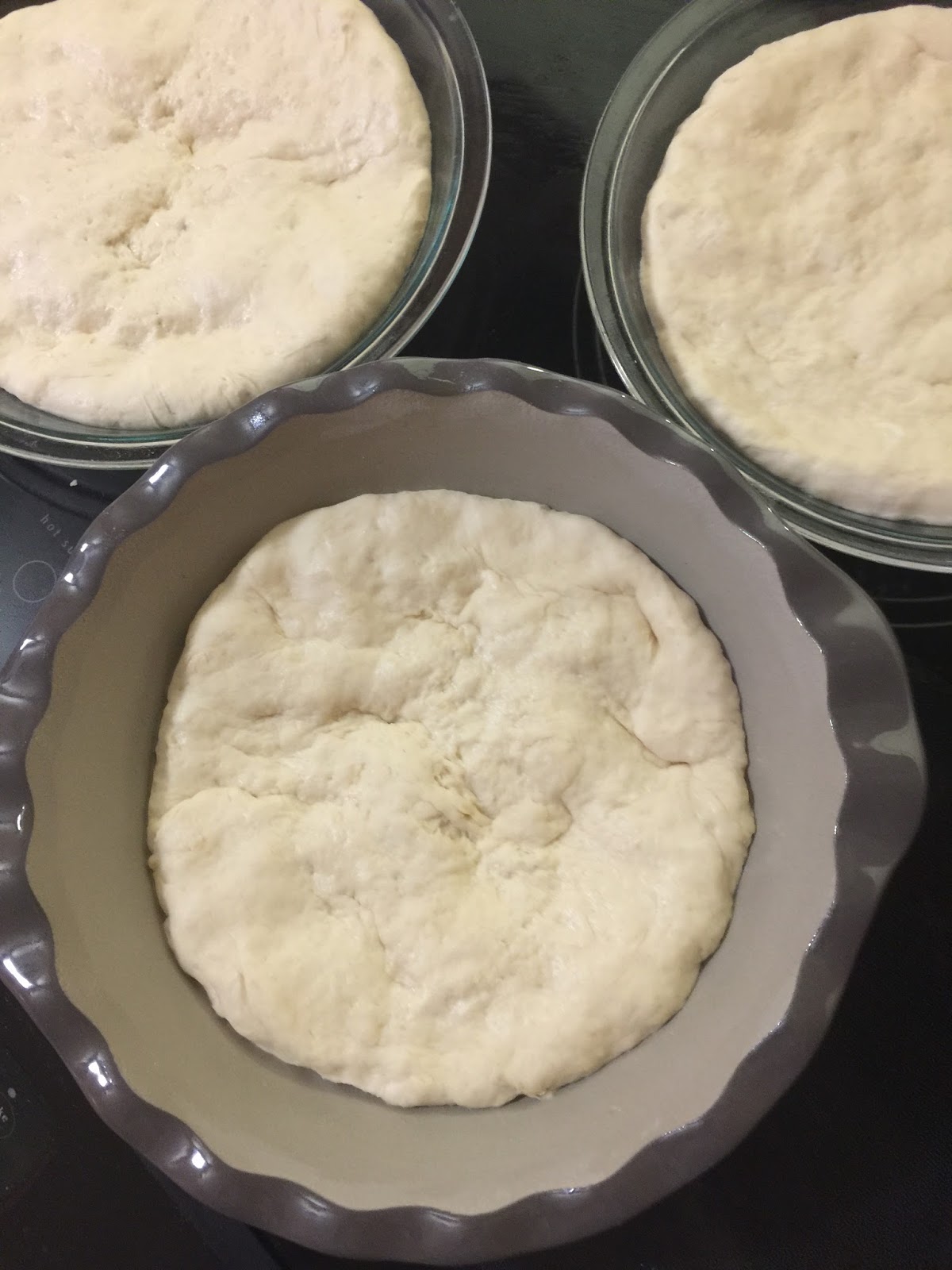
Flatten the dough firmly on a lightly floured work surface and divide into two 8-ounce and one 10 1/2 ounce piece. Roll each piece into a ball and let rest under a towel for 15 minutes. Dimple and spread the balls with your fingers to cover the bottoms of two oiled 8-inch pie plates and one oiled 10-inch pie plate. Brush the tops with oil and sprinkle lightly with salt.
(I had to use three 8-inch pie plates as I didn't have a 10-inch plate.)
Cover with a towel and let rise until doubled, about an hour.
Cover with one of the following toppings:
2 red onions, thinly sliced and sautéed in 2 tablespoons of oil and 1 tablespoon of butter over low heat for 15 to 20 minutes; sprinkle with 1 tablespoon of fresh basil
or 3-4 fresh tomatoes, thinly sliced, sprinkled with chopped basil leaves and 3/4 teaspoon of salt
or 2 yellow and/or red peppers, thinly sliced and lightly sautéed with a large garlic clove in 2 to 3 tablespoons of olive oil for 15 minutes; discard the garlic
or 4-6 small zucchini, cut lengthwise into thin slices and lightly sautéed with 2 whole cloves of garlic in 3-4 tablespoons of olive oil; discard the garlic; sprinkle with 2 tablespoons of chopped fresh basil.
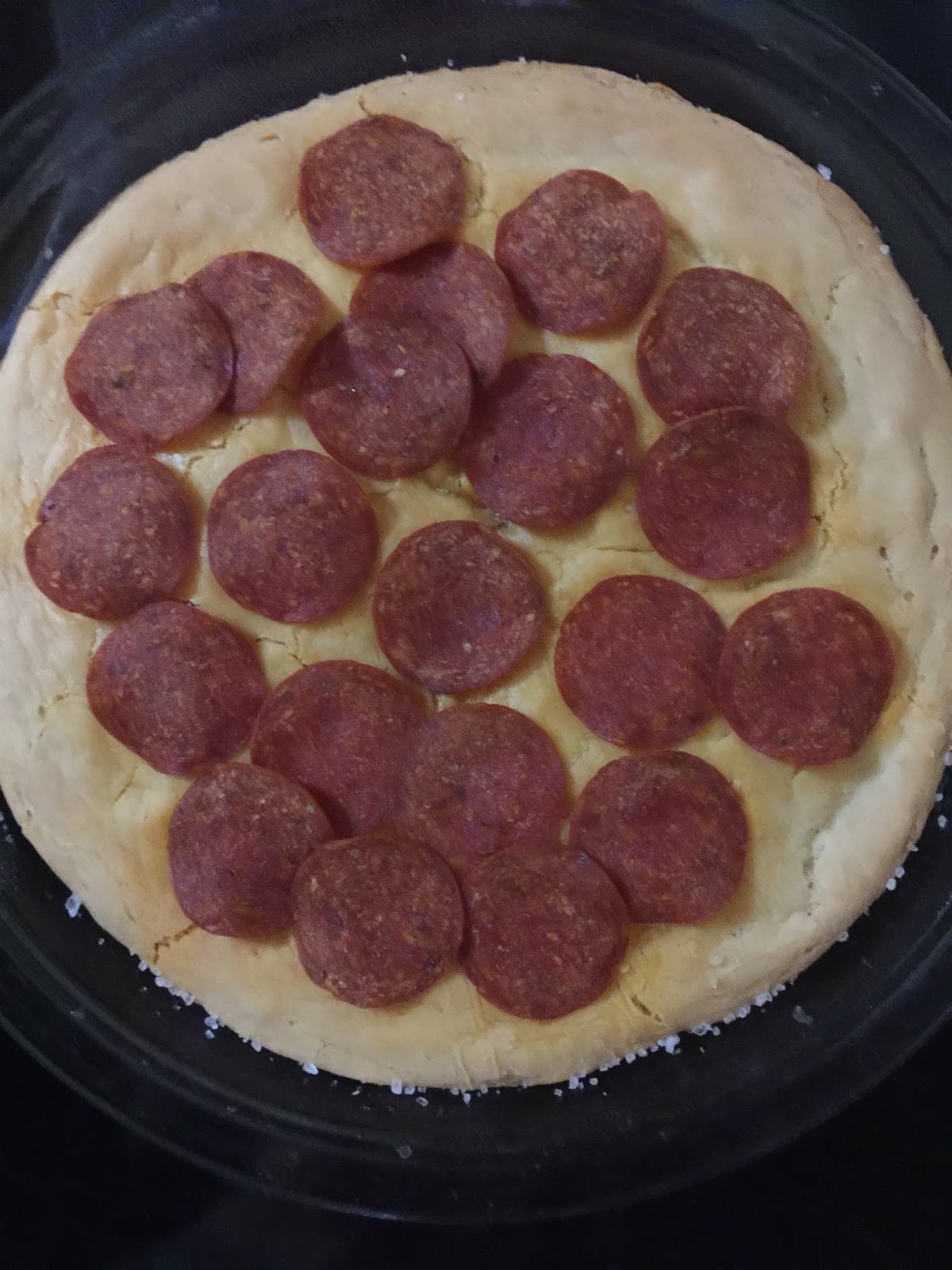
(I used tomatoes with fresh basil for one pizza, cheese for another, and pepperoni for a third. I liked the cheese and the tomato pizzas best)
Preheat the oven to 425 degrees. Using baking stones, if possible (turn on oven 30 minutes before baking) and place the baking pans directly on the preheated stones. Bake the schiacciata 25-30 minutes. Serve hot.
During the last few years of my father's life, he became highly whimsical - buying many things he did not need. He'd then gift many things to me, my brother and my sister. Among the better items he gave me was a signed copy of this baking book. Traditional pizzas and bread were emerging onto the food scene in the Bay Area, and Field's book is the best entry into making traditional bread at home with the aid of a baking stone. There are great things about making ANY kind of bread at home, but if you are a beginner or even an intermediate or advanced baker, you know that there is nothing you can do to recreate the crusty loaves one gets at the local bakery. The ovens just work far too differently from our home ovens. Enter the baking / pizza stone to help you - and Field to explain in progressively easily accessible recipes how to use it.
The section on rustic breads is worth the price of the book. On each recipe, there are instructions for preparing by hand, by food processor and by mixer. Field travelled all over Italy, visiting bakers to learn recipes and then translated them into North American flour types.
I have used my copy of this so many times that the spine has broken. I'd replace it except then I'd have to transfer all my notes.
One of the best lessons I learned from reading "The Italian Baker" is to add a small amount of whole wheat flour to white flour in order to mimic hand-milled flour. For loaves that are look to be made with only white flour, this adds just the right trace of nuttiness and a depth of flavour that is missing with just white flour.
I wish I had bought the print edition, instead of the Kindle edition, of The Italian Baker because I need to constantly flip sections for more complete instructions when baking from it. This inconvenience will stop as I become more familiar with Field's methods. I enjoyed reading all of the histories and background information about bread, desserts and ingredients, but I am having problems recreating the doughs as described. My bread dough is never as wet as Field's, but the bread is amazing. The Italian bread is better than any I have ever purchased from Italian bakeries. The rosemary bread is exquisite and we gobbled it up with our black bean chili.
I tried using our own wicker baskets for bannetons, as Field suggested (and because these bread forms are so expensive), but I never got a pleasant pattern on the crust. I finally found a cheaper source for bannetons and will be using them for the first time this weekend. Once I am used to the "workflow" for these loaves, the breadmaking will be shorter and less messy than it is now. Learning all this is loads of fun and, for me, deeply satisfying.
I have marked many breads, tarts and pizzas that I want to make. Even some cookies, which I usually find frustrating and tedious. If you bake bread, you need to have this book. Go order it now.
I am not much more than an amateur home baker but I have been improving my skills during the pandemic. Lots of baking books have been checked out from the Dallas library. Reading/perusing them made me realize how much I do not know. When I ran across the recipe for pugliese bread in this book, I wonder if I would no longer be afraid of making this bread. I have gotten better at working with yeast after I decided I needed to move beyond quick breads (banana, pumpkin, squash, zucchini). The first time I had looked for a recipe on-line for this bread, I felt intimidated. Once, I saw the recipe in this book, I realized I was ready. Yes! Success with the pugliese and a decent ciabatta too. I have a few more recipes to try. I found a couple of rye bread recipes and cornetti (sweet and savory).
Happy to have found this book. Libraries are our friend.
I have Carol's latest revised edition of this book. Anyone who loves to bake as much as I do will not only enjoy this book, but pick up some great tips for making Italian style breads and pastries. The introductory sections of the book are inviting and interesting in explaining the process Carol used to collect the recipes in Italy and then test them out. Her descriptions of ingredients and equivalents is very illuminating. The recipes themselves are calling to me. I'd been searching for a recipe for "Saronno" style ameretto cookies for ages and found the perfect recipe in Carol Field's book. They are delicious and taste amazingly authentic. I received the book as a birthday gift and I'm working my way through it one recipe at a time!
Just finished reading through all the aromatic 400 pages of this one. Beautifully written with a lot of original ideas (considering it was pubished in 2011) but I was specifically looking for doughs made with poolish starters. But, NO. Not a word or mention of it. But, for pain, dolchi, you can't go wrong. Directions are also given for each recipe according to how you will be making it: hand; mixer; or processor. Not sorry I bought it, I think this will be my 'go to' for many desires.
Great book with terrific recipes and and interesting stories in between. There are enough "good" recipes in this book to make the purchase price justifiable. And by "good" I mean a completely subjective selection of recipes I would try.
This is a great baking book. Took me by surprise as I had not heard much about it. The Italians have a deep and rich regional baking cuisine and this book catches a lot of it. The regional rolls alone make this book exceptional, as to that breads, cakes, tarts, etc. wow.
this book kicked off my interest in baking bread and i haven't bought a loaf since. well, maybe the odd artisanal thing when visiting kids away from home, but not at home. when i went to italy in the 70s, i discovered a society where fresh bread was basic to life. this book helped me to appreciate what went into the making of that staple, not just the assembly of bread--and the techne is critical--but choice of ingredients, where they come from. also, raised my awareness about flours, especially durum, and my appreciation for north dakota and manitoba, where some of the best durum wheat is grown, and how such unexpected places could actually have anything to do with the italian baking enterprise.
Surprisingly useful despite its age ...must have been _way_ ahead of its time when first published. Nice way to see how baking styles have changed (not always for the better:-) in the last few decades. Very pleasant to see a more relaxed -slower paced- style than is typical today; by no means "boring" or "watching paint dry", but invites you to curl up on the couch and really get into it rather than just flipping it open to the necessary information for a recipe then flipping it closed again.
Nice to see that this classic has been reissued. I'm working my way back through the recipes with my son after 20 years of non-baking, and Field's comments are always helpful. Her introduction to the history of bead in Italy is a gem; now I'm eager to read Pellegrino Artusi's 1890 cookbook on her recommendation.
Another cookbook I checked out recently where I was intent on trying at least one recipe, and I could not find one recipe that interested me. I am sure this isn't true for everyone. I'm just reporting my experience.
I am basing this on the one recipe I tried so far. I know one recipe over many months is not many, but I have been trying recipes from a range of sources. The one cake I have made, a spice cake was easy to make and tasted great.
Nonna was from the old country and did her baking from scratch. Regretfully at my age I didn't think to write the recipes down with amounts. This hit the mark of her baking. Thanks for the memories.
I gave this as a gift. I ended up liking what he cooked out of it I bought one for myself!! My favorite is the marbled pund cake with chocolate & vanilla flavors!!