In a work of painstaking and wide-ranging scholarship, backed up by fieldwork among the Kalahari hunter-gatherers, Louis Liebenberg explains how the art of tracking represents a crucial step in human evolution. Liebenberg examines the principles of tracking, and the classification and interpretation of spoor under difficult conditions. He also shows how the original speculative hypotheses of early hunter-gatherers have a direct line to the propositions of modern physicists who track sub-atomic particles. In the book, the author argues that the art of tracking involves the same intellectual and creative abilities as physics and mathematics, and may therefore represent the origin of science itself. The book has been hailed as a real contribution to our understanding of the complexity involved in the process by which indigenous peoples track and hunt animals. It is insightful, detailed and well articulated.
Louis Liebenberg is Co-Founder and Executive Director of CyberTracker and The Tracker Institute. He is an Associate of Human Evolutionary Biology at Harvard University. He is the author of The Origin of Science: On the Evolutionary Roots of Science and its Implications for Self-Education and Citizen Science (2013), The Art of Tracking: The Origin of Science (1990) and A Field Guide to the Animal Tracks of Southern Africa (1990).
Right now, your eyes are following a track of squiggly scratches, and your mind is comprehending meaning from them. This morning, my mental processes created those tracks, and they contain specific meaning for those who have learned the ability to interpret them. The farther you are able to follow my tracks, the more you will learn.
Similarly, animals leave behind tracks and other signs as they move across the land, and folks who are skilled at reading this information can accumulate pieces of a story. The indigenous trackers of the Kalahari Desert in Botswana can perceive a fantastic amount of information by studying spoor — footprints, urine, feces, saliva, blood, fur bits, feeding signs, smells, sounds, and so on. Spoor provides clues about the animal’s species, gender, size, behavior, direction of travel, time of passage, and so on.
There are large regions of the Kalahari that are quite flat, an endless landscape having no notable landmarks for a white boy like me, who would quickly become hopelessly lost, and turn into cat food. Hunter-gatherers, on the other hand, always know exactly where they are, because they orient themselves by the layout of plant communities, noting their size, shape, position, and unique features. They know the face of their land as well as they know the faces of their family.
Louis Liebenberg is a South African lad who has spent years with Kalahari trackers, learning their art. He calls himself a citizen scientist, not a professional, and he has special gifts for thinking outside the box. His work has impressed famous academic heavyweights at Harvard. In 1990, he published The Art of Tracking.
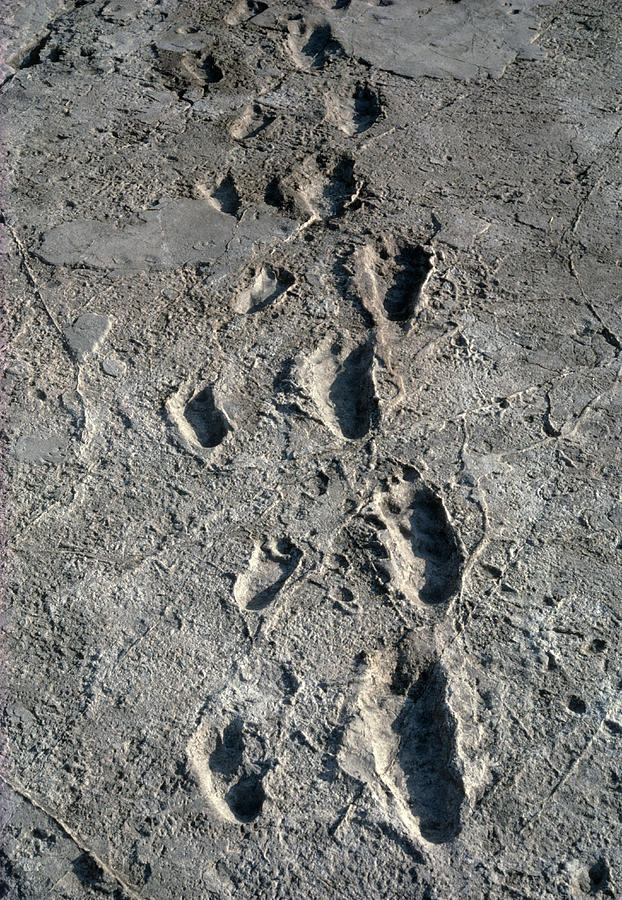
After our primate ancestors moved out of the trees, they eventually evolved for bipedal travel — walking upright on two legs. In Tanzania, 3.6 million years ago, two bipedal ancestors left their footprints in wet volcanic ash. In 1978, scientists discovered 70 of their fossilized footprints, in a sequence that was 88 feet long (27m). [Image] These ancestors were probably Australopithecus afarensis.
Today, our living primate relatives are quadrupeds, four legs. Chimps can sprint much faster than humans, but we excel at running long distances. Moving on two legs is more energy efficient than on four. Evolution optimized our feet and legs for the spring-like mechanics of running, not walking. Over time, we lost our fur coats, and developed the ability to sweat profusely, so we excelled at shedding body heat. Standing upright gave us a better view of the surroundings.
Many game animals can move much faster than humans, for short bursts, then they must stop to cool off. The desert is especially hot at midday. Humans are unusual because we can run for hours in the heat of the day. We can doggedly follow the tracks of speedy prey, not giving them a chance to rest, until heat stroke brings them down, and often kills them. Hunters also carried spears or clubs, to finish the job, if needed. HERE is a 7-minute video.
This is called persistence hunting, and Liebenberg was apparently the first civilized scientist to participate in this (he nearly died from heat stroke). In other regions, this method has been used to hunt reindeer, kangaroos, deer, and pronghorn antelope. Our ancestors have likely practiced persistence hunting for two million years or more. It played a central role in the evolution of the person you see in the mirror.
Gorillas are vegetarians, spending long hours stuffing their faces at the salad bar. They have evolved large guts in order to digest this bulky fibrous diet. In addition to plant foods, chimps, bonobos, and baboons also eat meat, an excellent source of nutrients and calories. They are good at predation, killing small animals without weapons.
In the early days, our bipedal ancestors likewise killed small critters with their bare hands. Eventually, they became hunters. Early hunters used pointed sticks, stones, and clubs to stun small mammals and birds. By and by, the ancestors learned how to kill large game, via persistence hunting, javelins, spears, bows and arrows, and so on. Meat maybe provided forty percent of their calories.
In addition to predation and hunting, our ancestors also acquired meat by scavenging. Large carnivores often kill large game, devour as much as possible, and then abandon a partially eaten carcass. On the Kalahari, hunters always note vultures circling in the distance. They indicate the location of a dying animal, or a yummy carcass. With luck, our ancestors’ running abilities sometimes enabled them to beat the hyenas to lunch. Hyenas are not as good at shedding heat. They periodically need to stop and pant to cool off.
Because game animals can move faster than humans, for limited distances, the success of persistence hunting largely depended on tracking skills — following the spoor of their chosen prey who might be out of sight. Kalahari people had exceptional tracking skills. Women were as good as men, or better, at interpreting spoor. Everyone in a band, both men and women, could observe human tracks, and accurately identify the individual person who made them.
One time, Liebenberg asked some trackers if they could actually recognize the spoor of an individual antelope. “They found it very amusing that I should ask them such a stupid question. To them it is difficult to understand that some people can not do it.” Liebenberg described three levels of tracking strategies.
(1) Simple tracking is just following the prey’s footprints, under ideal conditions, when the prints are clear and easy to follow.
(2) Systematic tracking is used when the spoor trail is less than complete. Using reasoning and deduction (inductive-deductive reasoning), the tracker can then develop a hypothesis of what the prey was doing, and the most likely direction of its escape route. This is solely based on real evidence. Then, the hunter proceeds in the prey’s probable direction, in hope of picking up the track again.
(3) Speculative tracking is the most advanced and creative. “Anticipating the animal’s movements, by looking at the terrain ahead and identifying themselves with the animal on the basis of their knowledge of the animal’s behavior, the trackers may follow an imaginary route, saving much time by only looking for signs where they expect to find them (hypothetico-deductive reasoning). By predicting where the animal may have been going, the trackers can leave the spoor, take a shortcut, and look for the spoor further ahead.”
Like vervets, baboons, jackals, and most other species, our ancestors learned ways of communicating with each other, via sounds and gestures. Some birds make one warning call for lions, and a different one for snakes. Many species, including humans, pay careful attention to the vocalizations of other species. It’s good to know when a lion is approaching, long before it can be seen.
At some point, nobody knows when, the ancestors developed complex language. As social animals, they lived in small bands. Each member collected and shared information, and the group developed a body of wisdom. Language made it easier for them to relay accumulated wisdom to the next generation.
Biological evolution (genes) moves at a snail’s pace, but cultural evolution (knowledge) can boogie like gazelles on meth. With spears and javelins, the ancestors didn’t need to spend hundreds of thousands years evolving claws and fangs.
A few million years of scampering through the rainforest canopy, followed by a few million years of persistence hunting and tracking, fundamentally directed the evolution of our bodies and minds. Today, we have abandoned our ancient way of life; it’s nearly extinct. Imagine what we’d look like after 500,000 years of sitting on couches, entranced by glowing screens, chugging sugar water.
I’ve now given you a wee whiff of this book. When I write reviews, I usually select a few subjects that especially interest me. This one was especially interesting from one end to the other. It carries readers off to a sacred mountaintop, where we can get a better view of the big picture. If we want to live sustainably for hundreds of thousands of years, simple living is the only option. What good are all our amazing gizmos if they require an insanely unsustainable flash-in-the-pan culture?
In every way, the wild people of the Kalahari were completely in tune with their ecosystem. In my world today, I observe the opposite — a society that could not possibly be more alienated. Recent DNA mapping strongly suggests that the hunter-gatherers of the Kalahari are the ancestors of all humans now on Earth. You and I carry their genes. Liebenberg pulls back the curtains of modernity and provides readers with a mind-expanding peek into distant corners of our family tree — the ancestors we have forgotten, and would be wise to remember.
In 2013, Liebenberg published The Origin of Science, which furthers his discussion of our Kalahari relatives. My review is HERE. There is some subject matter overlap between the two books, and my two reviews. Sorry! Take your anxiety meds.
Free PDFs of two Liebenberg books can be downloaded HERE. YouTube has many Kalahari documentaries.
The main idea of this book is expressed in the title - that the mental techniques and attitudes used by modern day scientists first developed in humans using tracking in hunter-gatherer societies.
I'm not a scientist so I can't speak to the validity of this idea, but I found it very convincing. Liebenberg draws knowledge and examples from his own time among Kalahari tribes as well as recorded observations from other academics who have spent time with hunter-gatherer tribes, mostly from Africa.
I was amazed by the depth and genius of tracking methods illustrated. Extremely subtle details found in the environment are combined with lateral thinking and a prodigious knowledge base to produce useful assumptions about animals' activities. Tracing this process held the wonder of unveiling the secrets behind a magician's trick, except instead of illusion the method was an extreme combination of skill, learning and logic.
Liebenberg begins by putting tracking into the context of early human subsistence and demonstrates the importance of tracking to human survival in different periods of development and environments. I'd imagine some of the evidence from the 70s and 80s that he used in this section could have become obsolete these days, but this is only a prelude to the sections about extant cultures.
Beyond simply following an unbroken string of footprints, Liebenberg classifies advanced tracking into two forms: systematic or speculative. Systematic tracking uses all available evidence and knowledge to work toward logical conclusions. Speculative tracking is instrumental where less evidence is available, using imagination and intuition to make hypotheses about the animal's activities that are constantly tested and revised. Later in the book he directly compares these to modern scientific methods, framing them as complementary modes of thinking that are both useful to science. He also compares the methods of tribal trackers to scientists in revising their personal body of conclusions, working with a small group to actively test them, and sharing them with the wider community.
Although it wasn't a main point of the book I was struck by the similarities between tracking and the archaeology described in the earlier chapter, which often used very sparse evidence such as bones, tools and cut marks to make complex inferences about prehistoric life.
Due to the clear central idea and the many colourful examples from real life I found this book a relatively enjoyable read. It did occasionally get bogged down with a lot of details of tracking principles. Although it is not set out as an instruction manual I think anyone interested in tracking would get a lot out of it as it goes through many practical concepts in order to give a picture of how tracking can work. I think it would also appeal to those who are interested in human development, anthropology, animal behaviour and ecology.
This book feels like taking a step back and learning some part of what it was like to be human for the thousands of years before civilization.
For thousands of years, people carefully learned about the natural world and worked hard mental effort to track animals for hunting. This wonderful book makes the case for how similar ancient hunters were to modern scientists.
The book is, perhaps sadly, too formal and thorough to break into the wider public imagination. But I loved it.