A heartwarming debut introduces readers to the adventures of its overachieving porcine narrator Blending the sophisticated satire of Jonathan Swift with the charming exuberance of a Pixar film, Pyg tells the story of Toby, a truly exceptional pig who lived in late eighteenth-century England. After winning the blue ribbon at the Salford Livestock Fair and escaping the butcher's knife, Toby tours the country, wowing circus audiences with his abilities to count, spell, and even read the minds of ladies (but only with their permission, of course). He goes on to study at Oxford and Edinburgh—encountering such luminaries as Samuel Johnson, Robert Burns, and William Blake—before finally writing his own life story. Quirky, beguiling, and endlessly entertaining, this memoir of a "remarkable sapient pig" is a sharp and witty delight.
"I know of no other animals who are more consistently curious, more willing to explore new experiences, more ready to meet the world with open-mouthed enthusiasm. Pigs, I have discovered, are incurable optimists and get a big kick out of just being." - Lyall Watson, The Whole Hog: Exploring the Extraordinary Potential of Pigs
Having had a boundless love of pigs since childhood (so much so that most of my cuddly toys were pigs rather than the more traditional bears), I was in Hog Heaven throughout Pyg. The book tells the tale of Toby, a pig whose feats of learning and intelligence astound such 18th Century luminaries as Samuel Johnson, Anna Seward, William Blake and Robert Burns. A boy named Sam literally saves Toby's bacon by convincing his uncle not to sell the pig at market. When Toby demonstrates his remarkable intelligence, it becomes obvious that much more money can be made from touring 'Toby the Sapient Pig' than by selling him as meat. Toby and Sam go to live with Silas Bissett, a mysterious figure on whose estate all manner of trained animals exist in apparent happiness. After a period of study during which Toby learns English, arithmetic and 'mind-reading' tricks, the menagerie embarks on a tour of Britain and Ireland. Toby's adventures see him coming dangerously close to being served up on a dinner table; our porcine protagonist learns that for every charitable human who treats him with kindness and an open mind, there exists a cruel one eager to do him harm. Overcoming all adversity, Toby embarks on studies at Oxford University then later at the University of Edinburgh.
Having Toby as narrator of the story works well. The first-person (or, more correctly, first-pig) narrative is written with such excellence, and from such a uniquely porcine perspective, that the entire tale has a palpable sense of authenticity. The reader is on Toby's side from the start, rooting for the lovable pig throughout his myriad adventures, and fearing for his safety when he finds himself in danger. To anchor the book stylistically in the late 18th Century, Russell Potter has written it in eloquent old-school prose. Even the typeface (Caslon Antique, created in the late 1890s) and capitalisation of key words are true to the 18th Century style.
The story never feels implausible, which is testament to Russell Potter's literary prowess and the lovability of Toby as a main character.
In the late 18th Century, the learned pig became a popular circus attraction, with the pig spelling words with cards, they could answer questions, tell the time and even read minds! The first sapient pig was Toby and this is his story. Whilst the pig was a real historical figure, this is a fictionalised account told from Toby's point of view.
The prose is written in a mock 18th Century style and the font used is even reminiscent of the worn type used at the time. If you can suspend disbelief for the length of this fairly short novel, Toby will bring a smile to your face. Of course, the real pig would never have been quite so learned and he didn't meet so many important people but history suggests that a lot of them did talk about him. At the back of the book are notes about some of the characters that did actually exist and it's an interesting historical read in some aspects. Whilst many people have written about the life of prohibition era circuses, this is where they started out, with travelling showmen and their well-trained livestock.
In 1817, a biography of Toby, The Life and Adventures of Toby, the Sapient Pig; with his opinions on men and manners was released as a pamphlet and is commented on in Pyg as fraudulent. The British Library still hold a copy of the original in their collection.
I read Russell A. Potter's book with great fascination. He mentions that my musical "Toby the Incredible Learned Pig" was the inspiration for his book. I was flattered by this. Although both works are based on the Learned Pig or pigs they are certainly different. I based my writing on the information in Ricky Jays classic book "Porcine Prophets and Fireproof Women". Also I had a copy of Toby's autobiography from the Folger Shakespeare library and other books and articles on fairs in Britain. I tried to weave the different stories into one whole for the limited half hour time slot alloted. My Toby mentions his reincarnations as well as a birth from aristocratic parents. Russel Potter has a detailed itinerary of the travels of Toby and all the venues he performed at. I especially enjoyed his quips and the various luminaries of the time who dart in and out of the story line. By the addition of the teen character Sam Nicholson he makes it a story that a young adult, who wants to stretch, his mind might enjoy. I was unaware of the Oxford connection but enjoyed it very much. Don't they have a pub there named The Blue Boar? Also I enjoyed the typeface and the copious notes. Fun read!
Una finta biografia di un maiale capace di comunicare attraverso delle tessere. Mi ha sorpreso molto perché questo romanzo nasce a metà dell'ottocento e ci sono delle riflessioni antispeciste rivoluzionarie per l'epoca però non conoscendo l'opera originale temo che siano il frutto di un revisionismo attuale da parte del curatore di questo racconto. Questo maialino sapiente però si é dimostrato molto individualista e poco interessato al destino dei suoi simili, cosa comprensibile tenendo conto il contesto storico e la scarsità di possibilità nell'agire, però nel vedere il suo protagonismo e l'accogliere con fastidio la notizia di altri animali sapienti hanno fatto sì che Toby non mi stesse molto simpatico. La parte finale é la più lenta, più Toby é dotto e più la sua storia diventa paradossalmente meno interessante. Ultima critica é l'eccessiva carrellata di nomi a cui é stato difficile star dietro.
Was there really a pig who could read and write English? Reading this finely-crafted narrative is like watching an expert magician perform. Deep down you know it couldn't be real, yet from the first page onward, there is a nagging feeling that maybe, just maybe, it might have really happened.
The book begins with an Editor's Note (Potter credits himself as the book's Editor, not its author), which in scholarly language states that the present volume is based on Toby the Pig's original published memoir of 1809. There was indeed a "miraculous sapient pig" named Toby, who toured the fairs and performing halls of late 18th Century England and Wales.
As he tells it, Toby begins life on a farm, has a narrow escape from the slaughterhouse, and ends up in the care of a traveling entertainer with his troupe of performing animals. His linguistic skills are developed subtly, from first hints of understanding to training in card tricks and onward to...well, no plot spoilers here. Toby's travels through England and Ireland are depicted with nicely drawn details of places, clothing and transport.
But this is not a cute, archaic "Babe the Pig". More like Charlotte's Web meets Stromboli's Circus in Pinocchio. The relationships between Toby and his human caretakers, and the portrait of the cruel world of late 18th Century traveling circuses, are touching, funny, sad and gut-wrenching, and often terrifying.
The real joy of Pyg is the language. At first the slightly archaic terms and spelling might seem off-putting, but by the second page they meld into the rich and sonorous voice of Toby, which sweeps you along for the next 230 pages.
The book ends with a generous section of historical notes. It turns out that most (or all) of the people and places which appear in the narrative actually existed. As did a short book published in 1805, entitled The Life and Adventures of Toby, the Sapient Pig.
At the end you'll feel happy at having just enjoyed a well-told, unique and eccentric story, and you'll be scratching your head wondering just how much of it was true.
Finally, if you can get your hands on the original British hardcover edition, you won't regret it. Rarely do you find books these days with so much craft put into the design. From the exquisite, tactile cover to the slightly yellowed paper to the typeface, which mimics the look of 18th Century metal type, the book is a treasure to hold and look at.
Pyg, by Russell Potter, promises much and delivers little. For a book that is supposedly the "memoir of a learned pig," a subject which sounds at first inclination to have the potential to be most amusing, the actual narrative is very dry and lacking in much plot development. Essentially, Toby the pig is rescued from the slaughter, learns to spell as part of a performing act, and when it is recognized that he can actually read and understand the words in front of him, he gets the chance to become more educated. Nothing else of interest takes place that is not articulated in the cover description. Pyg is neither a comedy nor is it a social commentary in the style of Animal Farm. It is simply a matter-of-fact narrative that, had its protagonist been human rather than animal, would have no interest to readers whatsoever. As it stands, Pyg might be more interesting to advanced middle grade readers, providing that they have the necessary vocabulary and sufficient patience to wade through this text.
Toby is a sapient pig living in England in the late 1700's. He has written a memoir of his life on the stage and at University with the assistance of his friend. Toby faces adversity in the form of a scornful and disbelieving public, but also finds his champions and admirers are many. The tale is alternately heartbreaking and heartwarming. Toby is a likable narrator and the reader will fall in love with him. He understands much about the world about him and makes valuable observations about the nature of humanity and the thirst for knowledge. My only complaint about the book were the various italicized words, which I felt interrupted the narrative flow, as it did not seem that these words were to be emphasized. In fact, I could discern no rhyme nor reason for the device, except that possibly this was frequently done in texts of this era. The Capitalization of words that have come to be more frequently lowercase in today's grammar was more readily ignored as well as accounted for.
It's a cute read but it does drag on repetitively, it's perfect on the nightstand for pre-bed reading for that reason, a charming bore (a very British description maybe, for a very British book). I enjoyed the author's commitment to treating the book as a true work of non-fiction, with a House of Leaves-esque historical notes section on the people referenced in the narrative that sometimes doesn't match Toby's.
Overall the book has almost no humor, and the deeper questions an autobiography written by a sapient pig could possibly answer remained unexamined. Why was it Toby that was able to learn language? Do all pigs have this potential? It's mainly a dry telling of the places and the conditions of those places where Toby found himself. Deeper examinations of possible activism, employment, interpersonal relationships, the nature of consciousness, the results of any scientific examination - none of these avenues are explored. A cute concept but a missed opportunity.
One of my favorite passages, that also gives you an idea of how the book reads and is an example of the closest attempts at humor: "There is scant consolation, when regarding one's life with humans, who have a proclivity for accidental doublings of meaning, call 'hind-sight', in saying that what happened was necessary, and what was necessary indeed happened. And yet so it was with me: had it not been for the fortuitous circumstance of Sam's youthful sentiment there can be little doubt that, instead of this my book before you on your table, you would have a rasher of bacon and a rack of ribs - and that these would be my only mortal remains. Among your kind, such things are quite commonly credited to divide Providence, but as I recall, the good Lord dealt only once with pigs - which was when he sent into them a horde of demons, causing them to leap off a cliff to their deaths - so I will, I hope, be forgiven if I do not give thanks to that particular source."
Ci si può sentire in colpa ad entrare dal salumiere per comprare del prosciutto dopo aver letto un libro??? Sì... se si ha letto questo! Vengono narrate le memorie di un maialino, Toby, che potrebbe essere considerato dai più un fenomeno da circo visto le sue capacità. Invece gira per teatri, si fa conoscere grazie alla sua sapienza e intelligenza, visto che è in grado di leggere, compitare, ragionare addirittura e porre domande. Grazie anche al suo amico Sam e a chi lo porta a fare spettacoli nel Regno Unito, addirittura viene portato ad Oxford dove gli verrà insegnato il latino e materie scientifiche difficili per i più. Un libro che avevo preso per "svago" dove pensavo di trovare leggerezza, invece vi sono degli spunti di riflessione non indifferenti su vizi e virtù umane. L'autore ha creato benissimo queste memorie, un mondo e dei personaggi che, oltre a portarti nell epoca storica narrata, mi hanno dato modo di pensare che Toby sia realmente esistito... e chissà quanti prosciutti potevano essere dei maiali sapienti come lui, se solo si avesse dato loro modo di evolvere e studiare..
Russell Potter claims only to have edited this book that was written by a pig named Toby. Toby dictated his story by using a letter board to spell out words and his trainer would write them down. Toby's story began on farm where Sam lived with his uncle. Sam particularly liked the pig, Toby and was very distraught when he found out Toby was sold to a butcher to be made into ham, bacon, sausage and so for. So with the help of Sam escaped from the butcher and ran for their lives! Eventually, they ended up on the farm run by Mr. Silas Bisset who had a traveling animal show. Mr. Bisset trained his cats, dogs, turkeys and now a pig to perform at the shows put on in various town. In the meantime, Sam is actually teaching Pyg to read! This is a really fun story and it makes you want it to really be true-that a pig could read and communicate and become the most educated pig to ever attend Oxford College in England.
Pyg is a novel written to look like a genuine memoir, assembled and edited by Russell Potter from original late eighteenth-century manuscripts, allegedly held in the Bodleian, University of Edinburgh, and the National Library of Ireland in Dublin. This is all established with great care, including a doctor’s endorsement that the author is indeed, “anatomically and in every other sense, a pig.” By the time the narrative begins, the reader is expected to have suspended disbelief that this is a work of fiction, and to interact with the text as though it is a genuine memoir.
The book is set in Calson Antique, a font meant to imitate the old printing fonts of the late eighteenth century. This adds some dimension to the text in the same way that costumes contribute to a play, but Calson Antique is a bit hard on the eyes. Its rough edges are intended to mimic the chips and cracks that lead letters would acquire with frequent use, and I found my eyes getting tired much more quickly than usual.
Pyg is narrated entirely in first person by Toby, using the language and capitalization common to the time and place when he lived. Toby’s life is initially unremarkable, but by luck he has a series of encounters with humans who view pigs as something more than bacon-in-waiting. These characters elevate Toby above the fate of a common pig and give him the tools and knowledge necessary to become The Sapient Pig — his claim to fame.
The premise of this book is very interesting, and the manner in which Potter establishes its context makes it easy to suspend disbelief, but by the last third of the book I found Toby tiresome. He pontificates so quietly, padding his opinions with manners and professions of gratitude, that his hubris would be easily missed if he didn’t repeat himself so often.
For example, Toby makes his opinion on the practice of eating animals clearly known on many occasions. Animals are represented as intelligent, emotional beings whose earthly remains are cut up according to the whims of Man’s tables, so if you’re teetering on the edge of vegetarianism, this book might just push you over.
Toby frequently compares the behaviour of animals and humans in terms of moral quality, and always finds the innocence of animals superior, to the point of painting anything non-human with the same brush used to render the Noble Savage. Toby’s statements imply that the the casual cruelties engaged in by animals are somehow better because they are not premeditated and are undertaken for survival, whereas human cruelties are engineered and endlessly justified.
Toby’s entire life is spent consorting with humans. First with Sam, his Benefactor, and then with Mr. Bisset, his trainer, and with many other teachers, handlers, and businessmen — some of them men of note, whose names the reader will recognize. Throughout all these anecdotes, Toby is careful to imply that, though he is grateful to these people for their generosity and skill, their race is flawed and he is somehow above them for possessing both animal innocence and human knowledge.
Though Toby got on my nerves, he’s not all bad. I was somewhat amused by Toby’s interactions with Miss Seward, the closest thing to a love interest in Pyg. I think it’s fair to say that Toby has an intellectual crush on Miss Seward, which is quite sweet.
Later in the novel, after Toby has stopped performing in order to pursue his education, his pride — one of the character’s most humanlike faults — is wounded by word that other performers are imitating his act and profiting by it. Toby endeavours to retain his title of The Sapient Pig against imitators and successors, with mixed results. He struggles with the opposing desires to retire from the stage and to remain relevant to the public. To accomplish the latter, he must be in public, something that Toby eventually accomplishes on a more permanent basis by publishing his memoirs. If Toby had no pride, he would have never cared enough to have written the book. I daresay he has not totally escaped human vice, despite his preaching.
As a novel / pseudo-memoir, I’d recommend Pyg to fans of the classics. The writing style and vocabulary aren’t the most easily accessible, and casual readers of fiction might struggle to get into the book unless they’ve already trained their brains with eighteenth and early-ninteenth century works. Other than that, Pyg is an interesting representation of England and Ireland at the end of the eighteenth century — its social geography, its economy, even its morality. Give it a try if you’re in the mood for something totally outside the box (but remember: vegetarianism may result).
(I received an advance copy of Pyg from Viking, an imprint of Penguin Canada, in exchange for an honest review.)
I feel a slight tang of guilt as I sit down to write this review, as I definitely wasn’t in the right mindset to fully appreciate Pyg: The Memoirs of Toby, the Learned Pig. This is a case of misplaced expectations, and so you`re welcome to take the little I have to say about Russell Potter`s latest with a grain of salt.
'Had it not been for the fortuitous circumstances of Sam's youthful sentiment, there can be little doubt that, instead of this my Book before you on your Table, you would have a rasher of Bacon and a Rack of Ribs—and that these would be my only mortal remains.' So begins the memoirs of Toby. However, these are no ordinary memoirs; these are the memoirs of a pig; the most gifted, charming, distinguished (and luckiest) pig in recorded history.
After escaping the butcher's knife with the help of his steadfast companion Sam, Toby soon finds himself under the order of the volatile impresario Silas Bisset and his travelling menagerie of performing monkeys, horses, turkeys, and canaries. Before too long, he is packing out theatres and concert halls, impressing the crowds with his ability to count, spell and even read the minds of ladies. But celebrity comes at a cost.
Despite the evident seriousness of the synopsis, I had assumed that a book called Pyg: The Memoirs of Toby, the Learned Pig would have a sense of humor (if not about itself, then about 18th century England ... I mean, look at the cover ... it's a pig wearing a sweater). This, as it turned out, was totally off-base. There`s very little humor involved, and when there is, it`s often of the crusty, Jane Austen style of which I`m not a fan. Because I expected something a little more playful, Pyg was a bit too stuffy for me. The story itself is only 232 pages (and small pages at that), and yet I was more than eager to just finish the damn thing to get it over and done with. That`s about all I have to say about the experience.
But since you`re wanting at least a half-hearted review, I`ll mention a few more things. Potter anchors the text, stylistically, in the 18th century. It`s written in eloquent, classical prose, and even the typeface sets the tone. The book begins with a disclaimer written by a doctor who asserts, without doubt, that this book was written by a legit pig. So there are a lot of neat little details that help form a cohesive 18th-century product.
The big issue, though, is that this is a (fictional) memoir, rather than a novel. Since Toby’s sapience is never addressed, the mystery of it would have worked so much better had the novel been narrated by, say, Toby’s friend Sam. There would have been a power to the story had we not been inside Toby’s head. However, the memoir style was executed extremely well (for what it was trying to do). I just thought it was the wrong choice. (I do think, though, that Potter was trying to separate this story from other animal-sapience stories, like, say, Ishmael; which wasn’t a terrible decision.)
I was also a bit perplexed by the fact that the book doesn't make any insightful arguments about the nature of carnivorous/destructive/power-hungry humans. If Toby is the first pig to ever have human-level thought, then we should be privy to a host of interesting commentaries and realizations about the life of a pig (and, by proxy, the juxtaposition of humans and pigs). It occasionally attempts to show the foibles of man, but these are mostly shallow and/or unconvincing (i.e. the repeated notion that animals are more civilized than humans … I see where Potter is coming from, but it’s a bit of a reach to claim superiority as a result of innocence).
Some readers seemed to really enjoy how Toby meets and interacts with famous real world luminaries in the second half of the tale, but they were a bit of a letdown. They don’t have much of an effect on the story, and the result is almost a long-winded name drop session. The concept was a bit of a wasted opportunity.
But, despite its flaws, I can’t say that I disliked Pyg. It definitely wasn’t what I expected, but if you’re in the market for a quirky 18th-century romp about a sapient pig, then this is the book for you.
Premise: The author, Russell Potter, assumes the persona of “editor” is this novel, the (obviously) fictitious “found memoirs” of a sapient pig named Toby, the porcine embodiment of the phrase “knowledge is power.” The story itself is very sweet and follows Toby from his piglet-hood to adulthood. With the help of his human companion, Sam, Toby narrowly avoids the slaughterhouse and finds himself the main attraction of an animal circus where he is accidentally, then intentionally, taught to read. Over the course of his life, he trods the boards in London, studies at Oxford, and encounters luminaries such as Samuel Johnson, William Blake and Robert Burns. Not bad for a pig…I wish the “editor” himself were nearly as successful.
To really convey a sense of time and place, Potter appropriates the construct of historical diary. As I was reading, I kept having flashbacks to high school readings of The Dairy of Samuel Pepys…which was part of the problem. Historical diaries aren’t written to be read as novels; in Pepys’ diary, there are lots of entries that consist of events and descriptions of the day to day, which aren’t exactly the most riveting to read. Interesting: yes. Exciting: no. And unfortunately, Potters’ piece consists of a lot of listing of events, mostly of traveling. You know how there are entire passages of the Bible that read like “and ________ begat __________, who in turn begat ______ and _________”? I feel like there were entire stretches of the narrative that read like “from thence we traveled to __________ via _________, whence we happened upon the __________ Inn, and four miles hence is ____________, where we played but a fortnight ago.” I get it, Potter. You researched. You know stuff about English history. A little bit of that is fine to establish a sense of historical setting, but gets a tad tiresome after fifty pages or so. It became what the book was ABOUT, and the book was supposed to be about an intellectually curious pig.
And then there was the Random Capitalization. Once and a while, the Author, would choose to Capitalize important Nouns and Verbs, with the occasional Italics thrown in for good Measure. It felt real Schtick-y, real Quick.
Finally, the themes that Potter references are not new (what it means to be intelligent, man’s inhumanity toward man and nature, the danger of ignorance and assumption, etc). Which would be fine, if Potter had anything new or unique or particularly compelling to add to the subject. Unfortunately, he does not. I requested to read and review this book because, as a former teacher myself, I saw in the premise a lot of potential for classroom use in maybe 5th or 6th grade…it seemed like the type of piece that may serve as a side door into history, a piece that might complement some of the established classics. Alas, Potter has explored nothing in this book that Charlotte’s Web or Animal Farm hasn’t already tackled, and tackled FAR better. It felt to me like Potter got so caught up in the Style of the narrative that Substance suffered.
In all, I feel like he really just scratched the surface of the story he meant to write. Toby, as a character, was flat. Underneath all the name-dropping, the Ye Olde English-y font, and the excessive historical referencing, and damned TRAVELING, there really wasn’t much Story there.
This little jewel of a memoir is recently republished after being thoroughly authenticated by the editor Russell Potter. He has gone back to the original, published in 1809, and has seen documents of authentication by several academicians of the era in question. The memoir is the product of an extraordinary pig, or perhaps an ordinary pig who received an extraordinary opportunity to master written language. Toby the pig narrates his own life story.
Toby began his life on a small farm near Salford, not too far from Manchester, England in 1781, or thereabouts. His owner, Mr. Francis Lloyd, had a nephew, Samuel Nicholson, who took a special liking to Toby the piglet, and favored him with extra treats, which led in short order to Toby's becoming the biggest and ruddiest pig of the farrow (a word Toby defines for our benefit as "a word then used to Signify the Pigs born alongside one.") In telling how he came to have been given a name, Toby compares Sam's fondness for him with that of a boy and his pet dog. Toby sardonically explains though, that most men of the day saw little need in naming pigs, unless with terms associated with supper, such as Loin or Roast.
Toby's adventures begin with a trip to the Salford Livestock Fair, where he is awarded a Blue Ribbon. In short order, he and Sam both realize the unfortunate ramifications of that "honor," as Toby's new owner transfers him to another cart and takes him to another farm in another town. Thankfully his Benefactor (Sam) sneaks onto the cart and travels with Toby to save him from his fate. He is able to rescue him and they strike out on their own. Before too much time has passed, they run across a farm with happy animals who seem very well trained. They have happened on to the property of Silas Bisset, a man with an exceptional talent for training animals. Lives are about to change!
Mr. Bisset treats Sam and Toby as guests for awhile, but gradually works his way into a training mode with Toby. As he has with his other animals, he uses patience and a reward system to teach Toby to select certain letters on alphabet cards at the subtlest of signals, so that he will appear to be answering simple questions. Sam is not present in the room during these sessions, but he privately works with Toby until Toby actually associates meaning with sounds and can actually spell words. Mr. Bisset is pleased with Toby's response to his training and has no idea how much further his understanding goes.
Bisset, the animals and Sam as a helper, go out on the road, travelling from village to village and entertaining at fairs and performance halls. Toby, the Sapient Pig, quickly emerges as a star. It is only when Bisset discovers that Toby can answer questions with the alphabet cards without the benefit of Bisset's subtle clues, that he perceives that Toby and Sam have colluded against him, and in anger separates the two.
Toby is eager to step away from show business, but his fate seems to be tied to Bisset's ambitions. In spite of some pretty harrowing experiences, Toby eventually has an opportunity to study in an academic setting, meeting some poets and other literary giants along the way. He eventually has the leisure time and the opportunity to write his own memoirs, and we are the richer for it.
When I finished reading this book I was unsure whether I would even write a review of it, as it had not immediately endeared itself to me. However, over the several days since then it has grown on me, and I have found myself happily relating sections of it to friends. So in fact I think it is a book which needs - and deserves - a period of reflection rather than immediate reaction. So my eventual rating is 4* - good, and worth reading if you like that period of history and form of writing, but not unequivocally a favourite.
The book presents itself as the autobiography of Toby, the pig himself, an apparently normal farmyard pig of the late 18th and early 19th century. Because of early training from an enthusiastic young lad, Toby becomes able to answer questions by means of letters and numbers written out on cards. This starts with simple responses to hand and voice cues from the trainer to the pig (which most dog owners would recognise and use simple versions of), but before long Toby transcends these sleight of hand signals and becomes genuinely able to read and write. Now, the existence of such a pig - usually called "The Learned Pig" in other accounts I have read - is beyond doubt, and important intellectual figures of the age wrote of their encounters with him. The great question of the age was precisely whether he was actually intelligent, or if some cunning scam was being perpetrated.
Potter includes a brief appendix in which the evidential background to key episodes in the story (for example Toby's appearance in several towns as a travelling show, or William Blake's mention of him) is provided by means of extracts from contemporary letters and so on. This highlights one of my reservations about the book - it is quite hard to identify which events are in fact factually-based and which are pure fiction. I happen to know that a reasonable amount is historical, but suspect that many readers would simply presume that the whole was invented, and see it simply as a slightly weird offbeat tale.
The autobiography form is maintained consistently, and Toby neatly expresses both his pleasure and bewilderment at his interactions with the world of humans. This also means, of course, that there are no external perspectives on the matter (other than the appendix) which is a little limiting. Potter has, engagingly, kept quite strictly to using the diction of the period, including the very liberal use of capital letters for key words, a habit which has dropped out of English now but is very obvious in the writings of Wordsworth and others. Toby's mild and gentle humour is crafted into both the story itself and the occasional reference to authentic Bodleian library manuscripts and subsequent (inferior, naturally) imitations by pigs and their owners claiming sapience but relying solely on trickery. Potter's considerable familiarity with the writings of this age come to the fore here.
In summary, after a pause for reflection I am confident of the 4* rating, and am very glad to have read it as a holiday book. Not all readers will enjoy the content or the form of this book, but some will, and it is a gentle and rather delightfully whimsical tale.
If Wilber (from Charlotte's Web) or Babe the Pig were targeted slightly more academic and wore refined waistcoats, they would be awfully close to Toby of Pyg: The Memoirs of Toby the Learned Pig. This charming tale of Toby, a pig who goes from humble farm beginnings to the life of an Oxford scholar, is fun for all. The story begins with Toby as a baby pig; he is quickly selected as favorite by Sam, the nephew of the farm owner, and the two build a rudimentary means of communication. When Toby is taken to the fair and wins a ribbon as the best pig, he doesn't realize that he is well on his way to being sold to market. Through determination, Sam is able to rescue Toby and the two set off on their own. On the brink of collapse, they are welcomed in by Mr. Bisset, a landowner who has a menagerie of animals that he has trained for a show. While Mr. Bisset exhibits kindness toward the animals, he is a determined man, and after training Toby to recognize letters and respond to basic clicks, he takes all of his "pets" on the road to perform multiple shows with Toby heading the bill as the "Sapient Pig". Unbeknownst to Mr. Bisset, Sam has furthered Toby's education, teaching him to read and spell. When this becomes evident at a stage show, Mr. Bisset threatens Toby and leaves Sam behind so that he cannot interfere further with Toby's show (or Bisset's profit). After Bisset's sudden death, Toby fears that he will be sold to market, only to find saving grace at the last minute. After much hard work, Toby arrives at Oxford where his academic side takes root, and readers see his talents grow (even to the point of inspiring imposters to take to the stage), and eventually see him "retire" to compose his autobiography. This story is delightful and has historical elements woven throughout to make it a reflection of the late 18th and early 19th centuries. Pyg is a unique tale that is absolutely enjoyable, and Toby is an endearing character, but with traditional British voice and somewhat antiquated language it might not appeal to young children who would appreciate Charlotte's Web a bit more. Overall, it is a fun and engaging read.
What is it about pigs that makes us want to tell stories about them? There was Babe (otherwise known as The Sheep-pig), there was Wilbur from Charlotte's Web, and there was, er, Harry Hill's tale of Buster, his pet pig, from his Harry Hill - First Class Scamp DVD?
Well now add to the list this, the memoirs of Toby the pig. He was born in the 18th century. If you can get past the antiquated language and the antiquated typeface too then there is something here worth reading, although the story for me seemed to run out of steam towards the end.
The tale follows Toby's escape from becoming sausages, his first period of learning, his subsequent tour showcasing his talents, his adventures along the way, his second escape from possibly becoming sausages, more touring, more learning (you can see why I thought the book ran out of steam after a while), a trip to London, a farewell tour, more learning and finally his settling down once and for all.
Russell Potter says at the beginning that he is simply the editor of this book, not the author, with the memoirs being real and taken from the first editions that were published all that time back. However at the end Toby the pig talks about the success of his memoirs so this was either a mistake or the end chapter must not have been from the first editions as stated.
There is also an appendix giving biographies of the characters and places in the book. Perhaps this was there to add authenticity to the book but for me it held little interest although it did have the translations for several Latin phrases that were used in the latter half of the memoirs. If only I'd known that whilst I was reading them.
I have just finished reviewing this novel for a major UK retailer. Pyg follows the life of a pig, Toby, as he escapes the butchers knife and embarks on a career as a performing 'sapient' pig. The tale follows Toby, as he travels around the country performing in theatres counting, spelling and reading minds. I'm a little unsure what I think about this novel. It is important to remember that this is a novel and not really life as it is cleverly written to imply. It is the style of writting which I really think lets this novel down. I've read 'Babe' and found this really endearing and was really attached to the pig by the end. However, in this case I didn't get that feeling and so at times found this novel really quite boring and a bit of a plod. I didn't get any of the excitement I should have got when Toby achieves various things and reaches certain milestones which I think are the highlights of the novel. Its a shame that this was the case for me as I did actually like the concept of this and was quite interested in seeing how this would develop and therefore was slightly disappointed with how much I liked this. I think though, that this is just a matter of taste and this novel just wasn't written in such a way that worked for me. I'm also not normally a fan of novels with animals as the main protagonist and I think this was another reason I didn't really enjoy this. If you are a fan of animal novels then I do think you would like this, and I think the integration with real life and known characters of the period was a good touch and so would recommend this to readers who ususally go for this type of novel. However, for me, it didn't really work
Source: Won from a Goodreads FirstReads giveaway hosted by Penguin Canada. Thank you!
Written like a memoir would be written, except the subject is simply a very very smart pig.
From birth to retirement, this is Toby’s story. The story of a pig living in the eighteenth century. On the surface it sounds very interesting. What did a pig do in that age? Were there any differences to today’s age? In fact, Toby’s story is very unique and likely not the norm amongst all pigs. I love that there is history involved within the story; it makes Toby’s memoir all the more realistic.
His character is a unique one. He reminds me of an elderly British gentleman, if that makes any sense at all. The language is a bit upper class and some vocabulary may not be appealing to some of the younger audience members. However, his point of view and stories were fun to read. This is a story that is unique, but may need a certain mood to enjoy. It is not a typical fictional book. Not too much humour involved. And it was at times dry. However, it may appeal to certain audiences. Good read nonetheless.
I won this book from first reads. My thanks go out to the website, author, and publisher for getting me the novel.
I didn't think this book was anything special. I quite liked the font and the old time feel of the book, however, the random capitalization and style of writing made it a little hard to read. I also felt that the novel had a very weak connecting plot. Usually there is one main story that follows throughout the book, however, in this book I guess it was just how Toby ends up writing his autobiography.... It was more like a series of short stories that just use the same main character. There were individual events that occur and don't connect with each other well. Particularly, the last segment where Toby does his higher learning, lacked some needed detail. This section was where he did the most impressive things, but the book lacked so much detail that it became completely implausible. Also, I found that if the main character is a pig, maybe you should be writing about things that pigs normally would do. Example, loving to eat, always feeling hot in the sun, wanting to mate, etc. Not once was there a mention of Toby wanting to mate. I also found it strange that the author made no reference to if and or how pigs talk to each other (if they can't talk).
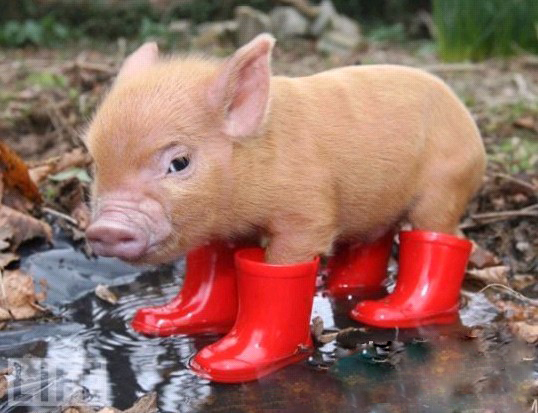
See how he's giving you the "Please don't eat me" sads? Doesn't he just fill your heart full of the awwwws? Don't you just want to scoop him up and give him a hug and go find a little rain coat to match those boots?
This little piggy is making me feel that way, most animals and animal stories give me the awwwws, Toby the sapient pig of PYG, didn't. I didn't want to hug him or go find pants to match his little jacket. While the piggy in the picture looks like a cute little butterball of fun, Toby is boring.
Toby bores you to a slow death with the story of his rise from breakfast meat to self appointed pig laureate of Edinburgh. Toby and his human (Sam) escape from the butcher, become show business types then finally learned scholars. It's all really too boring to even write about.
The oldy time narrative of the story, set in the late 1700s to the early 1800s, wasn't colorful. Everything came across as monochrome and dull, or maybe it's just that pigs aren't good at story telling? Well whatever, I say eat a ham sandwich and skip this PYG.
A marvelous book which accurately portrays 18th century Britain. Toby, a pig destined for the meat factory, is saved by Sam, a young man who had formed a friendship with Toby while they were at Sam's uncle's farm. After their escape, they are taken in by Mr. Bissel, who trains animals for his "circus." Toby is taught to "spell" and answer questions from the audience by means of cardboard with letters on it and subtle signals from Bissel. Unknown to Bissel, Sam teaches Toby to actually read, which results in some unexpected answers during performances. Eventually, Toby and Sam find themselves on their own and then begin the REAL adventures. Toby is enrolled in Pembroke College by the President, Mr. Adams, but after a year must leave because of the reactions of the other students. He and Sam then roam through England and Scotland, meeting such luminaries as Samuel Johnson, William Wilberforce (later founder of the SPCA), Bobbie Burns, members of the Royal Society.
What makes this story really wonderful is that no one in it appears to think it beyond belief that a pig could learn to read, spell, and even learn Latin. It seems a perfectly natural thing.
Please read it. It deserves a wide, appreciative audience.
Beautifully presented and hugely enjoyable, ‘Pyg’ is the tale of Toby the Celebrated Sapient Pig, commencing with his escape from the butcher and subsequent journeys across Britain and Ireland, peppered with Latin quotes and other examples of his great learning.
The cod- 18th century style is written as a first-person memoir, with echoes of Boswell’s travelogues, Gulliver, Tristram Shandy and Fanny Hill, and all perfectly rendered in an appropriate typeface. Start to finish, it feels absolutely real, brilliantly done and a delight from start to finish. My only real complaint is that I’d have liked to have heard more of Sam. Other characters in the narrative are wonderfully rendered and round, but poor Sam, Toby’s saviour, benefactor and constant companion, has virtually no voice at all, only mentioned here and there as a seeming afterthought, which was a shame.
I think ‘Pyg’ would be a wonderful way to introduce children to eighteenth century syntax and style before throwing the full weight of Swift and Defoe at them.
In what purports,tongue in cheek, to be a memoir, Russell Potter recounts the life and times of Toby, the sapient pig. Narrowly escaping the butcher, Toby along with his human friend Sam serendipitously find themselves at an extraordinary farm where the animals are treated as family. Turns out that they are trained for a traveling animal act, thus Toby learns to read. He them makes his way to Oxford, later to London where he is the toast of the town. He meets with the era's clerisy including S. Johnson. Toby's journey is sometimes fraught with potholes, most of which are the product of the small mindedness of the humans he encounters. Here satire is intended, but never to any satisfactory effect. The story had its moments, but I was never drawn into the plot. In my reading career, I have struggled with animal protagonists;this does not include children's books such as Winnie the Pooh. Yet, I don't think that is what hampered me. I just didn't really cotton to the story as a whole. Skated through bits.
I WAS A LUCKY GOOD READS FIRST READS WINNER OF THIS BOOK.I just love reading books about animals. this one was very fun to read. Toby is a very smart pig. he was born in the late 1700s and his life spanned into the early 1800s. he was taught to read and spell. at first he traveled with his beloved friend Sam was taken away from him by Mr. Bisset. at first Mr. Bisset is nice to Toby until he could teach toby to read and spell and turn him into a circus type attraction. after awhile Toby gets away from Mr. bisset,and reunited with Sam. Toby gets go to college at Oxford and later at a college in Scotland. the book is narrated by Toby. I found it interesting that This book is based on a real life Pig during that time period. I like the way the print is reminding me of how a book was written way back in the 18th century. a very charming read. so far this is one of my favorite books to win on Goodreads. I love reading books about animals.
Usando l'espediente del "manoscritto ritrovato" Russell Potter rende verosimile l'inverosimile storia di Toby fin dalla premessa. Il punto di vista e la voce del "maialino sapiente" porta avanti il racconto biografico: dalle umili origini in una fattoria di Salford al suo unico destino di portentoso maiale da fiera, dalla fuga con il giovane Sam all'incontro con Mr. Bissett che lo ammaestra e lo rende maiale sapiente, il tour per l'Inghilterra, l'arrivo all'Astley's Circus di Dublino, l'educazione ad Oxford, le sfide di Londra. Ambientato tra '700 e '800, salvo che per i particolari, la storia avrebbe potuto svolgersi in qualsiasi altra epoca. Qui l'aspirazione Russell Potter di raccontare l'uomo dal punto di vista di un animale, di mostrarne le miserie e l'arroganza di essere la sola specie capace di raziocino. All'inevitabile affetto per il maialino Toby e la sua vicenda si affianca una narrazione fluida che talvolta però non riesce ad essere incisiva come dovrebbe.