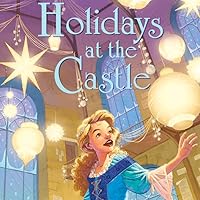
Deep inside the broom cupboard of Rose Cottage, two mice live in great style. Tumtum and Nutmeg lead cozy and quiet lives, secretly looking after Arthur and Lucy, the disheveled human children of the cottage, never dreaming that so many exciting adventures will soon find them. But when evil Aunt Ivy, a squeamish schoolteacher named Miss Short, and pirating pond rats threaten the safety of those they hold dear, the courageous pair will stop at nothing to save the day. In three thrilling tales with charming illustrations in every chapter, Tumtum and Nutmeg--along with the valiant efforts of veteran hero General Marchmouse, Ms. Tiptoe's bouncing ballerina army, and a team of caged gerbils--prove that small-size mice can have world-size hearts.
Emily Bearn has written nine children's books and has been the children's literary critic for The Telegraph since 2016. She has been a journalist since the age of 20 and has worked on the staff of Harpers & Queen magazine, The Times and The Sunday Telegraph. She lives in London.
Absolutely delightful series of adventures about two extremely British mice who live in the finest mouse house in village, which is hidden in a forgotten pantry in shabby little Rose Cottage. Tumtum and Nutmeg adopt the human children in the cottage, and try to make things nice for them, mending and cleaning and leaving little surprises that the children believe are from a fairy. They also have a series of adventures involving mice-hating aunts, a kidnaping, and pirates!
The stories are delightful, the chapters are the perfect length for reading aloud, and the illustrations are charming.
I just finished reading this with my daughter and we both loved it. This is perhaps one of the best new books for emerging readers. What is not to love, two mice, two disheveled children and three adventures. My daughter laughed out loud with the antics of the Great General Marchmouse.
2023 - Re-read with my three youngest kids who have no memory of the book. Just as delightful as ever and they said they'd love to get going on the second series of stories. My youngest is 8 and the oldest one I read it to this time was 11. Good, innocent fun with Tumtum and Nutmeg.
Favorite quote:
"What they both liked most of all was peace and quiet, so all this excitement did seem rather bad luck. But then it occurred to him they might not appreciate their peaceful days nearly so much."
*******
Read aloud with the kids ages 3- 11 and everyone thoroughly enjoyed these charming stories about mice Tumtum and Nutmeg. These books have a classic feel to them and are a true delight. Simple fun, well told with lovable characters. Highly recommended.
My kids LOVED these books (this is a 3-in-1)!! We had so much fun reading about these quiet-loving mice and their many adventures. Both children leaned over me the entire time we read, literally on the edge of their seats. We look forward to finding the rest of her books, and Tumtum and Nutmeg have a permanent place in our book memories.
I’m not sure who is more excited to start longer read-alouds — me or the 5-year old! He picked this one from a stack of choices I gave him and it didn’t take long for him to be fully captivated by this series. I expect we will be continuing straight through the series. This first volume included the first 3 books (150-180-ish pages each, for a total of 503 pages!) and there are 4 more left. We are definitely not leaving picture books behind, but it sure is nice to mix things up AND these are books I’ve been wanting to read myself, so it’s extra fun to get to share them together.
General Marchmouse is an exceptionally annoying character, but the stories are gripping and well written. I bought this for my 7yo for Christmas to read aloud to her, and she loved it!
Very cute. The storyline and characters made this a perfect bedtime read aloud for my 5 year old: endearing protagonists, not-too-scary villains and slightly hilarious adventures. She loved it.
These are actuall three stories, each about a long-married mouse couple named Mr. and Mrs. Nutmouse who live in extraordinary comfort and even luxury in a large manor house (mouse-sized) in the long-forgotten and blocked-off broom closet of a small and somewhat decrepit cottage. Two children, Lucy and her little brother Arthur, live there along with their poor and absentminded father - and Nutmeg (for so Mr. Nutmouse calls his wife for the exotic color of her fur) and Tumtum (named by Nutmeg for his round stomach) adopt them as foster children of sorts, mending their clothes and fixing things around the house. Eventually the human children and the two mice begin a correspondence with each other, although they never meet and in fact the children think that it's a tiny and benevolent fairy that is doing all these good deeds.
Life in Nutmouse Hall is good, but even the coziest lives occasionally encounter a spot of bother - and in these three stories it is a virulent mouse-hating aunt, imprisonment in a classroom gerbil cage, and a scary encounter with rat pirates respectively. The adventures are exciting, the mice are intrepid - and everyone always gets back home safely and soundly. Detailed, old-fashioned, British-y drawings by Nick Price add to the cozy feel.
Nutmeg wears a dress and apron and bustles in the kitchen, while Tumtum mainly eats and sits by the fire - this portrayal of not only traditional but downright outmoded gender roles is disappointing but is partly redeemed by the fact that Nutmeg is by far the more imaginative and intrepid of the pair. And as their lifestyle seems to stem from some timeless British era of tweed suits and dresses with aprons, I suppose it all makes sense. Still, I'd like to see Tumtum cooking, cleaning, or sewing up a storm while Nutmeg settles down by the fire with a glass of sherry and a book.
Tumtum & Nutmeg would make an excellent read-aloud for younger kids in K to grade 2, while older children in grades 3 - 5 - especially those beset by Worries who need a lovely, comfortable read - will find this a fine read-alone.
The kids loved this one. It's 3 different books in one and we read it very quickly. The anticipation kills them, but there is always a happy ever after. I love the sweet old fashioned English setting (even if I don't love the somewhat sexist roles given to Mrs. And Mr. Nutmouse). My favorite part of these stories were the troup of brave ballerinas that saved the day! Definitely recommend.
Our girls loved this book! The escapades of the mice are hilarious, engaging, and well-written. The author throws in some words above their reading level, which keeps things interesting and prompts more than a few questions. I found it extremely enjoyable to read aloud to my kids.
I read this aloud to my 4 and 7 year olds and they were both hooked. I was too! Well told and sweet but it has a lot of action and adventure—enough to keep my kids begging me to keep going when I’d have to stop each night.
So fun. My only complaint is that mrs nutmouse always does all the housework and mr nutmouse always sits around reading. Quite an inequitable division of labor in an imaginary household where anything could have been possible. 🤷♀️😆
Great kids book!! You will fall in love with the Nutmouses and be supremely annoyed with General Marchmouse for disrupting their peace, except that he brings all the exciting adventures. A great innocent read except for the drunk rats 🤪. Haha Can’t wait to get book 2.
We read this aloud with our 2 year old and almost 5 year old and we all loved it! Tumtum and Nutmeg are delightful characters and their adventures around Rose Cottage are fun to read. This will definitely be read again in our house. A new favorite!
Delightful! Super well written and enjoyable for kids and adults. We all loved reading about Tumtum and Nutmeg’s adventures. I laughed quite a bit reading the first book. I haven’t seen my kids both so engaged like this in a chapter book in awhile. Looking forward to reading more in this series!
Note: there is mention of drunkenness in the third book when some rats overdo it on chocolate liqueurs.
Love these. My single yet significant complaint is the gender dynamics and roles. I like that the books are written as if they are old fashioned because there are no electronics. I was surprised to see they were published around 2010 rather than 1910 (though a cellphone is mentioned very briefly in one of the other books, so there are a few slips that show you they are actually in current times) but and I am mystified as to why the author and the editor/publisher decided to push 100 year old gender stereotypes in these modern children's books. I had to modify text on the fly to make sure my 4 year old son didn't get harmful gender messaging from the books, though it wasn't very hard to do and I'm sure many of us are used to doing it with older books already and very young children. I could explain it to him if he were older but right now it goes over his head so I have to modify the words. It's a mix for sure: Mrs. Nutmouse is proactive and has a lot of good ideas to solve problems. But there's just little pointless things sprinkled throughout the book that shouldn't be there in 2010. Here are some:
Mrs. Nutmouse is excessively described slaving over domestic chores (which are depicted as her life's passion) from dawn to dusk while Mr. Nutmouse sleeps in, sits at the table and eats food she puts down in front of him, then spends all day in the library reading and napping while she cleans the house frenetically and spends hours preparing him elaborate meals. The books present this as just how things are. When they help the children, Mrs. Nutmouse exclusively does all female gendered work (cleaning, sewing) while Mr. Nutmouse (if he bothers to come along at all) exclusively does male gendered work (repairing broken things with tools). Male characters will think things about women characters like that they aren't smart enough to have good ideas, aren't strong enough to do physical tasks, etc., and this is not always contradicted later in a way that would make it clear to children that it's not true. Often these internal dialogues are from male characters who are depicted as bad or buffoons and it could be the author means them to be subtly understood to be incorrect by readers, but my kid is too young to get that if so. Additionally, the author sometimes describes events as "Mr. Nutmouse and his wife" or "Mr. Nutmouse grabbed his wife," without ever turning that around. There is a Mouse Army, and apparently mice do not allow women in the military because there are none. The third central animal character in the books is General Marchmouse, who has a wife who is always left at home dithering and worrying for him while he goes out and has adventures, and otherwise plays zero role in the books.
The human children also own gendered toys: the girl has a dollhouse and the boy has toy solders and boats. Like the mice, children of both genders actively accomplish great things, help out, and have ideas. Their mother is dead and they live alone with their father, and in this book that means they live uncared for and in squalor because their dad cannot learn to do what is implied (by Mrs. Nutmouse's internal dialogue) to be women's work of tending children, cooking, and cleaning. There is a point where they say "what they really need is a mother." The kid's dad is also unemployed and doesn't make any effort to get a job, even if a boring one, to support his kids and feed them. He just tickers on his hobbies all day and ignores them, but is depicted as the book to be a harmless, absent, loving character. These kids should be taken away by social services in real life, but the books kind of paint of picture of this scenario being ok and perhaps even expected of a single man. I would completely expect all of this in a book written in the 1950s or earlier and I'm happy to modify the language as I read, it's just really frustrating to see it in books published ten years ago!
I read this aloud with my kids this summer. They really enjoyed it, and the adventures of the mice were clever and funny. But I was disappointed in the ending of the third book. It didn’t seem appropriate for the target age group (I read ahead and knew what was coming, so actually decided not to finish reading the third book).... Mice giving rats chocolates filled with liqueur and getting the rats drunk in order to escape?! The other ways the mice escaped from trouble were cute, but this just struck me the wrong way.
I read this as a read-aloud to my 3 kids, ages 9, 7 and 4. These are 3 adventures in the tiny world of 2 cultured mice and the host family they live with. The children are incidental as are the adults, the real characters are Tumtum and Nutmeg, the lovely mice who live in a mansion built inside Rose Cottage, a dilapitated home. Very silly and pleasant with enough adventure and preposterous scenarios to engage all ages. We will be reading more of Tumtum and Nutmeg.
I would have rated this hight, but the story would be great for 2nd and 3rd graders but the reading level, length of book and size of type are for at least 4th graders. I would make a great read-aloud though.