Jump to ratings and reviews
Rate this book

The Substance of Style: How the Rise of Aesthetic Value Is Remaking Commerce, Culture, and Consciousness by Postrel, Virginia I. Reprint Edition

Rate this book
Excellent Book

Paperback

First published January 1, 2003

83 people are currently reading
1098 people want to read

About the author

Virginia Postrel

10 books106 followers

Ratings & Reviews

What do you think?
Rate this book

Friends & Following

Create a free account to discover what your friends think of this book!

Community Reviews

5 stars
87 (16%)
4 stars
172 (32%)
3 stars
190 (36%)
2 stars
58 (11%)
1 star
16 (3%)
Displaying 1 - 30 of 52 reviews
Profile Image for Emily.
687 reviews688 followers
November 9, 2009
Postrel writes mainly about economics, but in this volume, she is talking about aesthetics--more specifically, aesthetic value. Taking on centuries' worth of critics who denigrate aesthetics on economic and moral grounds, she claims that we are living in an age of high aesthetic value: "We expect the most mundane products to provide not only function but aesthetic pleasure and meaning." Today, we eat in restaurants that provide immersion in a programmed environment and buy toilet brushes with a design concept,--in contrast to the mid-twentieth century, when consumers delighted in the convenience and standardization provided by mass-produced products. One hotel ad proclaimed that "The best surprise is no surprise," suggesting that "Americans were more concerned with avoiding below-par experiences than achieving unique or extraordinary ones."

Postrel discusses two age-old critiques of aesthetics and decoration in general. One is that it is decadent and superfluous. People who would pay more for a beautiful object that is the functional equal of a less beautiful one are either stupid or brainwashed by advertising, this view would say. To counter this idea, Postrel gives a brief history of beauty's manifestation in non-affluent cultures, arguing that beauty has its own intrinsic value, invoking again the pleasure that people take in ornamentation. The other critique is that decoration is about status and recognition, and therefore causes us to betray our natural inclinations in favor of what impresses others. Here, though, Postrel shows how people manipulate their own appearance, for example, to deviate from the norm in carefully planned ways that are intended to communicate something about the person's image of themselves. They choose their aesthetics as much to project something to others as to absorb others' taste.

In this way, then, aesthetics are not a challenge to authenticity but rather an embodiment of it, and a form of expression that is increasingly important in American society. People spend money on, and derive pleasure from, aesthetic value, and this has increased the pleasure in Americans' daily lives and their standard of living--but economists cannot measure it; or, if they do, it appears to be non-productive spending on ephemera.

This book seemed much less mind-blowing than I remembered, and I'm not sure whether that's because Postrel's points have become more obvious with time or perhaps because I internalized her argument. In any case, this reread made me focus on one theme of the book and wonder whether anyone has ever written a broad, popular study of conformity. A major theme of this book is the way that people carefully calibrate how much they appear to be like the people around them; some are comfortable being quite different, others want to be quite similar. Many prefer to conform rigidly to the norms of an outsider group (e.g. goths). How do they accomplish this and what benefits do they derive from their efforts?
Profile Image for Phil Simon.
Author 28 books101 followers
March 9, 2012
I agree with some of the other reviews of this book: Postrel's premise seems to lose steam midway through the book. Yes, style and substance matter. But the author seems to lack a definitive viewpoint. Sometimes it matters to people who live in upscale communities, but it doesn't matter to others who choose to move out because they become annoyed with overly restrictive home owner associations. So, style and substance matter sometimes...and may matter more in the future. I would have preferred a more decisive stance.

Also, the anecdotes are certainly interesting and varied, but they don't seem to advance a central premise. Unless I read the book wrong, they just serve to illustrate that we are seeing more interest in style over the past 20 years as technological advances have made so many things ubiquitous and cheaper. Great, but what should we do with this information? I would like to have seen that question answered. I don't mean checklists (which I despise), but how will this help the average reader? If this were a sociology book, then I probably wouldn't have bought it. Instead, the book doesn't really seem to answer the question inferred by its subtitle "How the Rise of Aesthetic Value Is Remaking Commerce, Culture, and Consciousness." I figured that it was a business book and it really isn't, in my humble view.

This isn't a bad book and Postrel is a gifted writer. I just had some different expectations when buying the book.
Profile Image for Nick.
707 reviews191 followers
May 15, 2011
Would have gotten 4 stars if there was less material derived from Reason magazine articles from the early 2000s. Several times I skipped a section because I thought "yup, already read the Reason article on this subject". I hate reading the same thing twice! Why do I get punished as a student for handing in the same paper twice, but academics and writers get rewarded for it?? Ok that was a mini rant.

Interesting look at aesthetics, why aesthetics has value, and a brief history of pretty objects. She makes a good case, but stretches her thesis sometimes, especially when theorizing about why people like things which they are aesthetically attracted to. "I like that because I'm like that" is a thought she brings up a lot, but is it true? Do modern stylish hip people wear the outfits they wear because they really think "I'm like that"? Certainly this is true some of the time but labeling it as a general motivation is a stretch. If it is true then style and authenticity/substance are connected by definition. Nevertheless I did come away from it with a new appreciation for everyday aesthetics. Look around! Everything is beautiful!

I wish I could explain more about this book but Im hungry.
Profile Image for Suzannah Rowntree.
Author 34 books590 followers
February 2, 2016
Really good. Postrel is an insightful economic and cultural commentator, and she ably defends beauty as a worthwhile pursuit complementary to truth and goodness, not opposed to it.

Parts of this book felt like reading about another planet to this rural Australian. The sheer levels of American consumption left me occasionally breathless. But Postrel's argument is that this is not necessarily a bad thing.

One of those rare but precious books that leaves you feeling thankful for the 21st century.
Profile Image for Joe.
20 reviews
October 1, 2022
I can’t believe the person I have become. For years I would make fun of book people. Always reading random ass boring things. Then today I found myself finishing this book and thought to myself “wow younger you would have called you a fucking pussy” and younger me is right. Book was good tho.

- A fucking pussy
Profile Image for Lee.
Author 13 books118 followers
Read
December 17, 2009
Virginia Postrel argues in this cultural study for the inherent value of aesthetics in everyday life and against claims that dismiss aesthetic value as either irrelevant or as merely the expression of drives for social competition. I think she makes a decent, if perfectly unoriginal, case for aesthetic value as a semiautonomous sphere of human value; she also is correct, I think, that aesthetic dimensions of consumer products become important when the marginal value of "look and feel" increases relative to other value-spheres (like functionality, quality, etc). She is less persuasive in her praise of the 'age of aesthetics' as a newly democratic moment in the history of consumerism. The problem here is a betrayal of her ideologically libertarian worldview: she equates markets with democracy. In fact, markets and democracy are about as close to opposite conceptions as you can get. In a market, one dollar equals one vote: those with the most money get their way. In a democracy, every person gets an equal say in what happens. So, what this means, is that Postrel has written an OK book on how present-day markets affect the aesthetic components of consumer goods. Her favorite example is the designer toilet brush: I would be greatly negligent as a reviewer if I did not suggest that Postrel's book constitutes a form of intellectual designer toiletbrush: moderately interesting from a stylistic perspective, somewhat useful in thinking through some situations, simple to use, but mostly forgettable.
Profile Image for Hilary "Fox".
2,154 reviews68 followers
August 8, 2011
This is another book I've had forever, one actually recommended to me by Daniel Pink. The book, as the title says, deals with the importance of style and design in varying cultures. Why do we pay a premium for products that are the same as their counterparts, just differently colored? Why do we even care so much about style in general? The book tries to answer these questions.

The book is worthy of more than a two star rating in terms of how well it is written, as well as for its general premise - the topic is a fascinating one. I only rated it so low for two reasons: 1) The book is out of date. I'm uncertain whether or not a new edition has come out, but it would behoove the reader to search for it if it has. 2) The book, likewise, could have been significantly shorter. By the end I felt as if the same exact thing was just being reiterated over and over again.

Essentially, as our general needs are met i.e. shelter and food, we begin to search out things to make life pleasurable. In instances wherein general needs cannot be met, we still seek out escapism in the form of better things. So, essentially, if we can find something to bring a bit of novelty into our lives, we will; if we don't find novelty, our creativity dies and we suffer burnout. A basic idea, but one that perhaps doesn't come up quite as often as it should. Interestingly enough, the book also counteracts a lot of the beliefs of design being merely frivolous. It's in our nature to find pleasure in the shiny and new.

No wonder Project Runway is so popular.
Profile Image for Jessica Blevins.
123 reviews4 followers
March 3, 2011
The author's case for the importance of design and aesthetics is very strong. It's true that our society tends to denigrate the look and feel of things vs. the product's performance. While this does make sense, it also makes sense that when the performance is similar, look and feel become very important. The design of something can bring an immense amount of pleasure to our lives, inspiring us to do great things.

However, I agree with many reviewers who say the book could have been much shorter. I felt like it dragged on, especially after the first few chapters.

Two intriguing quotes that I really loved...

"Is Michaelangelo's Sistine Chapel more authentic if it's covered with the grime of centuries or if it's cleaned to show the colors the artist intended?"

"Design review turns designers into legal strategists and political conspirators; it suppresses artistry and innovation; and like other forms of absolute power, it corrupts those who wield it and compromises the processes they preside over."
Profile Image for Daniel.
302 reviews
September 24, 2020
Some say timing in everything.

According to Amazon, I bought this book in October 2013, rediscovering it as I was going through the books in my to-read pile in anticipation of moving into my first house. And I had been wondering why it so mattered to me that my house was aesthetically pleasing.

Would I have fallen in love with this place if not for the well-tended garden in front that completed the façade of this Craftsman design? What was behind what Virginia Postrel defines in her first chapter as "The Aesthetic Imperative"?

I still haven't fully answered the question, but know that I am not unique in valuing surface beauty. What that surface says to us says something about us. I had wanted to find a Spanish-style home, but I saw this house and I knew.

In short, this book explores how, in an increasingly affluent society, people are becoming more conscious about design, the look of things. We are expressing ourselves in the things we buy, the houses we live in, and the clothes and cosmetics we wear.

Postrel argues that aesthetics "is not a luxury, but a universal human desire." She takes issue with "Abraham Maslow's seminal writings on psychology," holding that
It's the ever-changing mix that matters, not a hierarchal checklist. There is no pyramid of needs, where each layer depends on completely satisfying the need under it. Rather, the marginal value of some characteristics, such as nutrition or shelter, is high initially--we don't want to starve or freeze to death in a snowstorm--but that value drops off faster than the marginal value of other characteristics, including aesthetics.
It seems that humans have been thinking about design at least since our ancestors painted the walls of caves in Europe and Africa.

Maybe I don't need to understand precisely why it was I wanted to live in a beautiful home. It may just be enough to know that this appreciation of a home's aesthetic value is in my nature as a human being.

It is nothing to sniff at.

As you read this book--as I encourage you to do--you may find yourself--as I did--scribbling notes on stickers or in the margins, seeing how you too recognize, as Postrel puts it, "aesthetic pleasures as an autonomous good".

A very good read this book.
477 reviews36 followers
November 5, 2019
Even looking back 15 years later this still feels like a perceptive and accurate thesis about the proliferation of style in modern culture, and her articulation of how to think about the value of aesthetics/style is a good counterweight to the deriders of "superficiality" she contests. She does a good job acknowledging the trade-offs and economic rationale behind debates about aesthetics, rather than resorting to more wishy-washy arguments. As a result, this mostly felt like a book where I agreed with the author but was not particularly excited by their form of presentation, and got fairly tired of its repetitiveness. There were a couple points where I felt more in disagreement, generally along the lines of thinking she didn't do an adequate job of probing the psychology of why people have the reactions she was criticizing. So while she did do a good job exploring trade-offs in some areas, I think she doesn't necessarily provide an answer to the "deeper" concerns (or about how tenable her type of drab pluralism is). That is a recurring issue I find in many books of this ilk though, and expecting much else would be unfair. Solid and insightful work.
Profile Image for Chu Qiao.
191 reviews
October 2, 2019
Pursuing aesthetic values is a natural choice to embrace. It improves communications process, avoid biased judgement, and projections. I need work on my appearance to make it presentable. I start to look website for fashion over 40s . I can change my outside as well as inside.

Tolerance and not imposing your "sound"judgement on certain things. unconformable things can be evolved as beautiful as part of our history. The idea especially applies to our architecture environments. Thinking OF WHY we did lot size protection. We tried to protect framework of historical environment, not details of building specifics . all things will be blended in the long era of history.

This entire review has been hidden because of spoilers.
Profile Image for Karen Calhoun.
117 reviews
January 15, 2019
An interesting discussion about how aesthetics influence our financial decisions- I'll have the pale pink one with gold speckles, please. Another example of an article-length idea being stretched out to book length, this becomes redundant in the second half. It is, however, well researched, and the bibliography/notes have steered me toward some interesting reads!
Profile Image for Rick.
991 reviews27 followers
March 12, 2021
"....aesthetics can be a complement to, not merely a substitute for, other values". (p. 171) Other values? Cognitive skills, rationality, measures of goodness and truth. Perhaps. Can we be both smart and pretty? This books deals with all this and more.
Profile Image for Eileen Ptacek.
123 reviews3 followers
September 23, 2022
Interesting and I especially liked the last chapter about incorporating aesthetics into school lessons.
1,688 reviews4 followers
November 2, 2024
well written and interesting but i found it repetitious. i think i'd have loved it as a long essay at about 1/4 the length.
6 reviews
April 1, 2025
what i appreciate about this book is the new POV it gave me to see things in their aesthetic.

it's an amazing book but a hard read. just felt a bit bored reading it.
91 reviews
June 7, 2012
A well-meaning book, deflates a lot of ill-thought-out contemporary wisdom about consumerist culture. The book's overall perspective is that aesthetic design and variety are among the goods, celebrating commercial culture for bringing such design to the masses. In setting out this view, Postrel identifies and takes on diverse but related targets: loosely, modernism, puritanism and romanticism. First, she questions the modernistic view that valorizes efficiency and function, but disparages concern with mere outward flourish. This is essentially a defense of the iProduct - if you're going to spend several hours a week working with a laptop, there's nothing wrong with wanting it to be aesthetically appealing, instead of caring *just* about machine specification and cost. Surfaces matter too, in other words. A related target is the guilt-ridden conception of enjoyment and consumption as being distractions from the Serious Business of life. In its modern incarnation, this is the Marcuse-type view that Advertising, (or Corporations, or Hollywood, pick your bogeyman) manipulates people, creating artificial desires where none would naturally exist. Postrel sees this "adbusters" type view (correctly, in my view) as emerging from the Puritanical tradition, and would have us be more skeptical of its claims. She reminds us, as sanity check, that we've cared for trinkets and jewelry for as long as we've been human, possibly since before. Ad agencies are the latest facilitators of our age-old desire for ornamentation, not shadowy creators of new, false idols. She sketches out poignant scenes from post-Taliban Afghanistan, where people in bombed out houses, with little security or money are just as interested in nail polish and hair styling as any fashionista in New York. Color, decoration, taste, leisure, these are among the things we all value, which add comfort and joy to life; they are not to be dismissed cleanly, not without disclaiming essential aspects of our very nature. A final, "big" target for Postrel is the romantic concern with "authenticity," where the proper way to do a thing is constituted by what people in some different place or time do, not by what works for us. Against this, Postrel notes that mixing and matching, reworking the old, fusion, and novelty are at the heart of culture, not mere corruptors and despoilers. Authentic chocolate is a savory brew, and not a very tasty one at that.

I went in broadly sympathetic to these ideas, found myself nodding along frequently, and decided to worry no longer about paying a premium for my ipod. Why a mere three stars then? The basic problem is that a lot of these arguments are getting at strawmen and vanquishing idiotic views. To be sure, there are many idiots about, but I fancy a good defender of the authentic, or opponent of commercial values might have had better arguments to make than are rebutted here. As a result, the book feels lazy, and not particularly clever - I found myself agreeing frequently indeed, but never really reading anything I couldn't have said myself. There weren't many moments where I learned something, or encountered difficult arguments, or even uncovered new connections between familiar ideas. I actually suspect Postrel is right about many of her claims, at least in the sense that the academic/intellectual climate is skewed against the sorts of views she presents for reasons of politics and fashion. But it's hard to see this book changing any minds - I don't think I'd recommend it to anyone, since it seems likely that people less predisposed toward Postrel would find themselves frustrated by the glibness of the argumentation, not challenged but merely annoyed.
Profile Image for John Jr..
Author 1 book71 followers
June 4, 2016
We’re living in an age of design, or, as Virginia Postrel sometimes calls it in this 2003 book, the age of look and feel. The way a product looks, the way a house or retail establishment looks, the way we look: all these are increasingly important to us.

Some aspects of this go back pretty far; Henry Ford’s offer of a Model T in any color the buyer wanted as long as it was black is far behind us, and for decades we’ve been offered any number of vehicles that all provide the same broad functions but differ greatly in aesthetic terms. On the other hand, it wasn’t that long ago that Apple introduced the first iMac and Sony launched the Vaio line of laptops, effectively ending the domination of beige boxes in the realm of personal computers. And consider the design of book covers. To pick an example at random, the first edition of Breakfast at Tiffany’s, from 1958, was exceedingly plain, whereas a 1993 reissue of the paperback used a trompe-l’oeil effect, and a 2011 edition uses a deliberately retro collage effect. One might disagree with what the two more recent covers convey, but they do convey something, whereas the original cover is little more than a wrapper. Though she doesn’t include book design, Postrel ranges far and wide in her discussion, examining (to name a few) the meaning of personal styling choices such as dreadlocks, the conflicts that arise in imposing design restrictions, the immense range of materials, textures, and colors offered to designers, even the availability of designed choices in the mundane matter of drawer pulls and toilet brushes.

To some extent, the very processes she’s talking about have undercut the punch of Postrel’s book. Design has spread even further since it was published, and today’s reader may find some of what she says obvious. But many of her points are still striking; for instance, it’s no easier now, as far as I know, to estimate the economic value of the spread of design, yet it has pretty certainly improved our lives. And she tackles the seeming opposition between practicality and aesthetics; given the range of argument and evidence presented here, it’s hard to disagree with her claim that style isn’t valueless but has a substance of its own. The New York Times review complained that she sweeps aside the manipulative aspects of design; I think Postrel’s point of view is that consumers are, or should be, wised up by now, a stance she explicates here, for example.

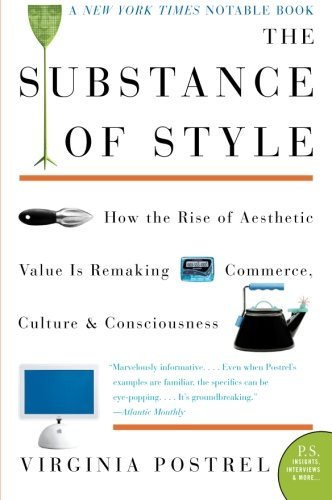
I wouldn’t have minded a little more probing of the philosophical background. It’s conceivable that the centuries-old inclination toward essentialism underlay the long-standing suspicion of style as superficial and that the rise of existentialism contributed to overthrowing it. But this might’ve lost some readers. And illustrations, such as those that dot the cover of the print edition of The Substance of Style, might’ve helped. Her most recent book, The Power of Glamour (published in 2013), has many, which in a way illustrates the march of the design imperative. Nonetheless, Postrel’s writing is clear and evocative on its own; you’re in no danger of missing her point.
1,376 reviews15 followers
May 15, 2021

[Imported automatically from my blog. Some formatting there may not have translated here.]

A marvelous book (that I've finally got around to reading) from Virginia Postrel, who I like to call The Smartest Woman in the World. I seem to recall from her blog that the original title was Look and Feel; that would have been better, I think.

And if this book had been written by someone else, I probably wouldn't have read it. As matters stylistic go, I'm solidly in the lower percentiles of the bell curve. Should Ms. Postrel visit my house, I would imagine an uncomfortable silence as she scanned the rooms, perhaps with a small arch of the eyebrow, gently biting her lower lip.

But I digress. Even if you don't think you're interested in that stuff, Ms. Postrel will make you interested, because her observations are fresh, insightful, and cleanly laid out with zero academic bafflegab. Topics range from toilet brushes, computers, cosmetic practices of Afghan women, plastics, shopping malls, and many, many more. She goes through life with eyes wide open, and she'll tell you interesting things that you'll be glad to know.

Coincidentally, Ms. Postrel recently had a blog post semi-lamenting the "respectable but unspectacular sales" of this book. So consider this an unabashed plug; the link above goes to Amazon, so go there and buy a copy already. (The link actually goes to the hardcover edition, because that's what I read, but you should buy the in-print paperback to get her the royalty.) You won't be sorry. Don't take two years to read it, either, as I did.

Profile Image for Brandt Kurowski.
18 reviews
June 8, 2015
Far more than just an apology for style (though that would have been enough).

After mounting a convincing argument for the intrinsic value of style and aesthetics (and solidly rebutting the age old criticisms of style as worthless decoration, or worse: deception), Postrel then explores the effect of rising purchasing power on the demand for style, and the follow-on effects on gender roles, urban planning, and macroeconomics, just to name a few areas of focus. I started highlighting particularly insightful and interesting paragraphs as I read, and the only problem is that I ended up highlighting most of the book. There's far more food for thought here than just "making things pretty makes people value them"; instead you'll finish the book wondering how on earth our core economic metrics can be completely blind to ongoing increases in quality of life through vast improvements in the aesthetic richness of our surroundings.

I highly recommend this as an intriguing read for anyone who is suspicious of stylish, highly-designed products and experiences. I wasn't fully convinced by every one of Postrel's arguments, but she certainly convinced me of her thesis and gave me tools for considering the impact of style in various contexts.
437 reviews28 followers
September 10, 2014
"The Substance of Style" makes an interesting point in a whole lot of words. Postrel hypothesizes that style--contrary to the derisive "form over function" old saw--is integral to the new economy, and that success for millenials and younger hinges on them developing skills in making products that are not only useful but pretty. This doesn't just mean actual engineers making sleek Apple Watches, but also office drones making visually appealing powerpoint presentations and job-seekers handing out aesthetically balanced resumes. Postrel also makes the case that more beauty in consumer products should be appreciated as an end in itself. I found her defense of her hypotheses convincing, but it was not a super-interesting book and, ironically, Postrel didn't make the book pleasant to read, going on just a little too long about each subject.

My review is colored by having read this over the course of almost a year, as it was on my Kindle which I usually use when I travel. So I'd pick it up each time I had a trip and read a small chunk. On the other hand, perhaps it says something that it was so easy to put down at the end of each trip...
9 reviews2 followers
December 13, 2011
I wanted to like this book a lot more than I did, but I found it to be all over the place. Most of it felt like a series of more or less unsupported assertions, with little in the way of a hierarchy of ideas or sustained development of arguments; unfortunately very like a business book in places (and not a very sophisticated one.) Postrel has a very unconvincing historical perspective; she seems to feel that widespread interest in, and application of, aesthetics to consumer goods and daily life is a recent invention - which of course makes no sense whatever. The recent "rise of aesthetic value" that she claims to identify is the result of much more complex economic and, especially, technological changes than she seems equipped to discuss. The first chapters of the book were the most frustrating to get through: I thought she was at her strongest in Chapter 5, "The Boundaries of Design," where she begins to sound more like an essayist developing several lines of thought rather than a journalist stringing together sound bites into book length.
Profile Image for Nina.
1,854 reviews10 followers
July 27, 2016
Interesting, but a bit wordy. She could have cut this down by 15-20% without losing any points. Essentially, the message is that aesthetics have intrinsic value; all things being functionally equal, we are still attracted to the more aesthetically appealing product-- or person. As we get exposed to more style and variety, and it becomes more affordable as a result of both rising incomes and lowered production costs, we come to expect more. A resume written with black ink on white paper isn't going to cut it anymore, and we won't settle for bland toilet brushes if we can get a stylish one at Target, despite the fact it is likely our guests will never notice. We like attractive things for their own sake, not just for status. I've always laughed at archeologists who try to ascribe deep meaning to every decorative thing they find. The ancients might have just thought they were pretty!
5 reviews2 followers
November 2, 2007
This book filled me with optimism about the future, I thought it was exciting that our culture is becoming more and more designed, and life is all-around getting better. I tend to be nostalic and sad that I missed out on decades and eras past because the design was so great or glam, but Postrel wittily explains that people are living better now than they ever have. For instance, in the twenties, most people still had outhouses and in the fifties, women owned like one nice dress and that was it.

Great book!!
Profile Image for Stacey.
794 reviews6 followers
September 16, 2011
I hated this book with such a passion that I frequently had to restrain myself from chucking my Kindle at the wall. Why didn't I just give up? I had to lead a grad school class discussion on it. But, to get back to the point, I found her arguments specious and sometimes even offensive, and was extremely frustrated by her habit of setting up straw men to knock down. Excessive consumption of useless products and obsessions with appearance are bad for society, whether Virginia Postrel thinks so or not.
Profile Image for Erica.
Author 3 books15 followers
December 1, 2012
The first chapter of this book had some good research and interesting points, but it rapidly became repetitive. I read about 20% before giving up on it... I was reading the ebook, and perhaps if I'd had the print version I'd have skipped to a later point or skimmed through a couple of chapters (or perhaps a print medium would have made the book seemed less like a random compendium of trivia and more like an actual book), but it really didn't interest or entertain me enough to read it straight through.
3 reviews
February 8, 2015
Pretty AND Useful

I very much enjoyed this book. Well written and argued, I enjoyed the premise much more than I originally thought. This book has had me rethinking my own orthodoxy, and caring a bit more about the finer, less functional, things in my work and play. The author has an incredible grasp of language, logic, and perception, pulling together a compelling case that that in less of skilled hands, would in itself, could come across as simplistic or petty. Well done, worth the read.
Profile Image for Geoff Bartakovics.
Author 1 book6 followers
January 22, 2008
A pretty intriguing (though sometimes intellectually confused) overview of the rise of "style" and "design" within the commercial sphere. I'm reading based on my current interest in the growth of (straight) men's interest in clothes and shopping -- and specifically the way that guys have been (successfully) marked to through a clever elision of terms like "fashion" into "style" or "products" into "gear," etc. Good but not great read.
Displaying 1 - 30 of 52 reviews

Can't find what you're looking for?

Get help and learn more about the design.