Return to the apocalyptic deserts of the Dark Sun world as unlikely heroes spark a revolution against an evil sorcerer-king For thousands of years, the devil sorcerer King Kalak has used vile magic to drain Athas of its precious life-force. Now, his reign is coming to an end—though the city of Tyr, like the rest of the world, is nothing more than a magic-blasted ruin and a desolate place of dust, blood, and fear. All that’s left is desperation—and revolution. Leading this revolution against Kalak are a maverick statesman, a winsome half-elf slave girl, and a man-dwarf gladiator bred for the arenas. But if the people are to be freed, the mismatched trio of steadfast rebels must look into the face of terror and choose between love and life. First introduced in 1991, Troy Denning’s post-apocalyptic world of Athas remains one of the most talked-about and fan-requested settings in the Dungeons & Dragons universe. Now, a new generation of readers can discover the magic-blasted deserts of the unforgettable Dark Sun . . .
15 years after I read this series out loud to my youngest brother, and more than 30 after I read it when first published, I return to the Wastes of Athas!
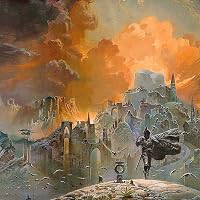
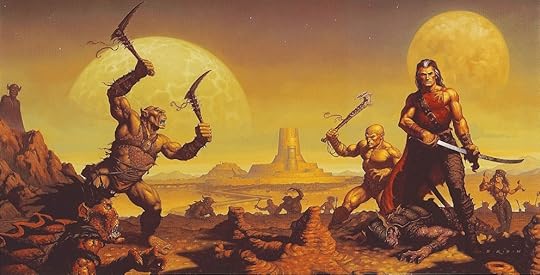
This cover art really deserves the full uncluttered reproduction treatment. These three are the big Heroes of the first phase of the series but it is the cynical Tithian and the stalwart Neeva, neither shown here, who ultimately become the most interesting.
Judged on its own merits I'd say this setting and series was way ahead of its time, a post-apocalyptic AD&D world wrecked by the abuses of life-energy consuming sorcerers where commodities taken for granted in most North-western European inspired fantasy settings -such as water, metal, and basic decency- are critically scarce and the environment relentlessly hostile.
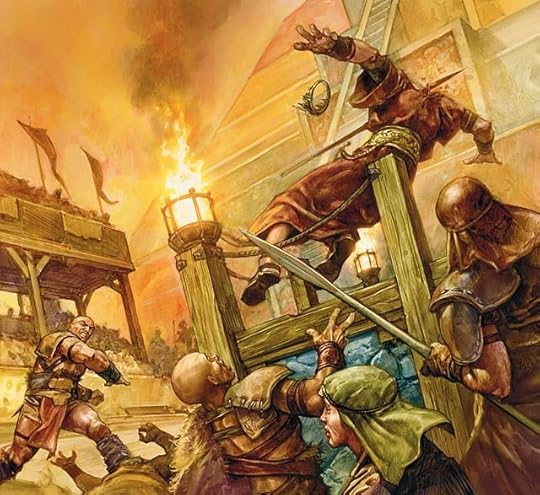
The climactic moment of the arena sequence. Love me an attempted regicide!
My main quibble this time through was the truly shocking quantity of typos in the Kindle edition I read. Where's the quality control, O Lord Jeff B.? Apart from the nuisance of seeing templars referred to as "teinplars" I enjoyed this comfort re-read very much, and unlike my earlier feelings I really saw Agis' flaws as a ostensibly "noble" slave owner more than as a younger man, while also appreciating Tithian's deviousness and treachery against his arch-horrible boss King Kalak a lot more as well.
Overall, I found this book surprisingly enjoyable! It captured the feel of the Dark Sun setting (a brutal post-apocalyptic fantasy world in which unchecked magic has left most of the alient planet Athas a barren wasteland and sorceror god-kings rule the few remnants of cilization with an iron fist) admirably, the plot was legitimately interesting, and the writing was unobtrusive (ie: I noticed the story and characters more than the author trying to impress his readers).
I especially liked the way Denning approaches the complex moral issue of magic-use. In the Dark Sun world all magic is fueled by ripping the life-energy out of a nearby living thing, usually plants; this is why the planet is a wasteland, as reckless sorcerors kept using the planet's life to fuel their conquests and internecine squabbles. There's a middle ground, using only enough magic to fuel the desired effect, but leaving the living things enough energy to recover and flourish; this middle ground is less powerful however and magic-use in general is highly addictive (sort of like potato chips or peanuts). It seems as though the middle ground would be the "good" option, but Denning puts the characters in several situations in which their lives are spared by complete indulgence in unchecked sorcery and others in which the weakness of the middle ground imperils the characters. The three approaches to magic (non-use, reckless use, and guarded use) are presented as little more than amoral approaches to a natural phenomenon, their morality ultimately mediated by the morality of the individual using them.
However the author's style and characterization are also incredibly uneven.
There were several points at which it felt like he was so desperate to move the plot along that he skipped important narrative points and I found myself flipping back through to see if I'd missed a chapter; the escape from UnderTyr and the journey to the Forest Ridge are effectively ignored, mentioned only in dismissive references. This is unfortunate as the first 2/3 of the book moved along at a much healthier pace, and i suspect either Denning was in a hurry to get to the parts he "liked" or he was under pressure to make the book shorter/write it faster.
The prologue involving the templar Tithian and sorceror-king Kalak was gripping, introducing us to the bloody, slave-driven theocracy of the city-state of Tyr and characters who are at once compelling and contemptible; these characters are fascinating and well-written throughout, especially Tithian. Denning does an excellent job of juxtaposing Kalak's seeming frailty and age with his terrible power and cunning, but Tithian is one of the most well-drawn characters i've encountered in literature. He's a priest to a god-king, not because he truly believes in Kalak's divinity but because, lacking the discipline and drive to pursue the ascetic path of psionics, he found that the ranks of the templars promised easier access to power, wealth and influence; once a member of the sorceror-king's theocracy he comes to realize how truly powerful and truly vicious his "god" is, and ultimately regrets the favor he finds in Kalak's eyes. He is loyal to his old friend, Agis, but only insofar as it does not inconvenience or imperil himself -- he himself admits freely that he always does what he believes to be in his own best interests. Agis by contrast is a naive idealist, a man who possessed the discipline and strength of will to pursue asceiticism but who lacks the savvy and understanding of human nature which his childhood friend Tithian posseses; Agis truly believes that he can effect change in a theocracy through senatorial votes, and truly believes that by treating his slaves well he is doing better by them than he would be if he were to free them. Indeed, his failure to understand the value of freedom to a slave costs him dearly. He fancied himself a champion of slaves and the downtrodden, but it is only after he finally becomes affiliated with an anti-slavery, anti-government terrorist cell called "the Veiled Alliance" that he realizes how hypocritical and naive he has really been. The slaves-gladiators Rikus and Neeva and their friends are written with attention to their different life experiences (when compared to the nobility and templar's lives) and the fact that they have been raised to kill or be killed. Oh, and the gaj. THE GAJ! One of the best and most interestingly alien characters I have ever encountered; it lacks all humanity, yet learns to communicate like a human, and there is something delicious about the way in which, when caught in a lie, it responds by simply stating that deception is useful.
Sadira however...every time Sadira and her mentor appeared or the focus shifted to them, it felt like I was reading a different book by a different author. Those pages were HORENDOUSLY cliched and full of needless, flavorless exposition. Indeed, once Sadira and the other characters start traveling together, the book's overall quality dips drastically. It's clearly not that he can't write female characters -- there are at least three other, better-written, far more interesting female characters. It almost seems like he felt he HAD to include her, or saved her portions of the book for last and then just hurried through them without an editor or feedback. Arguably the only interesting thing about her is Sadira's approach to sex/romance; she trained from a young age to use sex against men and, for the sake of espionage, she was not allowed to develop her monogamous instincts. As such she annoys and offends and dismays many characters with her polyandrous desires. But even that is only mentioned a few times. It really does feel like Denning forgot to develop the character and just stuck with a vague outline he'd created.
This book could have been one, two, or three hundred pages longer and would likely have benefited from it. I understand that there are four more books in the series, but the second half of this volume suffers dramatically for the rushed pace and the temporal skips. I enjoyed it, but I hope the rest of the series will be more even and that the author will better develop many of the elements he unfortunately neglects in this one.
THE VERDANT PASSAGE by Troy Denning is the first installment of the Prism Pentad series for the now-defunct DARK SUN campaign setting for TSR (later Wizards of the Coast). The premise was that it was meant to be a blasted arid wasteland where magic has destroyed the world that was half-planetary romance as well as half-Mad Max. It was a post-apocalypse setting that had a strong influence on my CTHULHU ARMAGEDDON series and still holds an important place in my heart.
The book is fairly simple and could easily be read as a standalone if you wanted to just have an enjoyable read for a time. The evil sorcerer king, Kalak, is building a massive ziggurat for reasons unknown with the entirety of the city-state of Tyr being forced to help. Slaves are being confiscated from the plantations of the city's nobility, the resistance against him is prepping for a major offensive, and there are plots afoot. The half-dwarf gladiator Rikus, called a mul, is the perfect person to carry out an assassination plot against him. Unfortunately, Rikus has no interest in politics and just intends to win his freedom at the games.
Rikus is just one of an ensemble of interesting characters for this group of misfits, though. There is also Sadira, a half-elf sorceress who is willing to experiment with black "defiler" magic in order to get the job done but is also romantically interested in Rikus. She's also romantically interested in Agis, a nobleman who deludes himself into believing that he is a benevolent slave master when there is no such thing. Finally, there's Neeva, a beautiful female gladiator who has reluctantly tolerated Rikus' many affairs.
Neither hero nor villain or, perhaps, villain but not our heroes' enemy is Tithian of Mericles. The leader of King Kalak's templars or state priests, he's a cowardly and scheming scumbag. However, Tithian recognizes that Kalak is not the kind of guy to reward loyalty. As such, it is his goal to do whatever it takes to survive as well as prosper. It makes him an unusual sort of character in Dungeons and Dragons fiction and all the more entertaining for it.
The book contains a strong anti-slavery and pro-environmental message. The former may not seem like something that was important but I grew up in the Deep South in the Nineties where Confederate apologia was still a thing. Agis' belief that one can be a "good" slave owner's values is called out and every other slaver is treated as complete scum who needs to be murdered with no attempt to soften the blow like A Song of Ice and Fire seems to do when the latter books appear. I support that strongly.
The book isn't particularly accurate to Dungeons and Dragons with the fact that Rikus, Sadira, and the others are able to take on a Sorcerer King (which were 41st level at the minimum according to the original 2nd Edition boxed set). However, I don't believe that being accurate to that overpowered crazy bunch of ideas is a good thing and our heroes being able to smack down the evil tyrant is pretty much the "point" of D&D.
In conclusion, The Verdant Passage is an enjoyable epic fantasy story. It is also fairly self-contained and while it is part of the larger Prism Pentad, everything is wrapped up enough that you could stop after reading this without much difficulty. I also like the book has an unusual take on romance with Sadira simply dating whoever she desires and saying that anyone who has a problem with it to stuff off.
I read this a long, long time ago, and sort of dreaded returning to it. Why? Well, when I was a kid and having a great deal of difficulty building up reading confidence, I'd read the Dragonlance books (also tie-ins to D&D product, like this), and they helped a ton. For 35 years, I've held a fond place in my heart for those books. But a couple years ago, I went back and tried to read the first Dragonlance novel and it was horrible. Just awful. Like bad, self-published, Tolkien fan-fic. So, I have to admit, I wasn't holding out a lot of hope this would be any better. But I also remember Dark Sun being one of the only D&D settings I found especially compelling, because it eschewed a lot of the Tolkien/Northwest European tropes and style. A couple things I've seen online recently got me thinking about revisiting it. Color me (pleasantly) shocked. Troy Denning's writing is actually pretty good. Sure, like a lot of the genre, especially of this era, the prose is as purple as it comes...but that's my jam. The story is solid. The characters aren't bad. The setting is realized in rich, but appropriate detail. It's a fun, fast read. Heck, though not always handled with the most delicate or sensitive hand, even some of the really touchy subjects are dealt with in mostly healthy ways. Could it have been handled better? Yes. Could it have been handled worse? Again, yes. Dark Sun has become a bit of a touchstone for manufactured outrage among a certain type of reactionary, terminally online troll, who thinks anything made after they were 18 is "woke," and because they've never directly experienced discrimination, racism, or sexism, it doesn't exist. They're angry that Wizards of the Coast has no plans do any new material for Dark Sun. Personally, I'm convinced they're angry because all they do is complain about whatever WotC does do, and if they don't put out any new Dark Sun, how can they complain about it? Does that sound tiresome? It is.
This book had a tale that was sumptuous and enthralling as an opener to an epic 5 book fantasy series! Troy Denning wrote well with engaging and lively dialogue between the characters and great descriptive prose as well. It was simply a pleasure to read and a great time was had reading this book. I look forward to the other 4 novels as I read with avid anticipation these other 4 novels!!
The most interesting thing in the book is the setting: the D&D Dark Sun setting is a brutal desert world filled with psychics and weird creatures (both intelligent and feral). As for the plot itself, it's a pretty basic fantasy premise (a group of people have to team up to stop a big bad).
D&D's answer to grimdark Dark Sun is a horrible dying world filled with cannibal halflings, sorcery that is taken from life itself, muls and dragons. So in other words a lot of fun.
This book is set in this world with our heroes having a typical quest in this case assassination and they are the good guys.
An enjoyable book with decent characters in a cool dark depressing world. Good junk food book.
Warning this is book 1 of 5. I had read these before but I'm doing a reread as it's been 22 years and I finally collected the last one to add back into my library.
Denning really brings the Dark Sun world to life. I have seen Brom's art for Dark Sun and I knew of the D&D campaign setting, but I really didn't know a lot about the overall background of the world. This book acts as a great introduction to Athas and the city of Tyr. I look forward to the other novels in the series (5 in all). I, however, do not look forward to WotC refusal to use editors on their novels including ones that they have rerelased in a shiner more expensive version. Original published in the 1990's the book suffers from some clear and at times glaring errors. In a section where a character is looking at a creature and describing it to the reader it talks about the nose, eyes, and the creature's "month". I believe this was meant to be "mouth" but perhaps it is a form of monster anatomy I am not familiar with. There were several other instances of this throughout the book. Barring those errors I would have given the book 4 stars for sure, but some of them just took me right out of the moment, which is a shame given Denning's talent as an exceptional action, magic, fighting writer.
Hadn't read this since I was maybe 15. Was fun to revisit. I'm sometimes nervous re-reading beloved childhood reads, as if the magic might dissipate, and, with horror and disappointment, I realize the book isn't actually that good. That does happen, and I admit that The Verdant Passage is not nearly as well-written as teenage me thought. It's quite clunky, sometimes even just bad. It could use some proofreading as well; plenty of typos that a professional outlet of this size should never allow. But this remains a functionally efficient piece of fantasy literature.
Typos and formatting errors aside, the clumsiness and rather obvious and over-explained world and characters serves a valuable function: the book is meant as a creative teaching tool to aspiring D&D DMs & players. Denning and many of the other D&D authors are also D&D gamers and designers, developing campaigns and tutorials for players. So the novels are meant to flesh out and solidify the D&D worlds, and teach readers how to be better gamers. Sure, this means that, as literature, these books aren't amazing, serving a more supplemental function than lit people might want. But they beat reading dry technical manuals and tutorials. It's a different way of showing rather than telling, splitting the difference between creative writing and tech manual. So the character descriptions are overdone. The mechanics of the world, character relationships, and such are all overwrought. But they're making sure that readers of all ranges can see exactly how worlds are built, what aspects of character, scenario, politics, magic, etc. to consider when developing your own worlds, characters, and campaigns.
Furthermore, I would apply this exact same criticism to authors like Robert Jordan, Brandon Sanderson, and George R.R. Martin--they overshare how their worlds work through lengthy exposition that bogs down narrative propulsion and demystifies the world. It becomes world building for world building's sake, where the author is amazed at their own attention to world-building detail, which they desperately want us to notice. It's essentially boring, gutting the worlds of mystery and discovery. The imaginative, creative, mystery goes out of the thing and it often feels like an extended technical manual more suited to scientists, business majors and politicians than creative artists. Instead of revealing a world through narrative and character action (showing) they offer reams of pages of exposition (telling). They might be better writers than Denning and other D&D authors, and their scenarios more complex (though also often overly convoluted too--you gotta make the thing a ten thousand-page series after all) but the payoff is also often not much better. And they don't have the excuse of creating tutorials for readers to become skilled Dungeon Masters and players. Their oversharing is just bad writing, where, despite their many skills and talents, they never figured out how to merge world and character development with narrative action (something Mad Max: Fury Road does masterfully, and Stephen King's The Gunslinger does quite well). And despite the excessive descriptions, The Verdant Passage is refreshingly stripped-down and direct. The entire Prism Pentad clocks in at fewer pages than two Robert Jordan books. So some of the criticisms directed at these D&D books should be equally applied to some of the heavy-hitters in fantasy literature.
Speaking of story, this one is still a fun yarn. It's pretty classic D&D pulp fantasy, but with an added edge that I always liked about the Dark Sun world. It's harsher, more post-apocalyptic, and savagely cruel than Forgotten Realms or Dragonlance. The class structures, while clearly indebted to ancient Greek & Roman civilizations, also feel relevant to contemporary class warfare and authoritarian politics of our modern age. The differences are in the particulars, but the broad parallels still resonate. And I appreciate how magic is connected to the natural world in a way that feels uncomfortably relevant in our current moment of environmental degradation and climate crisis. We see lots of implications and room for further learning, but this single volume is not interested in creating some sprawling global epic. It's instead rather focused: people are oppressed, the leader is bad news and planning something even worse, so a plucky band of misfit companions tries disposing of said leader. End of story. No grand cosmic stakes. No Saving The Whole World. Just straight-forward adventure in one city among many. Not bad. I like it. Certainly there will be more to this story--it's part of a series and a world, after all--but it's not trying to do too much. And the structure of future entries in the series maintains a pretty good focus that is a breath of fresh air when compared to other series with casts of hundreds, and thirty different narrative strands all interwoven and bouncing around. All that convolution is exhausting, and the payoff far less than we really think. Such works are the all-you-can-eat buffet of fantasy lit and I'm rarely impressed by it.
I dunno why you'd want to churn out this tired retread of sword and sandal movies when you have a world as batshit insane as Dark Sun, but leave it to TSR to snatch defeat out of the jaws of victory.
When picking up these mass-market AD&D fantasy paperbacks, you tend to automatically adjust your expectations (ie lower them). However, this is actually a well-written fantasy novel. Sure; the characters are a bit bland and underdeveloped; There are some giant plot holes; There are some unnecessary McGuffins (that halfling spear, anyone?), but here it all works. The truth is that this is peak 90s fantasy. Troy Denning can write and I now understand how this book was pivotal for the success of the Dark Sun campaign setting. In my mind, Dark Sun was more "grim dark", though. There are some scenes with some light gore, but this is still very accessible and kid-friendly. If you've never read the books and want to do something with Dark Sun as a DM, this is an almost mandatory read. Having said that, one (1) is enough and I won't be reading the four (4) other tie-in novels anytime soon.
This book accomplished what it set out to do - it’s a good fantasy story exploring a fascinating campaign setting with a strong plot and interesting characters. But with genre fiction like this, I always wonder, why can’t it be more? Maybe that’s the point, and it’s just that I don’t get it. I’m going to finish the series, so perhaps I’ll understand more as I delve further within.
This book is worth skimming as an introduction to the (now defunct?) "Dark Sun" setting, which is why I picked it up in the first place. You'll get a taste for Athas and some ideas (or 90% of an outline) for a campaign there.
The story isn't something that's weathered the last 30 years. (And, caveat, it didn't have to!) It misses the mark on what makes post-apocalyptic stories enjoyable, and it feels really formulaic by today's standards. Focus is directed in all the wrong places, characters are flat, and a lot of the dramatic elements are ignored or lightly touched on. I think this is done to make the story appeal to a larger market, at the detriment of the story. A choice that is still prevalent today.
One element I think makes post-apocalyptic stories irresistible is that they show a grotesque, but uncomfortably familiar, version of our world. What makes it unsettling is how we COULD see our world devolving into something like this if X, Y, and Z happened. (Generally speaking, these settings come to be when selfishness and ignorance are unfettered and do irreparable damage to the world and spirit of those living there.) The building blocks are here in Athas where survival and power can only been achieved at the expense of others. That's the ethos which births chattel slavery, dark magic, and so on.
This story doesn't get any meaningful drama, emotion, or beats out of these things. Which, again, I think is because a 300 page book exploring endemic slavery affects doesn't sell as many copies as one that's performs the requisite gestures of denouncing slavery but makes sure to stress that Liberty and Freedom are coming in the end. (Which will make everything better, so don't worry about it!) So instead there's an unconvincing evil plot that's meant to be even worse for us to worry about, so we can move quickly over all the awful truths implied by the setting and characters.
I understand why Dark Sun has been largely abandoned by WotC: It is hard to make a game where the world and nearly everyone in it is awful, including the players at the table. I can't imagine a group of players that thrives in this setting, because everyone has to be "Evil" to get by. Slavery, abuse, and any other third-rail you can think of are baked into the setting.
However a book CAN go there, and I wish this one would have.
If all the angry men in the D&D comments complaining re: Wizards of the Cost not revisiting Dark Sun in 5/5.5e cited a book like this instead of what they do (usually say something racist), then they might have a stronger pitch. Extreme nature autonomy / nature stewardship in magic themes. No wibbledy wobbledy Magic-From-Nothing. All the characters a touch flat, but that’s alright. Cool to see women who are like “why can’t I love multiple people at once” and it doesn’t even reek of male fantasy here. Compelling bad guy, cool plot, great action. It doesn’t feel like the edgelord harsh world nonsense that Dark Sun can and often does get used as in games. The slavery in the world is handled mindfully, however heavy-handed our Noble character’s journey to discovering “even as a generous slave master I am still immoral” arc was.
I thrifted my copy from behind an inaccessible shelf in a shop that took 10 minutes of dedicated shuffling and gentle coaxing to even get a look at the title (I was looking for Delany titles) and the another 5 to acquire. It was worth the effort. And it’s good enough that I’m going to continue with the series.
I read this on a whim because my group is about to start playing Dark Sun for D&D.
I think this book does a great job introducing the setting. You get a real feel for Athas and what makes it unique. I particularly enjoyed some of the descriptions in the book of the buildings, gear, and people.
The characters in the book itself are rather mediocre, they feel very similar to many D&D fiction books from this era.
The pacing and story itself follows a pretty predictable path. However, the story goes from a relatively normal pacing to zipping to the end. It isn't a terrible move, because I don't think the story could have sustained itself for a very long time, but I liked the first half a lot more then the second half.
יש משהו בספרי פנטזיה מבוכים ודרקונים סטייל שהם או גרועים או ממש טובים, אין באמצע. אז זה ממש טוב! לא יצירת אומנות, לא ספרות איכותית, אבל ספר שכיף לקרוא ועולם מעניין שסיפורים טובים קורים בו. קל 4 כוכבים
Took me awhile to read. it's booked didn't necessarily grasp me with any specifics. The world building is very impressive, the characters are pretty flat but not necessarily in a bad way. Denning uses a lot of words that are out of fashion for description, but still enjoyable to read.
Comienzo de una saga de forma vertiginosa. Creación de un mundo (Dark Sun) que es de lo mejor de fantasía. Una mezcla de Mad Max y Reinos Olvidados donde la magia está prohibida porque consume el mundo. Monstruos mutantes. Poderes psíquicos. Desierto. Caníbales. Reyes Hechiceros. Dragones. Gladiadores. Esclavos que luchan por la libertad y tiranos que pretenden ser dioses. Una mezcla sin igual. Entretenimiento puro. No se le puede pedir más. Es el primero de cinco.
Up front: I'm not a big fan of game-related fiction. I hated the Dragonlance books, for instance, even when they first came out and I was heavily into Dungeons & Dragons. In general the only books related to a game that I've really enjoyed have been Dan Abnett's books for the Warhammer 40k Universe (particularly the Inquisitor Eisenhorn series). On top of that, I completely missed 2nd edition Dungeons & Dragons, which introduced the Dark Sun setting. There are no fond memories for me of playing the game or reading the books. So I was predisposed to dislike this book, and really only read it because my brother Jeff had taken the initiative to hand it to me the last time I saw him.
And there are plenty of issues with the book. Characters are broadly drawn and their backgrounds and motivations thin. The dialogue can be clumsy and stilted. The action scenes are often chaotic and confusing - and not in a good way.
However, I can honestly say I enjoyed the book. The setting is fantastic and Denning does an excellent job of evoking a strange, brutal, and apocalyptic world. The plot, while a bit straightforward and with some holes, is exciting and moves at a good clip. I even started to enjoy the characters and got sucked into wondering whether (some of them) would live or die. The world of Athas is unique and different enough from any other fantasy setting that even standard tropes, like magic and elves, seem fresh.
In the end, I was carried along by the story and invested in events. The biggest compliment I can give it is that it left me interested in what happens next while being satisfied with the story that was told. It may be faint praise, but that level of interest has been hard for me to come by in gaming fiction. Looking forward to reading the next one!
I originally read this for background on a game world I DM'd for. At the time it was a refreshing read and twist on the normal AD&D tales of the time. I added storylines to our campaign based upon the writings of Troy Denning and when the next book \ module came out we had already played it (mostly). My players used to swear TSR was bugging our game sessions - and I admit, it was uncanny.
Years later after our group had split up, never to be heard from again, I re-read the series. It was just as good all over again. Maybe good memories of our heroic deeds under the Athasian sun swayed my opinion - but this series was a good time. Even the follow-ons by Simon Hawke were pretty good (Tribe of One series).
My favourite of all DS books was Rise and Fall of a Drogn King. This book was probably the most challenging of all because of some of hte surprises the reader discovers about King Hamanu. Some of us were left with that WTF look but then you figure - if you life is measured by a "Kings Age" which is 175+ years each - somethings become boring...
It was fine. If I’m being honest, it was actually better than I expected a Dungeons and Dragons tie-in novel from the ‘90s to be. Plenty of action, but not much soul. Character development and the development of their relationships had some issues. Mostly it just didn’t make me feel anything, but the action carried me through the story. Fine.
Except for the cover art??? That is not at all what I expected Agis to look like. And why is Sadira, one of the main characters, relegated to the background behind the two dudes? And Neeva not included at all?? Sexism in cover design.
Troy Denning was one of the primary game designer for Dungeons & Dragons’ Dark Sun setting, so it is no surprise he got tapped to pen the first Dark Sun novel. Dark Sun is one of D&D’s more vivid settings—with arresting artwork by Brom—and it bears scant resemblance with its sun-blasted landscape, bizarre monsters, psionics, and environment-destroying magic to the watered-down Tolkien pastiches of Greyhawk and Forgotten Realms. But it does fit squarely with D&D’s roots.
Edgar Rice Burroughs’ Barsoom books and Jack Vance’s Dying Earth are most frequently cited as primary inspirations for Dark Sun. In his famous list of inspirations for D&D as a whole, Appendix N, Gary Gygax lists explicitly lists both. And another work explicitly listed on Appendix N was likely a major inspiration for Dark Sun: Hiero’s Journey by Sterling Lanier. Hiero’s Journey is set in our own post-apocalyptic future, not a secondary world, but it includes many elements in Dark Sun. First and foremost is the prominent role of psionics (although present in the Barsoom books, but to a much smaller degree). The works are dystopian and post-apocalyptic. Each features inventive, bizarre monsters. They share a certain environmentalist moral. The four leg of the stool holding Dark Sun is Brom’s artwork, which gives the dark fantasy world its own distinctive feel.
The Verdent Passage centers around four main characters living in Tyr, a city state ruled by an immortal sorcerer-king Kalak. Tithian is a High Templar, serving Kalak and charged both with completing his massive ziggurat (generations in the making) and the gladiatorial games that will mark its completion. Rikus is slave to Tithian, gladiator, and Mul (a dwarf-human hybrid), who is focused on winning the ziggurat games to win his own freedom. Sadira is a half-elven sorceress and member of the Veiled Alliance, who is undercover as one of Tithian’s slave. Agis of Asticles is an enlightened aristocrat, psionist, and member of the ineffectual senate. Together (in the loosest sense of the word) the four will challenge Kalak’s rule.
The Verdant Passage suffers from the usual bugs of a D&D tie-in novel, and it isn’t as good as Denning’s Twilight Giants trilogy, but it is an enjoyable read. There is too much “our elves are different,” too much time spent describing city features and monsters in great detail for the DM’s benefit, monsters so distinct as to be hard for Denning to describe and the reader to picture. But the gaj really is a cool monster, and the setting really is a highlight.
The Verdant Passage stands alone well but is part of a 5-book series. I don’t know if I will continue on with it. It is central to the story of Dark Sun, which unfortunately makes it hard to read anything about the setting without spoiling the book.
It was fine for what it is, very solidly in the bucket that if I could give it 2.5 stars I would. I originally gave it a soft 3, but re-reading some of my other 3 reviews and considering my experience with this book, I have downgraded it to a 2, though that might be a touch unfair.
The overall technical aspects of the writing are decent, a bit of unevenness in quality, but it gets the job done. I felt that the writing got better as the story progressed, but that may have just been due to the firsts 3/4s of this book feeling like an excuse to get to the last quarter.
As was the style of the time the story starts out with a number of disconnected narratives that get presented as stems or short stories, which eventually merge into a single main narrative for the final act. Some of these sections are solid, some of them less so.
The strict chronological presentation of things from different perspectives I think did a bit of a disservice to the story that was being told, because some of the reveals of character's actual motivations/actions appear early on, when it may have been better to hold onto them for latter reveal/emotional impact.
This structuring issue I think hits on exactly what the main issue I had with this book was. It was very much structured as a narrative retelling of a Dungeons & Dragons campaign. Whether or not it was a retelling of an actual game I don't know, but a lot of elements of the storytelling indicate that the author's writing style is influenced by the type of linear narrative that a game session would have.
Additionally, because it is a tie-in with a D&D property, at various times the rules of the game bleed into the narrative. Things like the magic system and spells being used are straight out of the rulebook with the names filed off. And having all of the specific classic D&D species/races somewhat hinders the world building at times. Even at the minimum of only having world fitting names for the new one, for example of using half-giant in spite of no strong indication that giants are a major player in this world. If it wasn't a requirement to checkoff things from the rulebook; elves, half-elves, and humans could merged into just humans with different cultures.
The worldbuilding for the book feels like both a boon and a hinderance. There is a lot of interesting things going on with regards to a spin on a classic swords and sorcery dying earth setup, but man do they not describe things. It is obvious I am expected to own the Dark Sun box set and look up the weird ass monsters that get name dropped. And as I mentioned above elements of the story getting boxed in with being vaguely 2E compliant. The story is at its strongest when it is ignoring these restrictions and allowing itself to do what serves its narrative vs what serves it as a marketing vehicle.
A summary example; the dwarves having life focuses that if they deviate from/fail leading to them becoming 'banshees' when they die a really interesting concept, that just kinda gets dropped out of nowhere as a narrative device and it doesn't get investigated in a meaningful manner. It has so many interesting implications on the world, where allegedly the gods are dead and magic is such a destructive force to have this one type of faith still be so strong. But the story has no time or interesting developing or interrogating this concept or even give it its own name, instead just transplanting a concept out of celtic mythology as a short hand.
Most people describe the world of Dark Sun as “Dungeons and Dragons crossed with Mad Max”. I’d say that’s pretty accurate. But instead of diesel cars, the magical world of D&D has descended into something far more primitive: tools made of wood, bone, and stone. Magic exists, but it’s hoarded by near-demigod sorcerer-kings and their maniacal templars. Metal is a luxury, and even water is hard to come by.
There’s a certain bleakness of the world of Athas that draws you in. It’s so fleshed out that you can almost feel the red sun baking your skin as thirst swells your tongue. It makes the world feel so much more gritty and lived-in than other TSR books I’ve read, like Dragonlance.
It’s interesting because Wizards of the Coast have said that the universe of the Dark Sun is too much for modern audiences. Perhaps that’s why I love it so much. It feels so raw.
The story itself is pretty simple and straightforward: slay the evil king/dragon. You may think it’s a bit cliche for the opening arc of a D&D campaign, but Troy Denning’s sharp writing, combined with TSR’s distinctive setting and a cast of genuinely likable characters, adds depth and flavor that lift the plot into something far more compelling and enjoyable than it should be. In fact, I found it better than a lot of modern fantasy novels.
No, there’s nothing particularly groundbreaking about The Verdant Passage, but it’s also a book that’s very competent and doesn’t shy away from being dark yet fun. It’s hard to find faults with it, and you’ll enjoy every moment.
For being the first book in a five-book series, it felt complete but a perfect introduction into what will be a deeper exploration of the world. I can’t wait to see more of Agis, Sadira, and Rikus as the series unfolds. Each of them brings something interesting to the table: Agis with his moral clarity, Sadira’s journey into power, and Rikus as the classic reluctant hero (who might not be all that reluctant after all). Plus their budding friendships build a strong anchor to the harsh world they live in.
If you’re not afraid of edgy, grimdark-lite fantasy, this is a nice place to start. It’s pulpy, grimy, dark, and surprisingly introspective. Perfect for the edgelords out there.
Most of the reviews I've read on this seem to highly praise the world building and the setting... But I just don't feel it. In contrast to other post-apocalyptic fantasy (Mistborn Series for example) where there is a dark, ominous presence looming over everything. Where ash falls from the sky and the inquisition are inhuman monstrosities, The Verdant Passage just feels flat and bland.
There's talk of how it's a hot, bleak landscape where rain falls once every decade and a sorcerous God-King rules but it just doesn't feel impressive to me.
Potential spoiler ahead: The one time I feel Denning had a real opportunity to present the harshness of the setting was when the group break free to head towards the halfling forest. But the journey has one minor interaction about not drinking too much water and one character being tired. Then on their way back Denning literally just skips the entire journey and the next chapter starts with them being back in the city.
Compared to say Robert Jordan's build up of The Aeil Wastes in "The Wheel of Time" setting, it just feels like it's a bit hot over here in the Dark Sun setting. Oh besides the magical forest over the mountains.
The rest of the novel feels a bit trite at times and is enjoyable but not one I would actively recommend. All in all I feel the concept of the Dark Sun setting is more interesting than the author portrays here in The Verdant Passage.
This entire review has been hidden because of spoilers.



![Profile Image for [Name Redacted].](https://i.gr-assets.com/images/S/compressed.photo.goodreads.com/users/1347082397i/287915._UY200_CR0,0,200,200_.jpg)