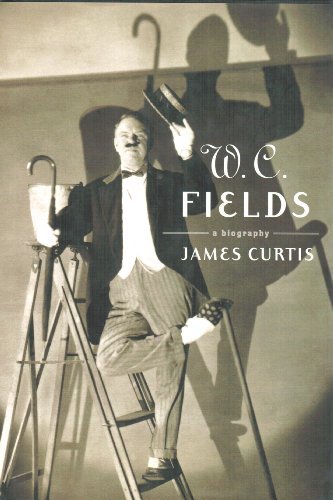
The legend of W. C. Fields has persisted for more than half a century--the gin-guzzling misanthrope about whom Leo Rosten famously said, “Any man who hates dogs and babies can’t be all bad.” But there was another Fields, the man behind the character of the red-nosed card sharp, who wrote, directed, and performed in some of the most enduring comedies of all time, including "It’s a Gift," "My Little Chickadee," and "The Bank Dick." Fields’ career spanned the whole of the 20th Century--first in burlesque, then vaudeville, the legitimate stage, silent pictures, talkies, radio, books, and recordings, and only death prevented him from moving into the promising medium of television, where he found an entirely new audience in the turbulent 1960s and 70s. He was one of the cultural icons surrounding The Beatles on the cover of "Sgt. Pepper’s Lonely Hearts Club Band." In 1980 he was honored with his own postage stamp. Now James Curtis reveals the man behind the myth, telling the story of Fields’ life and work as it’s never been told before. With exclusive and unrestricted access to the Great Man’s papers and manuscripts, he shows us the passion and intellect that fueled Fields’ creative drive, and the broken family that gave such a bitter edge to his comedy. Drawing from interviews with over 50 friends and co-workers, as well as the comedian’s own recently-discovered notes for his autobiography, Curtis vividly details Fields’ Philadelphia childhood, his first tentative steps as a performer, his arduous climb to the very pinnacle of show business, and his struggle to regain his footing once talking pictures had seemingly put an end to his career. He also shows the evolution of one of the world’s most recognizable figures, whose nasal voice and shifty mannerisms helped make him, in the words of James Agee, “the toughest and most warmly human of all screen comedians.” "W. C. Fields" is a singular work of research and scholarship that is certain to stand as the definitive biography of one of America’s greatest humorists.
This review originally ran in the San Jose Mercury News:
His image used to be found in every college dorm in the country: a man with a great blob of a nose, wearing a ridiculously tall hat and squinting suspiciously over the playing cards clutched in his gloved fingers. In the '60s, W.C. Fields joined Bogart, Brando and James Dean as icons of a generation's revolt against convention, complacency and sentimentality.
But the image that haunted me from James Curtis' new biography is captioned ''Whitey Dukenfield, circa 1892'' -- a narrow-shouldered tough with an askew necktie; he has a pale face, pale hair and pale eyes that look out warily above a dare-all mouth and jaw. It's W.C. Fields at 12 or 13, putting out the message that you don't want to mess with this kid.
Biography is about how images form and fade. We look to it for clues about how the famous emerged from the obscure, or in this case how a street urchin christened William Claude Dukenfield turned into W.C. Fields, tender-hearted misanthrope, klutzy con artist, irascible paterfamilias, master of the muttered aside and the polysyllabic quip -- ''everyone's disagreeable uncle,'' as Curtis puts it.
Fields was born in 1880 in Darby, Pa., on the Philadelphia fringes, to a working-class family. His father, Jim Dukenfield, had two fingers shot off in the Civil War, though Fields, who loathed his violent-tempered old man, claimed he had lost them picking pockets. Fields was closer to his mother, Kate, from whom he inherited the doughy nose -- in a portrait of the Dukenfield family, circa 1903, Kate eerily looks like the mature W.C. Fields in drag.
''By most accounts, Claude Dukenfield began running away from home at the age of nine,'' Curtis tells us, and ''he never claimed anything more than a spotty grade school eduction.'' But he read books with a passionate hunger -- the eccentric vocabulary of the characters Fields created surely comes out of an autodidact's fascination with words.
Fortunately, vaudeville, which as Curtis says ''was born at approximately the same time as W.C. Fields and in approximately the same place,'' offered a career open to talents. In Philadelphia, the ''Cradle of Vaudeville,'' all young Dukenfield needed was to find a talent. So he took up juggling, a not unlikely skill for a light-fingered youth already adept at shoplifting, and by the time he was 18 he was onstage, eventually truncating his name into W.C. Fields.
On the vaudeville circuit, he met Harriet Veronica Hughes, known as Hattie, and they married in San Francisco in April 1900. Hattie joined his act as the ''lovely assistant'' who was often the brunt of jokes, getting the blame whenever a juggling trick went bad. Having someone else in the act helpedFields develop his comic timing and his fuming persona.
Hattie became less essential to the act when Fields developed the first of his great routines, as a pool player struggling with a crooked cue and billiard balls that seemed to have minds of their own. And when their son, William C. Dukenfield Jr., was born in 1904, Hattie wanted to settle down, which the ever-touring Fields was both unable and unwilling to do.
Fields and Hattie separated but never divorced -- she was a Catholic -- and he came to detest his wife and feel contempt for his son, known as Claude, after it became clear that Hattie had a kind of Oedipal hold on the boy. (When Claude married, Curtis tells us, Hattie gave the couple twin beds as a wedding present.) Fields later worked this family dynamic into movies like 1935's ''The Man on the Flying Trapeze,'' in which, Curtis points out, ''The prune-faced, disapproving mother-in-law . . . was clearly patterned after his wife, Hattie,'' and the plump, pampered stepson played by Grady Sutton ''was deliberately named Claude.''
In 1915, Fields left the vaudeville circuit to appear in the Ziegfeld Follies, the most prestigious of all Broadway revues. Producer Florenz Ziegfeld created the Follies to display showgirls, not comedians, whose routines he usually wanted to cut to a minimum. Once, when someone pointed out to him that the audience was laughing hysterically at a Fields sketch, Ziegfeld insisted, ''They don't mean it.'' But in spite of his humor-impaired producer, Fields was a big success in the Follies, performing in them until 1921.
The Follies turned Fields from a juggler into a sketch comedian, and indirectly turned him into a drinker -- alcohol impaired the dexterity needed for juggling, but was less of a hindrance in sketch comedy. He also had an affair with a Follies showgirl, Bessie Poole, that led to the birth of his second child, a boy who was adopted by the sister-in-law of another Follies girl.
In 1923, he had a smash hit in the play ''Poppy,'' which helped launch his career as a feature film star when D.W. Griffith made it into the movie ''Sally of the Sawdust'' in 1925. Fields' silent features were mostly flops, but moviemaking appealed to a man pushing 50 and ready for something that looked less demanding than stage work.
So in 1931 he left the stage for good to try freelancing in Hollywood, where the arrival of sound had the studios welcoming Broadway performers. Fields' voice, Curtis observes, ''had the range and distinction of an antique pipe organ, and he used it to best advantage when wrapping it around a ten-dollar word or a surname he recalled from his Philadelphia childhood,'' such as Prettiwillie, Snavely or Muckle.
Movie success came slowly -- only later did some of his early films, such as ''Million Dollar Legs'' and ''International House,'' become celebrated as loony classics. He achieved some notoriety for his hostility toward the loathsomely adorable Baby LeRoy; their most famous moment comes in ''The Old Fashioned Way,'' in which Fields gives the baby a boot in the butt. (The nervous studio inserted a shot of the toddler grinning happily after the kick, to show that no harm was done, but the effect is really quite creepy, suggesting that the kid is a nascent masochist.)
In 1935, Fields gave one of his finest performances, in David O. Selznick's film of ''David Copperfield,'' playing the feckless but enduringly loyal Mr. Micawber. It's a near-definitive interpretation of the Dickens character, and once you've seen the film it's almost impossible to read the book without hearing the Fieldsian drawl in each of Micawber's lines.
But the iconic Fields really emerged in 1934 with ''It's a Gift,'' which along with ''The Bank Dick'' in 1940 represents the peak of Fields' artistry. In ''It's a Gift,'' Fields plays the put-upon Harold Bissonette (whose pretentious wife insists on pronouncing the name ''Bisson-ay''). He valiantly tries to save his store from the destruction wrought by the blind, cane-wielding Mr. Muckle, and later tries to nap on his back porch, only to be harassed by an insurance salesman searching for ''a man by the name of LaFong? Carl LaFong? Capital L, small a, capital F, small o, small n, small g. LaFong. Carl LaFong.''
Of the movies from Fields' peak years in Hollywood, there are cherishable moments in ''The Man on the Flying Trapeze,'' ''You Can't Cheat an HonestMan'' (1939) and the surreal ''Never Give a Sucker an Even Break'' (1941). On the other hand, the teaming of Fields and Mae West in ''My Little Chickadee'' (1940) sounds like a better idea than it turned out to be -- director Edward Cline's pacing is soggy, and West's immortal bawdry had been scrubbed clean by the censors.
Fields' stardom was achieved despite his alcoholism -- he spent nine months drying out in a sanitarium in 1936 and early 1937. By 1940 he had become ''the highest-paid movie star in the country, reporting more than $250,000 in earnings,'' Curtis notes. But ''Never Give a Sucker an Even Break,'' the last film in which he played the lead, was a colossal flop; as his health grew steadily worse he did old routines and cameos in forgettable films and made radio appearances until his death from cirrhosis of the liver, on Christmas Day, 1946.
Curtis has previously written biographies of Preston Sturges and ''Frankenstein'' director James Whale; this densely detailed biography is probably as close to a definitive account of Fields' life as we're likely to get. It's not a lot of fun, but biographies rarely are -- life tends not to have a happy ending. Still, Curtis gives us rich, colorful pictures of the places, people and institutions -- lower-class urban family life in the late 19th century, the hustle of vaudeville, the backstage intrigues of Broadway, the endless conflicts of talent and commerce in Hollywood -- that turned Whitey Dukenfield into W.C. Fields.
This is one of the best star bios I've ever read. The fascinating thing is the differing opinions co-workers had of Fields. Some thought he was a total jerk and impossibly difficult, others that he was highly disciplined and a joy to work with. You come away with an understanding that a star has only his/her carefully crafted persona as a commodity, and that sometime one has to to anything and everything to protect against the "franchise" being compromised by others who may not have the star's best interests at heart.
Biographers often have to split the difference between accuracy and understanding -- sifting through contrasting facts & anecdotes, while vividly interpreting their subject's strange path in the world. W.C. Fields is the worst though: it's still impossible to explain what made him such a bizarre genius, and the facts of his life have become so frosted over by mythology (much of it his own invention of course), I can't begin to imagine what sorts of Augean stables Curtis had to hose before he could get a glimpse of the coprolites and wall carvings that built this masterful bio.
Curtis lays out some well-documented facts of his early life -- young Bill an angry, nondescript boy tussling with dad, then living in a ditch. Then the juggling career takes him worldwide and hooks him up with a wife, Hattie, and then a child, both of whom appear to be the biggest mistakes of his life. Next comes Ziegfield, then Hollywood, a sequence of mistresses, and an increasing confidence in his own invented personality and capacity to ad lib and manipulate hats, golf clubs, tooth-removing tongs. Then comes the the acid tongue, and the wink and sneer, and the overall air of besotted trickery. Beset by shrews, beloved by daughters, forever popping the cork from his lunch -- this guy was mad, lovable, hideous. And Curtis gives us some great backstory -- from Fields's war on swans at his own home, to gossip about kicking his beloved Carlotta, to suing his own physician for celebrity gouging.
I didn't know, for example, that Fields was very self-conscious about his nose (and no it didn't grow crimson & bulbous from booze), his drinking, and his weight. He wanted the public to see him as a witty trickster, not a physical caricature -- hence his radio shows (which few people can hear now). I also didn't know that he'd kicked Carlotta Monti out of his home well before his death, and she came trudging back to help him through his final illnesses even though both of them were shagging other partners. Polyamory in the W.C. Fields house, no wonder the hippies loved him & he got shopped into the Sgt. Pepper cover.
I only wish that Curtis would have taken some time out to engage man's strange genius now and then -- the sorta thing say Nick Tosches would have done. On the whole this is straight reporting, but someone in the year 2525 reading this book without any experience of It's a Gift or The Fatal Glass of Beer will wonder what the hell is going on. Still I was hungry for every page, and all 550-odd pages went by in a flash. My favorite moment was Curtis's reproduction of an early stage pitch Fields used circa 1922, prior to his film work. Fields could make a mint today as a viagra huckster, says I:
Ladies and gentlemen, has your daily dozen of buckwheats lost its zest and that pillar of our ancestors, the boiled dinner, relinquished its punch? Can you no longer saw off your morning cord of wood or join the gay revelers in the light fantastic toddle to the stirring strains of the parlor organ? Be of good cheer, ladies and gentlemen! Again you can crochet lamp doilies, make and eat beaten biscuit, cut the ice and kill hogs like a boy of 18. And what is this great discovery, you ask? Why ladies and gentlemen, it is Purple Bark Sarsparilla, the greatest discovery in the scientific world of medicine since Hippocrates discovered the onion!
Nice biography of WC Fields. He appears to be the same character in real life. His treatment of his wife was alarming as was his other women. Divorce might have been kinder but was against the Catholicism of the wife. The portrait of Fields in vaudeville and theater is so interesting.
I love biographies, and this one started off with a bang. The part that grabbed me was featured on Delancey Place, an Internet site that posts excerpts from non-fiction books each weekday. I read the featured section and bought the book. It took a while to finish, but all 700-plus pages were good to the end. Jim and Katie Dukenfield's oldest son was named after an uncle, William Claude Felton, but referred to as Claude. He began running away from home at the age of nine, and Claude fought physically and violently with his hot-tempered father when they began working together selling fruits and vegetables when Claude was twelve. He started juggling the produce as an attention-getter when selling door-to-door, and when he couldn't take home life any longer, broke into vaudeville. James Curtis refutes the myths surrounding the memory of W. C. Fields, and backs up his work with extensive research, listing pages of periodicals, books, films, sound recordings, etc., so I found his writing very believable. My only complaint is that he often breaks into stage jargon, with no explanation for those readers who may not follow the trade. For instance, he began referring to ponies. It was obvious that he meant chorus girls, but it took a minute for me to figure it out. This kind of thing happened throughout the book. I learned a lot about W. C. Fields, and I consider this book a worthwhile read.
He was more than a gin-besotted juggler and movie funnyman. W.C. Fields was a tragic figure who worked hard for his career, even though the movie studios didn't always cooperate.
Like many comedians, it seems, Fields worked through personal issues - drinking among them, yes, but also a loveless marriage, a series of affairs and continuing professional disappointments.
Fields went from vaudeville to radio, from love to loneliness, and from success to failure and back again. Along the way, he wrote many of the scenes and gags that made him a known quantity. But the legend of his drinking always outweighed the reality.
Throw in a wife he left but never divorced and a handful of skits from the formative days of vaudeville that he kept resurrecting in movie after movie and you'll see why he never quite rose up to the top until, ironically, after his death.
Fields is quoted extensively from his own memoirs and letters, and comes off as a much smarter man than I was expecting. He also was shrewd - he stashed away money at banks all over the world just in case.
I love this man. The only person who was ever funnier was Harpo Marx in his "Animal Crackers" scenes. This biography has its very sad moments. Was his whole life sad? No. Few lives are simple and one thing, even this irritable alcoholic comedian. The story of his marriage is sad, though, and was a constant. He was a poor father who didn't make enough effort to have a relationship with his son apart from the failure of his relationship with his wife. The failure of his marriage also inspired some of the funniest laughs in his films, so thanks, Hattie! --That's a joke.
At last we have as true and balanced an account as is possible of the man, as opposed to the legend, the character that he himself helped to cultivate, and from which he became inseparable after death. Quite dense, detailed and vivid; a sideways step into the history not just of one man, but the changing entertainment industry of the early 20th century. Certainly one of the best biographies I've ever read, and THE best movie-star biography.
If you wish to know all the FACTS of the life of WC, this book is excellent. Unfortunately, it fails to bring him to life. Nonetheless, I recommend it because it is a fine, accurate history devoid of judgments or excessive praise or criticism.
This book is meticulously researched and includes much original correspondence. Curtis does a marvelous job at explaining how and why Fields became the characters he portrayed, including his lack of formal education and his decades-long rift with his separated wife. There are charming anecdotes and a lengthy description of my favorite Fields movie, "It's a Gif." The book sheds light on Fields' many illness and gives a truthful account of his drinking habits. There is perhaps a bit too much trivial background. There is nothing about Fields in the movies until page 165.
Who knew? I sure didn't... Curtis gives the reader (at least, this one) an interesting glimpse at a fight for voice ... for craft ... and a fairly wild ride-of-a-life all at the same time. There is strength and fragility ... humanity and the need to be loved and understood. I have absolutely no idea why I should be so surprised that Mr. Field's is like eveyrone else - but I guess it is because I only saw the performance dimension. This was a very good biography of a very interesting man. I went out and bought a compilation of W. C.'s films!
Without any doubt the best Fields biography ever written, I was flabbergasted at the amount of new detail he was able to dig up after all these years and given that there were several biographies of varying merit preceding it. It may said to be only for fans though; non-fans may not care for this amount of detail.
Fields’ career spanned the whole of the 20th Century--first in burlesque, then vaudeville, the legitimate stage, silent pictures, talkies, radio, books, and recordings, and only death prevented him from moving into the promising medium of television, where he found an entirely new audience in the turbulent 1960s and 70s. #biography #entertainment
I've read nearly all the Fields bios and this is my pick, although Simon Louvish's 'Man On The Flying Trapeze' is a good read and full of information (some of which Curtis calls into question).
the best fields bio - oddly enough - because it dispenses with the great man's tall tales and reveals previosuly unknown details about his early life and vaudeville years.