7.2 million YouTube viewers can't be A provocative new way to look at the global warming debate.Based on a series of viral videos that have garnered more than 7.2 million views, this visually appealing book gives readers-be they global warming activists, soccer moms, or NASCAR dads-a way to decide on the best course of action, by asking them to consider, "What's the worst that could happen?" And for those who decide that action is needed, Craven provides a solution that is not only powerful but also happens to be stunningly easy. Not just another "change your light bulb" book, this intriguing and provocative guide is the first to help readers make sense-for themselves-of the contradictory statements about global climate change.The globe is warming! or The globe is not warming.We're the ones doing it! or It's a natural cycle.It's gonna be a catastrophe! or It'll be harmless.This is the biggest threat to humankind! or This is the biggest hoax in history.Watch a Video
According to the author (from his introductory instructions) I should not have even bothered to read this book. According to him, his book is for people who think 1) global warming is bunk, or 2) the problem is way over-blown or not as important as a lot of other problems, or 3) haven't learned enough to form an opinion about it. Having read at least a dozen books on the subject of global warming and recognizing the very high probability of at least severe if not devastating consequences, I do not fit into any of these categories. But I read the book anyway and was glad I did.
First of all, the book is not meant to persuade anyone of the science behind global warming. It is simply meant to educate people about simple scientific tools and concepts that may be used by anyone to assess probabilities and risks associated with issues involving scientific matters -- like global warming. The author goes way overboard (in my opinion) to demonstrate that he is being unbiased in his methods even though he is unabashedly biased in his conclusions. He allows for everyone to develop their own methods and draw their own conclusions as they follow the scientific methods that he explains.
The most interesting part of the book was the explanation about the human tendency of "confirmation bias". This is what we all do when our minds tend to accept and even bolster the significance of data that supports our pre-held beliefs and biases while ignoring or discounting data that contradict them.
The book is written to be accessible and readable for everyone. The author's purpose is simply to make this debate understandable and open to analysis by the average non-scientific person. I feel that he succeeded in that regard and that I benefited greatly from reading it.
This book is what we "green elitists" would term a game-changer (I can be cheesier if you would like). If you take the time to read this lesson, in book form, and listen to what Mr. Craven says, then your mind will be stronger for it. Directly the book is not about global warming, it just takes up over half the book. The book is basically a high school science lesson, amazing really considering the author IS a high school science teacher. Yes, at points Mr. Craven treats the reader like they don't know ANYTHING, but if you're sooo smart why aren't you analyzing the global climate situation correctly?
The basic, and insightful, premise of the book is that the global climate debate is not a question of "Who is right and who is wrong" (In my opinion, the right and wrong game is a horribly stupid game to play). The question in the debate is "Why risk it?" In order for Mr. Craven to get the question of who is right and who is wrong out of the reader's head he has to teach you a bit about the scientific process and how your (everyone's) brain works.
This is a book that attempts to teach people how to think for themselves, instead of listening to Bill o'Reilly or Al Gore or the mass media.
If you're even a bit unsure of the global climate debate, read this book.
If you're even a bit skeptical about Mr. Craven and his book, read the book and find out if your skepticism is well founded.
If you're 100% positive that global warming is real and the end of humanity, read this book (who knows, you might be wrong because of your brain's little tricks)
Either way, watch Mr. Craven's video "Whats the Worst That Could Happen" on YouTube.
Greetings, climate change skeptics and those undecided!
This is not another book demanding your belief. Craven is good on his word that this book will help you sort the 'shouting match', not add to it. This is a truly awesome book, and you should read it for the following reasons:
1. It doesn't tell you who's right in the Climate Change debate. Surprise! :)
2. It explains how science works (falsifying hypothesis), what's peer review, 'authority' in science and how the lack of 100% certainty helps point science to better answers.
3. It shows you how our biases(we all have them) muddle thinking, and how to avoid them. Given this is an issue attached to "catastrophe", it pays to know what Craven describes as the "con man" in our heads.
4. It emphasizes we don't always have 100% certainty. As you can see, "Do humans cause Climate Change", is not what we need to focus on, but what should be done given what we know now.
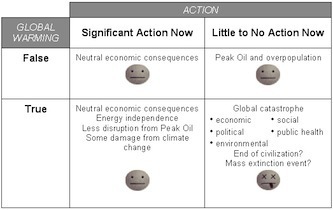
Which column would you buy? Craven helps you build your own decision grid like this.
5. Craven helps you build your own scale for determining which information source is less muddled by bias or motivation. (e.g. how believable is a group of climate scientists talking about the climate? how about economists? profit motivated companies? individual researchers?).
6. Only after giving you all the necessary thinking tools, Craven discusses what is human-caused Climate Change and lets you form your own conclusions. Isn't that great?
And if you're not a global warming skeptic, it still pays to read this, because this is great template for showing people how to wade through the deluge of BS.
Greg Craven is a first class teacher. Go pick up the book. :)
So far this reads like a 'RISK Management for Dummies' book - almost certainly what the author was aiming at. The emphasis is on Global Warming , or whatever the buzz phrase is this week , and the language is over-the-top non technical : the tone cringes from the thought that a reader might have more than a handful of brain cells ( scientists are geeks and eggheads ).
Having said all that this is not another partisan offering from one side of the debate or the other. The author is trying to coach a reluctant and scientifically poorly educated public to adopt better analysing techniques when considering their attitudes and beliefs about G.W. no matter which side of the debate they are on . He is disarmingly frank about his own stumbles in his approach to the topic and how he arrived at the point of writing this book. I'm interested enough to continue.
Fantastic and easy read where you will learn something important about information overload and how to make an informed decision with the multitude of information available today. It's got humor & sarcasm along with cool pictures, how could you not enjoy it? Whether you are a warmer or a skeptic, this book is more about critical thinking and how to make a decision with all the mass amounts of conflicting information out there about global warming. Check it out. I don't think you'll be disappointed.
I've read lots of books about climate change ...including some from the skeptics....but Greg Craven takes a different approach here. The book is really about a decision-making technique to help us decide whether we should be doing something about climate change. Basically he starts with a "Boston Box". On the vertical scale are 1. Global Warming is true and 2. Global warming is false. And on the horizontal scale he has A. Take significant action now. B. Little or no action now. And the rest of the book is about making these choices for ourselves. Though Craven also takes us through his own reasoning and comes out quite strongly in favour of taking action now. He draws attention to humans almost infinite capacity for self delusion and the particular dangers of the "confirmation rule" where we look for instances that confirm our beliefs and disregard the non-confirming instances. He suggests one way to check for such bias is to try and falsify the belief. (What evidence would falsify the belief?). He also cites an article by Daniel Gilbert in the Los Angeles Times that argues that the human brain's alarm system has been conditioned over time to respond to threats that are immediate and visible....and climate warming doesn't fit these conditions, There are some quite useful techniques employed here. One is his way of ranking the various (competing and contradictory) sources of information by credibility. Ranking them as more credible and less credible For example individual lay people (with no formal qualifications in climate science are given quite low credibility whereas the global CEO letters from Shell oil and Exxon (stating that Global warming is real and they need to be taking action) are given high credibility because that stance would seem to require that they were working against the immediate interests of their industry. Another thing I found useful was his potted summary of various sources such as the Stern Review. Though Craven gives rather more credibility to Government reports than I might give myself. I have helped produce such reports and saw first-hand how "stakeholders" fought long and hard to defend their organisations "point of view". Often this resulted in having the report language watered down: "softened" so it became less hard-hitting (and maybe less accurate). But, having read about the tactics employed by the cigarette industry and more recently the fossil fuels industry.....such as paying/rewarding scientists to throw doubts on scientific findings....I guess that Government reports, where the individuals, putting their names to the report, are publicly known......tend to have more reliability than, say, the "Global Warming Policy Foundation". At the start Craven insists that we write out what it would take to change our current view on climate change: Mine were: "That I'd need to be convinced that a. the world is not already warming at a rapid rate. and b. that reducing CO2 and greenhouse gases won't make a difference". And I didn't come away from reading the book convinced that either of these were correct. Mind you, the book is really not about convincing one of the truth or otherwise of climate warming, it's about a methodology of making a decision where there is a cacophony of competing views being spouted and many "experts" supporting opposite views . (They can't both be right....though they could both be wrong). Did I find the methodology useful? Yes I did. and it was somewhat original and some of the material that he included was useful;. Happy to give it four stars.
Review update: In my original review I downrated Craven's book because after five good chapters laying out tools and methods for rational decision making (how to think), Craven turned his book into a polemic on the specific topic of global warming (what to think). Ken Watanabe's Problem Solving 101: A Simple Book for Smart People is the book I thought I was reading in the first five chapters of Craven's book. After the debate with Craven and others stating his case in the comments below this review, I would now rate Craven's book three stars if Amazon allowed reviewers to change the star ratings. But if you are looking for a simple and straightforward book on how to think with understandable methods, tools, and examples, without the polemical baggage, go to Watanabe's book.
Original Review:
Reg Craven, a high school science teacher who is clearly passionate about his work and would probably be a fun teacher to sit under, spends the first give chapters giving his readers tools decision tools for thinking about the issue of global warming, as promised in the title and on the back cover marketing. His tools are basically a decision table combined with a method to rank the credibility of source materials and ways to detect and prevent the reader's own internal biases and logical fallacies from influencing their decision making. All good things, and all quite useful thinking tools.
Then, under the guise of working an example "on the board", Craven spends the rest of the book arguing very forcefully for the proposition that global warming is the most pressing and immediate danger to humanity and most be addressed by very aggressive political and economic changes immediately (along the lines of a World-War II-type mobilization, he suggests). While making these strong claims, Craven continues to repeat this is just an example, with frequent marginal comments to question his assumptions and suggesting that these are just his thoughts and he might be wrong.
The learning tools are useful and simple enough that most readers could use the tools and the suggested method without Craven's example and reach their own conclusions. In fact, decision tables and the credibility tree could be used by readers to help them clarify their thinking about any troubling proposition they want to judge or major decision they need to make.
However, if Craven really felt an example was necessary to explain the method, then on such a divisive issue the wise thing to do would be to provide two examples. It seems clear from the example that he does give that he is doing this not as a teaching example but as a polemical argument in favor of his response and suggested actions.
In fact, after I finished this book I realized that Craven was arguing for the extreme global-warming position with the zeal and language of a true believer. Just one example: "Focus on burning the number 350 [parts per million, the concentration of carbon in the atmosphere] into the collective consciousness. . . .I suspect that 350 will go down in history as 'humanity's number'--a symbol of our collective fight for our civilization and an emblem of the challenge that finally united humanity to struggle together, instead of against one another." (p. 229) I was reminded of the language used to describe the "number of the beast" (666) in the book of Revelation.
Faith in science is a religion on par with any other religious faith, and by now many if not most scientists acknowledge and embrace this faith in science by the name of humanism. I have no problem with that (although I believe it is faith in the wrong thing), and I have no problem with Craven espousing it strongly in proto-religious language. What I do have a problem with is masquerading this faith under the guise of reason alone in the first half of the book, then sliding in the religious argument in the second half with the annoyingly frequent asides that "I could be wrong"--with the unstated "but I'm not" qualifier all too obvious from the frequency and "friendly facetiousness" of the asides
Is it prudent to sometimes take action based on incomplete evidence? In our daily lives we do it all the time. We buckle our seat belts even though a crash is unlikely, lock our doors to deter theft, use our senses to determine whether an apple is ripe before eating it, etc.
Given that the best science can do is to provide better and better approximations to truth, is it prudent to take action to stave off global climate change?
Greg Craven argues that this decision can be made based on the potential consequences of action vs non-action in the absence of a consensus on climate change ... and he provides a set of tools to help (of course there is a large scientific consensus, but the demagogues in conjunction with an uncritical populous have done a good job sowing controversy on the issue). The book also provides a primer on critical thought and a means of cutting through the shouting match that passes for reasoned debate in this country.
Unfortunately, our brains did not evolve to handle threats of this type and as a natural consequence the global response will prove to be too little too late. The result of inaction could be bad ... of course it could also be even worse than anyone can imagine.
I truly enjoyed this book. The perspective the book gave was enlightening. Helping me see how the general public views science, how my bias clouds my view, and ideas for how to prepare before entering a loaded topic. This book has made me more aware about myself and the world around me. I'm planning on applying the decision making guidelines to future complicated topics.
312965 Decent book that is really a guide to critical thinking about complex topics and making decisions based on your newly learned critical thinking skills. Craven did his research and the best parts were the summaries of the pro and anti warming (weirding) arguments.
Though he tends to repeat himself, Craven's arguments are concise, compelling, and, in my mind, irrefutable (spoiler alert: skip to the chapter on empirical evidence).
You owe it to yourself and your children to own a copy of this. Even better: don't have kids!
I liked the interesting and (kind of) unbiased approach to the topic. Also it was good at communicating the information to someone (like me) who did not know much about the topic. For me, it was boring at parts.
A good book about climate change that manages to move past the shouting matches. The focus here is on how to think about climate change, how to think about risk management and not what to think about it.
Solid way to think about tough problems, where we must act on limited information. The book cover is wonky, but the content is great. This book will help you take the time to think critically about your views on global warming, whatever they are! (And yes, you should do that.)