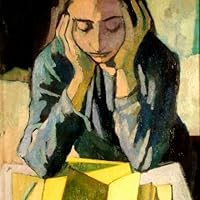
Cora Sandel was the pen name of Sara Cecilia Görvell Fabricius, a Norwegian writer and painter who lived most of her life abroad. Her most famous works are the novels now known as the Alberta Trilogy.
Sara Cecilia Görvell Fabricius was born in Kristiania (now Oslo). Her parents were Jens Schow Fabricius (1839–1910) and Anna Margareta Greger (1858–1903). When she was 12 years old, financial difficulties forced her family to move to Tromsø where her father was appointed a naval commander. She started painting under the tutelage of Harriet Backer, and while still a teenager moved to Paris, where she married the Swedish sculptor Anders Jönsson (1883–1965). In 1921 they returned to Sweden, where she won custody of her son Erik after divorcing Jönsson.
In her youth she tried, without much success, to establish herself as a painter. And it wasn't until she was 46 years old that her debut novel, Alberte and Jakob was published, the first in what became the semi-autobiographical Alberta trilogy. Sandel used many elements from her own life and experiences in her stories, which often centre on the spiritual struggles of inarticulate and isolated women. The Alberta trilogy traced the emotional development of a lethargic and unhappy girl into a self-sufficient woman. These novels earned her an immediate place in the Scandinavian canon, but it was not until the 1960s that Sandel, now living as a recluse in Sweden, was discovered by the English-speaking world.
Despite her great literary success, she remained hidden behind her pseudonym and lived a rather secluded life. She was decorated with the Royal Norwegian Order of St. Olav in 1957. Her home in Tromsø, built in 1838, now houses the Perspektivet Museum.
I love the way this author has the ability to paint the story!! Short stories were never my favourite until reading hers. She can paint the power of silence in a relationship to how animals can touch our lives. The author is originally from Norway, but spent most of the time of Te Great War in Italy, France and Sweden.
“All I know about Rosina is that she is from Asti and has spent three years in Paris and that she has the dogged tenacity of northern Italy in her work and the melancholy dreaminess of southern Italy in her eyes.
***
‘Oh, one always knows what should have been done when it’s too late. Well, well … you stay there till the water’s boiled for the tea.’ She curls up in the little patch of warmth left in the bed by their two bodies, listening to him hacking a hole in the ice in the bucket and tapping the bottom of the tea-caddy to find the last leaves. She lies with her eyes closed. She can think no further ahead than to tea, hot tea. The slight whisper of the flame reaches her like a reminder of a better world, a world fit to live in. When you listen to it and lie completely still so that none of the accumulated warmth escapes, it is almost cosy.
*
They stumble in through the swing-door on the corner. The transition to the dense, stifling atmosphere indoors is so extreme that it is painful at first. It takes their breath away. Only gradually do they feel relief. And then it's all marvellous: the tobacco-smoke, the steaming coffee, the babble of voices, the clatter of coins and of checkers. Stifling, enclosed, unhealthy and marvellous. They are seized by a primitive need for shelter, a primeval longing to be together with other living beings, to share their warmth.
***
When darkness begins to fall she leaves us. We watch her and Petit getting smaller and smaller as they go downhill. Shortly afterwards we know she is letting herself into the dark little house, alone again with everything collapsing about her, and with the eternal sea. The sea is never silent. Even when it lies shining like silk it licks at the land with its long tongues. It advances with a hiss and retreats with a deathly sigh so enormous that it fills the vault of heaven. And the pebbles at the low tide-line rattle in it like bones.
I wasn’t a fan of short stories until I read this. Sandel is able to perfectly capture a moment and mood. I am in awe. This is what short stories should be. It’s not trying to be a condescend full length story, it is simply a few pages observing a moment and capturing the essence of something. My favourite short stories were: The Polar Bears, Artist’s Christmas, Carmen and Maia, There’s a War On, Avalanche, and Allie.